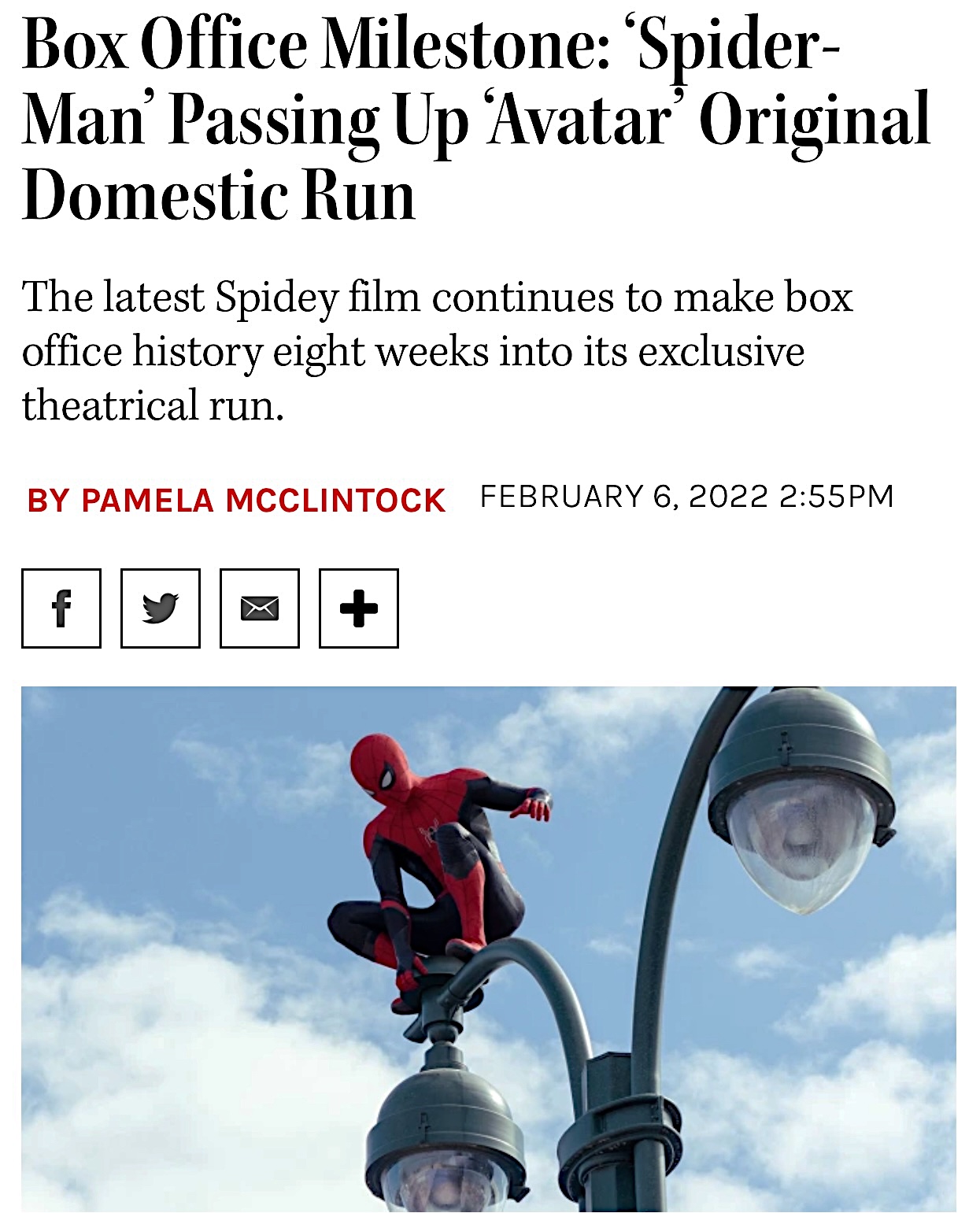
The Academy members, it seems, are too blind and obstinate to understand that Spider-Man: No Way Home deserves a serious “thank you” for levitating theatrical, not just in terms of revenues but from the buoyantspiritofthefilm and the overall joy factor…if they don’t understand that a single Best Picture nomination (oneoutoften!) is the least they can do to celebrate the fact that S-M: NWH delivered a spiritual booster shot that lifted all boats…if they’re too old and out of touch to at least recognize what this film managed to do and thereby give it a Best Picture nomination in tribute, then you know what? Tohellwiththem. The Oscars are an island unto themselves and whatever happens, happens.
That said, Sony did itself no favors by delaying streaming opportunities to industry voters, largely over fear of piracy.
Not too long ago the NAACP Image Award guys nominated Awkwafina for an “Outstanding Character Voice-Over Performance,” partly for her doing a Black-speak thing. In formal professorial terms, Awkwafina’s crime is/was appropriating or making fun of African American Vernacular English, or AAVE**.
After being slapped around by humorless wokester scolds (particular Women of Color Unite founder Cheryl Bedford) for using a Blaccent for comic effect, Awkwafine has basically said ‘y’all can go fuck yourselves, and Twitter can blow me.”
Awkwafina: “Well, I’ll see you in a few years, Twitter — per my therapist. To my fans, thank you for continuing to love and support someone who wishes they could be a better person for you. I apologize if I ever fell short, in anything I did. You’re in my heart always.
“[But] I am retiring from the ingrown toenail that is Twitter. Not retiring from anything else, even if I wanted to, and I didn’t drunkenly hit someone with a shoehorn and now escaping as a fugitive. Also am available on all other socials that don’t tell you to kill yourself!”
…with people who pronounce Oregon as “Awrriginn.” It’s pronounced “OHRuhgone.” How could anyone possibly look at the spelling of that state and think “oh, yeah, sure…Awrriginn.” You’d have to be a bit of a cracker to say it that way.
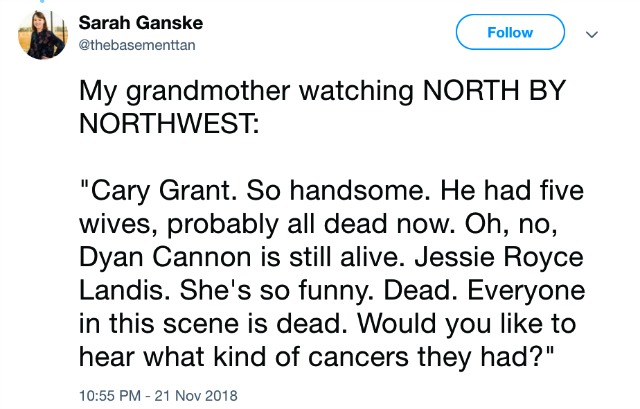
[Posted on 11.22.18] When I watch Cary Grant in North by Northwest I’m always aware this was his crowning big-screen moment of the ’50s, his last great role and the last film in which he could make a case for looking late 40ish and perhaps a suitable sexual partner for Eva Marie Saint (he was 54 when Alfred Hitchcock shot NXNW in ’58 — she was 34), and after this he was more and more the silver fox and starting to go gently downhill with grace and elegance (nobody believed he was an appropriate romantic match for Audrey Hepburn in Charade) but heading there regardless, and of course destined to retire by the mid ’60s. So North by Northwest was really the last shining moment of his career…the last VistaVision moment when everything was truly in place.
Good or great movies deliver all kinds of payoffs. They don’t need a big feel-good finale — they can end quietly, modestly, shockingly, in a way that reaffirms the basics or like an Antonioni film. We all understand that this feel-good finish (from a film that opened a bit more than 25 years ago) is obviously not “real” — it’s a bowl of emotional showbiz soup. But it works, and if it had somehow opened last October or November (what contemporary movie star in his 30s could play the Tom Cruise role?) it would almost certainly be the leading Best Picture contender. Just ask Sid Ganis or Rod Lurie. It hit me just now that the only 2021 Best Picture contender that delivers something even close to what Jerry Maguire had (and obviously still has) is King Richard.
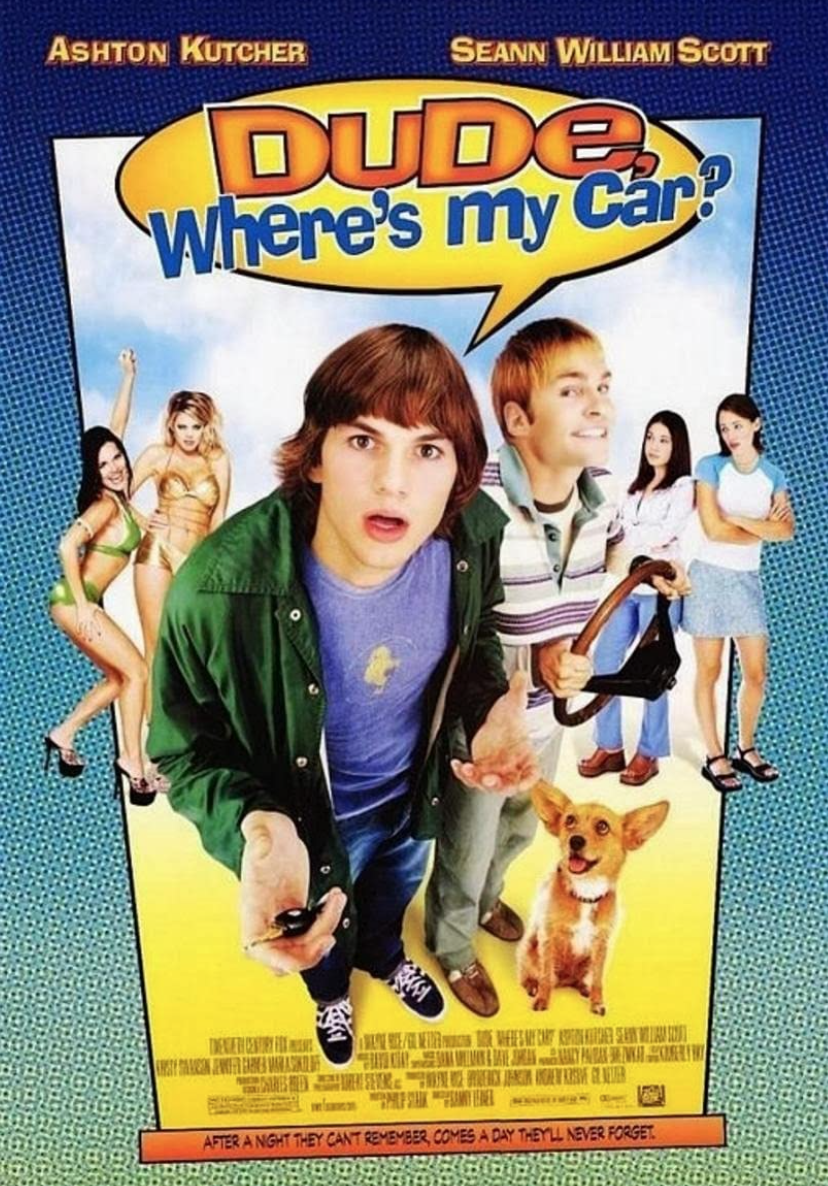
Hollywood Elsewhere is hereby requesting all motivated Photoshop enthusiasts to try and construct a movie poster for the re-christened version of Ryusuke Hamaguchi‘s Drive My Car, henceforth to be known as “Duuude, Drive My Car!”
The idea is to mimic or otherwise re-use the basic poster art concept of Danny Leiner‘s Dude, Where’s My Car? (2000) but nudging aside images of Ashton Kutcher and Seann William Scott in favor of Hidetoshi Nishijima, Tōko Miura and Masaki Okada.
The lead paragraph on the Dude, Where’s My Car? Wikipedia page says that “the film’s title became a minor pop culture saying, and was commonly reworked in various pop cultural contexts during the 2000s.” Indeed!
The basic idea is to make Justin Chang and the rest of the Drive My Car cabal seethe with anger.
I’m thinking of something a name-brand director and actor said during a discussion before press and WGA members when he was promoting a certain 2005 film.
He mentioned having recently stood before an infant girl in a crib, a baby who was bright-eyed and beaming and glowing with excitement over the joy of being alive, and this guy was feeling almost heartbroken knowing what she’ll almost certainly go through when she gets into her tweens and teens, the inevitable hurt, the possible encounters with cruelty or callousness…emotional stuff that will almost inevitably leave bruises.
I had the same thought today. I suppressed it right away, telling myself “why dwell on potential negatives? Focus on the joyful and push your sad thoughts aside.” But that director’s thought was in my head for a few seconds. The infant girl he spoke of is now 17 or 18, and probably doing okay or maybe great. But who knows? Life is fraught with peril, not a bowl of cherries, etc.
And here I am the next morning (Saturday, 2.5), sipping my first cup and finally paying attention…bullet time!
Arie’s montage shows Rogan using the racial slur roughly two dozen times in the clips, which were used by Arie to illustrate why she was withdrawing her music from Spotify, where Rogan licenses his podcast, The Joe Rogan Experience.
Rogan ASKED for this all on his own. He waved it all in. The whole thing started due to his spewing cavalier bullshit about Covid vaccines and now THE BEAST IS ON HIS BACK and DIGGING THE CLAWS IN.
Being double or triple-vaxxed won’t save you from Omicron infection, but the vast majority of people who are dying or greatly suffering from infection are those who haven’t been vaxxed. That’s a FACT. Plus the vast majority are those who are over 65 and overweight / obese. These are irrefutable facts that Rogan felt like fiddling around with and in some instances challenging, and new he’s dealing with the consequences.
Deadline‘s Bruce Haring: “It was reported today that [Spotify] has taken down roughly 70 Rogan podcasts without explanation. Many of the podcasts that were yanked involved other controversial commentators, including Alex Jones, Milo Yiannopoulos, Owen Benjamin and Canadian writer Gavin Miles McInnes.
Rogan: “[This is] the most regretful and shameful thing I’ve ever had to talk about publicly,” alluding to the India Arie montage video that consists of “out of context” snippets from “12 years of conversations” on his show.
“It looks f–king horrible. Even to me.”
“I know that to most people, there is no context where a white person is ever allowed to say that word, never mind publicly on a podcast, and I agree with that now. I haven’t said it in years. Instead of saying ‘the N-word,’ I would just say the word. I thought as long as it was in context, people would understand what I was doing.”
“No, dumbass, it’s not in the center. It’s NEVER in the center. I thought you said you knew a thing or two about framing landscape shots. God, are you some kind of fucking Arizona dumbass?”
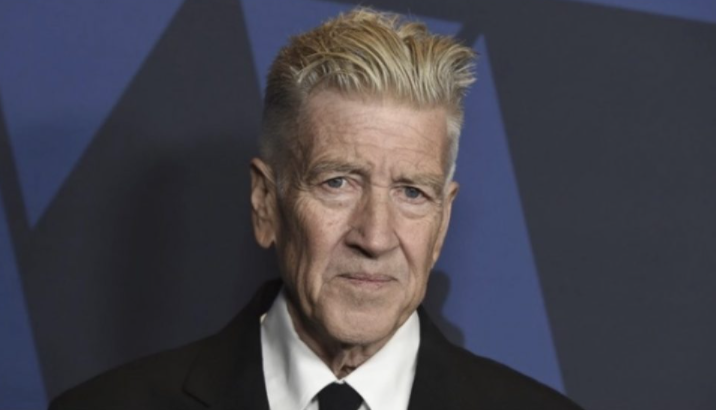
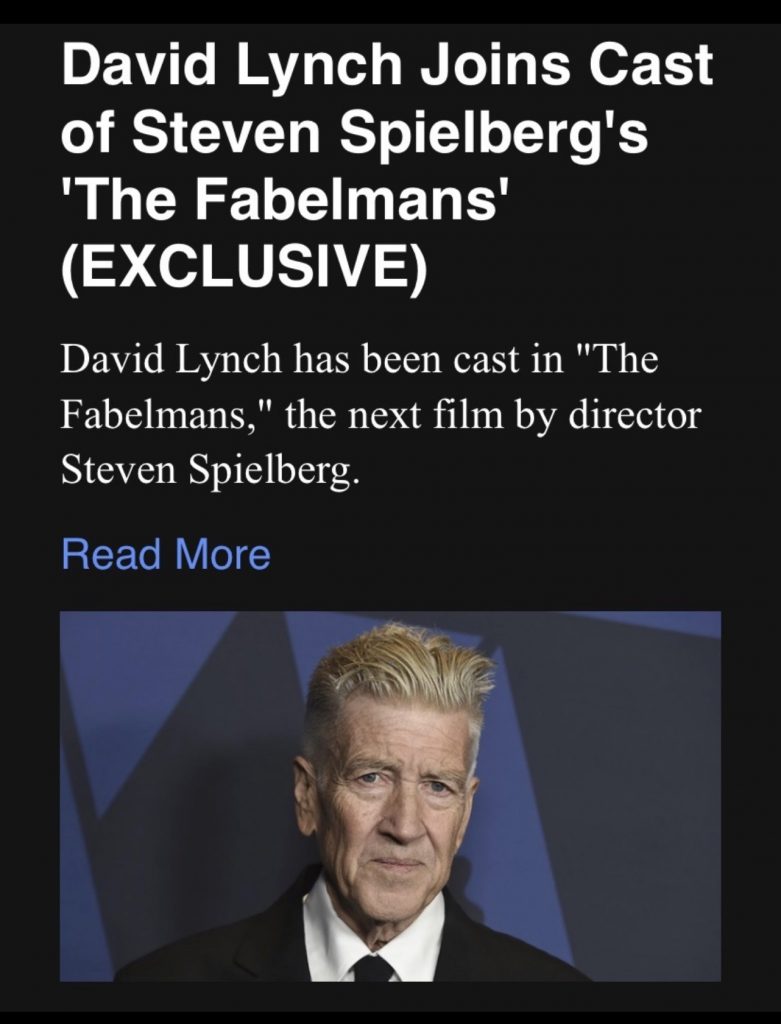
David Lynch is supposedly playing the snarly, blustery John Ford in Steven Spielberg’s TheFablemans, according to Rodrigo Perez.
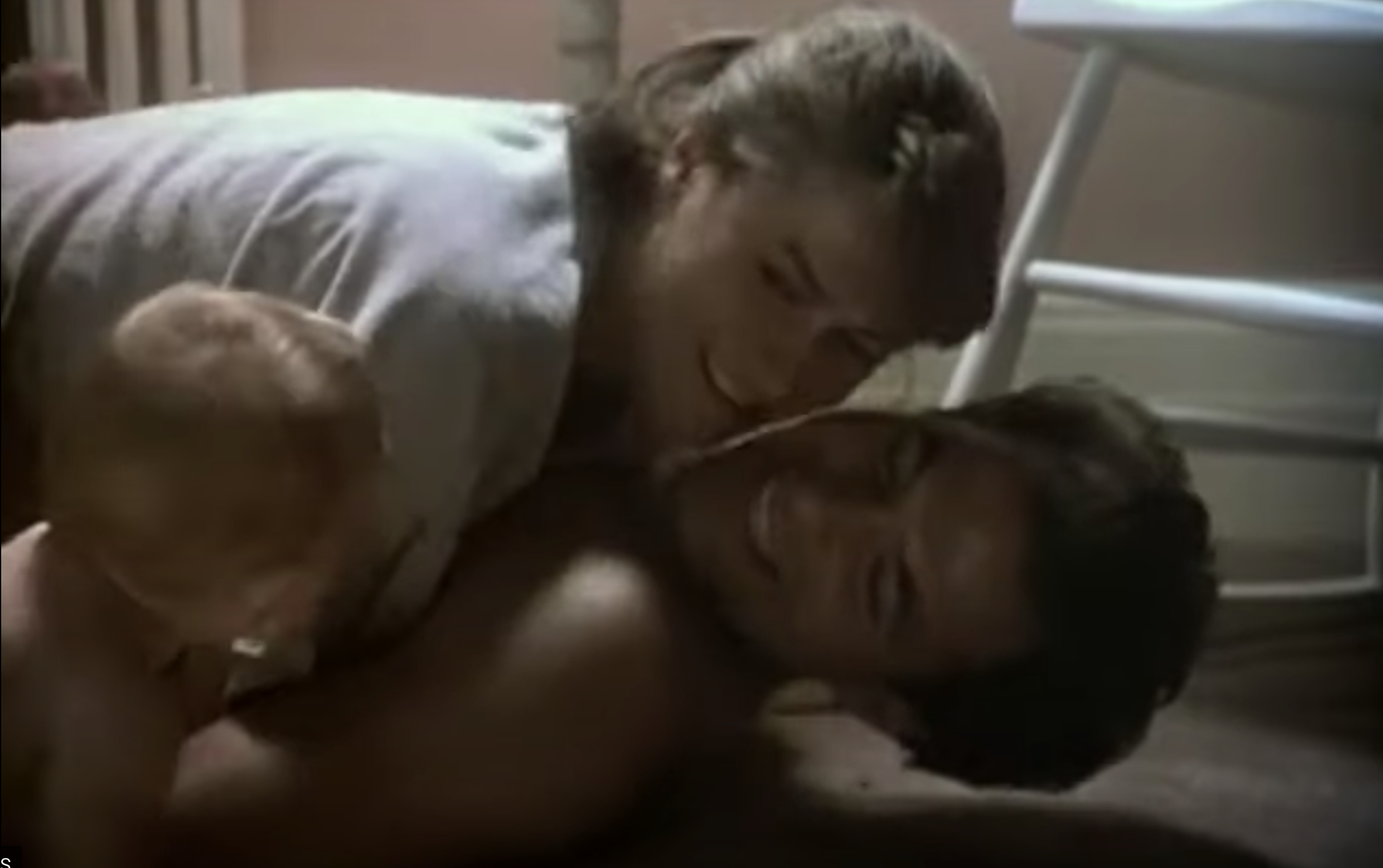
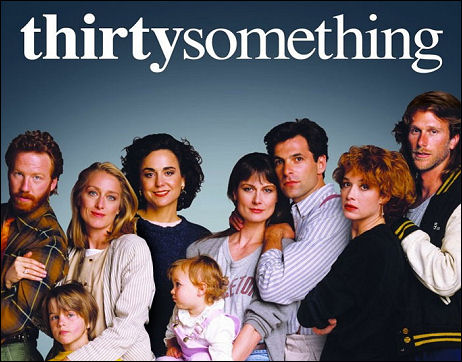
What about a relaunching of thirtysomething, only focusing on child-rearing, home-owning Millennials and to some extent Zoomers? If the producers could keep it real and really drill down on the particulars and undercurrents of life among professional-class people attempting to live more or less conventional lives in the early 2020s (like Jett and Cait are doing right now), it might work. The cast would have to be at least 50% non-white, of course, but we’re all accustomed to that enlightened system and embracing of the here-and-now. What does the HE community think? Yes, it should be called thirtysomething…straight, no apologies, un-ironically.
I always felt that thirtysomething, the zeitgest-reflecting, essential-viewing yuppie series that ran from 9.87 through 5.91, was too sensitive-wimpy.
As honestly written and impressively acted as it often was, the show suffered from an almost oppressive self-examination syndrome — a constant exercise in fault-finding and angst exploration — among its boomer characters and their difficulties in managing and/or growing into adulthood and parenthood. To varying degrees everyone on the show wore a hair shirt, suffered or caused suffering, and was afflicted (if not wracked) with self doubt.
I forget who said “an unexamined life is not worth living” but thirtysomething sure as hell put the wisdom of that statement to the test. The women (Mel Harris, Melanie Mayron, Patricia Wettig, Polly Draper) were constantly fretting and kvetching over some crisis of the spirit, the bedroom, the bankbook or whatever. Always something darkening, taunting or haunting their brow.
And the guys especially (Ken Olin, Timothy Busfield, Peter Horton) — those poor Hebrew rock-pounders, bent and sweating under Pharoah’s lash! — were always being busted, picked apart and de-balled for this and that profound failing.
(l. to r.) Timothy Busfield, Patricia Wettig, Polly Draper, Mel Harris, Ken Olin, Melanie Mayron, Peter Horton.
I hated Harris’s character, Hope (who played Olin’s wife), most of all. I remember being told by a cast member in ’88 that Hope was referred to by others on the show as “mope.” Everyone hated her. I’m certain she brought tens of thousands of watchers down every week. For all I know she may have inspired real-life fights, separations, divorces. (Or maybe people saw her personality as a cautionary tale and tried to be unlike her as much as possible.) Either way she was a huge drag to be around.
I related to what the show was, of course. I began watching just before getting married to my ex-wife Maggie in October 1987. and we both both became fairly devout fans (Maggie wore a gray “thirtysomething” t-shirt that I bought her) until the end of the run, during which time Jett came along in June 1988 and then Dylan in November 1989. It wasn’t a portrait of our marriage in every last respect, but there were certainly echoes.
And it happened during the bulk of our time together (we split up in the fall of ’91) so it became — in my head, at least — a kind-of running commentary on not just our life but all yuppie life in the late Ronald Reagan and George H.W. Bush years and yaddah-yaddah.
And that’s what we were, all right — 30ish yuppies with kids and two cars living a nice Los Angeles life. We lived in the top half of a house in the West Hollywood hills (with a great view) and then in a nice Spanish home in Venice. We did volunteer work for Michael Dukakis. We took our kids to Gymboree. We threw parties about twice a year, and often flew east to see the parents (or we hosted them in LA). In Venice we had a backyard jacuzzi, a brick patio and an ivy-covered privacy wall.