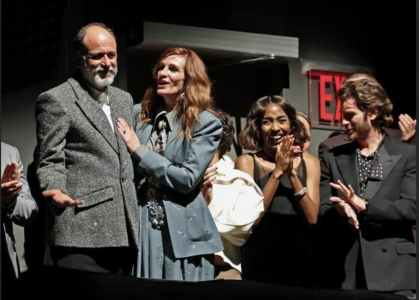
…it’s the first Hollywood-financed, Oscar-tasty, mainstream upscale drama that implies…no, states very plainly that #MeToo has created a predatory mindset that is out to “get” cis white males. It doesn’t scream this premise or conclusively demonstrate that this is absolutely the case, but it certainly says “okay but wait a minute…hold on.”
It’s certainly possible that Hunt features two “bad guys”, played by Ayo Edibiri and Andrew Garfield. There may be only one, if you think about it. In my mind it’s both, but Garfield may be slightly less blame-worthy.
I saw it for the second time two nights ago (i.e., Friday), and since then it’s been simmering in warm butter and sauteed garlic.
Fuck me hard and long, not to mention all squishy and sweaty, and I mean EmeraldFennell-style…shrieking like pigs and salivating like hungry dogs. But noaccidentalfarting.
I finally saw Waltzing With Brando the other night. Before opening it had been obvious to everyone that Waltzing was an insubstantial bauble, a cinematic piffle…interesting only for Billy Zane‘s performance as an early ’70s incarnation of the great Marlon Brando.
The fact that the 59-year-old Zane is almost a dead ringer for the Godfather/Last Tango-era Brando…that’s the sellingpoint. He’s certainly striking and actually rather disarming to hang with, which is all the film is basically about…chilling with a whimsical, easygoing, laid-back legend…bask in it!
There are portions of Waltzing With Brando, trust me, in which Zane’s Brando schtick is enough, which is to say pleasantly transporting or at least alpha-vibey. His unpretentious, laid-back, low-key confidence is actually pretty great. I totally bought into it.
And the mid 40ish Jon Heder, whose last big score was the titular role in Napoleon Dynamite, which enjoyed a glorious reception at the 2004 Sundance Film Festival..Heder isn’t half bad as architect and ecological planner Bernard Judge, whom Brando hired to convert Tetiaroa, the Tahiti-adjacent, horseshoe-shaped atoll that Brando bought in 1966, into an ecologically wholesome, self-sustaining haven.
This is what Waltzing With Brando, directed and written by Bill Fishman, is basically about — a South Seas design-and-engineering project with interludes in which Brando hangs out, sips from drinks, charms the womenfolk, talks about what he wants to see happen on Tetiaroa, drops trou without going full frontal, etc.
Judge works for years on end (initially in Tahiti but mostly on Tetiaroa). ’70 to ’75 or thereabouts. No story tension, no dramatic arc, no third-act twist….nothing. Just a lot of engineering details about potable water, building a small airstrip, this and that logistical challenge. Plus Fishman breaks the fourth wall by having Heder talk to the camera when the mood strikes. (The Brando resort wasn’t built until well after Brando’s death in 2004 — it opened in 2014.)
The only thing that “happens” of a dramatic nature is when Judge impulsively decides to cheat (or at least start to cheat) on his 40ish wife Dana, portrayed by Alaina Huffman. The object of temptation is the blonde, 15-years-younger Michelle, played by Camille Razat. But he does so foolishly. Most of the time Dana is back in Los Angeles (they have a school-age daughter); she only visits Tetiaroa from time to time. So when does Judge express a brief interest in ravaging Michelle? During one of Dana’s visits, of course. Idiot.
The only sensible way to discuss One Battle After Another is in a form-vs.-content fashion.
Form-wise it’s obviously quite good — driven, vigorous, excellent at times. The longish length doesn’t feel all that burdensome…really. But the insurrectionist, death-to-the-racist-whitey-bad-guys, eat-hot-lead, anti-ICE, lefty-Antifa-women-of-color content (is there even one female speaking role played by a European-descended paleface?) will prove to be a box-office problem over the next week or two. A problem for Average Joes and Janes, I mean.
The radical political stuff is presumably playing well in the costal blue cities. That plus the “okay, Paul Thomas Anderson, a brand, has earned my ticket-buying allegiance” crowd.
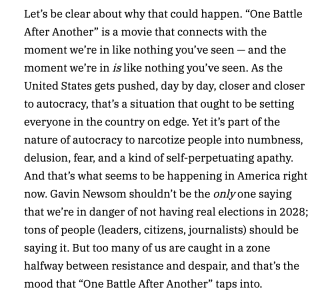
From Owen Gleiberman’s 9.27 Variety essay, “One Battle After Another, With Its Thriller Vision of Authoritarianism, Is the Rare Movie That Could Rule the Cultural Conversation”:
The heart of this rant begins at the 1:00 mark…”looney woke shit“, etc.
One of the main reasons Kamala Harris lost is that she never even began to acknowledge that Average Joes and Janes despise the left for this. She never even alluded to the possibility of this feeling being out there.
Harris: “Looney woke shit what? You’re talking about us? Since when? Whudda-whudda whah?
Stuart Rosenberg and W.D. Richter‘s Brubaker (’80) was a ’70s hangover film. Not a trace of the influence of Star Wars or Jaws. It could have been released in ’74 or ’75 and no one would have blinked an eye.
Robert Redford was 43 during filming in ’79, and he didn’t look a day older than he did in The Candidate, The Sting or Three Days of the Condor.
Morgan Freeman‘s brief performance as a crazed psycho inmate put him on the map, and this was seven years before Street Smart (’87), mind.
Richter’s adaptation of “Accomplices to the Crime: The Arkansas Prison Scandal” was nominated for Best Original Screenplay at the ’81 Academy Awards.
Brubaker opened on 6.20.80, three months before the 9.19.80 release of Redford’s Oscar-winning Ordinary People.
Remember the old days when typical ComicCon devotees tended to be schlubby, dorky-looking straight guys with a generally horrific dress sense (shorts, low-thread-count T-shirts, black socks, sneaker slip-ons) and a tendency towards corpulence?
Last night around 10-something I was chilling at the arrivals area at JFK’s Terminal 1, idling in a black, snappy-looking Lincoln SUV.
A 40ish blonde woman had just popped the trunk of a newish black coupe that was maybe 15 feet away, and a middle-aged bearded guy in a cream-colored sweater and a dark baseball cap was loading his suitcase.
But my curiosity had been aroused. I’ve had Luca’s Italian cell since that introductory lunch we shared near Spezia in early June of ‘17. So what the hell…I texted a message: “Are youwearingacream–coloredsweaterandabaseballcap?”
Immediatereply: “Yes! Where are you?” HE: “Right behind you.” Hug, smiles, joyful greetings.
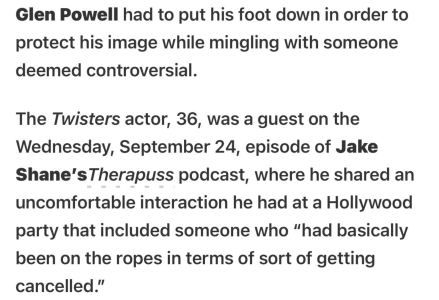
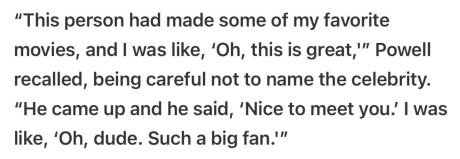
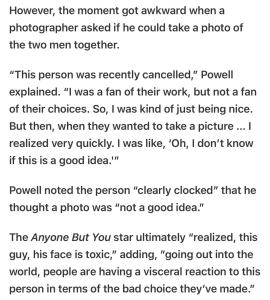
HE to commentariat: Who’s the present-day cancelled actor Glenn Powell was afraid to be photographed with? What actor has a totally toxic reputation? Either way, how did Powell, 37, manage to grow this kind of cast-iron backbone?
How would Powell have responded if he’d met Dalton Trumbo at a Hollywood party in 1957?
Trumbo: “Hey, Glenn…nice to meet ya.” Powell: “Dalton! Love your work, man! Kitty Foyle, Gun Crazy, The Brave One, Roman Holiday.” (A photographer comes up, attempts to snap the two of them.) Powell: “Holy shit!”…ducks out of the frame, runs away in a crouch position.
Clark: “Are you a coffee fan, Dr, Ryan?” Ryan: “Yeah, I like coffee.” Clark: “Try the Lindo brand. I think you’ll like it.”
If you’ve seen a film more than 10 or 12 times over the last 30 years, it can be safely stated that you really, REALLY like it.
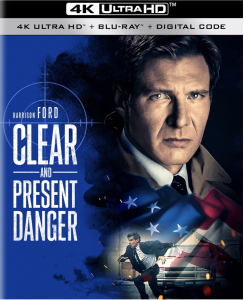
I attended the Clear and Present Danger press junket in San Francisco in the mid-summer of ’94. (31 years ago and change.) I forget why it happened at the top of Nob Hill instead of at one of the usual venues (the Four Seasons in Beverly Hills, etc.) but for whatever reason that was the drill.
I had my 12-minute interview with Harrison Ford, and of course we discussed the Reagan administration’s involvement in the Iran-Contra affair.
I love how Clear and Present Danger doesn’t try to trick or fake you out. It just guides you along, lets you watch, listen and observe, and basically treats the viewer like a smart, well-educated person…it doesn’t play games.
Is ‘Clear and Present Danger’ the Best ’90s Action Flick? by The Bulwark
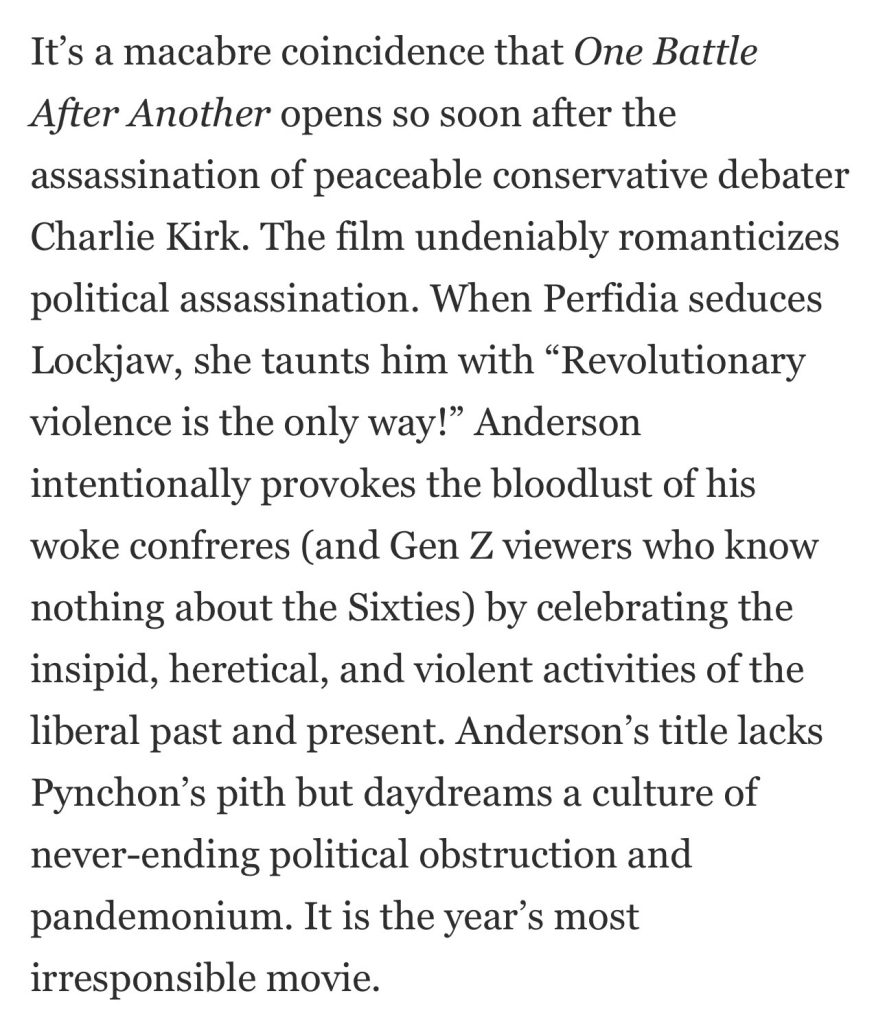
One, the political tone of her review — the theological undercurrent — sounds like it was penned by the critic for Rampartsor even TheBerkeley Barb in the late ‘60s. So she’s clearly in the tank for Paul Thomas Anderson’s empathy for (or excitement over) lefty, insurrectionist, down-with-whitey politics as well as the propulsive cinematic chops.
And two, Dargis doesn’t even allude to the charged political climate out there — to the fact that (a) within the last two weeks leftynihilistshavefired bullets at government-allied, conservative-minded figures (Charlie Kirkbeingthemosttragicallyprominent) and(b) — hello? — the fact that OBAA is a film about lefty revolt, insurrection and bullets.