Concentrated Denial

The 20th anniversary of the 9.11 attacks is tomorrow, and many of us, I suspect, are once again watching the catastrophic footage. I’ve been watching standard samplings of coverage as it happened, and one thing stands out. The determination to steer the conversation away from the obvious was somewhere between mind-bending and surreal.

CNN commentators had been told that a commercial jet had slammed into the North Tower around 8:46 am, but even mentioning the possibility of terrorism was verboten. What were the odds that a commercial jet had plowed into the side of a building due to some kind of bizarre pilot error? It was obviously a suicide move, but what kind of demonic pilot would decide to murder hundreds of innocent victims while offing himself? And yet the news guys relentlessly pondered the possibility that the impact might have somehow been accidental.

Even after the second plane hit the South Tower at 9:03 am, three or four commentators said “this appears to be on purpose” but others bit their tongues.

The reaction of ABC’s Peter Jennings to the collapse of the South Tower is almost poignant. Raw live footage of the South Tower disintegrating had been aired plus a nearby eyewitness had told Jennings on-air that the entire building had been reduced to rubble, and Jennings’ response was “the side of the building has collapsed?” No, came the reply — the whole building. “This is the entire South Tower?” Jennings asked, refusing to believe what he’d seen and had been told by a sane-sounding person standing four blocks away.

Good Review

Born on 9.24.93, Benjamin Platt was 23 when he played the titular role (a high-school senior, aged 17 or thereabouts) in the Broadway version of Dear Evan Hansen, which opened in December 2016.

But his playing of the same lead role in Stephen Chbosky‘s Dear Evan Hansen, which was shot in late 2020, happened when Platt was turning 27, and by that point he was just too damn adult-looking. And in the wake of last night’s disastrous Toronto Film Festival screening nobody is buying it. Platt and Chbosky have been all but tarred and feathered for this titanic miscalculation of casting.

Nate JonesVulture review, titled “How Old Does Ben Platt Look in Dear Evan Hansen?“, is a withering dissection and a very pleasurable read.

Greatest Sad Endings

On 9.7 I posted a short riff about the ending of Sydney Pollack‘s The Way We Were, which I’ve always regarded as one of the saddest ever. The scene also contains one of Robert Redford‘s finest acting moments.

A friend has forwarded five of her saddest ending picks — Letter from an Unknown Woman (d: Max Ophuls>) with Joan Fontaine; Waterloo Bridge (d: Mervyn LeRoy) with Vivien Leigh; Madame Bovary (d: Vicente Minnelli) starring Jennifer Jones; Anna Karenina (d: Clarence Brown) with Greta Garbo; and Dr. Zhivago (d: David Lean) w/ Julie Christie and Omar Sharif.

Please forward titles of films that measure up in your own regard. Extra points if your submissions are outside the usual realm.

Tragedy of “Detroit”

Kathryn Bigelow and Mark Boal‘s Detroit (Annapurna, 7.28 and 8.4) opened and died a bit more than four years ago. It flopped, I feel, because it felt more like crude torture porn than an urban thriller, and not enough like Gillo Pontecorvo‘s The Battle of Algiers or Costa-Gavras‘s Z, both of which seemed like adaptable models for dramatizing the 1967 Detroit race riots.

Primarily a reenactment of the Algiers Motel incident, Detroit mainly felt like a bludgeoning. I’ll never give it another go (I saw it twice before it opened), but perhaps someone in the community has? And if so, how did it play?

HE really misses the vision and discipline of director Kathryn Bigelow, who also helmed The Hurt Locker (Best Picture winner of ’09) and Zero Dark Thirty (’12). The failure of Detroit was undoubtedly painful, but life is short and you have to get back on the horse. Bigelow is too good of a filmmaker to sit on the sidelines. The first woman to win a Best Director Oscar needs, in fact, to return and do it again.

Detroit Broke My Heart,” posted on 7.23.17: Detroit is a raw-capture history lesson hoping to arouse and enrage, but it mostly bludgeons. I’m saying this with a long face and heavy heart as I like and admire these enterprising filmmakers, but there’s no getting around the fact that they’ve made a brutal, draggy downer. Detroit lacks complexity and catharsis. It doesn’t breathe.

I was hoping that this blistering docudrama, which isn’t so much about the 1967 Detroit riots as the bloody Algiers Motel killings, would play like Gillo Pontecorvo‘s The Battle of Algiers, but alas, nope. Failing that I wanted Detroit to be an investigative political thriller in the vein of Costa Gavras‘s Z, but that wasn’t the scheme either.

No one is more beholden to Bigelow-Boal than myself; ditto their magnificent Zero Dark Thirty and The Hurt Locker. But after these two films I’ve become accustomed to brilliance from these guys, or certainly something sharper, leaner and more sure-footed than this newbie.

At best, Detroit is a hard-charging, suitably enraged revisiting of what any decent person would call an appallingly ugly incident in the midst of a mid ‘60s urban war zone. And of course the system allowed the bad guys to more or less skate or not really get punished. What else is new?

The Algiers Motel incident happened, all right, to the eternal discredit of Detroit law enforcement system back then. But guess what? It doesn’t serve as a basis for an especially gripping or even interesting film.

Detroit has good chaotic action, street frenzy, bang bang, punch punch and lots of anger, and I really didn’t like sitting through it and I watched it twice, for Chrissake. For they’ve made a very insistent but air-less indictment film — militant, hammer-ish, screwed-down and a bit suffocating.

Read more

Adams Breaks It All Down

Thelma Adams to Sasha Stone about how the factors of racism and homophobia have affected Oscar viewership: “When Republicans like Trump spent the past 10 years mocking Hollywood and rightwing cranks spent decades fear-mongering about the mythical liberal agenda, why the heck would we not expect to see 10 or 15 million Republican viewers stop watching?

“A huge number of those people that have abandoned the Oscars would rather sit in the dark on Oscar Night rather than risk seeing any LGBTQ Oscar winners thank their partners for their love and support. Why do we even want those people watching the Oscars with us?

“Do I have any proof for my suspicions? Well, only circumstantial, but there’s this: What was the very first year that Oscar ratings plummeted from the 40 million range to the 30 million range? It was 2003, the year after Denzel and Halle won, that’s when.

“And what other shift in the Oscars coincided precisely with the steady decline in viewers? The decline began right after movies like Brokeback Mountain and Milk and Dallas Buyers Club started winning major awards, that’s when. So those changes that caused the Oscars to lose wrongheaded viewers were not anything the Oscars did wrong. Those viewers stopped watching when the Oscars began doing things right. It was the new era of [embracing] progress that upset several million viewers. How’s that for a theory?”

“Licorice Pizza,” If You Will

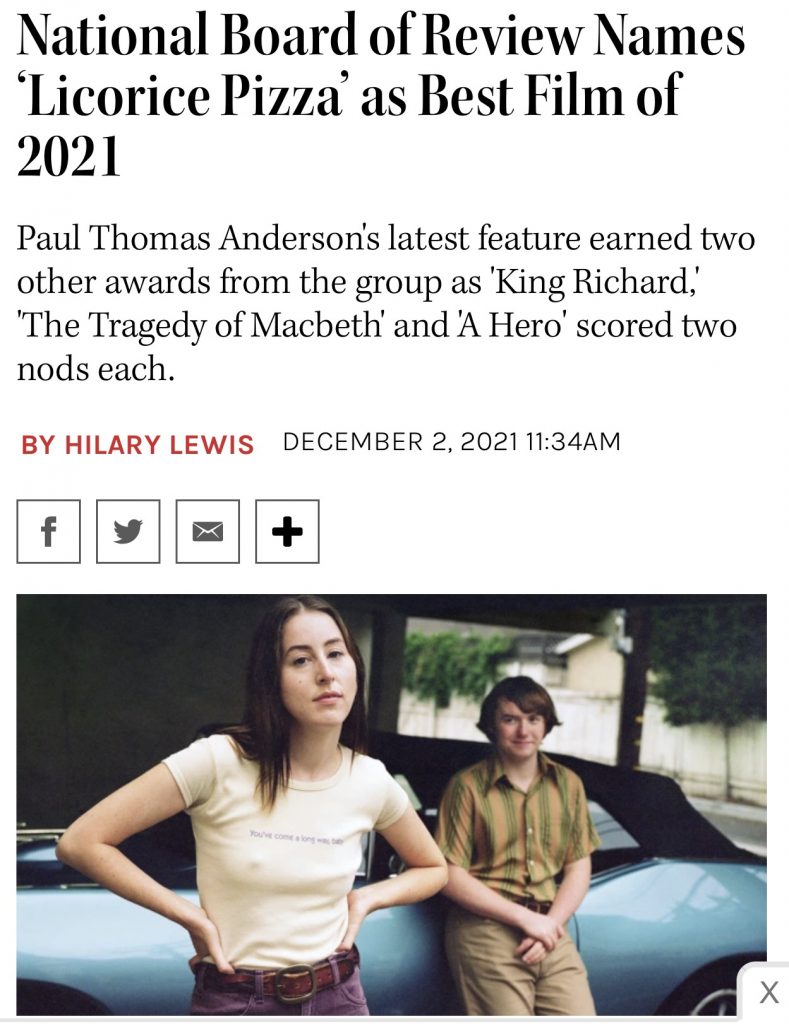
World of Reel‘s Jordan Ruimy is reporting that the actual, real-deal title of Paul Thomas Anderson‘s Soggy Bottom (a working title that’s been kicking around for months) is Licorice Pizza.

The title doesn’t do much for me, but I guess it’s okay. PTA’s film is set in Los Angeles in the early to mid ’70s. Back then Licorice Pizza was a Southern California-based record store chain with 34 locations, including one on the Sunset Strip.

3:35 pm: Wikipedia has run with the new title, although their page is still titled “Soggy Bottom“.

Ruimy has linked to a Reddit guy named The_Horace_Wimp who claims to have attended a London screening of a 35mm print of American Graffiti earlier today, and that the trailer for Licorice Pizza played before it began. Others on Twitter are also reporting that this new title is legit.

Read more

Rushfield Explains The Basics

Awards Daily‘s Sasha Stone recently asked “the best and the brightest” several basic questions about what’s broken and needs fixing in the Oscar realm. One of the questions was “why do you suppose the [Oscar telecast] ratings have dropped so dramatically since 2014?”

Here’s how The Ankler‘s Richard Rushfield replied:

1. RR: “The sector became bloated and self-important, glutted on a eight-month long season.” HE sez: The season was eight months long between ’20 and ’21, true, but it’s been a six-month thing for years and is reverting back to that.

2. RR: “They rested on an ancient creaky format that in every way is at odds with the entire drift of the culture.” HE sez: True, but how exactly could they have remedied this problem? The Oscars have been “the Oscars” since the late 1920s, and the televized versions hasn’t substantially changed since the early ’50s. Older viewers like the sameness of it all — the red carpet, the smart-ass jokes, the emotion, the tributes, the buildup to the big awards, etc. It is what it is. Millennials watch to some extent; Zoomers don’t care.

3. RR: “Hollywood stopped minting new stars that people were excited to see. The ones that did come along, we see far too much of already via social media, etc. Glamour requires some level of scarcity. Instead we’ve flooded the market with them.” HE sez: The only stars I care deeply about are ones who came to prominence in the ’90s and aughts, for the most part.

4. RR: “The stars when they were up there had became a bunch of pompous bores. Take a creaky old format, and throw in a bunch of fantastically rich people scolding their audience — and you’ve got a formula to chase audiences away in droves.” HE sez: Rushfield’s use of the term “scolding the audience” means industry wokesters admonishing Joe and Jane Popcorn for not getting with the progressive program.

5. RR: “But most of all, above all else, it’s a race between a bunch of movies that very few people have even heard of, let alone seen. Who is going to watch a race between some movies they’ve never heard of?”
HE sez: I’ve explained why Average Joes aren’t watching wokester movies.

6. RR: “If they can’t figure out how to address that last problem, then no other fix is going to make any difference.” HE sez: They’ll never fix this problem. The elite Hollywood community is going to have to accept the fact that they’ve politically isolated themselves from the hoi polloi, and that the Oscar awards no longer mean much to most of the country, and that they’re basically become about the values of “aggressive progressives.” The Oscars will simply no longer be the cash cow they once were, and they’ll have to downshift in scale and expense.

“Increasingly Niche Tastes”

In a recent “What I’m Hearing” column about the Motion Picture Academy’s plan to somehow arrest and even turn around the ratings plunge that has been increasing over the last five or six years, Matthew Belloni wrote that the “increasingly niche tastes of Academy members” are a principal reason why most people haven’t seen the films up for awards.

The whole rundown was posted earlier today by Awards Daily‘s Sasha Stone.

What Belloni means by “increasingly niche tastes” is that since ’16 or thereabouts, the film industry has increasingly fallen under the grip of aggressive progressives, otherwise known as wokesters (POCs, #MeToo-ers, LGBTQs, obliging guilty liberals, kowtowing corporations). And they’ve been calling the shots more and more, and it was this increasingly dominant influence that made last spring’s Steven Soderbergh Oscar telecast seem like such a suffocating experience.

We all understand that the Soderbergh Oscars absolutely killed whatever was left of the old mystique. They made it clear that the Oscars had been transformed into a West Coast Tony awards thing — awards that reflected the mentality of an elite membership that had its own progressive game going on, and to hell with skillfully finessed movies for the politically neutral meatheads — i.e., films that reach out to people and reflect their lives as actually lived.

(Sidenote: it’s heartening to note that one such film is Reinaldo Marcus Green‘s King Richard, due from Warner Bros./HBO Max on 11.19.)

Five or six years ago the “increasingly niche tastes” crowd, understandably goaded by the election of Donald Trump, decided that the older-white-male dominance had to be strongly diminished and that the world needed to change. And so the industry, Marvel and D.C bullshit franchises aside, needed to increasingly forego the usual escapist or emotional engagement elements and/or baseline reflections of real life that movies have historically provided over the decades, which meant mostly ignoring the experience of average Americans who live outside the NY/LA bubble.

Streaming changed everything and the pandemic really up-ended the salad bar, but what’s been implemented more and more over the last five or six years is a variation of the social realism movement that took hold in the modern art world of the 1930s.

I explained it all on 3.22.21 in a piece called “Wolfe Reminds, History Repeats.” Here it is again in a nutshell:

“Since wokeness began to manifest in ’17 and certainly since the pandemic struck, the movie pipeline has been losing steam and under-providing, to put it mildly. Nothing even approaching the level of Spotlight, Manchester by the Sea, Call Me By Your Name, Dunkirk, Lady Bird, La-La Land, the long cut of Ridley Scott‘s The Counselor, Zero Dark Thirty or Portrait of a Woman on Fire has come our way from domestic filmmakers.

Above and beyond an array of pandemic suffocations, a significant reason for the strange absence of robust cinema, for this general faint-pulse feeling, is (wait for it) wokeness and political terror.

Read more

Unmitigated Cash Grab

Since the release of the original and revolutionary The Matrix 22 and 1/2 years ago the red pill vs. blue pill metaphor has completely embedded itself into the mass mindset. You knew it had really penetrated when Elon Musk invoked it 16 months ago, and Ivanka Trump responded “taken!” The blue pill means safety and security by way of mediocrity and tedium, and the red pill is about illumination and “whoa!” and adventures in Wonderland. We’ve all been chewing on this notion since the late Clinton administration.

And yet Lana Wachowski, director, co-writer and producer of The Matrix Resurrections (Warner Bros., 12.22), felt obliged to literalize and re-boot the metaphor by showing us actual pills of a red and blue color in the new trailer. My response was “really?” The metaphor has to be re-explained because…what, GenZ never got the memo or something?

Why would anyone want to make another film with the word “Matrix” in it at all? It’s been 18 years since the double-shot poison cocktail of The Matrix Reloaded and The Matrix Revolutions killed this franchise but good. Why would anyone want to drink from the same glass again?

From “Shoulda Quit When They Were Ahead“, posted on 4.1.14: “I remember paying to see the original The Matrix in the old multiplex at the Beverly Connection, on the southeast corner of La Cienega and Beverly Boulevard. It was opening weekend, and I remember floating out of the theatre and listening to the chatter as the crowd trudged down the stairway exit. A visionary knockout. The first grade-A cyber adventure. Bullet time! Obviously a hit.

“For the next four years I was convinced that the press-shy Wachowskis, who’d also directed the brilliant and hot-lesbo-sexy Bound, were pointing the way into 21st Century cinema and that everything they would henceforth create would dazzle as much as The Matrix, if not more so.

“And then The Matrix Reloaded came out a little more than four years later (5.15.03) and the millions who’d flipped over The Matrix were standing around with dazed expressions going “wait…what? ” And then The Matrix Revolutions opened on 11.5.03 and that was it…dead, finished, imploded. Larry and Andy who?

Read more

Really Bad Casting

Earlier today I rented Impeachment: American Crime Story. I watched a portion of episode #1, and I just couldn’t get over the wrongness of Beanie Feldstein as Monica Lewinsky. They just don’t look similar, not even a little bit. Monica was shapely; Beanie is chubby. I can’t invest in the supposed reality. I’d like to submit, but Feldstein keeps getting in the way.

Sarah Paulson is excellent as Linda Tripp. Make that delicious. Such a brilliant actress; such a carefully measured performance; you can read her every thought and suppressed impulse.

Missed It in Telluride

Okay, I wanted to see or do other things when it was showing. I’ll catch it soon. The idea of Joaquin Pheonix playing a gentle, mild-mannered uncle seems odd. Most of us have come to accept that default Joaquin means being self-absorbed and caught up in the usual melancholy and smoking cigarettes, etc.