Three Bowling Pins

Kenneth Branagh‘s Belfast, Jane Campion‘s The Power of the Dog and Pablo Larrain‘s Spencer screened in Telluride last weekend, and in my opinion they’re all shortfallers. Certainly as far as the Movie Godz are concerned.

Each is destined to slam into a big thick concrete wall. Joe Popcorn and your straight-shooting, shake-it-off Academy and guild types will see to that. Every year we have to re-learn the difference between rarified mountain-air reactions vs. sea-level reality. We’re about to be schooled yet again.

There was only one film that hit a grand slam last weekend, and that’s Reinaldo Marcus Green, Zach Baylin and Will Smith‘s King Richard — period. A Best Picture Oscar nom is 100% assured, and even at this early date the odds seem to favor a win. Not to mention a Best Actor trophy for Smith, and a likely Best Supporting Actress nom for Aunjanue Ellis, who memorably portrays the brutally honest wife of Smith’s Richard Williams and the mother of tennis legends Venus and Serena Williams.

Right now certain critics, award-season handicappers and industry voices are telling each other that Belfast, The Power of the Dog and Spencer are award-season hotties. They’ll continue to insist upon this narrative for the next two or three months, and eventually the smoke will clear.

Belfast (Focus Features, 11.12), which producer Sid Ganis believes to be one of the best films he’s ever seen in his life, is a mawkish family drama that channels The Wonder Years, and delivers a vague impression of the “troubles” that plagued northern Ireland in the ’60s and ’70s. Plus a monochrome palette, perhaps the most insufferably cute and endearing performance by a child actor (Jude Hill) in film history, a dab or two of puppy love, Cieran Hinds‘ genuinely charming performance as a kindly grandpa, and loads and loads of Van Morrison. Then again the curious affection some have for this film (watch it win the TIFF audience award) may keep the torches burning.

The Power of the Dog is a chilly and perverse cattle-ranch drama that insists over and over that it’s a very bad thing for toxic males to suppress their homosexuality. (HE agrees.) Campion is a top-tier filmmaker but Dog‘s milieu is grim and stifling and melancholy, like the dark side of the moon. Yes, Benedict Cumberbatch is excellent as the enraged and closeted Phil, but he’s basically doing Daniel Day Lewis‘s “Bill the Butcher” in Gangs of New York. Or, if you will, “Daniel Plainview” in There Will Be Blood.

Spencer is an oddly surreal dreamscape flick that uses Lady Diana‘s anguished and loveless marriage to Prince Charles and a 1991 Christmas celebration at Queen Elizabeth’s Sandringham estate as the basis of what boils down to an elite psychological meltdown flick…”poor free-spirited, pheasant-sympathizing, pearl necklace-loathing Diana vs. the cold, bloodless gargoyle royals,” etc. Yes, Stewart will most likely be Oscar-nominated for Best Actress — her performance is definitely commendable.
Same Teaser I Saw A Month Ago

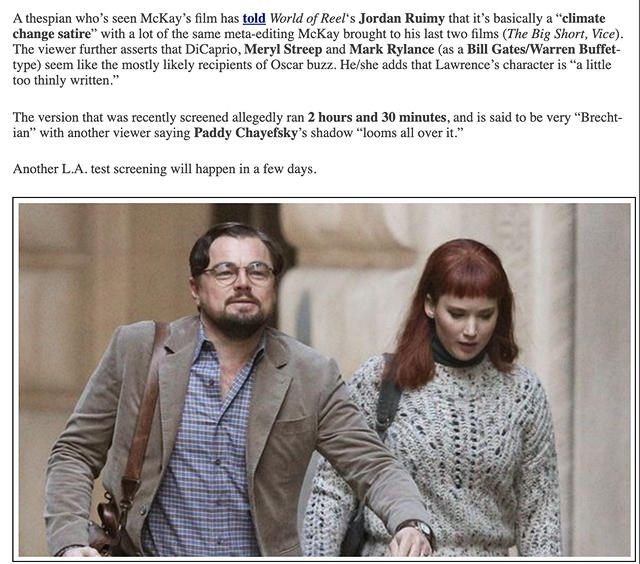
In early August a bootleg copy of a Netflix teaser for Adam McKay‘s Don’t Look Up appeared on YouTube. Today a similar teaser appeared legitimately. Same Leonardo DiCaprio chin-beard and anxiety attack, same sense of hurtling meteoric panic-anxiety, same Jonah Hill smiling conference line about “whoa, dude…you are stressing me out“, etc.

Bemoaning The Brogue

Four days ago (Friday, 9.3) I tweeted about one of my Belfast problems — the partly indecipherable Irish accents. Cue the usual HE knee jerk derision about my ears being the problem…naturally. But earlier today (9.7) along came Rory Carroll’s Guardian piece (“Hollywood Struggling With Accents in Branagh’s Belfast”) about others having the same issue.

Has Davis Dinged “Spencer”?

Variety‘s award-season columnist Clayton Davis tends to be very encouraging when it comes to assessing the Oscar odds of nearly every would-be Best Picture contender, at least in the early stages. He can be (and usually is) a very generous handicapper,

Which is why Davis may have delivered a symbolic kiss of death to Pablo Larrain‘s Spencer. Davis believes that Kristen Stewart‘s performance as Diana, Princess of Wales is good to go for Best Actress (at least a nomination) but the film itself…well, who knows?

Basic equation: If an obliging good-time Charlie is skeptical of a film’s Best Picture chances in September, there may be reason for concern down the road.

One of Greatest Sad Endings Ever

Barbra Streisand holds her end up in this final scene from The Way We Were, but it’s Robert Redford who delivers the emotion. It’s all in his eyes…the heartache, the buried regret, the faint unhappiness about his current gig as a live TV writer, the lingering love. It’s one of his most poignant acting moments ever, and I’m not even a huge fan of this 1973 film.

“You never give up, do you?”

Mike + Mechanics Meditation

Pablo Larrains Spencer ends on an “up” note — Diana, Princess of Wales (Kristen Stewart) and sons William and Harry escaping from the Windsor gargoyles in her car and singing Mike + the Mechanics’ “All I Need Is A Miracle,” which was released in early ’86. But here’s the thing…

Written by Mike Rutherford and Christopher Neil, “All I Need Is A Miracle” is about a guy who’s been indifferent and even abusive to his ex-girlfriend, but now he realizes what an asshole he was and desperately wants her back. If she decides to forgive him and return, it’ll be because God has smiled and lent a hand.

If you believe that a certain someone agreeing to be your boyfriend or girlfriend constitutes a miracle, you’ve got the wrong attitude, man — perhaps a low-self-esteem loser. If you’re a good person with character and inner value and whatnot, you shouldn’t need a miracle to make things right in terms or a desired relationship. Some guy saying “left to my own devices my would-be boyfriend or girlfriend might blow me off or find someone better, but if a ‘miracle’ happens I’ll be saved!”…c’mon, man.

I had the same attitude back in my hormonal heyday. If I was the object of some woman’s intense desire and if she believed that if I reciprocated her feelings that a “miracle” would be at hand, my response would be “hold on a minute…there’s nothing miraculous about me or being with me…I have my good and not-so-good qualities but if you think that our falling in love or moving in together or whatever…if you think that would be some kind of miracle, then you’re dreaming…nobody is a miracle, nobody’s a perfect catch…it could be a good or better-than-good relationship or not, but come down to earth….we’re all flawed, all struggling…nobody’s a gleaming prize.”

Clint Eastwood: “Show me a drop-dead beautiful woman with an elegant education and great business acumen, and I’ll show you a guy who’s tired of fucking her.”

Read more

Serious Sorrow

Apologies for not posting about the death of Michael K. Williams during yesterday’s long journey. I feel genuine sorrow that the 54 year-old, Brooklyn-residing costar of The Wire and Boardwalk Empire accidentally took himself out. Respect and condolences. I’m just sorry — let’s let it go at that.

Hand-Slap on Knee

You’re sitting down and interviewing (or simply speaking with) a somewhat older and certainly more famous fellow than yourself, and as the conversation is winding down he affectionately, quickly, semi-aggressively grips your knee. That’s a gesture of courtly approval — it means that you’ve passed inspection.

I don’t know how many times this has happened to me personally, but I’d say a few. I’m thinking in particular of a 1999 Toronto Film Festival party for The Limey, and hanging for a half-hour or so with Terrence Stamp. As the party was ending and we were all starting to disengage, Stamp gave me a nice fatherly knee-grab — not too gentle, not too aggressive, right in the middle.

I can’t honestly say I’ve ever knee-gripped some younger guy. I tend to prefer shoulder grips or upper back pats.

Telluride Mark-Up

Last Saturday afternoon I sat and wrote a bit at Telluride’s Butcher & Baker Cafe (201 Colorado Ave.). I consumed two cans of La Croix sparkling water, for which most retailers charge $2 each, give or take. The Butcher & Baker guys charged a total of $13.68. High rent and all that, but you’d think that an exorbitant per-can price would be more in the vicinity of $4 per can, not $5.50 or $5.75.

Limits of Endurance

Due to pressing work issues and whatnot, Tatiana insisted Monday morning that we drive all the way from Telluride to West Hollywood (858 miles, 13.5 hours) in a single daylight-to-darkness marathon. We left at 11:30 am and arrived at the WeHo homestead around midnight, or 1 am Telluride time. Two (or was it three?) gas-ups. No meals or leg-stretching time-outs. The worst part was the endless uphill trek between Needles and Barstow.

Most long-distance drivers succumb to acute exhaustion after seven or eight hours. Tatiana drove the first seven; I took over in mid-Arizona. Any way you slice it 13 and 1/2 hours inside a VW Beetle at 80 mph is grueling.

I’ve been through one similar experience — a coast-to-coast, Los Angeles-to-NYC marathon that lasted 52 hours. Meals and one roadside snooze but no motels. The fastest potential time is 42 hours, but the pace would be inhuman. The most agreeable way to drive long distances is to bag 400 to 500 miles per day. Less if you can afford it and have the spare tine.

“Roma” Is Ballsier Than “Belfast”

Kenneth Branagh’s wildly over-praised Belfast is similar to Alfonso Cuaron’s Roma in three respects — black-and-white cinematography, focus on a family, violent political conflict affecting the basic climate.

The difference is that Branagh seems afraid of turning off the cinematic low-brows with a sudden plunge into monochrome, so he begins his 1969 tale in the glorious digital present, showing Belfast’s brilliant colors and upgraded commercial center, all spiffy and rockin’ to some punchy tune.

Only after the audience has been sated with the colorful safety of now for two full minutes does Branagh summon the resolve to commit to black-and-white and the Belfast that once was.

Cuaron, of course, started his film in monochrome from the get-go and stayed with it.

If They Can Dream

Initially written during Monday’s 858mile marathon, reedited and tweaked in West Hollywood on Tuesday morning: On Sunday night (9.5) I finally caught Wes Anderson’s The French Dispatch, and there’s no question that it’s brilliant and (I mean this respectfully) oddly hateful in a chilly sort of way.

It’s a visual knockout on a shot-by-shot basis. but except for a scene or two featuring Jeffrey Wright it refuses to provide any sort of narrative tissue or emotional connection with the characters. It’s all arch attitude, snide-ironic voice-overs and deadpan expressions, and after a while it makes you intensely angry. That or your spirit wilts or you become weak in the knees.

The French Dispatch is a bullwhip immersion in hardcore, doubled-down Wes. It’s not that there’s no way “in” as much as there isn’t the slightest interest in offering any kind of common humanity element.

So much so that I began to wonder if Wes might be going through a phase vaguely similar to Jean-Luc Godard’s Marxist-Maoist revolutionary period (‘68 to ‘79). I ask because it’s a pure head-trip objet d’art — there’s no sense whatsoever that Dispatch is looking to engage on any kind of semi-accessible level, even to the extent of reaching people like me.

It’s so mannered and wry and rapid-fire ironic that it sucks the oxygen right out of your lungs.

That said, I loved the boxy (1.37:1) cinematography. I was also kind of wondering why Wes didn’t use 1.66:1 more often. (I’m actually not sure he used it at all.). It seemed to be about 85% boxy and 15% widescreen scope (2.4:1).

For me the most humanly relatable moment doesn’t involve Wright’s character. It happens, rather, during the 1968 sequence that costars Frances McDormand as a Dispatch staffer writing about the fevered climate of French student revolt. Asked if writing is a lonely, isolating profession, McDormand answers “sometimes.”

There’s no chance that anyone this fall will even flirt with the concept of Dispatch being worthy of above-the-line Oscar noms — at best it could land some for production design, costumes, makeup, editing.

Again, Deadline‘s Pete Hammond: