I was settling into Gunpowder Milkshake on Netflix…”my God, this is heaven…amazing!…why doesn’t Netflix make more like this?” No, seriously, it made me sick to my stomach. So I turned it off and began to watch Arthur Penn‘s Night Moves (’75), not intending to watch it all through (it was after 11) but I watched about 45 or 50 minutes.
Night Moves runs only runs 99 minutes but always feels like two hours, and yet it’s always engrossing. As noirs go it’s colder than most. It’s a demimonde film about a community of friendly, cynical people who work in the lower end of the film industry and don’t care all that much about anything. It basically says that everyone’s guilty or corrupt or thoughtless…that everything’s rancid and foul. But Gene Hackman‘s Harry Moseby lends a certain humanity.
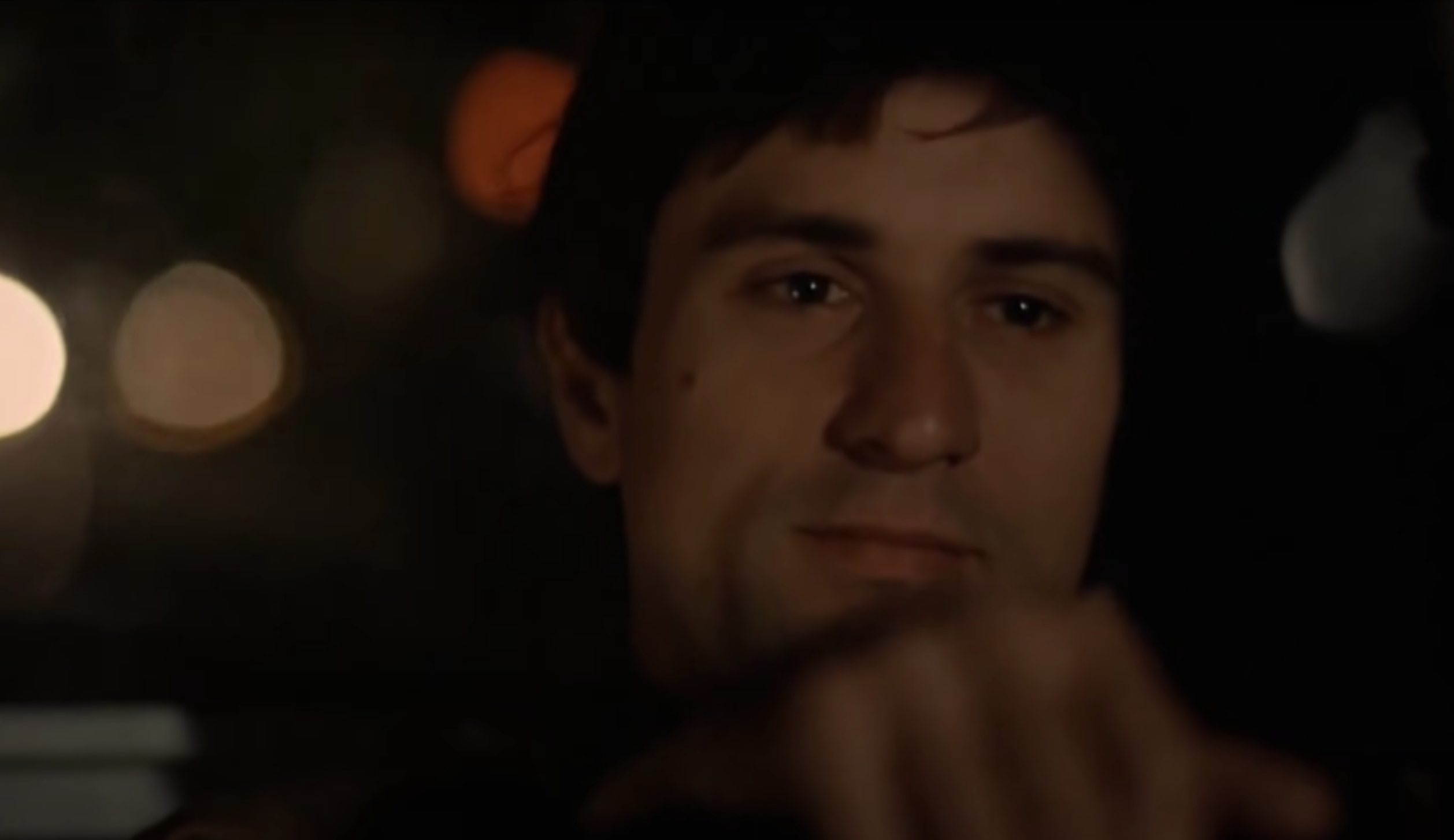
Anyway there’s a night scene early on in which Moseby, an ex-football player turned private investigator, happens to drive by the Magnolia Theatre (4403 W. Magnolia, Burbank…not far from Warner Bros. studio) with Eric Rohmer‘s My Night at Maud’s on the marquee. A bit earlier his wife, played by Susan George, tells Harry she’ll be catching this very Rohmer film with a gay friend and asks Harry if he’d like to join**.
So he pulls over and waits for the show to end. Never mind about what happens — I was suddenly swooning over the marquee and the quiet street and the idea of little independent movie theatres…a small single-screen theatre showing an arty French film on a weeknight in a quiet little neighorhood in the San Fernando Valley. And I was thinking “Jesus, I really wish I’d driven out there earlier this evening and caught the same 7 pm show.”
** Moseby responds with the famous line “I saw a Rohmer film once…it was kinda like watching paint dry.” This line was quoted in Rohmer’s N.Y. Times obituary.
I know that look on Leonardo DiCaprio’s face — as Ernest Burkhart, the bad-guy nephew of Robert DeNiro’s William Hale character in Martin Scorsese and Eric Roth’s KillersoftheFlowerMoon, he’s projecting a lowbrow dumbfuck attitude, a little hostile and guarded, probably not enough brain cells, etc.
Born in 1874, Hale wasn’t that old in the mid 1920s, of course — about 50 or thereabouts. DeNiro looks great-grandpa-ish but we’ll let that slide. (Leo will hit the big five-oh in November ‘24 — three years and change.)
Meanwhile Jesse Plemons, as FBI good guy Tom White, has a haircut and a head shape not unlike that of Lou Costello or, if you will, a basketball. He’s walking with a crutch on his left side.
Since returning from Cannes and presumably having concluded, along with everyone else, that the Toronto Film Festival has descended to (temporary) second-tier status, World of Reel‘s Jordan Ruimy has been trying, along with everyone else, to sagely spitball the Venice, Telluride and New York Film Festival rosters.
I have to say that I’m feeling a wee bit gloomy about the likely Telluride roster, given that two films that I was really hoping-against-logic to see there — Clint Eastwood‘s Cry Macho (Warner Bros., 9.17) and Andrew Dominik‘s Blonde (Netflix), which began shooting in August ’19 — won’t be there for sure, although the latter may turn up in Venice or Toronto.
I was also hoping to see the Sopranos prequel, David Chase and Alan Taylor‘s The Many Saints of Newark (Warner Bros, 10.1), in Telluride, but who knows?
I’m also hearing (although I don’t know this for a fact) that Adam McKay‘s Don’t Look Up (Netflix) will bypass Telluride. That’s a drag. And forget Guillermo del Toro‘s Nightmare Alley playing there also, I’m told.
There’s also the question of Joel Coen‘s The Tragedy of Macbeth (A24/Apple), which, I’m told, has been seen and gently passed on by at least one important award-season player. That, to me, means nothing because everyone will want to see it anyway because Coen + William Shakespeare + Denzel Washington + Frances McDormand is too highly charged of a combo. Slated for a theatrical fourth-quarter release by A24 followed by Apple streaming, it will seem curious if The Tragedy of Macbeth bypasses the festivals and just “opens,” as it were.
Right now the Telluride keepers (per Ruimy and others) appears to be Paul Schrader‘s The Card Counter, Reinaldo Marcus Green‘s King Richard, Pablo Larrain‘s Spencer (I regret having to repeat that Kristen Stewart is too short to play Diana Spencer), Mike Mills‘ C’mon C’mon, Jane Campion‘s The Power of Dog, Pedro Almodovar‘s Madres Paralelas, Lin Manuel-Miranda‘s Tick, Tick…Boom! (saga of Rent maestro Jonathan Larson), Denis Villeneuve‘s Dune, Wes Anderson‘s The French Dispatch and Maggie Gyllenhaal‘s The Lost Daughter.
Not to mention Todd Haynes’ The Velvet Underground, Celine Sciamma’s Petite Maman, Will Sharpe’s The Electrical Life of Louis Wain, Michael Pearce’s Encounter and Ken Burns’ multi-part Muhammad Ali documentary.
Toronto keepers include Edgar Wright’s LastNightinSoho, Michael Showalter’s TheEyesofTammy Faye and Kenneth Branagh’s Belfast. Blonde may also play there, apparently, in the wake of a Venice debut.
Ruimy’s Venice projections include Blonde, Madres Paraleles, The Power of the Dog, Triangle of Sadness, The Card Counter, Last Night in Soho, The Hand of God, Spencer”, Driftwood, The Lost Daughter, Official Competition, Freaks Out, Veneciafrenia, Lost Illusions and Henrico’s Farm.
The article has two stand-out proclamations, both alarmist. The first is the headline’s mention of the money-losing John Carter…that in itself is cause for shrieking. Ding-ding-ding-ding-ding-ding-ding-ding…parched desert milieu! big ugly monsters!…ding-ding-ding-ding-ding-ding-ding-ding-ding-ding! The second alarm-bell is a Mendelson statement that “the marketing folks at Warner Bros. have their work cut out for them” in order to spare Dune from a Carter-like fate.
“And that second trailer, mostly culled from the first ten minutes, was oddly less narratively coherent than the initial teaser,” Mendelson explains. “More so than the first teaser, the second trailer” — expected to pop early next month — “seems to be selling the mere idea of ‘Hey look, we made a mega-budget, all-star Dune movie!’ as its primary hook.”
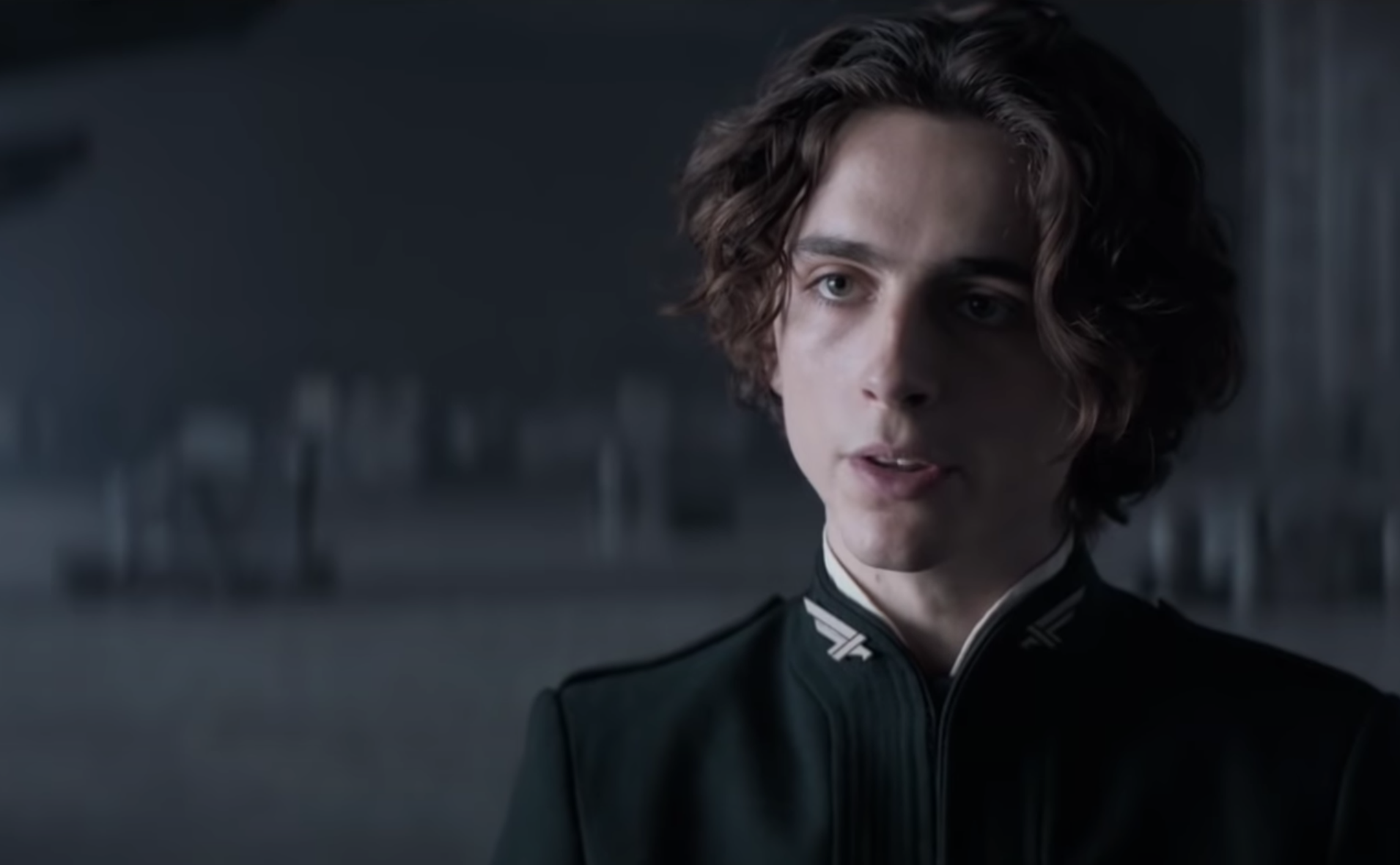
Helpful Mendelson suggestion: “[The second trailer contains] hints of a ‘prince of privilege switches sides and aligns himself with the oppressed’ plot. That primal story that has resonated in everything from Exodus to Avatar. If there is a third trailer (perhaps timed to the film’s Venice Festival launch or to No Time to Die in late September), I’d suggest leaning hard into that angle. Hell, even if they have to lie a little bit, I’d play up the notion that Timothee Chalamet and Zendaya are dueling protagonists whose destinies eventually intermingle.”
…but they’re always swamped with so many expressions of rapt adoration and slavish praise, like water gushing out of a firehouse, drenching everyone in attendance…a feeling of drowning, of not being able to breathe…give it a rest! It’s left to the recipients to turn it down and somehow make it feel real, but by the time they’re before a mike and sharing whatever you’re too drained and exhausted to care. The only tribute events that I can stand are roasts, except they’re exhausting and draining in different ways.
The John F. Kennedy Center for the Performing Arts has announced its 44th lifetime achievement award winners, to be handed out on 12.5.21: Motown founder Berry Gordy, opera star Justino Díaz (who?), singer-songwriter Joni Mitchell, entertainer Bette Midler and Saturday Night Live producer Lorne Michaels.
Gordy, Midler and Michaels are legendary, of course, but Mitchell is the only kissed-by-genius, Pablo Picasso– or Frank Sinatra– or Billie Holiday- or Isodora Duncan-level artist among them.
Sometime around ’82 or ’83 legendary film critic Andrew Sarris shared a classic line of despair — “the bottom has fallen out of badness in movies.” And within that particular pocket of time with the wrong people starting to exert more and more influence in Hollywood, that was a fair (if profoundly depressing) thing to say.
In a 4.3.07 review of an Ice Cube comedy called Are We Done Yet?, I mentioned the ’80s Sarris quote and said that “now the roof is gone also and the walls have collapsed, and makers of mainstream family comedies have throwninthetowel and said ‘if it makes money, we don’t care!…the family audience loved AreWeThereYet? so what do you want us to do, not make more money?’
“And so the movies they’re making radiate a terrible odiousness,” I wrote. “Or a kind of soul-rupturing stupidity…not just unfunny but suffocating in ways you wouldn’t think possible. You sit there staring at the screen and you feel dead inside, and then you feel poisoned and you realize you’ve been reborn except you’re losing your mind. Ice Cube got paid a lot of money for doing this thing, you’re telling yourself, but you’re just sitting there.”
Now it’s 14 years later (39 years after the Sarris quote) and earlier today I wrote the following to a friend:
“You know something? A certain percentage of movies…not a high percentage but maybe 5% or 7% or somewhere in there, used to deliver certain emotional nutrients. Those nutrients today are in shorter and shorter supply. I feel as if my personal spiritual garden is wilting from the lack of these nutrients, and the shitty movie virus is spreading like Covid and that movies have turned rotten in more ways than I could have possibly imagined back in the day.
“The cinematic preferences of Millennials and Zoomers are horrific, not to mention the GenX gamers and their longstanding comic-book appetites…don’t get me started. This is a ruined, jaundiced industry…a racket that has poisoned itself.”
I wish I could think of something more to say at this point. Maybe it’ll come to me later tonight.
Two Sarris anecdotes that have nothing to do with the depression: In the fall of ’77 Sarris agreed to talk about movies in front of a crowd at the Westport Country Playhouse Cinema, where I was working at the time. I was told to pick him up at his Upper East Side apartment and drive him up to Westport, and then drive him back a couple of hours later. We obviously enjoyed some chat time, but what I primarily remember was his energy and spirit — a genuine inspiration for me. He seemed indefatigable.
A year or two later I was a struggling New York freelancer, doubtful of my talent and unsure of my footing. I was at a black-tie New York Film Festival party, and I remember suddenly putting on a pair of jet-black Ray-Bans as I joined a group of five or six that included Sarris. He made me feel very much part-of-the-gang when he remarked a few seconds later that I looked “like a Roman pimp in a Fellini film.”
The coupling of Aaron Sorkin and Paulina Porizkova has gone south, and “why” is none of my damn business. But I can’t help myself. My guess is that Sorkin, like most writers, needs to live and work in a certain regulated hardcore way, and he’s not the type to drop to his knees and slavishly worship his wife or girlfriend on a daily basis. That or he simply didn’t spend enough money on Porizkova, who almost certainly demands, being an ex-supermodel, a triple-A, bucks-up, nothing-but-the-best lifestyle.
The thing I noticed about the new trailer for Ridley Scott‘s The Last Duel, which is set in 14th Century France, is that Matt Damon is wearing his hair in a rural-Pennsylvania ’80s mullet style. (I know this suggests that I’m not an especially deep or thoughtful person, but that’s the first thing that hit me.)
The second thing is the subdued color scheme used by dp Dariusz Wolski — grayish and almost monochrome except for evening scenes set near a fireplace, in which case the tones are primarily amber.
The third thing that came to mind is that the “accused rapist who insists he’s innocent” plotline, which is based on historical fact, delivers an echo of sexual harassment and assault in the #MeToo era.
There were some recent reports on Reddit about one and possibly two sexual assault scenes that were allegedly difficult for some viewers to sit through, but I don’t want to get into it.
Whoever approved the cover design for the forthcoming Criterion Bluray of Jack Arnold‘s The Incredible Shrinking Man (’57) was telling us in a plain, straightforward way (hello?) that the film is just as much of a penetrating look at the social and psychological issues afflicting mid ’50s suburbanites (mass man complex, creeping conformity, feelings of diminishment) as a sci-fi thriller and a landmark visual-effects film.
Speaking as the son of an advertising man who commuted to Manhattan every morning and often had a drink or two when he returned at 7 pm, Nunnally Johnson and Daryl F. Zanuck‘s The Man in the Gray Flannel Suit (’56) is one of the finest dramas about ’50s suburbia and the pressures that came with that manner of life.
I don’t have narcolepsy, but I can drop off any time, anywhere. It happened yesterday in the midst of a short trip to visit my local mechanic. I was driving east on Melrose when I thought of a mistake I wanted to fix on a recently posted story. So I pulled over and stopped in a legal white parking zone, and started to edit. I felt a slight drooping urge and closed my eyes. 20 minutes later I came to; I was shocked to discover how long I’d been out. The car had been running the whole time with the a.c. on. Weird to wake from a nap you hadn’t really “planned” to take in the first place.
I’ve melted down over certain feelings…moments of vulnerability and regret. Pets who’ve died violently, tragically. The things that most often prompt leakage are usually connected to loss (i.e., cherished deepheart things you can never get back). And sometimes it happens over nothing. I once broke down because I was so physically exhausted.
I know that as far as watching actors succumb to big emotional moments in films is concerned, it’s almost always more affecting when the weeper doesn’t turn on the faucets…when he/she attempts to keep it buttoned and can’t quite manage that. Gladys George‘s big moment in The Best Years of Our Lives…that line of country. Or that feeling you get from certain film scores.
So there’s nothing wrong with weeping or even people who tear up at the slightest provocation. Some of us are built that way…no fault or foul.
But there is a little something “wrong”, due respect, with weeping over superhero and fantasy movies. Certainly from my crusty perspective. This is a generational thing, obviously, but I just can’t understand how anyone could succumb to deep quaking currents over the fate of Yoda or Han Solo (carbon-freeze scene) or Natasha Romanov in Avengers: Endgame. Or Robert Downey‘s big Tony Stark death scene…I was delighted when that smart-ass billionaire finally bought the farm.
A couple of days ago the Canadian government relaxed its tough Covid restrictions on public gatherings, and suddenly the Toronto Film Festival, which many some distributors had more or less relegated to the “forget it” pile over its (recently modified) mostly streaming policy, was back in the game. But how “back in the game” can an allegedly big-deal festival be with headliners like Clifford the Big Red Dog and Dear Evan Hansen?
For the last three or four years the sprawling, industrial-strength, woke-minded TIFF has occupied a third- or fourth-place standing among early fall festivals — the immaculate Venice and Telluride festivals tied for first, followed by the respected New York Film Festival with the frail or at least somewhat lessened TIFF bringing up the rear.
Nothing has really changed in that respect, even with the restrictions lifted and the belief (despite the spreading Delta variant) that the pandemic may be coming to an end. Toronto is an okay fest — it’s fine — but it ain’t what it used to be. It’s no longer a vital thing for people in the press as well many some distributors. Lively, perhaps even urgent but not vital. TIFF has become a “big”, semi-important, second-tier festival.
Is it safe to say that Clifford the Big Red Dog will win the TIFF People’s Choice Award?
So TIFF is Clifford the Red Dog, The Eyes of Tammy Faye, Phillip Noyce and Naomi Watts’ Canadian isolation film Lakewood, the North American premiere of Last Night in Soho plus Dear Evan Hansen, an IMAX presentation of Dune and not much else. More titles will be announced, but today was supposed to be a big hoo-hah day.
Clifford, the Big Red Hoo-Hah!
Here’s a partial copy of the Variety rundown (*previously announced) with HE reactions following some titles.
*Belfast, d: Kenneth Branagh | United Kingdom / World Premiere / HE: Directed and written by Branagh, who was raised in Belfast. Set in the ’60s, presumably focusing on “the troubles,” etc.
Clifford the Big Red Dog, d: Walt Becker | USA/United Kingdom/Canada / World Premiere / HE: Forget it.
Dear Evan Hansen, d: Stephen Chbosky | USA / World Premiere / HE: “Is it me or does Dear Evan Hansen radiate an aura of extreme sensitivity and emotional vulnerability? It feels…what’s the term I’m searching for?…kinda snowflakey.”
The Electrical Life of Louis Wain, d: Will Sharpe | United Kingdom / Canadian Premiere / HE: British biographical twee, Benedict Cumberbatch, Claire Foy, Toby Jones…forget it.
Lakewood, d: Phillip Noyce / Synopsis: “A mother (Naomi Watts) desperately races against time to save her child as authorities place her small town on lockdown.” HE: Minimalist thriller, made by a master craftsman.
*Jagged, d: Alison Klayman| USA / World Premiere
*Last Night in Soho. d: Edgar Wright | United Kingdom / North American Premiere (i.e., debuting in Venice) / HE: Edgar Wright is a popcorn genre guy…he’ll never try to climb out of that box.
*The Mad Women’s Ball (Le Bal des folles). d: Mélanie Laurent | France / World Premiere
*Night Raiders, d: Danis Goulet | Canada/New Zealand / North American Premiere
One Second – Zhang Yimou | China / North American Premiere
The Survivor, d: Barry Levinson | USA/Canada/Hungary / World Premiere
Drive My Car, d: Ryusuke Hamaguchi | Japan / North American Premiere
The Eyes of Tammy Faye, d: Michael Showalter | USA / World Premiere (No Venice or Telluride)
*The Guilty, d: Antoine Fuqua | USA / World Premiere
Paris, 13th District (Les Olympiades), d: Jacques Audiard | France / North American Premiere
*Petite Maman, d: Céline Sciamma | France / Canadian Premiere
*The Starling, d: Theodore Melfi | USA / World Premiere