Seyfried Moment

Proclaimed and repeated many times, but once more can’t hurt: Amanda Seyfried creates a layered and humanesque Marion Davies in David Fincher‘s Mank. Best performance and role of her life, and she’s been at this racket, remember, for the better part of 20 years. (Or since she was 15.) Seyfried has never had a role this substantial or interesting. This is it for her…right here, right now.

That awful feeling I was getting from Lily James in Ben Wheatley‘s regrettable Rebecca — that she’s not authentic, that she’s pretending poorly to be a naif in the mid ’30s world, that she clearly doesn’t belong in this realm and is more or less playing dress-up — is something I never got from Seyfried. No one did. She seems to really understand Davies, who was unfairly caricatured in Kane. The girlfriend of the great William Randolph Hearst feels like a droll, decent, compassionate human being. She gets herself, and Seyfried gets her.

So what’s happened to the long-expected Seyfried blitzkrieg? To the supposed inevitability, at least, of a Best Supporting Actress nom? As recently as 2.24 Variety‘s Clayton Davis predicted that Seyfried would be one of the five (along with The Father‘s Olivia Colman. The Mauritanian‘s Jodie Foster and Hillbilly Elegy‘s Glenn Close). Each and every critic has conveyed approval and Seyfried has been nominated by this and that critics group and peripheral org. But that big-wave, “here she comes!” feeling hasn’t quite manifested like I thought it would. Well, it has but without the right oomph.

From THR‘s Scott Feinberg: “Cher Comes Out for Mamma Mia Co-Star Amanda Seyfried’s Mank Campaign (Exclusive)

All I can say to Academy members right now is “due respect but will you guys please do the right thing?”

Read more

Those Damn Geniuses

What’s the fundamental message of David Fincher‘s Mank, that smart, silky backstroke through the lore of 1930s and early ’40s Hollywood? And what is the main lesson to be gained about the boozy adventures of the wise and witty Herman J. Mankiewicz as he blurp-blurped his way through the political tangle represented by RKO, Orson Welles, William Randolph Hearst, Marion Davies, Upton Sinclair and Louis B. Mayer?

The lesson (provided by screenwriters Jack Fincher and Eric Roth) is that you can’t have genius without a certain amount of eccentricity and even (God help us) a touch of perversity.

Most of us would probably have it otherwise, but it comes with the territory. We all just want to get the job done, get paid and go home. Geniuses, alas, have other ideas and tendencies. For every ounce of divine inspiration, they often bring two or three ounces (and sometimes even a pound) of exasperation

It is Mank‘s task to gently remind us that geniuses are also, after a fashion, “fun” people to hang with. Fun as in “amusing in a fickle or irksome sort of way.” Not to mention stimulating, surprising, frustrating, given to mid-afternoon naps, mind-opening, amusing. Hollywood professions pay well, but what’s the point of doing anything in life if you can’t look back on your professional trials and tribulations and say “well, at least there were peaks as well as valleys!”?

I’ve just checked and Mank is still a “fun” movie — a mix of smarthouse Hollywood wit and dreamhouse-ing…the handsomest silver swagger flick to come down the pike in 2020…a Hollywood head-trip movie for the ages, And it’s aimed almost solely at seasoned, well-educated film sophistos. Which is a good thing, right? Considering that most films these days are aimed at folks who don’t get it or would rather not?

Brilliant and specific and always meditative, Mank is mostly about the ways of genius mixed with the rigorous discipline of writing, the slow ways of alcohol poisoning and the complexities of studio politics.

It hopscotches all around in a non-linear way, which of course is a tribute to the Citizen Kane scheme. I adored the use of clackety-clack scene descriptions dropping into the frame. And I loved re-hearing the line “it’s not the heat, it’s the humanity.” (Which apparently wasn’t written by Mankiewicz but Alan Jay Lerner for Brigadoon.)

The nutritional value of the dialogue alone should not be under-celebrated. For the film put me into a kind of subdued swoon mode — a certain form of smarthouse rapture that leaves you quietly stirred and pacified. That’s a fairly rare thing.

What’s the Mank arc? Basically that even for a self-destructive boozer like Mankiewicz, life took a turn for the better when Orson Welles came calling. And that despite the political intrigues and whatnot, things worked out very nicely for an all-too-brief period. And at the end of the path came a Best Original Screenplay Oscar.

Boozy behavior and pot belly aside aside, Mankiewicz is depicted in each and every scene as a humanist and a good fellow — a man who sides with the weak and unlucky, with the less fortunate and downtrodden. He’s good company.

Oldman is wonderful. That thin, raspy little voice tossing off one witticism after another. He simply won me over. I just fell for the verbal derring-do.

Read more

Critics Choice

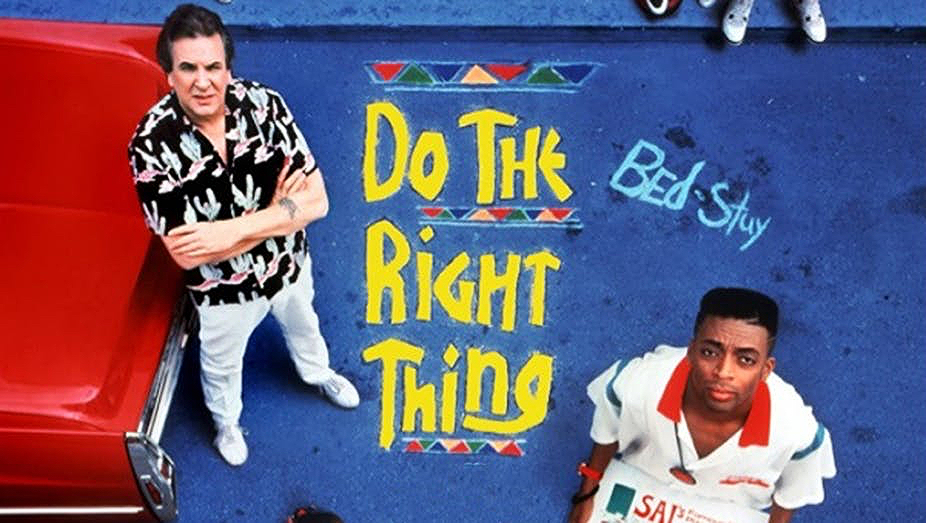
I am one of the many columnist-critics who regard Spike Lee‘s Do The Right Thing as one of the finest films of the ’80s. I have it ranked sixth on my current ’80s roster. I decided that the instant that Mookie threw that garbage can through Sal’s Bed-Stuy pizza parlor window. It therefore comes as no surprise to me or anyone else that World of Reel‘s Jordan Ruimy announced yesterday that Do The Right Thing was the #1 choice among over 200 critics.

If this or that critic insists that Lee’s film is the best of the Reagan decade, fine. Ditto others choosing Platoon or Local Hero or The King of Comedy or Prince of the City or Raging Bull. Or HE going with Risky Business. Whatever. But when you hear that Do The Right Thing topped “almost half the lists,” as Ruimy puts it, one can at least wonder why. Most of us agree that people (and especially critics) tend to judge films according to whatever cultural winds may be blowing at a given moment, and right now Spike’s 1989 film seems to fit right in.

Ruimy: “Lee’s film no doubt benefited from an abundance of relevance over the past year in a socially and politically tumultuous America dominated by racial issues.”

HE ’80s faves: Risky Business, The Hidden, Drugstore Cowboy, Raging Bull, Local Hero, Do The Right Thing, Crimes and Misdemeanors, Prince of the City, Blue Velvet, Platoon.

#11 through #16: Full Metal Jacket, Scarface, Thief, Lost in America, Die Hard and Aliens.

Skanky, Pre-Corporate Manhattan of ’60s, ’70s and ’80s

An assortment of clips from New York-centric films of the ’60s, ’70s and ’80s might suggest a portrait of grime, grit and squalor — a city that used to scare the shit out of tourists who dared to venture out of the Times Square area. But Jonathan Hertzberg‘s “Dirty Old New York” is not that. It’s mainly a portrait of old analog Manhattan — dicey-looking black dudes with big Afros, gas guzzlers, gaffiti-covered subway cars, dial pay phones, trash on those John Lindsay-Abe Beame streets, vinyl turntables, tube television sets, a co-residing Dustin Hoffman and Mia Farrow, 3/4″ video tapes, VCRs, etc. A nice time-trip thing, but I wouldn’t call it “dirty.” [Originally posted on 3.27.14.]

Never Managed To See It

I have a certain affection for films shot in Ultra Panavision 70 and Camera 65, processes from the ’50s and ’60s that yielded aspect ratios of 2.76:1. (They were technically identical or damn near.) Actually, there were 11 such films in all, but I only have a fondness for three — Ben-Hur (Camera 65), Mutiny on the Bounty (UP70) and The Fall of the Roman Empire (ditto).

I never got around to seeing Raintree County, which also was shot in Camera 65.

Bounty and Empire were shot by the great Robert Surtees, and the framings and lighting are quite elegant. Empire was shot by Robert Krasker (Odd Man Out, Brief Encounter, The Third Man).

I have no affection at all for Quentin Tarantino‘s The Hateful Eight, which squandered the UP70 potential by mostly shooting inside the darkly lighted Minnie’s Haberdashery.

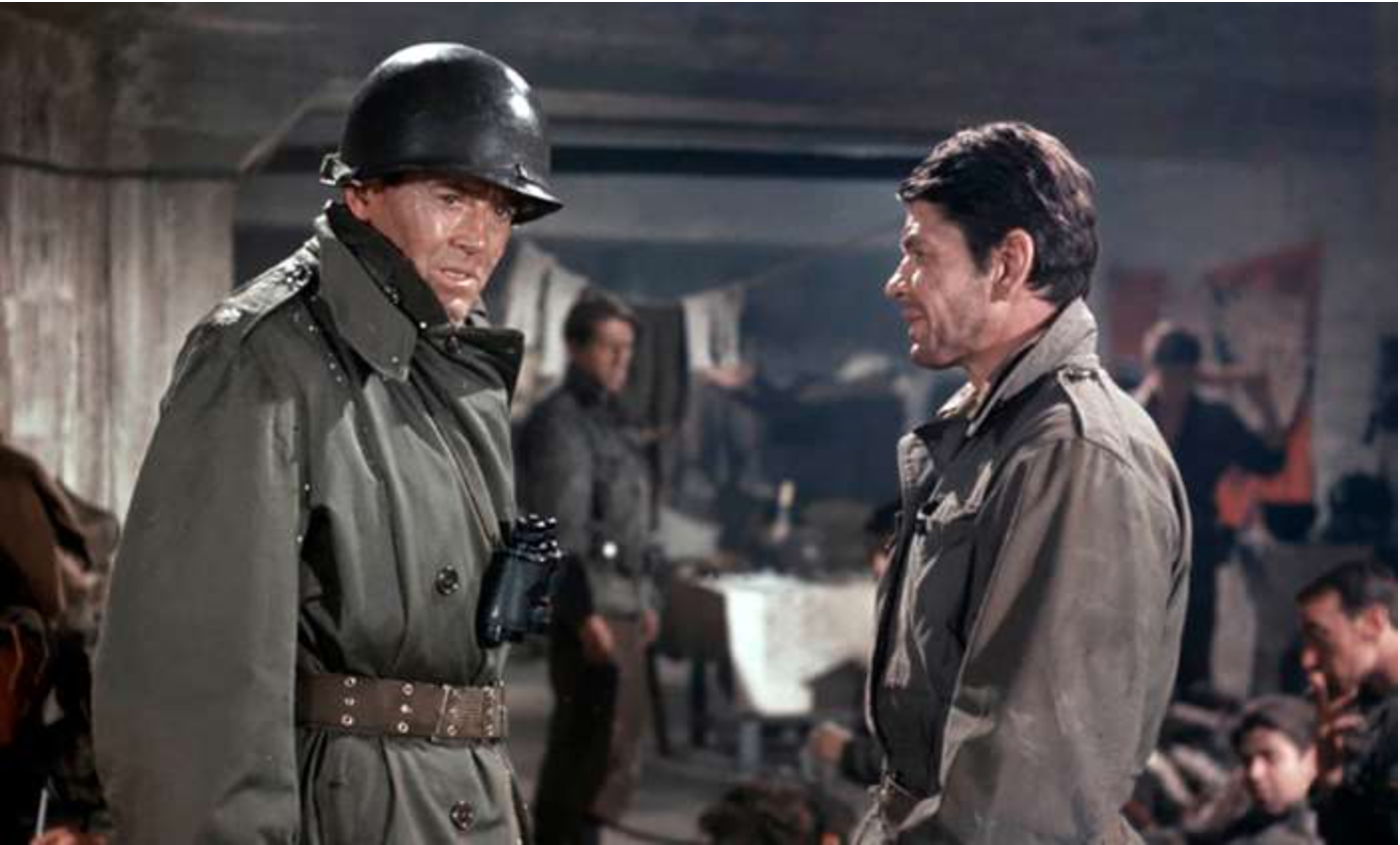
I’ve never seen Ken Annakin‘s The Battle of the Bulge (UP70, released on 12.16.65), and after watching this Smilebox trailer it’s possible I may never set the time aside.

The dialogue conveys stodginess, or what I would call an overdose of “officer-talk”. You can tell the whole thing smells. Any mid-’50s-and-after movie costarring Dana Andrews is something to be feared. German soldiers speaking German-accented English was outlawed after The Longest Day, but Annakin went there anyway. The Wikipedia page features a long list of historical inaccuracies. Dwight D. Eisenhower came out of retirement to denounce the film for gross inaccuracies. It was shot in Spain with little or no snow on the ground, and too many scenes feature the wrong kind of typography (I’ve been to the the Ardennes forest) and not enough pine trees.

Will Tarantino, “Taxi Driver” Follow Dr. Seuss?

Six Dr. Seuss books by Theodor Geisel (1904 – 1991) have been zotzed by the p.c. police.

Earlier today Dr. Seuss Enterprises announced the cancellation of “If I Ran The Zoo,” “And to Think That I Saw It on Mulberry Street”, “McElligot’s Pool,” “On Beyond Zebra!” “Scrambled Eggs Super!” and “The Cat’s Quizzer” because portions of said volumes “portray people in ways that are hurtful and wrong” by way of “offensive imagery.”

Everyone wants hateful images erased and hate speech squelched, but how aggressive and widespread will future cleansings be? And when will the dragnet extend to movies?

If there’s to be any consistency how can certain films that contain offensive content within a certain context — Martin Scorsese‘s cameo scene in Taxi Driver, for one, not to mention huge chunks of Quentin Tarantino‘s Django Unchained and portions of The Hateful Eight….how can these films be left alone while the legacy of Dr. Seuss is shamed and to some extent dismissed?

Friendo #1: “What’s weird is that under Obama Seuss was praised, understood and wildly appreciated. In 2021 not so much. I guess no one can really argue with this. Our culture has simply and dramatically changed where the past is no longer tolerated. Or understood.”

Friendo #2: “Ugh…I want to move to Neptune. Fortunately, those aren’t classic Suess titles, but still: Erasing the past is a Marxist-fascist paradigm. You don’t erase a work of art because of stereotypes. What’s next — erasing Taxi Driver because of Scorsese’s back-seat rant? This is madness.”

Friendo #1: “Yeah, good point.”

Friendo #2: “I think most liberal/progressives think that doing this is common sense — right in line with the idea of making blackface or the N-word verboten. They don’t seem to realize that this is book burning. You don’t erase the past. At least, not in a free society. I’m also outraged at the demonizing of Laura Ingalls Wilder.”

Friendo #1: “It’s really the corporations that buckle.”

Friendo #2: “The corporations love wokeness. Most of them are run by racists (i.e., the bro ‘libertarian’ fascists of Silicon Valley), but wokeness has turned out to be the greatest means of dividing and conquering their workers, and controlling their every move, that has ever been devised.

Robin DiAngelo isn’t a racial-sensitivity guru. She’s a highly paid, whip-wielding corporate disciplinarian who cloaks her control-freak ideology in race propaganda. It’s no surprise, really, that her latest book is an attack on white progressives. I have no doubt that she’s a closet Republican.”

Friendo #3: “Even Biden broke tradition by not mentioning Dr Seuss in his ‘Read Across America Day’ proclamation He’s woke! Or at least scared of the wokesters.”

HE: During last year’s election campaigns I was nursing an idea that wokesterism and cancelling might begin to ease when Trump is finally gone. Now I’m not so sure.”

Meghan & Harry Thing

Who in this country constitutes the core rooting audience for the Meghan and Harry show? Who cares? Not guys, I’m presuming. Late teens to early 30something women? The same would-be TikTok and Instagram influencers who follow Taylor Swift, Kylie Jenner, Charli D’Amelio, Cristiano Ronaldo, Ariana Grande, Kim Kardashian, Selena Gomez, et. al.? I’m not getting what the thing is. Followers are hoping some of that residual British royalty aura might rub off?

When Meghan Markle and Prince Harry withdrew from their royal responsibilities in England and moved to this country, it was agreed they would no longer receive “sovereign grant” money and would earn professional income. Settled in Montecito, they’ve “founded their own production company” and “signed a multiyear deal with Netflix,” says Business Insider. Harry is worth between $30M and (according to townandcountrymag.com) $40M — an inheritance from Princess Diana plus an annual allowance from Prince Charles. Markle is allegedly worth around $5M.

I addressed Harry’s thinning thatch last fall — no need to go there again.

So Cuomo Will Resign…Right?

Remember the “creepy handsy kissy Joe” problem, which began to be a thing about two years ago? The recent accusations of overly intimate flirtation and touching on the part of Gov. Andrew Cuomo sound vaguely similar, perhaps with a the dial turned up a bit. Or not. What do I know?

The descriptions and complaints make Cuomo sound (emphasis on the “s” word) like many male politicians of a certain age, like alpha lions who like to subtly (or not so subtly) sniff, sample and paw their way through a room.

I’m wondering if Cuomo drinks. If so that could be a factor. Guys who’ve had a couple tend to be less restrained, more impulsive.

Either way it appears as if Cuomo is about to be Al Franken-ed. With every new accuser the pressure intensifies all the more. We know how this goes.

Message From Fairfield

Received today at 1:21 pm (Pacific): “Good afternoon, Jeffrey. I hope you and your family are doing well. I am reaching out to family members who have cremated remains in our care at Shaughnessey Banks Funeral Home. I found your contact information on your mother’s obituary from a few years ago. We currently have your brother Anthony’s cremated remains in our care. They came into our possession in 2010. Is there someone who would like to come and pick them up? — Brendan McKeon, Shaughnessey Banks Funeral Home.”

My brother’s ashes have been sitting in a box for 11 years and nobody said boo until today? If I was in the region I would drop by and suitably dispose. I could have sworn that I made arrangements after his passing (an accidental blend of swine flu, alcohol and Oxycontin) on 10.19.09. We were never especially “close”, but I attended a small farewell gathering of Tony’s friends at a Georgetown saloon.

When my sister passed from cancer in the spring of ’08 Tony and I scattered her remains into the Atlantic, right next to the Barnegat Lighthouse on Long Beach Island. My mother saw to my father’s remains when he died three months later. When my mom passed in ’15 I sprinkled her ashes around the Wilton Playshop, where she’d acted and directed in the ’60s and ’70s.

Tony was a good guy who fancied himself an X-factor prole. He was into healthy foods (wheat grass) and had excellent taste in films. He led something of a lonely life (no wife or girlfriend, no dog, no cat). The poor guy ran into a rough patch when the ’09 recession hit, Tony passed 11 and 1/4 years ago (10.19.09) in Georgetown, Connecticut.

Toy in the Attic

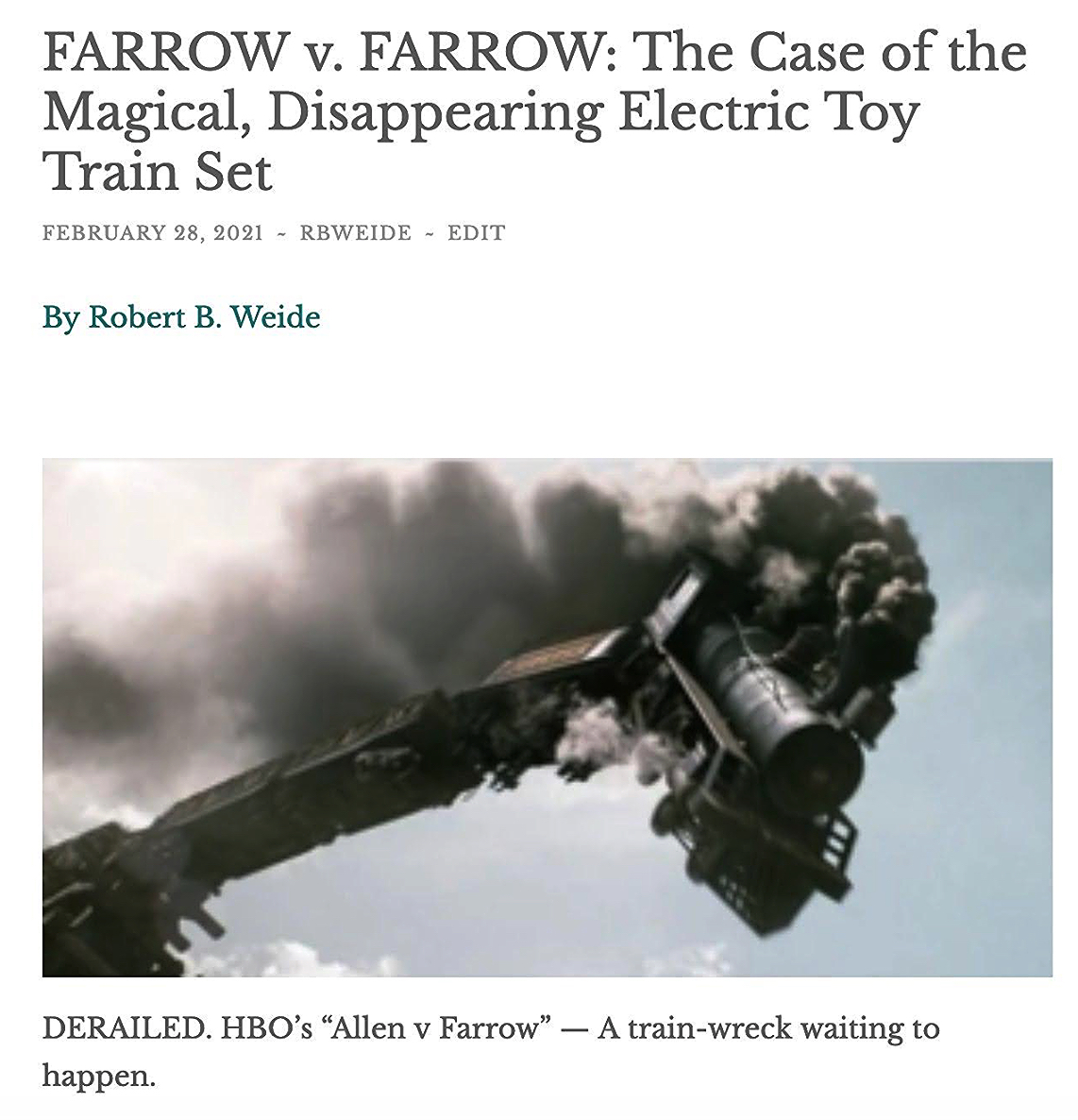
Yesterday a much-anticipated retort from Robert Weide, the documentarian and Curb Your Enthusiasm producer who’s been steadfastly defending Woody Allen in the years-long battle with the Farrows (Dylan, Mia, Ronan) over that allegation of child molestation on 8.4.92, appeared.

It deals with the alleged moving electric train set that Dylan described in some detail in a 2.1.14 N.Y. Times article, written by Nicholas Kristof.

Weide’s rebuttal surfaced concurrent with the airing of episode #2 of Kirby Dick and Amy Zeiring‘s Allen v. Farrow, a four-part series about same. On 2.22 or exactly a week ago, Weide accused Dick and Zeiring of either being “half-assed researchers” or “inherently manipulative and dishonest.” He pledged on Twitter that he would explain in due time.

The gist of Weide’s 2.28 argument, directly drawn from testimony from pro-Farrow nanny Kristi Groteke, who was working at Frog Hollow on the day of the alleged assault, is this: There was no electric train, moving or stationery, in the attic that day, but there was a non-electric plastic train toy — something for a two-year-old to push around and play with.

Does this constitute a ‘holy shit!” Perry Mason moment? No, but it does warrant a certain puzzlement.

Weide: “Dylan specifically recalls the train set ‘travel[ing] around the attic.’ Then why does the police diagram show the track having a circumference of only 4 feet at its widest? Maybe Dylan didn’t literally mean ‘around’ the attic, but around in a circle, in the attic? Maybe we should give her the benefit of the doubt here. But the question remains: was there such a functioning train set in that space? Moses says there wasn’t even an electrical outlet in the crawl space. So was the electric train battery-operated? Is there anyone who can untangle this conundrum at the center of Dylan’s accusation?

“In fact, there is.

“Kristi Groteke, a nanny in the Farrow household who was on duty that day, testified in the 1993 custody trial, Allen v. Farrow, from which the HBO series takes its title. Groteke appeared as a friendly witness for her employer, Mia Farrow, and was asked about the content of the attic during direct examination by Mia’s attorney, Eleanor Alter. This means Groteke’s answer would have been known by Mia’s defense team prior to questioning her on the stand. (This is the recollection of a 23-year-old woman, less than a year after the alleged event, versus a woman recounting her memories as a 7-year-old, 23 years after the fact.)

“When asked about the content of the crawl space, Groteke recalls [as follows]: ‘There are some pictures and there is a trunk where things are stored, and there is a train set which the children take out and play with sometimes.’ When asked to describe the set, Groteke replies, “They are big, heavy plastic, green tracks and they fit into each other like puzzle pieces, and the train is a train car that is made for a child to sit on and ride.’ Alter asks, “Have you ever seen the train set in any of the rooms?” Groteke: “Yes. I have seen it downstairs in the living room, but more recently in the past year in Mia’s room and in the children’s room, through the hallways.” Alter: “’So they take it out of the crawl space?’ Groteke: ‘Yes.'”

HE comment: In short, for whatever reason Dylan apparently invented the recollection about a toy train moving around the attic or travelling along an oblong-shaped train track. You can put this down to the occasional vagueness of memory. I would put it down to unnecessary invention, which makes the water seem a bit murky.

A discussion of the merits happened this morning between myself, Friendo #1 and Friendo #2:

Friendo #1: “This doesn’t feel like the smoking gun Weide promised. I had thought, reading his implication, that we were going to discover the police drawing was some sort of fake. He raises an interesting issue, in terms of the nature of the train set. It wasn’t some electric train spinning around; it was larger and plastic — a notable discrepancy. But if anything, his post does serve to confirm that there was some sort of train set in the attic.

Read more

Rushfield’s Golden Globes Riff

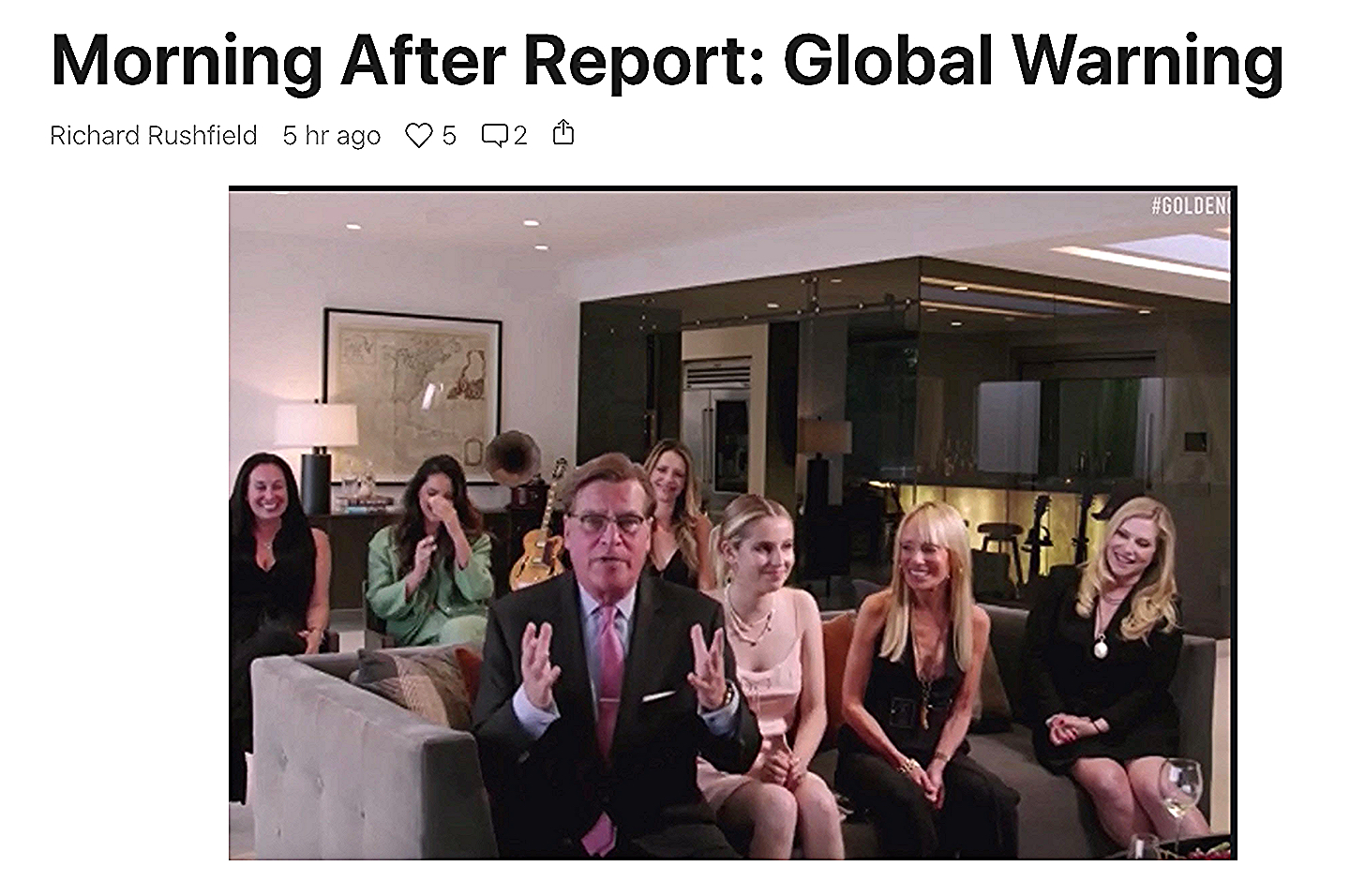
From Richard Rushfield‘s latest Ankler column, dated 3.1,.21 and titled “Morning After Report: Global Warning”:

“Not to get too maudlin and dramatic about it, but last night I felt like I was witnessing the death of Hollywood before my very eyes,” Rushfield writes.

Excerpt: “Hollywood’s awards circuit has always been interesting in that it shows the face that the industry wants to present the world. Glamorous! Caring! Creators of myths and spectacle! Good looking! Conscience of the world! You name it, as Hollywood’s vision of itself has evolved.

“Last night, at a moment in which the world is truly in enormous pain, the face of Hollywood was selfish, self-obsessed, small, petty and incompetent; thinking about itself, thinking about its causes, thinking about anything but what the audience might be looking for from its entertainers at this moment.”

HE to Rushfield: As you know, progressive Hollywood is riding a wave of woke evangelical fervor. Artists of color, LGBTQs, the #MeToo community and various supporters throughout the Twitterverse have grabbed the reins and are leading the San Juan Hill charge, and the goal they’re pursuing — the hill they’re looking to conquer and plant their flag upon — is nothing less than the transforming of American society into a better, more open-hearted, less Republican, more compassionate and forward-looking place.

Well, not American society as a whole but the upscale, moderate-minded urban blues — those who are theoretically capable of modifying their thinking and social behavior.

In a certain sense it’s a myopic realm that progressive Hollywood is operating out of, and at the same time they’re reaching out and looking to touch people where they live. “Entertaining” Average Joes is what a good portion of the streaming and theatrical industry is still trying to do. But this, by and large, is not what the award-season community is focused upon.

Friendo: “I don’t know if you’ve seen Richard Rushfield’s Ankler column this morning, in which he basically calls last night’s Golden Globes the Worst Thing Ever, the Death of Hollywood, and other crimes against humanity.

“I watched the Globes and thought they were fine. They were the COVID-era Globes — no more, no less. That’s why they were what they were. Should they have been cancelled (as Rushfield apparently seems to think)? No. That would have been dumb. Better a compromised show and a compromised Oscars, than giving up the ghost.

“And I thought it was interesting — actually rather humane — to see a bunch of glamorous showbiz folks try to put on a glitzy awards ceremony on Zoom.

“Why was this a disaster? It’s Covidthat’s the disaster, for Chrissake.

“Rushfeld is having his cake and eating it too. ‘The Globes don’t matter! No one takes them seriously!” So is it okay if they go on? No! It’s a fatal compromise! It’s the end! Of everything!’

“The subtext of his columns is that he wants all this stuff to die. He’d deny it, but it’s there.”