Neeson vs. Cartel Psychos

As noted on 12.2, Paul Greengrass‘s News of the World (Universal 12.25), George Clooney‘s The Midnight Sky (Netflix, 12.23) and Eduardo Ponti‘s The Life Ahead (Netflix, now streaming) share a basic plot. Which is…

A crusty, grizzled protagonist of advanced years and precarious positioning (Clooney’s Augustine Lofthouse, Tom Hanks‘ Captain Jefferson Kyle Kidd, Sophia Loren‘s Madame Rosa) is suddenly responsible for the well-being of an anxious, distant, shell-shocked youth who needs comfort and direction, and maybe a bit of love.

Now comes a fourth — Robert Lorenz‘s The Marksman (Open Road, 1.22), about a grizzled 60ish fellow (Liam Neeson) trying to help a young migrant boy get to his family in Chicago after his mother is killed by drug cartel baddies.

You Only Live Once

A one-time-only meeting between Sophia Loren and Elvis Presley happened at the Paramount Studios commissary in February 1958. Both were 23 at the time. Loren, born on 9.20.34, was four months older than Elvis, who began life on 1.8.35.

Loren was shooting Melville Shavelson‘s Houseboat (11.19.58) with costar Cary Grant, with whom she’d had an affair a year earlier during the filming of Stanley Kramer‘s godawful The Pride and the Passion. Presley was making Michael Curtiz and Hal Wallis‘s King Creole, which would hit screens only five months later (7.2.58). He began his two-year term in the Army on 3.24.58.

Presley’s life ended tragically on 8.16.77, at age 42.

Three months before Presley’s passing Ettore Scola‘s A Special Day, in which Loren gave one of her most respected performances, premiered at the Cannes Film Festival. It played at the New York Film Festival in September ’77, and opened commercially the following month.

Loren, 86, is currently starring in Eduardo Ponti‘s The Life Ahead (Netflix),

Barack Picked ‘Em?

A year or two ago a journo pally confided a belief that Barack Obama has an assistant who assembles a best of the year list, and that he just signs off. Okay, maybe, but what’s preventing Barack from catching the same films that everyone else is seeing and having some opinions?

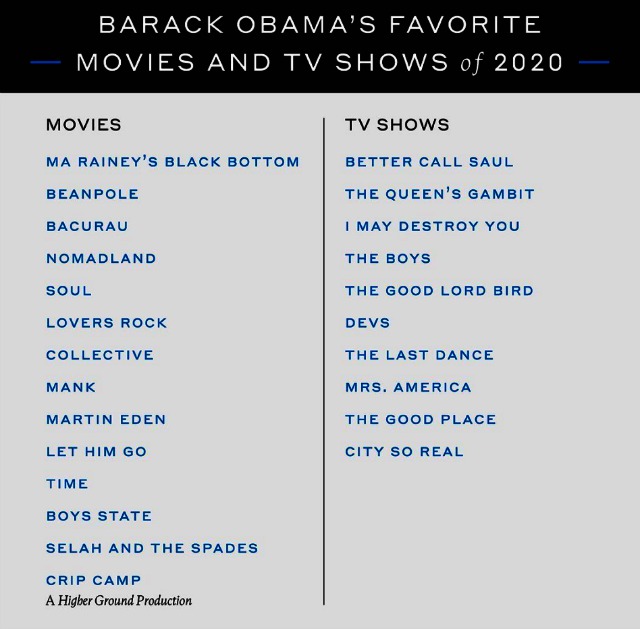
I was a little taken aback by his top five — Ma Rainey’s Black Bottom, Beanpole, Bacarau, Nomadland and Soul. (Nomadland is the only accessible goodie.) And placing Lovers Rock in sixth place under “Movies” means that unlike the view of Amazon management, Barack doesn’t regard Steve McQueen‘s “Small Axe” films as TV-level efforts.

How could he have left Mangrove off his list — maybe he hasn’t seen it? But at least he understands (as I do) that Alexander Nanu‘s Collective is one of the year’s finest.

Early Pandemic

Roughly seven months ago I watched Spike Lee‘s “New York New York” valentine video. Spunk and spirit, inspired by Covid hardships, “we’ll get through this together,” etc. Today the New York Film Critics Circle gave Lee a special award for it.

It’s decent enough piece but who was the camera operator? Because some of the shots aren’t exactly on the level of John Ford or Sergei Eisenstein. And may I ask what it was shot with? An iPhone, I’m presuming, but the footage looks a bit muddy. Maybe that was the intention, but for the most part iPhone video footage looks cleaner than this.

2020 NYFCC Awards Reckoning

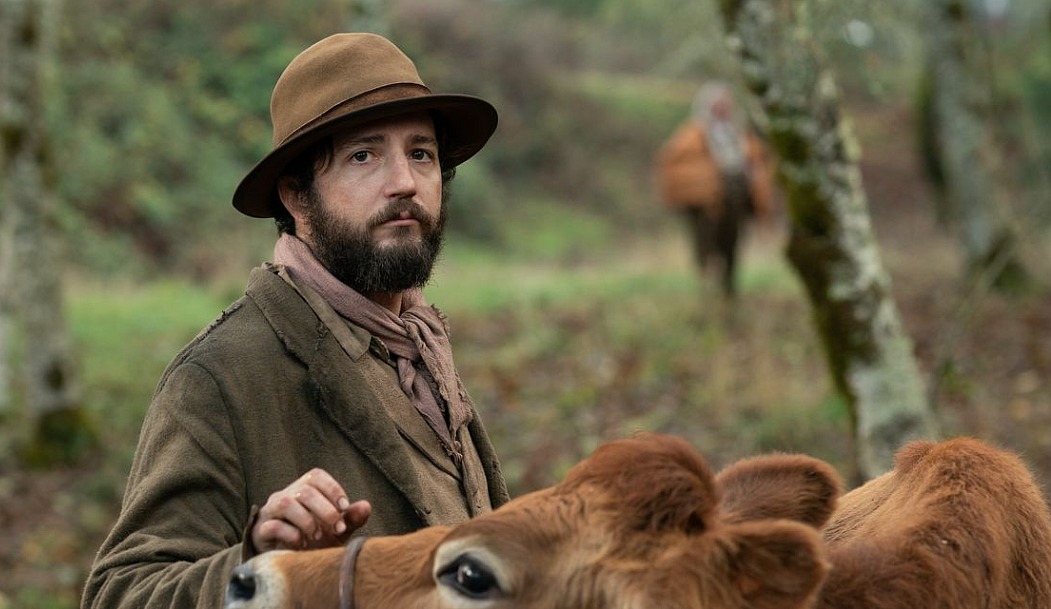
12:25 pm: Kelly Reichardt‘s First Cow, a commendable if vaguely irritating period drama set in 1820s Oregon, has won the NYFCC’s Best Film award. If this isn’t the most “what planet are these guys living on?” NYFCC award yet, I’d like to know what is.

For decades an occasionally offbeat NYFCC trophy signified something highly valued — a fully considered saluting of a worthy achievement by serious pros. But the woke-era NYFCC brand is something else. It used to be that the Los Angeles Film Critics Association was the loopiest award-giving group for their absurd mid-voting brunch breaks — the NYFCC has now overtaken them.

HE would have voted for Mangrove (despite Amazon’s decision to focus on Emmy awards), Nomadland, The Trial of the Chicago 7, The Father, Mank…each delivers a stronger, more levitational viewing experience than First Cow.

Excerpt #1 from HE’s First Cow review: “Do you see what I mean about watching a Reichardt film? She can’t even indicate whether or not Cookie and King Lu are gently sexual with each other or just palsy-walsy. (Skeletons holding hands doesn’t count — the dying King Lu may have simply reached for Cookie’s hand out of a primal fear of death.) She can’t devise a conversation between them in which the pair, feeling antsy about the thievery, go to Toby Jones and suggest that he might want to fund them in a start-up bakery business. She can’t show the guy with a rifle actually shooting Cookie or, more to the point, King Lu. Because if King Lu takes a bullet it would therefore make sense when he lies down next to Cookie and dies.”

Excerpt #2: “And yet the things that happen in a Reichardt film never feel movie-fake. Her stories might feel a tad confusing or under-explained, but I’ve never had believability issues. She has a certain low-key way of shooting her material, and always takes her time and yaddah yaddah. But as I watched First Cow (I actually watched it in three stages) I felt my soul draining out of me like sand. First Cow never comes to you — you have to come to it, and with the patience of Job.”

12:03 pm: Sidney Flanigan, who movingly portrayed a traumatized rural teen trying to obtain an abortion in Never Rarely Sometimes Always, has been handed the NYFCC Best Actress award. In a certain fashion Flanigan played the under-written “Autmun” to the hilt, and I’m not dismissing the solemnity or scope of her performance — it’s one of the saddest female turns ever, certainly over the last 20 years. But this strikes me as yet another manifestation of NYFCC eccentricity. I would have approved of Nomadland‘s Frances McDormand taking the prize. Or (my personal choice) French Exit‘s Michelle Pfeiffer. Or Promising Young Woman‘s Carey Mulligan. Or Pieces of a Woman‘s Vanessa Kirby. Or The Life Ahead‘s Sophia Loren as a career achievement tribute. Any of these.

11:32 am: Earlier this morning the NYFCC handed their Best Foreign Language Feature award to Kleber Mendonça Filho‘s Bacurau, an allegorical modern-day Brazilian western (Sam Peckinpah meets El Topo‘s Alejandro Jodorowsky). I hated Bacarau when I saw it at the 2019 Cannes Film Festival. Andrei Konchalovsky‘s brilliant Dear Comrades! should have won.

11:15 am: Eliza Hittman, director-writer of Never Rarely Sometimes Always, has won the NYFCC’s Best Screenplay award. Critics have been creaming over this melancholy abortion-driven drama all year long, but I happen to feel it’s underwritten as far as Sidney Flanigan‘s Autumn character is concerned. She’s so traumatized and self-suppressed that she can’t let go (except during that deeply touching scene in which she’s questioned by the abortion clinic lady). I’ve always felt that this was dramatically insufficient. I respectfully disagree with Hittman’s “less is more” aesthetic. Plus Never Rarely Sometimes Always, a good film within its own perimeter, doesn’t hold a candle to Cristian Mungiu‘s 4 Months, 3 Weeks and 2 Days.

11:03 am: Nomadland‘s Chloe Zhao has won the NYFCC Best Director award. Expected, no dispute, completely deserved.

10:47 am: Sorry for overlooking the NYFCC giving their Best Supporting Actress trophy to Maria Bakalova, for Borat Subsequent Moviefilm. She was engaging in that Borat sequel and yes, she helped to punk Rudy Giuliani but c’mon…this is pure eccentricity, pure organizational egotism on the part of the NYFCC. The Father‘s Olivia Colman or Mank‘s Amanda Seyfried should have won. Or Yuh-jung Youn in Minari for her colorful grandma. Or even Glenn Close‘s “Mamaw” in Hillbilly Elegy.

10:40 am: Delroy Lindo was won the NYFCC Best Actor award for his anxious, anxiety-torn performance as a Trump-supporting Vietnam veteran in Spike Lee‘s Da 5 Bloods. Lindo acted that part all to hell and he has a strong narrative on his side, but I would’ve voted for The Father‘s Anthony Hopkins. You know who was really good and hasn’t gotten much awards attention? Ben Affleck in The Way Back — a solid performance about a guy struggling with alcoholism and his own glorious past.

10:05 am: The New York Film Critics Circle has given its 2020 Best Supporting Actor award to the late Chadwick Boseman for his performance in Spike Lee‘s Da 5 Bloods. Boseman played a ghost and a memory whose name in life was “Stormin'” Norman Earl Holloway. You can call this a combination career tribute and shared grief award. The award essentially says “our hearts were broken when we lost this good and glowing actor to cancer last August, and this is our way of saying we love him and wish he was still among us.”

I understand the sentiment and share the sadness, but I also think it’s fair to ask if Boseman would’ve won for his performance had he lived. When the late Peter Finch won the 1976 Best Actor Oscar for his Howard Beale performance in Network, there were no post-win surprises or tut-tuts — Finch had hit a grand slam and everyone knew it. Ditto Heath Ledger when he won a Best Supporting Actor Oscar for his Joker performance in The Dark Knight. Plus the NYFCC is a highly eccentric awards-bestowing group. They’ve shown that to be the case many times over.

If it had been my call I would have suggested handing Boseman a sorrowful special career-tribute award, and then given the Best Supporting Actor trophy to, say, Bill Murray (On The Rocks) or one of the One Night in Miami guys (Leslie Odom or Aldis Hodge), or Trial of the Chicago 7‘s Mark Rylance or Sacha Baron Cohen. Or Nomadland‘s David Straitharn.

Misheard Rock Lyrics (cont’d)

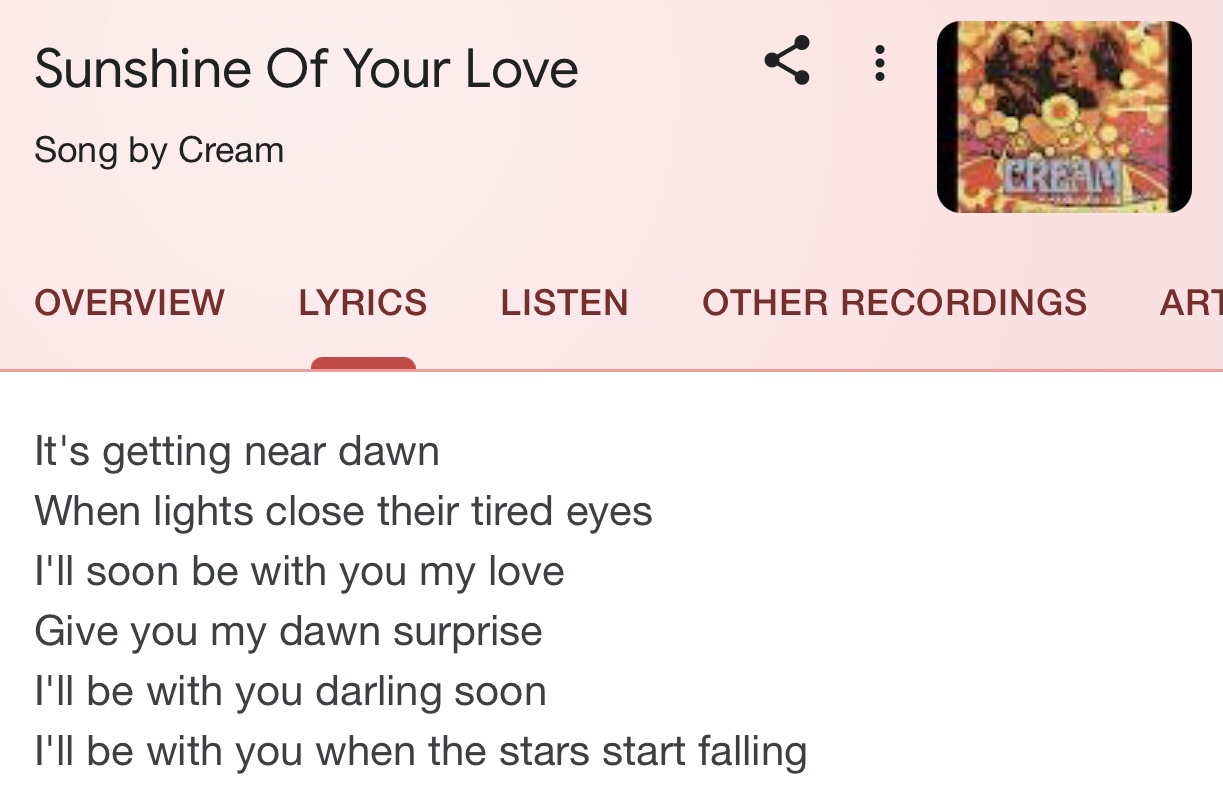
I’ve been singing “Sunshine Of Your Love” all my life, and in so doing I manage a decent Jack Bruce impersonation. I’ve been singing it with friends, in the car and in the shower for decades, and when I come to the fourth line I’ve always sung “give you my dog’s surprise.”

A dog being surprised by anything is a superfluous notion (dogs live in a constant state of surprise and stimulation) and certainly inconsequential in the light of any kind of cosmic perspective, but I can’t change now — gotta be “dog’s surprise” until my dying day.

No Mercy For The Prisoner

After reviewing Frank Marshall‘s How Can You Mend A Broken Heart, I was seized by the idea of finding a replica of my old “Death to Disco” T-shirt, which I wore in ’77 and ’78. It would be cool to re-wear it, I decided, because the issue was settled 40 years ago.

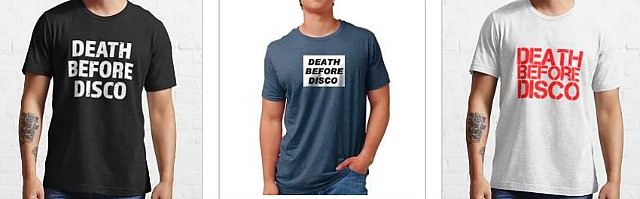
But all I could find online were T-shirts that say “Death Before Disco.” Which is totally the wrong sentiment as it more or less translates into “I will gladly accept death before dancing on a disco floor.” Which is analogous to the classic Tale of Two Cities line, “Tis a far, far better thing that I do than I have ever done; it is a far, far better rest that I go to than I have ever known.”

The proper sentiment should be a sentence handed down by a judge — “I sentence thee, disco, to death for having temporarily killed rock ‘n’ roll….say your prayers now for the sentence will be carried out immediately.”

Restoration Saga

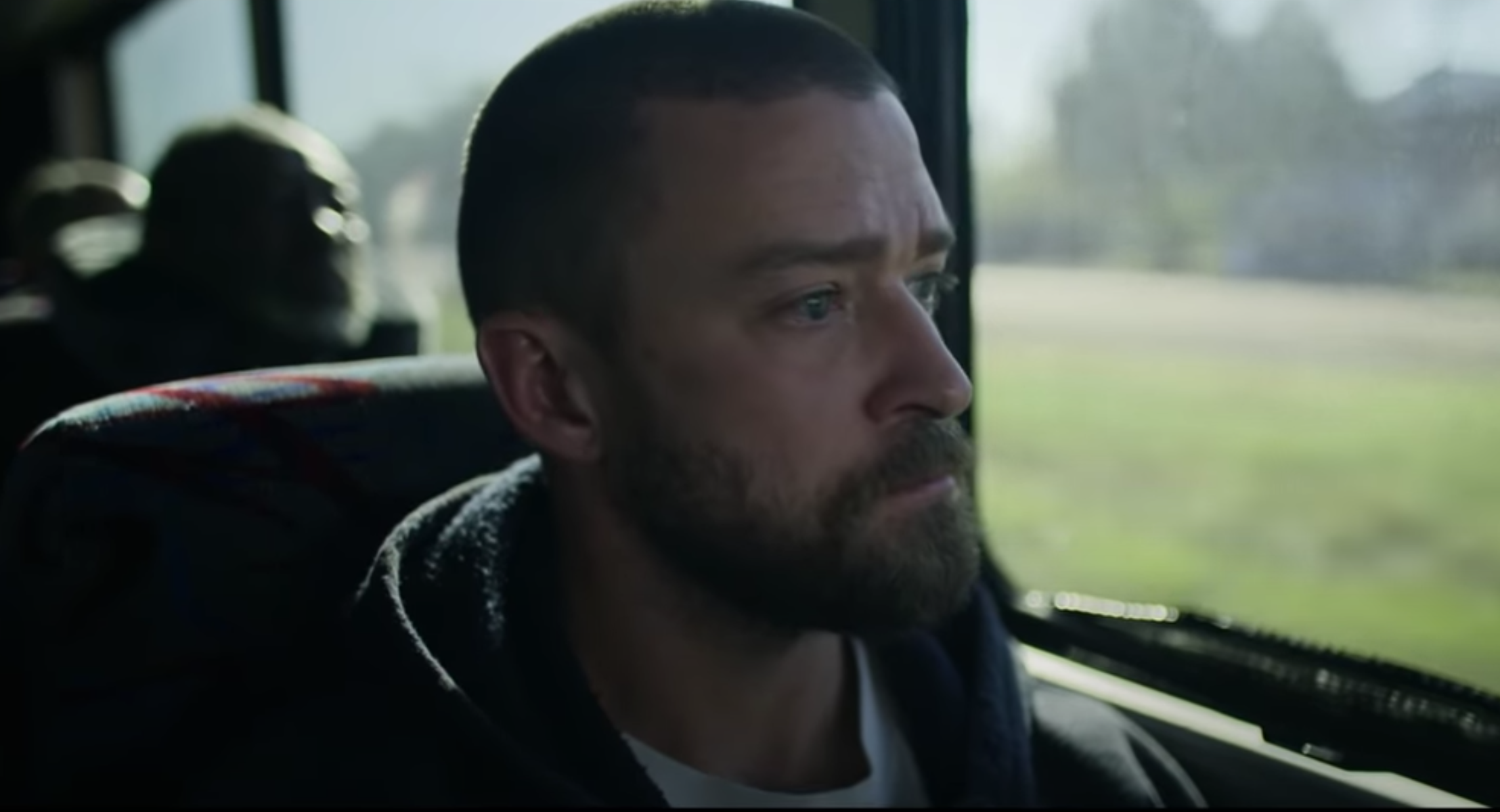
Given what it obviously is, Fisher Stevens and Justin Timberlake‘s Palmer (Apple, 1.29) has the right kind of attitude. Or so it seems. Timberlake (who hits 40 on 1.31.21) as a former high school football star who returns to his small podunk hometown after serving a 12-year sentence for…who knows? Moves in with mom (June Squibb) and forms an unlikely friendship with Sam (Ryder Allen), a young effeminate lad who lives next door. You can see where it’s going in a flash.

Truly Sorry

If I’d been in Times Square during last night’s snow storm, the idea of peddling around on a bicycle would’ve never crossed my mind. I would’ve just tramped around in my snow boots, scarf, silken long johns, three T-shirts, sweater, gloves and thermal hoodie. I hate what Times Square has become, but what a thing to miss out on. What a moment.


Times Square during great blizzard of December 1947.

ditto

Read more

No Award Season For Anti-Wokester Sourpusses

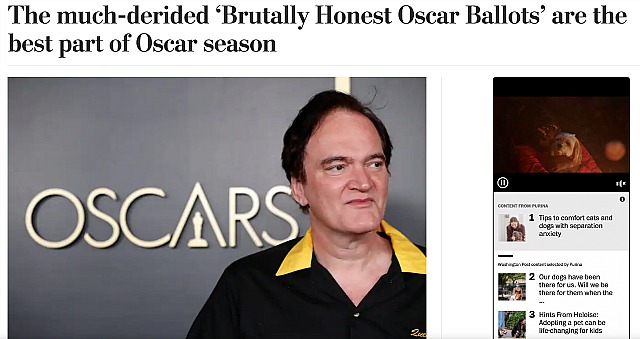
If you’ve ever read any of Scott Feinberg‘s “Brutally Honest Oscar Voter” columns, you know that a lot of Academy members are, to put it gently, stubbornly resistant to what could be described as present-tense, finger-to-the-wind, representational snowflake currents.

If you wanted to be dismissive you could call them woke-indifferent, under-the-radar scowlers. As in unenlightened, incurious, living in their own foxholes, “I miss the ’70s”, somewhat resentful, “I’m from Missouri,” “everything sucks,” etc.

They’re not lacking in talent or intelligence or love for movie lore, these people, but they do seem irked by the social justice warrior syndrome…to processing all the contenders with a carefully calibrated woke filter. They like what they like and respect what they respect, but they sometimes vote for films that the wokesters despise (i.e., Green Book) and thank God in heaven for that.

God Herself howled in triumph, trust me, on the night that Green Book won and Spike Lee turned his back. And She beamed with delight when Get Out was blown off.

There are, of course, many other Academy members who see things differently. Particularly the newly added internationals who voted overwhelmingly for Parasite + the New Academy Kidz who hate anything that smacks of OLDER WHITE GUYS and are always thinking “let’s give actors and filmmakers who aren’t part of the older-white-guy, Spielberg-stamped network a chance.”

But based on those “Brutally Honest” confessionals, a good percentage of Oscar voters and guild members don’t think like…well, any of the elite critics and Oscar-watching columnists.

It’s like Clayton Davis, Eric Kohn, Justin Chang, Tom O’Neill, Robbie Collin, Manohla Dargis, Angelica Jade Bastién, Steve Pond, Erik Anderson, David Ehrlich, Alison Willmore…it’s like the wokesterati and SJW banner carriers live on one planet, and the people who actually work in the film industry and vote for Oscars (and Emmys and guild awards) live on another.

Do certain tastes and preferences overlap? Yes, of course, but generally speaking very few….I should say almost no critics or columnists seem to live, think and breathe like the rank and file. Put another way, very few critic-columnists dare to think and write like stubbornly independent foxhole contrarians. Because to do so would mean (and this is crucial) not getting hired by the editors and publishers who are also living in fear of the Khmer Rouge…who are white-knuckle terrified of offending the comintern.

Bottom line: If you want to be survive in the film-assessing, Oscar-covering journalistic world of 2020 and ’21, you must play along with the wokesters. Or at least pretend to play along. Which is why almost everyone is more or less singing the same tune.

Except, that is, for Hollywood Elsewhere (i.e., myself) and a few others out there. That’s right…HE and very few others stand alone. Alone against the wind and the herd.

Read more

In So Many Words

[Posted in 6.14.19 comment thread for “And I Knew When I Got There…“]

In the opening voice-over, Tommy Lee Jones‘ Sheriff Bell speaks about decency, trust, values, tradition. About how previous generations of Texas lawmen had behaved and held their end up and handled their jobs with due diligence. And about a kind of feral madness in the land that, to Bell’s dismay and confusion, has begun to manifest.

The dream Jones tells his wife about at the finale is a bookend — a return to this meditation. The trust and affection he felt for his father and the values he lived by — knowing without being told that his dad was riding on ahead to find a camping spot and build a fire. Jones longs for that history, that sense of assurance and steadfast character in daily life.

“And then I woke up,” Bell says, finding himself in the present with the spreading malice and madness of the Anton Chigurhs and a moral or spiritual atmosphere that will one day embrace even worse things, including the monster that is Donald Trump.