Compassionate Seed Pods

HE to Journo Pally: You know what’s going on out there. You know how p.c. knee-jerk spitballing is baked into the default mindset of at least some Gold Derby handicappers. That or they’ve been terrorized into thinking that way. I talk about possibly gathering together an alternative attitude fraternity that might not fall into line with quite the same willingness and p.c. obsequiousness, and you put me down for that?

Journo Pally to HE: If you were a driver heading into the wrong lane of the Malibu Canyon tunnel, I’d stop you. If you were a neighbor whose house was on fire, I’d hand you the water hose. If you reported to me at [a publication], I’d steer you toward writing about film and television…writing that called upon your vast reservoir of knowledge, your passion, intellect, savvy — and away from your darker impulses.

There’s a way to have fun, serve your readers and steer a sober, responsible business course. There are ways for you to embrace the changes of our times, to highlight the incredible talents in every creative category of filmmaking, celebrate filmmakers from around the world and in every corner of our country. That’s a much better use of your time and a much better business strategy than [your] Straight Shooters idea.

You wrote a column a while back about reflecting on your life, your feelings, about turning over a new leaf. Do that. Lay down your weary tune. Turn on your love light. Get with the program.

HE to Journo Pally: Wow, thanks. I agree with the positive thrust of the message, but — don’t take this the wrong way — you also sound a bit like Dr. Kauffman trying to persuade Kevin McCarthy‘s “Miles” to relax and let the seed pods take over.

Dr. Kauffman: Less than a month ago, West Hollywood was like any other town. People with nothing but problems. Then out of the progressive community came a solution. Seeds drifting through space for years took root in a farmer’s field. From the seeds came pods which had the power to reproduce themselves in the exact likeness of any form of life.
Miles: So that’s how it began…out of the sky.
Dr. Kauffman: Your new bodies are growing in there. They’re taking you over cell for cell, atom for atom. There is no pain. Suddenly, while you’re asleep, they’ll absorb your minds, your memories and you’ll be reborn into a simpler, purer world.
Miles: Where everyone’s a wokester?
Dr. Kauffman: Exactly. If you give in, tomorrow you’ll be one of us, and you can become the new Perri Nemiroff. You’ll be happier. You’ll smile all the time.
Miles: I love films by Roman Polanski and Woody Allen. Will I feel the same tomorrow?
Dr. Kauffman: [shakes his head] There will be no more need for Allen or Polanski or any other artist who hasn’t accepted the new reality.
Miles: No more watching J’Accuse or Rosemary’s Baby or The Pianist? No more Manhattan or Crimes and Misdemeanors?
Dr. Kauffman: You say it as if it were terrible. Believe me, it isn’t. We’ve all seen their films. They never last. They never do. Sardonic wit. Love and desire. Intrigue. Betrayal and facing evil. Without their films, life will be so much simpler, believe me.
Miles: You’re basically saying I need to stop fighting the idea that if I wasn’t a huge fan of Little Women, I’m a sexist who doesn’t get it.
Dr. Kauffman: Miles, if you didn’t like Little Women you are a sexist who doesn’t get it. Don’t you understand that?
Miles: I don’t want any part of it.
Dr. Kauffman: You’re forgetting something, Miles.
Miles: What’s that?
Dr. Kauffman: You have no choice.

Persecution Complex

Yeshua of Nazareth: “Eli, Eli, lama sabachthani?” (aka “My God, why hast thou forsaken me?”)
God to Yeshua: “Don’t take it personally, bruh. I’m not forsaking you. I’m just dealing impartial cosmic cards. Table stakes. It happens. Roll with the punches.”

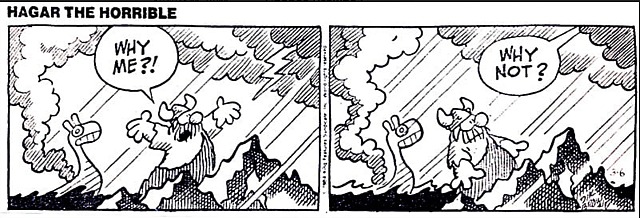
Chance Browne, a renowned Fairfield County cartoonist and musician as well as an HE friend for decades, is the son of the late Dik Browne, who created two hugely popular comic strips, Hi and Lois and Hagar the Horrible. Chance recently noted with some pride that a legendary Hagar illustration sits on Joe Biden’s desk

Chance: “In Joe Biden’s 2017 memoir (‘Promise Me, Dad‘) he writes that his father gave him the ‘Why Me? Why Not?’ Hagar the Horrible comic strip as an inspiration to get him through some tough times. It’s been on his desk for 25 years now.

“The day after Joe selected Kamala Harris to be his running mate, a photo appeared online of Biden FaceTiming with Harris. Right behind his laptop the ‘why not?’ Hagar strip can be seen in a gold frame.

“The day was August 11, which was my Dad’s birthday. I know that he and my mom would have been so proud to have our lovable Viking be inspirational to the man who will work to save our country from [toxic Trumpism].”

HE response: “Love the Biden endorsement factor, although I’m still not fully understanding the meaning of ‘why me? Why not?’ Or maybe I do understand it and it’s bringing me down.

“The thought seems to be ‘why am I so unlucky or why does everything happen to me or why am I going through such a hard time?’ And the cosmic response is ‘why not? Some people are unlucky or destined to endure a difficult path. We all know life is unfair and that God randomly decides who will suffer and who won’t so don’t fight it…just roll with the fact that your life is going to involve a fair amount of suffering, not because you’re a bad person but because you drew an unlucky lottery number.’

“What I don’t understand is, how was this message comforting to Joe Biden? How did an awareness of the cold and brusque impartiality of fate get him through some of his rough patches?”

Those Four Years

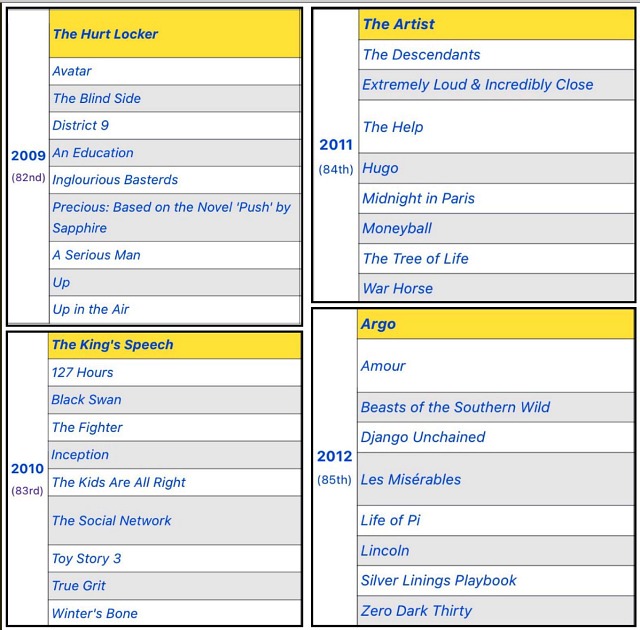
Earlier today Rory h asked “what’s the absolute worst film to get a Best Picture nomination since the category was expanded? Extra points for picking one that isn’t Bohemian Rhapsody.”

Forget Rory’s perimeters — what were the least and most deserving Best Picture nominees in 2009, 2010, 2011 and 2012?

Least Deserving 2009 Best Picture Nominees: Precious, Based On The Novel ‘Push’ by Sapphire and Inglourious Basterds.
Most Deserving 2009 Best Picture Nominees: The Hurt Locker, A Serious Man, Avatar, An Education, Up In The Air.

Least Deserving 2010 Best Picture Nominees: Toy Story 3, The King’s Speech, Inception, 127 Hours.
Most Deserving 2010 Best Picture Nominees: The Social Network, Black Swan, The Kids Are All Right.

Least Deserving 2011 Best Picture Nominees: The Artist, War Horse, Extremely Loud & Incredibly Close, Hugo, The Help.
Most Deserving 2011 Best Picture Nominees: Moneyball, The Descendants, Midnight in Paris.

Least Deserving 2012 Best Picture Nominees: Life of Pi, Django Unchained, Les Miserables, Lincoln.
Most Deserving 2012 Best Picture Nominees: Zero Dark Thirty, Silver Linings Playbook, Amour, Argo, Beasts of the Southern Wild.

Creative Huddle

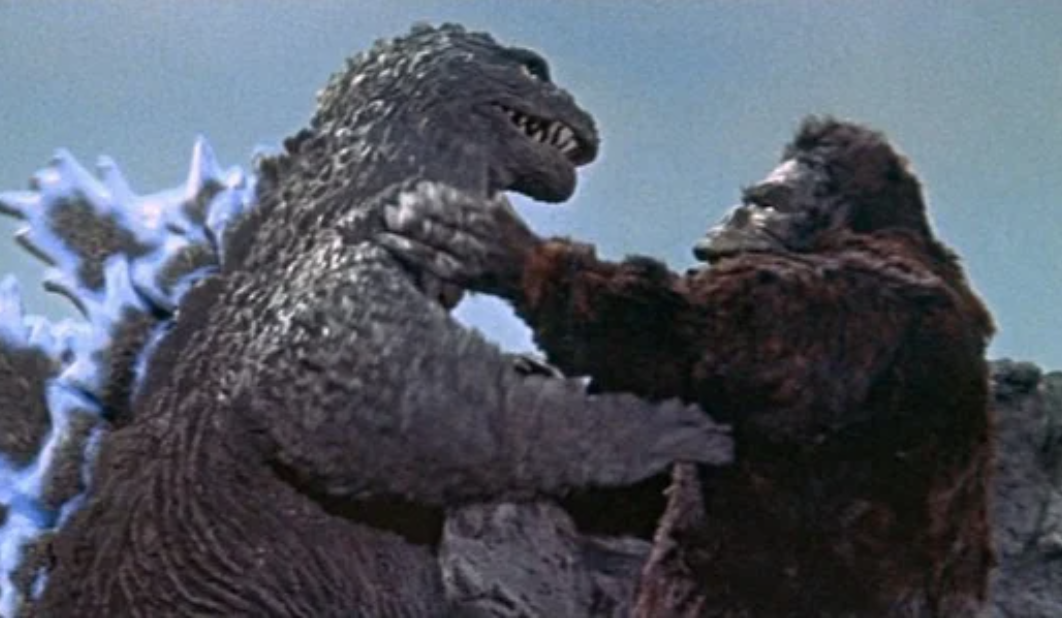
Just a reminder that Adam Wingard‘s Godzilla vs. Kong, which wrapped almost a full year before the pandemic enfolded everything and everyone last March, is still planning to open on 5.21.21. Pic stars Alexander Skarsgård, Millie Bobby Brown, Rebecca Hall, Brian Tyree Henry, Shun Oguri, Eiza González, Jessica Henwick, Julian Dennison, Kyle Chandler and Demián Bichir.

Then again Dr. Fauci said today that the world probably won’t be achieving a semblance of normal until 2022. The U.S. will have a vaccine in the next few months, he said, but there’s a chance a “substantial proportion of the people” won’t be vaccinated until the second or third quarter of 2021. Remember last spring (i.e., “the good old days”) when everyone was saying the pandemic probably wouldn’t start to lift until the late fall of ’20?


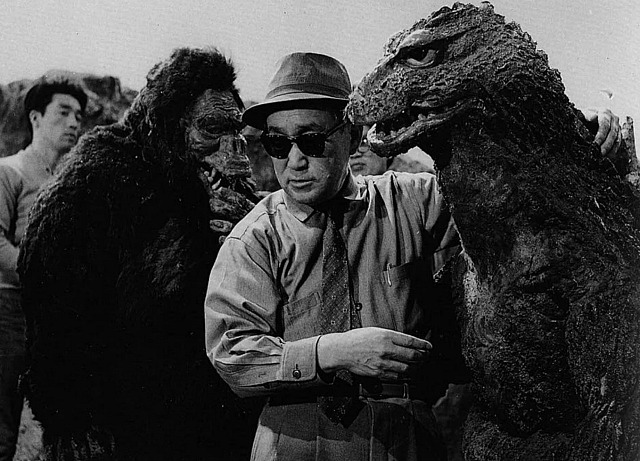
On the set of 1962’s King Kong vs. Godzilla, director Ishirō Honda confers with Shoichi Hirose (guy inside Kong suit) and Haruo Nakajima (guy inside Godzilla suit).

Where Is The Honor?

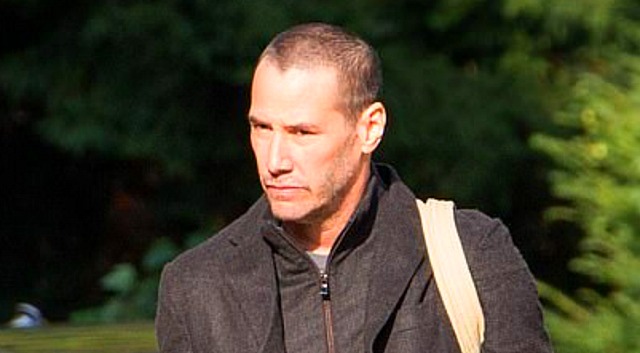
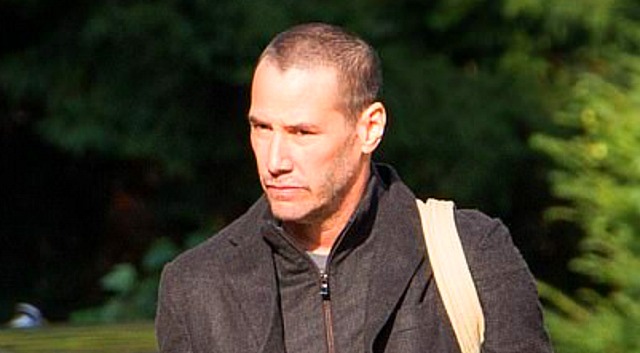
So Neo’s wearing a tennisball cut in Lana Wachowski‘s currently filming The Matrix 4. I realize I’ve never conveyed anything in the way of specific, adult-level reasoning, but there’s just something about a tennisball coif that rubs me the wrong way. Part of my concern in this instance is the fact that Keanu Reeves‘ follicles are a little too sparse.

And why make another Matrix movie at all? After the dual debacles of The Matrix Reloaded and The Matrix Revolutions, which opened and collapsed 17 years ago to moans of regret and embarassment, where’s the honor in dredging it all up again? What are the odds that the newbie restores even a fraction of the mystique of the original The Matrix, which opened on 3.31.99? I’ll never forget catching it for the first time at a commercial screening at the Beverly Connection plex. I came out levitating.

Keanu Reeves was 33 or 34 when The Matrix was filmed in ’98. The film suggested that he was 25 or 26, somewhere in that realm. Neo would therefore be in his mid 40s in The Matrix 4. I’ll allow that Reeves appears to be in fairly good shape these days. He’s lost that beefiness that he’s been sporting in the John Wick films. But he’s kept the scraggly whiskers.

Project Ice Cream began principal photography in San Francisco on 2.4.20. Shooting was halted on 3.16.20 due to Covid. Shooting resumed in Berlin sometime last August. The Matrix 4 is expected to open on 12.22.21.

Read more

Straight Shooters

There’s a movement afoot to launch a contra-Gold Derby Oscar Prediction chart, called Straight Shooters. The idea is to spitball the Oscars without the wokester filter — to resist the political stuff (or at least not to bow down in a kneejerk fashion), and to adopt a grounded and sensible ars gratia artis perspective.

Which would mean what exactly? Well, Straight Shooter members wouldn’t necessarily celebrate a film solely because it embraces POC, LGBTQ or woke female perspectives, although they might. Nor would they necessarily discount a film by an older white director or a performance by an older white actor or a film with a white-centric focus in general (i.e., Mank).

In a perfect incarnation, Straight Shooters would be about keeping wokester politics out of it, and letting the pure love of great films and exceptional film technique and world-class acting shine through.

People who may deserve to be Oscar-nominated wouldn’t be nominated strictly because of their ethnicity or gender or sexual identity. Or not be nominated for same. They would hopefully be championed or promoted because they’ve done excellent work. No one should be necessarily celebrated because of an absence of alignment with progressive causes, but at the same time a certain political ingredient or metaphor needn’t be a problem or an obstruction.

It could well turn out that most of the Straight Shooters might project Nomadland to win the Best Picture Oscar and Chloe Zhao to win Best Director. (As I currently am.) But they wouldn’t be required to support same because of Nomadland‘s subject or Zhao’s gender and ethnicity.

Straight Shooters would represent a symbolic unlocking of the handcuffs, and throwing off the politically correct ball and chain. People would be free to support who they want to support regardless of whatever p.c. points are involved. These estimations may in some instances (and perhaps more than a few) align with the predictable Oscar preferences of certain parties. Or not.

The point would be to judge films and performances as if it was 1988 or 1997 or 2005 or 2009 or 2014…to assess the best and the brightness without the demands or requirements of political correctness mucking everything up.

____________________________________

“The under-40 crowd has invested Race, Gender and Sexuality with a kind of cosmic significance. It doesn’t mean a lot to them — it means everything to them. Indeed, much of their conversation and writing seems to always come back to it.” — from “New Academy Kidz Aren’t Concerned With Whole Equation”, posted on 2.26.18.

McBride on Coming “Mank” Discussion

Received last night from Joseph McBride, author of “What Ever Happened to Orson Welles?: A Portrait of an Independent Career” (2006) and two other books about Welles; and cast member of The Other Side of the Wind:

“I am reserving judgment on Mank until I see it, as I always do with films. I am glad to know David Fincher and Eric Roth evidently have reworked Jack Fincher’s 1994 script, which was factually inaccurate about Orson Welles’ contribution to the screenplay of Citizen Kane.

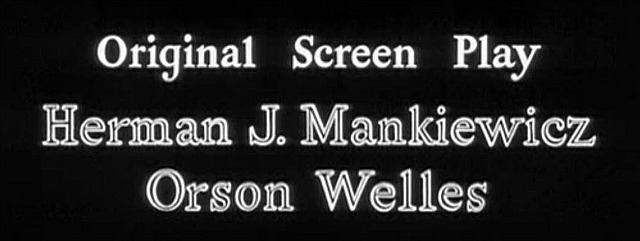
“Film historian Robert Carringer’s research into the seven drafts of the screenplay in his 1978 Critical Inquiry essay ‘The Scripts of Citizen Kane‘ — the kind of research Pauline Kael did not bother to do — proved that the screen credit is correct: ‘Original Screen Play / Herman J. Mankiewicz / Orson Welles.’

“However, I am dismayed that Herman’s grandson Ben Mankiewicz continues to be allowed by TCM and CBS to spread lies about the script, denigrating and minimizing Welles’s contribution. I guess they don’t have fact-checkers, but then the fabled New Yorker fact-checking department fell down on the job when the magazine published Kael’s article (‘Raising Kane’) in 1971.

“[Kael] called me the day it first appeared to discuss it, and I wrote a response in Film Heritage, ‘Rough Sledding with Pauline Kael.’ Andrew Sarris wrote that I was the first scholar to study Mankiewicz’s contribution in detail, in an appendix to my essay on Kane in my 1968 book ‘Persistence of Vision: A Collection OF Film Criticism.’

“I am very, very tired of writing about this controversy over the script credit, having done so for the last 49 years, and I hope I won’t have to do it again but am concerned that I may be doing so for another 49 years.

“My role in this mishegoss has always been to try to keep the historical record accurate, as Carringer and others have also done. Perhaps the final version of Mank will handle the matter fairly; at least I hope so. In the meantime, I refer readers to my essay on the subject, ‘The Screenplay as Genre,’ in the 2009 Harvard University Press book ‘A New Literary History of America’. edited by Greil Marcus and Werner Sollors, and to Carringer’s research on the subject.

Read more

Misses The Mark

HE: “This satirical ad makes some fairly astute points…’some’. But some of what she’s saying is really Trump Ugly. Mailboxes have been removed, etc. It’s basically saying that there’s a certain rhyme and rationale (and reasons that are not entirely crazy) for supporting an obviously ignorant and delusional liar and sociopathic bullshitter who winks at white racism, appoints corporate-level criminals and buccaneers and wealthy-donor idiots like Betsy DeVoss to cabinet positions, and who worsened the Covid crisis tenfold.

“It’s saying that because wokesters are Orwellian ogres and blacklisters (which they most certainly are), Trump isn’t so bad. And that’s fucking CRAZY.”

Journo pally who sent me the link: “In your world, yes. Not in mine. I am truly frightened by what is about to happen at the hands of the wokester left and you should be too. You are willfully ignoring the threat.”

Repeated Behaviors

A mentally challenged guy with a knife approaches some Philly cops, and ignores their orders to “drop the weapon.” Do they taze or otherwise overpower and cuff him? Of course not — they shoot him over ten times, sending him to God. Brilliant!

And now radical white wokesters and BLM rage hounds are back in the streets — burning cars, throwing rocks at cops, trashing small business, etc. Terrific!

If I were king I would stock and pillory the trigger-happy cops and wokester shitheads side by side, in urban neighborhoods across the country. I would also request good citizens to pelt them with rotten eggs, tomatoes and brown squishy bananas during lunch hour.

10.27 N.Y. Times story by John Hurdle: “The victim’s father, Walter Wallace Sr., urged looters to stop. ‘It will leave a bad scar on my son, with all this looting and chaos,’ Mr. Wallace said in an interview on CNN. ‘This is where we live, and it’s the only community resource we have, and if we take all the resource and burn it down, we don’t have anything.”

Read more

HE Advice Column on God, Love & Travel

As I have very little to lose now and life is about almost nothing except pain, disappointment, paranoia, betrayal and trap doors that can’t be trusted**, I will soon launch a modern HE version of Nathaniel West‘s Miss Lonelyhearts.

Well, not entirely but partly. A twice-weekly column about the glass-half-empty anguish of life, for starters. Plus recollections and laments, stories about being tortured as a child and as a student (tons of those!) plus advice to the genuinely lovelorn. Plus drinking stories, drug-taking stories, ex-girlfriend stories, satori stories, breakup stories, travel stories…everything that hurt before or which hurts now. And about things and places that I found bracing when I was younger (or as recently as last year). Plus wokester horror tales that will curl your hair. Plus answers to reader questions about how to handle the general horror or tedium of life.

It’ll be a twice- or thrice-weekly paywall thing along with a revival of good old HE Plus, which gave me so much agony in ’18 and ’19 that I had to put it aside. But I will start it again, and may God help me when I do.

** Aside from the daily joys of life with Tatiana, I mean.

Influence and Authorship

Alfred Hitchcock‘s Rebecca opened nationwide on 4.12.40. Orson Welles began filming Citizen Kane two and a half months later — on 6.29.40.

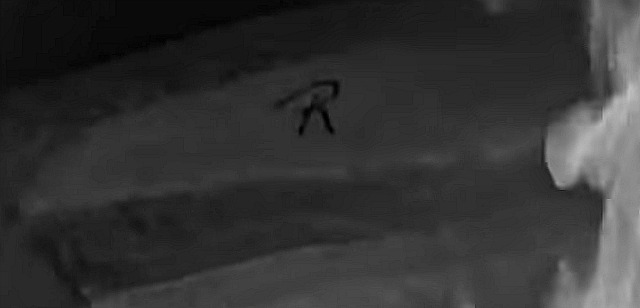
Rebecca ends with Manderley in flames and particularly a shot of Rebecca’s large elegant bedroom, and more particularly a closeup of a pillow with an R monogram…fuel for the inferno.

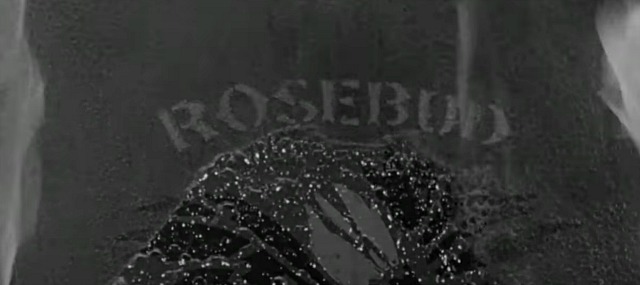
Citizen Kane ends with closeup shot of a small sled being engulfed in flames inside a furnace, with the name of the sled — Rosebud — front and center.

Both shots signify finality, the end of something mythical, lives and legacies up in smoke.

Is it really all that crazy to speculate that Herman Mankiewicz and Orson Welles, who no doubt saw Rebecca in the spring of ’40, were inspired to end their film with a close-up of something else being burned?

Wiki account: “During March, April and early May 1940, Mankiewicz dictated the screenplay, titled American. Welles re-wrote and revised an incomplete first draft given to him, dated 4.16.40, and sent it back to Mankiewicz. Forty-four revision pages dated April 28 were given to Welles. Mankiewicz and Houseman then delivered the second draft, bearing a handwritten date of 5.9.40, to Welles. Mank immediately went to work on another project for MGM.”

After seven complete revisions, the final shooting script for Citizen Kane was 156 pages.

No, I can’t remember if the original Mankiewicz script ends with a specific description of the camera going in tight and close on the name “Rosebud”. But even if it does, who’s to say Rebecca wasn’t an influence regardless?

Read more

The Old Kael-Mankiewicz Thang

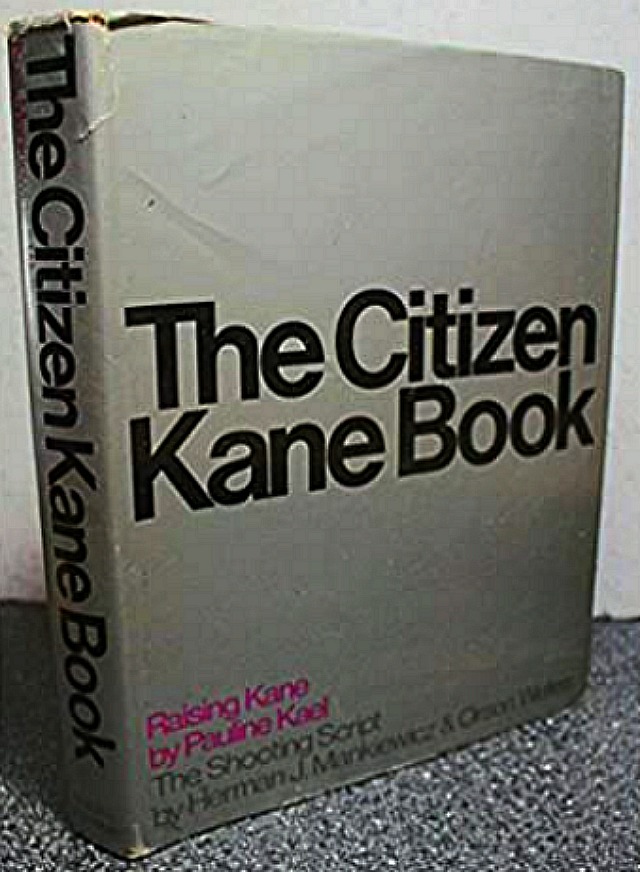
Everyone is familiar with the nearly half-century-old “Raising Kane,” a 50,000-word Pauline Kael essay about who really wrote Citizen Kane.

Partially drawing upon research by UCLA film professor Howard Suber, Kael sang the praises of screenwriter Herman J. Mankiewicz as the principal author of the Kane screenplay, and in so doing tarnished the contributions of director-cowriter and star Orson Welles.

Kael’s essay was later called into question if not discredited.

Two critics who’ve seen David Fincher‘s Mank (Netflix, 11.13), which is largely about the Manckiewicz-Welles relationship during the writing and making of Citizen Kane, are saying that the film revives the Kael view.

Mank “makes the implicit argument that Welles didn’t deserve co-screenplay credit,” says one. “This will unfortunately reignite the old Pauline Kael debate decades after she was rightly discredited for her shoddy research. The nearly 80-year-old argument that will never die, just slumber for years before being shaken awake again.”

The other critic agrees that Fincher’s film “does make that argument. But it’s called Mank and not Orson…I felt like [this] was okay in context.”

From a 2.28.16 Lou Lumenick N.Y. Post story, titled “My dad wrote Citizen Kane — not Orson Welles.”

“Orson Welles wrote ‘not one word’ of Citizen Kane,” insists a posthumous memoir by a son of the man who shared a Best Original Screenplay with the director of the 1941 classic.

Frank Mankiewicz — who was Robert F. Kennedy’s press secretary, ran George McGovern’s presidential campaign and co-founded what became National Public Radio — writes in ‘So As I Was Saying…‘ that his father, Herman Mankiewicz, agreed to a shared credit as a favor to Welles.

“The son strongly supports the findings of Pauline Kael, who famously minimized Welles’ contributions to the writing of the film in ‘Raising Kane’, a lengthy essay that originally ran in The New Yorker in 1971.

“Welles’ many biographers have disputed her conclusions, [which were] drawn largely from interviews with John Houseman and Rita Alexander, who helped Mankiewicz edit his overlong script.

Ben Mankiewicz on CBS: “The debate over who wrote Citizen Kane has been raging for decades. My grandfather had a long first draft. Welles condensed it. They shared the film’s only Academy Award, the Oscar for Best Screenplay.”