Dreary “Hearts” DVD

George Hickenlooper and Fax Bahr‘s masterful Hearts of Darkness: A Filmmaker’s Apocalypse (Paramount Home Video, 11.20) is one of the best making-of-a-famous-movie docs ever made, but the new DVD looks like a VHS tape. It could have looked much better if the original elements had been remastered, but Apocalypse director Francis Coppola, who narrates the DVD along with wife Eleanor, provided PHV with “the same 1″ inch tape that was used when they struck the materials for the 1991 videotape,” says Hickenlooper.
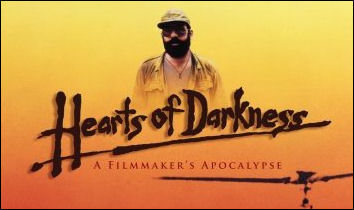
No remastering, tweaking or upgrading…brilliant! It’s almost 2008 with high-def video setting the hgh-end standard, and Coppola and Paramount Home Video have pooled their resources in order to give viewers an image consistent with video standards of 15 years ago.

DVD Beaver’s review says that “the quality is poor…parts of the documentary [are] dark and muddy since the footage was shot with 16mm cameras [and[ some scenes were shot or mastered on video. Plus “the raw footage that Coppola shot for his movie was un-restored (scratches, sprocket jumps, etc.), though scenes from the finished film look very good.”

DVD Talk’s review says “it’s aggravating that Paramount didn’t give the film a cursory touch-up…this 1.33:1 fullscreen transfer is only a step or two above my VHS copy of the film. The ragged, worn look does evoke the proper atmosphere, but the screens of text lack sharpness and often [and] the newer interview segments look flat and a bit washed-out…a very so-so transfer of a long-awaited title.”

“That Other Boleyn Girl”

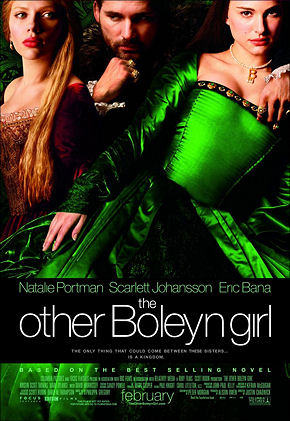
The Other Boleyn Girl (Sony/Focus, 2.29.08), based on screenwrirter Peter Morgan‘s adaptation of the historical novel by Philippa Gregory, is about a sort of romantic competition between Anne Boleyn (Natalie Portman) and her older sister Mary (Scarlett Johansson) for the love and allegiance of King Henry VIII (Eric Bana).

We all know which sister lost her head in real life. (Those of us with a high-school education, I mean.) I’m not sure if the film delivers this particular climax, but it will apparently depict a romantic triangle and a hissing sisterly rivalry.

Wikipedia says that while Mary Boleyn was first to “know” Henry, she was actually King Henry’s “short-term lover” during the time that she was married to Sir William Carey (played by Benedict Cumberbatch).

Anne Boleyn, the account says, “resisted [Henry’s] attempts to seduce her and she refused to become his mistress. Eventually she accepted his marriage proposal and yet “she decided not to sleep with Henry before their marriage, as pre-marital intercourse would mean that any children they had would be born out of legitimate wedlock.”

As the trailer makes clear, the film’s problem is not historical accuracy but the ornate hats that Bana is obliged to wear. They seem historically authentic, but they make Bana look a little silly, like he’s playing dress-up in the attic with stuff he’s found in his great-grandmother’s chest. He resembles one of those middle-aged Italian fascists in that drag scene from Pier Paolo Pasolini‘s Salo: The 120 Days of Sodom.

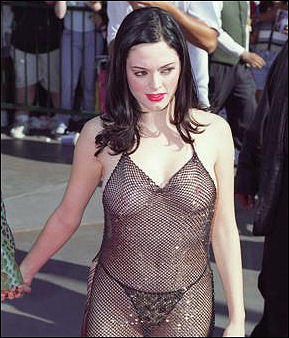
McGowan angry about slurring drunk

In a cottonball interview with Rose McGowan by some worshipping fanboy, McGowan is asked about the Robert Rodriguez Barbarella project, which the N.Y. Observer‘s Spencer Morgan reported last month was in doubt because Universal doesn’t believe McGowan is a big enough draw to topline a $100 million sci-fi fantasy.

McGowan tells the fawning suck-up that she “can’t answer that question just yet” but says that “anything negative that has been written about me doing this film is utterly and completely untrue.” Perhaps she’s speaking about Morgan’s piece (everyone reads the Observer), but perhaps not. Whomever she’s referring obviously struck some kind of nerve, however, because McGowan rips into the this person as a word-slurring alcoholic.

“I suppose i should’ve wasted more of my time trying to decipher the ramblings of a drunken, slurring writer,” she says. “It seems that since i didn’t give enough time to this drunk, he took out his bitterness by writing lies. One of the biggest downsides of my business is that when people have the forum to write lies, I don’t have a forum to fight back. I’ll be honest, that stuff does upset me and hurt my feelings.”

Weekend figures

My weekend Beowulf figure says $25,886,000 but Fantasy Mogul’s Steve Mason says Beowulf took in $10.4 million yesterday and will probably reach $30 million by Sunday night. (Who can you trust? Every day brings deception.) Bee Movie will edge out American Gangster, $13,801,000 to $12,792,000, for the #2 and ##3 slots. And Fred Claus, believe it or not, dropped only 32% — a pretty good hold. Critics and others with actual taste buds detested it, but the low-rent family audience will line up for almost anything cheery, glossy, broad and kid-friendly.

And yet they didn’t support Mr. Magorium’s Wonder Emporium, which will earn $9,396,000 and just under $3000 a print by Sunday night — a tank. (Was it the Dustin Hoffman factor? Family auds are renowned for their lack of standards so why did they blow this one off?) No Country for Old Men expanded to 148 screens and will end up $2,944,000 for the weekend — just under $20,000 a print. Love in the Time of Cholera is a wipeout with $1,960,000 and $2300 a print for the weekend.

“Debaters” is Last Great Hope

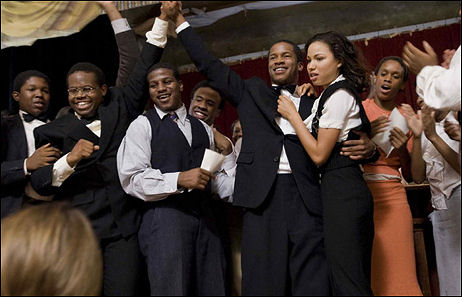
The Last Great Hope of the 2007 Oscar season is Denzel Washington‘s The Great Debaters, which isn’t saying much. “Hope” doesn’t mean zip in this context. No one has seen the Weinstein Co. release (the first screening happens on Tuesday, 11.20) and there are concerns that Debaters‘ inspirational story might be (a) a little too familiar and (b) take a little too long to unfold. But Washington’s a focused and confident director and I’ve been told the film works very nicely, so let’s see.

I’m saying this because the other presumed award-level contenders — Charlie Wilson’s War, Sweeney Todd and The Bucket List — are looking hazy as Best Picture contenders.

The word all along has been that Sweeney may be trippy or rousing or even euphoric on its own terms, but it’s too Burton-ish and purple-arterial for the Academy.

I’ve read the script of The Bucket List, and it suggests that Rob Reiner‘s film will be fine — it has an assured feeling for character comedy and offers a certain tidiness, wholesomeness and old-guy wisdom. (Of course, tidiness can be a hindrance in itself.) It’s no secret that director Reiner, nice guy and Hillary Clinton Democrat that he is, has been off his game since the mid ’90s, and I don’t see any great Bucket surge in the offing.

What happened to Charlie Wilson’s War, you ask? Nothing. It’ll begin screening later this month and then we’ll know what’s what. It’s just that (I can’t ignore this) a negative CWW comment popped up earlier this evening from a certain blogger who has since taken the comment down. How’s that for a solid piece of information?

I’m not simple-minded enough to presume that this opinion is necessarily related to Universal’s decision not to stage a traditional bells-and-whistles CWW junket, which is at least partly due to a reluctance (or an inability) on the part of director Mike Nichols and the cast to assemble in Los Angeles for more than one day (Friday, 11.30). They had to know that at least some eyebrows would be raised about this. And we all know how this plus the withdrawn negative item is going to spread over the next 48 to 72 hours.

All this crap tells us nothing concrete. Certainly nothing I’d care to put into words, but I am starting to suspect (in faint little hair-on-the-back-of-the-neck ways) that Charlie Wilson’s War, sharp and entertaining as it might be, isn’t this year’s Million Dollar Baby. The combination of these two items plus Julia Roberts‘ neo-Texas accent won’t support it.

Talks resume on 11.26

It was announced an hour ago that WGA strikers will resume negotiations with studios and networks on Monday, 11.26 — 11 days from now. Nobody can meet next week because everyone on both sides will be totally consumed by extensive travel, shopping and food-preparation arrangements in order to share Thanksgiving dinner with numerous friends and loved ones for a 90-minute period on Thursday, 11.22.

Ressner talks to Plame

Outed ex-CIA spy and Fair Game author Valerie Plame spoke earlier this week to Politico‘s Jeffrey Ressner about the movie version of her book, which will be produced by Jerry and Janet Zucker and Beautiful Mind screenwriter Akiva Goldsman for Warner Bros.

Plame told Ressner that (a) “the script follows the book fairly closely, but obviously the writers take [liberties]. It’s factual up to a point, and where there were areas I couldn’t speak to them about, they drew from their vivid imaginations“; (b) it’s “a story of political intrigue, an espionage story and a love story…about the loss of innocence, about speaking truth to power…and it has some black humor, too, where possible”; (c) she feels that George Clooney, “who’s shown a deft hand behind the camera as well as in front of it [with] Good Night and Good Luck,” would be a good director for the Fair Game film; and (d) the film will be “all-encompassing” in that Bush and Cheney “will make appearances, but there are creative decisions that haven’t been quite figured out yet…it’s a story about the decisions that were made to take our country to war in Iraq.”

Mailer Oswald

Robert Stone‘s Oswald’s Ghost, a comprehensive re-review of the Kennedy assassination particulars and their cumulative effect upon the American psyche, will open in NYC opening on Friday, 11.30, and then in L.A. at Laemmle’s Grande on 12.7. It will then be aired on Monday, 1.14.08 on PBS’s “American Experience” series. I couldn’t fathom what new information or slant could possibly be brought to this topic, but I watched it anyway. I got one thing from it — Norman Mailer‘s theory about Lee Harvey Oswald‘s motivation in killing JFK. It’s fairly convincing, certainly worth listening to.

“Mixed” reactions to Mungiu’s film

4 Months, 3 Weeks & 2 Days, the one foreign- language film of ’07 that could arguably be called a masterpiece, was seen by one of the four color-coded Oscar screening committees on 11.2, and the reaction, according to three people in the loop, was “definitely mixed,” as one journalist friend puts it.

The result of this reaction, the journo says, is that “it may not even make the short list.” He means the 12 or 15 foreign language films that will be re-screened and re-evaluated in early January ’08 with producer and senior committee guy Mark Johnson providing guidance and leadership as they decide on the final five nominees.

“Some felt it was a masterpiece and others didn’t,” according to a publicist. The journalist says he heard that some complained that Cristian Mungiu‘s film is “too slow” and that some “didn’t like the fetus on the floor shot.” The publicist says that “some complained about Oleg Mutu‘s static camera work” as well as “some of the hand-held tracking shots.”

Jesus wept! In the early ’60s the same kind of people were complaining about the “shaky” or “amateurish” photography in some of the French New Wave films. I remember an uncle complaining about A Hard Day’s Night when it first came out, saying it looked like “home movies.”

With all appropriate respect, the Academy’s foreign-language film committee needs to be gently reminded that the Movie Gods have their own laws, standards and decrees, and that Oscar committee members aren’t permitted to dismiss recognized masterpieces and Palme d’Or winners for reasons that are based on banal judgments stemming from limited vision or a lack of sophistication.

This gentle reminder doesn’t apply to all members of the Academy’s foreign film committee — just the lazy, not very hip ones. As one handicapper comments, “There are two branches within this group — the ones who see a foreign film and go ‘Aaahhh, I didn’t like that’ and ‘that part bothered me’ and so on, and the other ones who know a good or great film when they see it.”

Documentary Short List

We all knew Leonardo DiCaprio‘s The 11th Hour wouldn’t make the short list of Best Documentary Feature contenders (which have previously numbered 15), but the Academy committee has also given the boot to Seth Gordon‘s The King of Kong. Donkey Kong guy…out! People loved your film, we didn’t relate, life is hard, tough darts.

Charles Ferguson‘s No End in Sight. Michael Moore‘s Sicko and Tony Kaye‘s Lake of Fire made it though — good calls. Phil Donahue and Ellen Spiro‘s Body of War, Bill Guttentag and Dan Sturman‘s Nanking, Alex Gibney‘s Taxi to the Dark Side, Richard RobbinsOperation Homecoming and Sean Fine and Andrea Nix Fine‘s War/Dance.

That’s nine, leaving room for six more. Crazy Love should be on the list along with The Devil Came on Horseback, In The Shadow Of The Moon, Jimmy Carter: Man from Plains, My Kid Could Paint That, The Price of Sugar and Barbet Schroeder‘s Terror’s Advocate.

DePalma’s “Redacted”

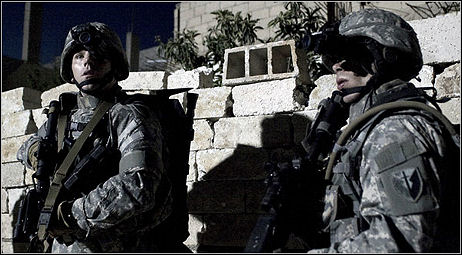
Brian DePalma‘s Redacted pretends to be a video verite account of some horrid homicidal behavior on the part of some U.S. troops (based on an actual incident) with a third-act stab at depicting the moral penalty for such deeds. I saw it as a sloppy film about a group of badly directed actors playing soldiers, and the rank agony of being surrounded by pretension gone wrong. I’ve never seen a worst-acted film by a major-league director in my life. DePalma has no ear — no ear whatsoever — and those who see Redacted will suffer because of this.

It’s basically about a grunt who sees himself as a future director (Izzy Diaz) incessantly taping his deeply irritating buddies talking about their pathetic lives and viewpoints, and basically watching these guys (a couple of whom are disgustingly overweight) be gross, common and deeply uninteresting. On top of DePalma making us listen to loop after loop after loop of George Friderich Handel‘s Sarabande (this music is owned by Stanley Kubrick‘s Barry Lyndon — what was DePalma thinking?).

And then the rape-murder atrocity happens, and then one of the grunts (Rob Devaney) goes through a post-traumatic meltdown when he’s asked about his Iraq War heroism by some friends back in the states.

I’m in full agreement with David Denby‘s comment, which is that Redacted is “hell to sit through.” It’s the atrocious acting (accidental or deliberate) that gives it this quality. It made me do the usual thing I do when I’m trying to get through a rough sit — leaning forward, tapping left foot, hands over face, quiet groans, singing favorite songs to myself, etc.