Sleepy Barcelona pics

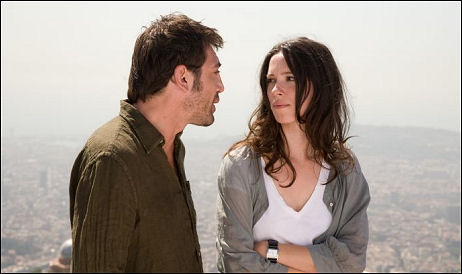
Rope of Silicon‘s Brad Brevet has posted two stills from Woody Allen‘s unfortunately titled Vicky Cristina Barcelona (Weinstein Co., 12.12.08) — one of costars Javier Bardem and Rebecca Hall, another (below) of a femme fatale-ish Penelope Cruz.


Bardem, Hall; Cruz in Vicky Cristina Barcelona

The oft-repeated synopsis: Vicky and Cristina (Hall and Scarlett Johansson), spending a summer in Spain, make the acquaintance of a flamboyant artist and compulsive hound (Bardem) and his beautiful but insane ex-wife (Cruz). Vicky is about to be married. They find themselves at emotional and sexual cross-purposes. Lezzie action reportedly occurs between two of the three women (reportedly Johansson and Hall, but you never know).

Eclipse of the Hunk?

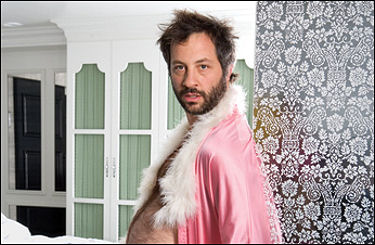
A very significant revolutionary concept has been pushed repeatedly in films produced, written or directed by movie-comedy maestro Judd Apatow over the last three or four years, and I’m not sure it’s been explained as throughly as it should be. The idea, admittedly old hat for anyone half-familiar with Apatow World, is that marginally unattractive guys — witty stoners, clever fatties, doughy-bodied dorks, thoughtful-sensitive dweebs and bearish oversize guys in their 20s and 30s — can be and in fact are the new “romantic leads” (for lack of a better or more appropriate term) in today’s comedies.
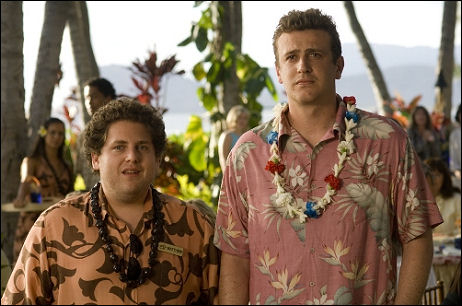

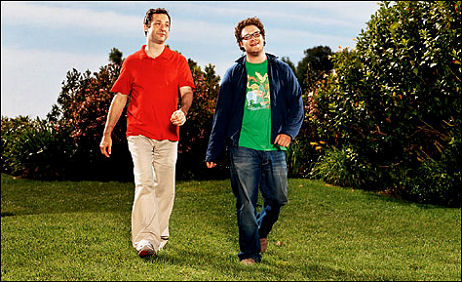
Jonah Hill, Jason Segel in Forgetting Sarah Marshall

Question is, what if this starts to manifest in realms outside Apatow World? Young teenage girls will always have a thing for the Zac Efrons and young Leonardo DiCaprios, but what if Hollywood, looking to follow Apatow’s lead in reflecting the real-life shlumpiness of typical GenX and GenY guys, generally starts to divest itself of conventionally good-looking actors as far as the over-21 ranks are concerned? Has Apatow started something, or does he live (and create) in a world totally his own?

I got started on this after watching Forgetting Sarah Marshall (Universal, 4.18) last night. The star is the galumphy, heavy-bodied Jason Segel, and the first thing you seem him do is wiggle his breasts in front of a bathroom mirror. Not by shaking his torso, but in the same way people wiggle their nose or their ears.

I immediately went, “Oh, shit…I’m stuck with this dude for the whole film.” Segel is an obviously bright guy with moderately appealing features, but he also has a chunky, blemished ass and little white man-boobs, and he could definitely use a little treadmill and stairmaster time and a serious cutback program regarding pasta, Frito scoop chips, Ben & Jerry’s and Fatburger takeout. I don’t relate to this shit at all, I was muttering to myself.

Judd Apatow

I’m not referring to the film itself (which everyone around me seemed to have a pretty good time with). I’m talking about the simple exercise of relating to a lead character during the first 10 or 15 minutes of a film and saying to myself, “Yeah, that’s me to some extent…I’m sorta like that guy…I’ve been there,” etc. If you can’t do that, as I couldn’t last night, the movie isn’t going to work for you. Like, at all.

The success of Apatow’s comedies strongly suggests that most moviegoers don’t have this problem. They’re cool with schlumps getting the girl. Dramas are another matter, but in Apatow World, at least, moderately good-looking (or at least pleasant-featured) regular guys, neurotics or semi-smoothies who go to the gym every once in a while and maybe resemble the slightly fuller-bodied, not-quite-as-good-looking brothers of Matt Damon or Adrien Brody or Brad Pitt are totally out.

Taking their place are guys who look like real guys, which means almost never slender or buffed, and frequently chunky, overweight or obese. And usually with roundish faces with half-hearted beard growth, hair on their backs, man-boobs with tit hairs, blemishes, and always horribly dressed — open-collared plaid dress shirts, low-thread-count T-shirts with lame-ass slogans or promotions on the chest, long shorts and sandals (or flip-flops), monkey feet, unpedicured toenails.

Dustin Hoffman, Katherine Ross in The Graduate

For better or worse, smart schlumps are the Cary Grants, Fred McMurrays, William Powells and Clark Gables in this very particular and restricted realm.

We’ve seen this phenomenon in six Apatow fims over the last four years — Anchorman: The Legend of Ron Burgundy (in which the semi-grotesque Will Ferrell seduces Christina Applegate), The 40 Year-Old Virgin (withdrawn, socially immobile Steve Carrell emerges from shell, falls in love with Catherine Keener), Knocked up (stoner-slacker Seth Rogen beds and gradually builds a serious relationship with Katherine Heigl), Superbad (the incorrigibly nerdy Christopher Mintz-Plasse gets lucky with a hottie, Jonah Hill finds the real thing with a nice girl in Act Three), Walk Hard (John C. Reilly-as-Johnny Cash, scoring and relationship-ing over a 40-year stretch with relative ease) and the upcoming Forgetting Sarah Marshall (Segel losing a hot-blonde girlfriend, hooking up with a beautiful brunette in the same class).

What’s happening here is more than just Apatow rewriting romantic movie mythology by selling variations of himself as sexually appealing. We’re talking about audiences totally buying into the notion that guys who look like this actually do attract hot women of good character, go to bed with them, fall in love and all the rest of it.


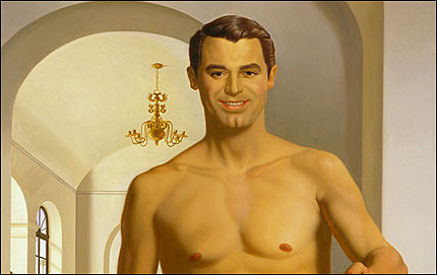
Cary Grant circa 1935 or ’36, painted by Kurt Kauper

Ten years ago female moviegoers, I believe, would have totally rejected this. Twenty or thirty years ago mainstream audiences would have walked out of theatres in confusion (if not disgust) if guys who look like Rogen, Segel, Hill or Mintz-Plasse got the girl. If filmmakers had tried to push this concept in movies of the ’40s or ’50s the House Un-American Activites Committee would have held Congressional hearings. If films of this slant had been made in the 1920s or ’30s people would have seen them as tragedies or grotesque oddities in the vein of Todd Browning‘s Freaks.

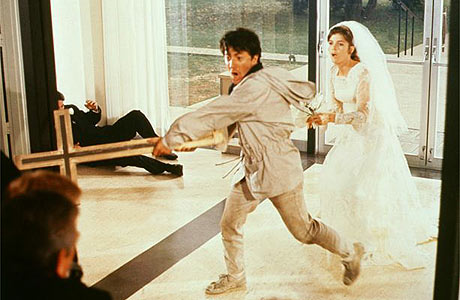
When you think about it, the last time Hollywood said to the moviegoing public “hold on…guys who look like this can get the pretty girl and in fact do score in the real world” was 41 years ago, when the short, dweeby-Jewish Dustin Hoffman connected with Katherine Ross and bedded Anne Bancroft in The Graduate (’67).

Before that landmark Mike Nichols film male romantic leads had all been pretty much cut from the same three cloths — traditional standard-handsome smoothies a la Cary Grant or Rock Hudson or Clark Gable, good-looking troubled moodies like Marlon Brando, Montgomery Clift or Frank Sinatra, or all-American sunny-personality guys like James Stewart or Van Johnson. Hoffman’s Benjamin Braddock was something very new — nice-looking but anxious, neurotic, not tall and of the Hebrew persuasion.

I don’t know where else to take this idea or how to end the article, even, so I’ll just kneecap it here and leave well enough alone. I only know that if I were a girl or gay and Jason Segel came up to me at a bar and tried to put the moves on, I would scrunch my face up and say, “Are you fucking kidding me?”

Tectonic Mamet shift

“And I realized that the time had come for me to avow my participation in that America in which I chose to live, and that that country was not a schoolroom teaching values, but a marketplace.” — David Mamet in his 3.11 Village Voice essay, “Why I Am No Longer a Brain-Dead Liberal.” Which means he’s evolved into what? A free-market libertarian…a right-leaning something-or-other? Whiffs of this have been in the air for a long while. Sooner or later the Mamet machismo element had to manifest in some kind of stated political posture.

Woodshed moment

Tonight’s Countdown with MSNBC’s Keith Olbermann will be a watershed moment for Hillary Clinton…or is that “woodshed”? He’ll presumably be addressing the tone and character of her campaign (race cards, stating her allegiance/preference for McCain over Obama, deliberate distortions, kitchen sink, scorched earth) in one of his “Special Comments” monologues. Olbermann usually slams Bush administration abuses. For the first time in Countdown‘s history, his remarks will be directed exclusively at a Democrat.

“Funny Games” = Clinton campaign

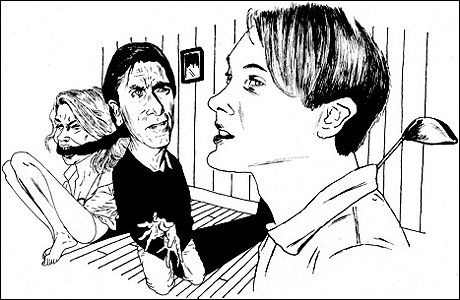
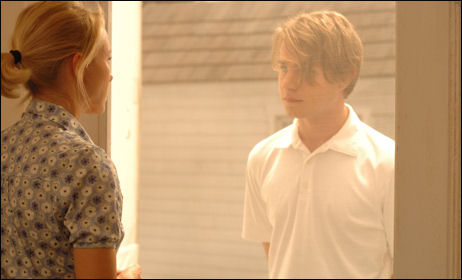
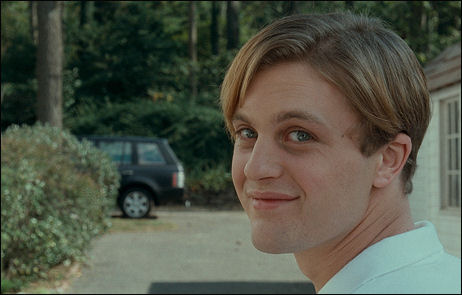
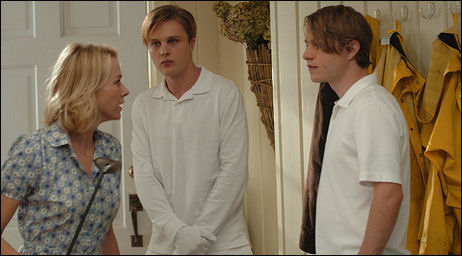
One of my reactions during the watching of Funny Games last night was a strange political resonance. In a baroque, very specific way, Michael Pitt and Brady Corbet — the polite but completely psychopathic fiends who, we come to realize, are focused on delivering a terrible fate to a house built upon love, health and a semblance of sanity — struck me as twin metaphors for the Hillary Clinton campaign.
Consider the following: (1) Just as HRC is now “in the house” and won’t leave, despite many reasonable people imploring her to do so because of the destruction she’s threatening, Pitt and Corbet’s tennis-outfit-wearing killers are also literally in the house and won’t leave; (2) Like Clinton, Pitt and Corbet are smiling, “well-mannered” and very persistent; (3) they have haircuts similar to Clinton’s — medium-length, swept-back blonde hair; (4) Pitt and Corbet are clearly monsters, a term that has recently been used to describe Senator Clinton by former Obama foreign policy adviser Samantha Power and writer Seth Graham Smith in a 3.9 Huffington Post piece; (5) Pitt and Corbet are without a shred of conscience or remorse about their destructiveness, as one could reasonably say about the Clinton campaign and their racially-tinted, bomb-Dresden, burn-the-house-down campaign at this stage; and (6) Pitt and Corbet’s actions make Funny Games a kind of horror film, which is how political columnist Andrew Sulivan has described the Clinton campaign in a 3.9 London Times article.
See? Not as much of a stretch as you thought. Think about it.

Olsen’s “Funny Games” story

Mark Olsen‘s 3.9 L.A. Times interview with Funny Games director-writer Michael Haneke mentions British-based producer Chris Coen buying the U.S. remake rights, but it doesn’t explain why the people at Warner Independent saw it as a worthwhile film to distribute. If it had been my decision, I would have said no.
Consider, for example, what a guy who calls himself “Mr. Mystery” wrote earlier today about seeing a Funny Games preview last weekend at a suburban theatre: “Total silence until the end when someone said ‘fuck you!’ to the screen, [and] the audience applauded.” What loon would say to him or herself, “Now that‘s a film I want my company to distribute.” I respect Funny Games for what it is and I admire Haneke tremendously, but what could Warner Independent president Polly Cohen have been thinking?
Olsen writes that Haneke “insisted on casting Naomi Watts — he said he would likely have not made the new film if she had said no.” But why is Watts listed as the film’s executive producer? What was that about? Did she agree to cut her price to nothing so she could have a juicy role to play?

Lane on “Funny Games”

“If this movie knows it’s merely a movie, and concedes as much, why should we honor its mayhem with any genuine fright?,” asks New Yorker critic Anthony Lane about Funny Games.

“When Michael Pitt turns to the camera and asks, with a smile, ‘You really think it’s enough?,’ or ‘You want a proper ending, don’t you?,’ we don’t feel nearly as chastened or ashamed as [director Michael] Haneke would like. We feel patronized, which is one of the worst moods that can beset an audience. Would Psycho have been a more profound film if Norman Bates had turned off the shower halfway through, adjusted his dress, and said to us, ‘Don’t worry about the blood. It’s chocolate sauce‘?”

“Funny Games”

Michael Haneke‘s Funny Games (Warner Independent, 3.14) is simultaneously the ugliest and most repulsive violent melodrama I’ve ever seen (including the thoroughly disgusting I Spit On Your Grave) and the smartest and nerviest critique of sexy-violent movies in the bang-flash vein of Quentin Tarantino, Tony Scott, Oliver Stone, Eli Roth and other purveyors and marketers of homicidal style.

A fair percentage of those brave enough to see this Warner Independent release this weekend are going to walk out on it — trust me. It’s a hateful and infuriating film, no question, and yet it has a worthwhile point. And you can’t not respect Haneke for this.
It’s certainly one of the ballsiest movies ever released by Warner Bros. (technically Warner Independent) in its 90 year history. I mean this in a sense that average people might come out of showings feeling enormous hate for Warner Bros. for having done so. Seriously. If the final effect wasn’t so stunning and dispiriting I could imagine people beating up ushers on the way out.
It’s basically a chilly, creepy home-invasion horror story about two young, ice-cold psychopaths (Michael Pitt, Brady Corbet) who terrorize a couple (Naomi Watts, Tim Roth, Devon Gearhart) and their young son with the intention of gradually killing them. No theft, no ransom, no rape…just sadistic mind games followed by brutal maiming and then awful death.

But it’s not a movie that pulls you into the story and persuades you to suspend disbelief and blah, blah. It’s strictly a “game” piece — an exercise film that feels real and naturalistic as far as it goes until it periodically pulls back, stops and tells you (in three instances with Pitt literally talking to the camera), “We’re wanking you off and trying to get you mad…get it? We’re making a point about all the violent gunplay movies you’ve enjoyed ad infniitum for the last 30 or 35 years, starting with The French Connection but particularly since the start of the Tarantino wave in the early ’90s. Violence is horrible, ghastly, reprehensible ….and it’s time for the all the little moviegoing children out there to wake up to this simple fact.”
Funny Games is a shot-by-shot, line-for-line remake of Haneke’s 1997 Austrian- based original. (Which I’m going to watch on DVD this weekend.) In the press notes Haneke says that “when I first envisioned Funny Games in the middle of the ’90s, it was my intention to have an American audience watch this movie. It is a reaction to a certain American cinema, its violence, its naivete…the way American cinema toys with human beings” and the way some of them make “violence consumable.”
What happens in the first 30 or 35 minutes of this film is so ugly and stomach- turning that I was starting to suffer an anxiety attack. I wanted to get up and walk into the movie, Purple Rose of Cairo-style, and shoot Corbet, whose face enraged me. His eyes and mouth especially. (If I see this guy on the street I’m going to have to take a breath and count to ten to keep from taking a poke at him.) I was muttering to myself, “This is the best argument for gun ownership and the NRA I’ve ever seen in a movie in my life.”

I’d love to get into particulars (there are ten or twelve aspects I’d love to sort through and dissect), but I’ll just get yelled at for spoiling. Fair warning: I’m going to discuss every damn aspect of this film that I feel like discussing, no holds barred, sometime on Sunday. No spoiler whining or squealing will be tolerated. If you want to get into it, see it on Friday or Saturday (a good idea regardless given the likelihood that this film is going to be gone very quickly) and get your ducks in order.

Norton vs. Marvel over “Hulk”

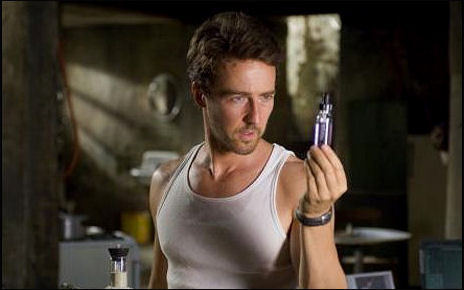
Edward Norton is reportedly fighting with Marvel’s chairman David Maisel and production prexy Kevin Feige over the final shape and tone of The Incredible Hulk. Quelle surprise! Norton has been getting into post-production scraps off and on for ten years now, starting with American History X. He’ll always be a collaborator and never just “an actor for hire” — and anyone who hires him knows this. Besides — arguing over a film’s final cut is a very healthy way to go. Better that than an atmosphere of complacency and mutual masturbation.

“Chapter 27”

The hard-luck Chapter 27, the killing-of-John-Lennon drama that’s been kicking around for two years now, will finally open on 3.28. Jared Leto (as Mark David Chapman), Lindsay Lohan, etc. A screening invitation for New York screenings arrived today; nothing yet for LA. Not in my inbox, at least.

PTA mashup

The beginning of this Paul Thomas Anderson mash-up is absolutely rancid, dreadful…I wanted to strangle the guy (going by the name of “barringer82”) who cut it. Then it turns into a first-rate thing — exquisitely cut, thought-through, avoiding the easy jokes. Except, like Magnolia, it goes on too long.