
Schemer#1: If I blundered like you, my head would roll.
Schemer#2: I dare say from a greater height than mine.
Schemer#1: You would?
Schemer#2: Yes. From the height of vaulting ambition.
Schemer#1: You have none?
Schemer#2: No.
Schemer#1: (Pause) Do you fear me, Rochefort?
Schemer#2: Yes, eminence. I also…hate you.
Schemer#1: I love you, my son. Even when you fail.
Month: March 2008
Unmistakable
If you didn’t recognize this main-title music, you’d know right away it’s some kind of spunky chick flick about starting over after a divorce. I’m kidding. The point is that there’s no mistaking what you’re in for once you hear it. The Mina-title music for Tim Burton‘s Beetlejuice worked just as well this way; ditto Ed Wood. This track gets you excited and in the mood besides. There are dozens of others that have done this; perhaps some recently. Examples?
Nocturnal Fancy
I finally clicked on that IFC/Red Bull ad, which I didn’t have a clue about since I don’t do the selling these days. The IFC guys want people to submit a trailer for a miniseries with an urban nocturnal theme. It can’t be any longer than six minutes and it has to tell some kind of story. That doesn’t seem too hard. As always, the thing to do is avoid the cliches. No stories about bartenders, waitresses, cabbies, cops. I got it, I got it — make one about a homeless cat. Or a dog. The lonely lives of vagrant animals.
My Kid Could Paint That
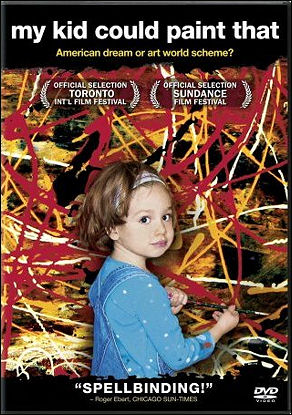
I’ve been trying to refine my reactions to Amir Bar-Lev‘s My Kid Could Paint That, an ’07 Sony Classics release that came out on DVD earlier this month. And they won’t. It’s a documentary that nearly kills you with its refusal to say “this is this.” Life itself may have indeed refused to provide a clear answer to the film’s Big Question, which has to do with a possible art fraud, but that doesn’t make the film any less irksome.
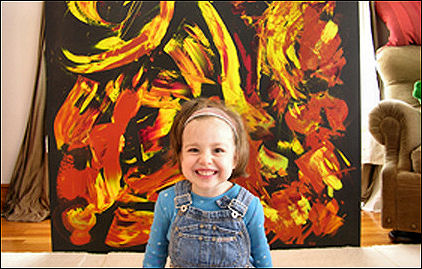
Marla Olmstead
I only know that when Bar-Lev’s film was over, I put it out of my mind. Later! All movies are show-and-tell games, but this one, however open and probing and appropriately non-judgmental, shows and blows smoke.
The B.Q. concerns Marla Olmstead, an eight year-old from Binghampton who became moderately famous in ’04 for having painted (when she was four) abstract oil paintings that were striking enough to sell modestly, and then get atttention from more and more journalists, and then sell in the big-time market for five figures.
Average Joe types have been snickering at high-priced canvases for decades, dismissing the whole modern-art culture as a kind of con game, etc. Which My Kid Could Paint That toys with throughout its running time. But the film mainly follows the lead of a big expose piece that Charlie Rose and 60 Minutes aired in February ’05 about whether Marla”s canvases were entirely self-created or whether she was helped a bit by her dad, Mark, a Frito-Lay factory manager who paints on the side.
Mark and his wife Laura, a dental technician, don’t seem like con artists, but they do seem to enjoy the attention and wealth that comes through Marla’s celebrity. And we’re all whores in the sense that we all like to glide along when things are grooving along. I don’t think Mark deliberately duped the art world by standing nearby and specifically telling his daughter what to do with the paint and brushes, but who knows? Maybe he suggested a couple of ideas here and there. Or more than a couple. Or none at all.
And perhaps “maybe” is all one can say about this situation. Maybe a definitive bust or exoneration is out of the question. But I don’t want fucking maybes when I go to see a movie. The only way I’ll accept them is when the filmmaker somehow conveys what he/she really thinks, and persuades me to come to the same gut conclusions. If there’s no clarity or closure or at least some kind of ending that has a discernible undercurrent, then whadaya whadaya?
I didn’t hate My Kid Could Paint That. It’s not boring, it’s intelligent and well made, it had me start to finish. But there’s a part of me that is mildly pissed at Bar-Lev for making a film good enough to get a 95% positive from the Rotten Tomatoes elite, and persuade Sony Classics’ Tom Bernard and Michael Barker, a couple of shrewd hombres, to pick it up and release it, and at the same time make me feel the way I did after it was over, which was more or less “what the fuck?”
The only clear conviction you come away with is a good feeling about Marla herself. She’s a character, mature beyond her years, robst of spirit. She may continue to paint or not. But I wonder what she’ll say about all this hoo-hah 10 or 15 years hence. Whatever and whenever she spills, it’ll probably be more intriguing than Amir Bar-Lev’s film.
If you want a satisfying dissection of the art world, something that provides a genuine sensation of curtains parting, some kind of semblance of the “aha!” phenomenon, read Tom Wolfe‘s “The Painted Word.”
Under Fire
Hillary Clinton‘s “Walter Mitty Moment” — an apparent fabrication about the non-dangerous circumstances of a 12 year-old state visit to Tuzla, Bosnia — is reviewed in this 3.22 Daily Kos posting and this Washington Post Fact-Checker report. Very Weird. Busted, in any case…and for what?
Lowball
There are two grabbers in Katrina Onstad‘s 3.23 N.Y. Times profile of Stop-Loss director-writer Kimberly Peirce. One is a blunt comment from Peirce about her career, the second is her non-response to a cheap-shot question by Onstad (and a cheap-shot collusion on the part of her editors).
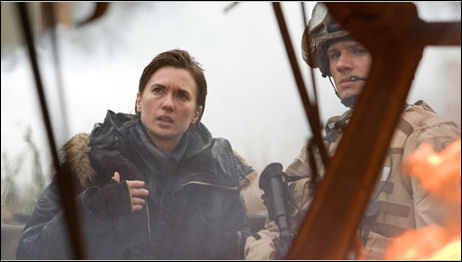
Stop-Loss director-writer Kimberly Peirce, Ryan Phillipe.
The first, following a statement that “after almost a decade in the Hollywood wilderness trying to find a project that would equal her first film, she earned just a single directorial credit, for an episode of the television series The L Word,” is Pierce saying “Yes, I should have made a movie sooner…yes, I should be a lot richer than I am….mea culpa.√ɬ¢√¢‚Äö¬¨√Ǭù
I’m not going to quote from or describe the second thing, but check it out and tell me what you think. I think it’s an icky paragraph.
Just Another Poll
Today’s Gallup tracking poll shows Barack Obama retaking the national lead over Hillary Clinton “after the Jeremiah Wright scandal had badly damaged his numbers and put him behind for nearly a week,” says a 3.22 Talking Points Memo report. Obama is now at 48% (up 3) to Clinton’s 45% (down 2). Obama’s Philadelphia speech last Tuesday combined with Bill Richardson‘s endorsement “have gone a long way in fixing his poll numbers for now, but he still has yet to fully recover the six-point lead he had in Gallup a little over a week ago.”
Richardson’s Reason
Last weekend’s Philadelphia speech is what finally convinced Gov. Bill Richardson to endorse Sen. Barack Obama. He was leaning in this direction, but the speech is what did it.
“The decision by Mr. Richardson, who ended his own presidential campaign on Jan. 10, to support Mr. Obama was a belt of bad news for Sen. Hillary Clinton,” writes N.Y. Times reporter Adam Nagourney and Jeff Zeleny. “It was a stinging rejection of her candidacy by a man who had served in two senior positions in President Bill Clinton‘s administration, and who is one of the nation’s most prominent elected Hispanics.
“Mr. Richardson came back from vacation to announce his endorsement at a moment when Mrs. Clinton’s hopes of winning the Democratic nomination seem to be dimming.
“But potentially more troublesome for Mrs. Clinton was what Mr. Richardson said in announcing his decision. He criticized the tenor of Mrs. Clinton’s campaign. He praised Mr. Obama for the speech he gave in response to the furor over racially incendiary remarks delivered by Mr. Obama’s former pastor, the Rev. Jeremiah A. Wright Jr.
“And he came close to doing what Mrs. Clinton’s advisers have increasingly feared some big-name Democrat would do as the battle for the nomination drags on: Urge Mrs. Clinton to step aside in the interest of party unity.
“‘I’m not going to advise any other candidate when to get in and out of the race,’ Mr. Richardson said after appearing in Portland with Mr. Obama. ‘Senator Clinton has a right to stay in the race, but eventually we don’t want to go into the Democratic convention bloodied. This was another reason for my getting in and endorsing, the need to perhaps send a message that we need unity.”
You Like Costumes?
“WANTED a PA for the costume dept for a upcomming [sic] Oliver Stone movie called W. A car a must & some computer skills also interest in costumes.” — from a 3.12.08 Craig’s List posting. An “interest” in costumes? As in…what, a passing interest? As in some good ole boy in a flannel shirt sitting around with a beer and saying, “Shit yeah, I like costumes”?
More Cannes ’08 Forecastings
A recent Agence Press article predicted that Steven Soderbergh‘s The Argentine, the first of his twin Che Guevara movies with Benicio del Toro in the lead role, would play at the ’08 Cannes Film Festival. That may have been half-wrong. A 3.21 Hollywood Reporter forecast piece by Stephen Zeitchik is reporting that both The Argentine and Guerilla, the second Che pic, will likely show there as a team.
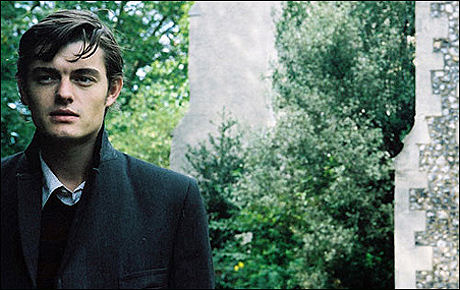
Sam Riley in Gerald McMorrow’s Franklyn
If this is true (and it seems like it might be with two disparate trade publications saying close to the same thing), it’ll be good to be able see and contemplate these films among liberal-minded elite journalists and the leftie European intelligentsia without having to deal with complaints from right-wing blowhards that these films glorify Guevara instead of rightly portraying him as a dogmatic fiend who presided over firing squads, etc. (I know for a fact that October ’06 versions of the two scripts don’t depict Guevara in a glorified light — here‘s my report.)
The tempest will kick in once the films open in the U.S., of course — cue Fox News! — but thank heaven there’ll be at least a brief period of Mediterranean calm beforehand.
Zeitchik is also hearing that the following films may be Cannes ’08 selections: Bertrand Tavernier‘s In the Electric Mist with Tommy Lee Jones; I Come With The Rain with Josh Hartnett; Fernando Meirelles‘ Blindness, Walter Salles‘ Linha de Passe; and Wim Wenders‘ The Palermo Shooting with Dennis Hopper and Milla Jovovich in an Italian-based setting.
Italian and French entries may include Paolo Sorrentino‘s Il Divo, Matteo Garrone‘s Gomorra (about organized crime in Italy); Michel Houellebe‘s La Possibilite d’un Ile, Souad el Bouhati‘s Francaise, Arnaud Desplechin‘s Un conte de Noel with Catherine Deneuve, Francois Dupeyron‘s Aide-toi, le ciel t’aidera, and Bertrand Bonello‘s De la guerre with Asia Argento and Mathieu Amalric.
English titles may include Saul Dibb‘s The Duchess with Keira Knightley, John Maybury’s The Edge of Love, a Dylan Thomas biopic with Matthew Rhys in the title role and costarring Knightley, Sienna Miller and Cillian Murphy; Gerald McMorrow‘s Franklyn with Sam Riley, Ryan Phillippe and Eva Green and possibly Julian Jarrold‘s new adaptation of Brideshead Revisited.
Hey, what about Beeban Kidron‘s Hippie Hippie Shake, about a counter-culture rag published in late ’60s London? Perhaps it won’t be ready until Toronto. I’m detecting a whiff of difficulty on this one.
Reappraising Che Scripts
Given the apparent likelihood of Steven Soderbergh‘s The Argentine and Guerilla playing at the Cannes Film Festival two months hence, here’s a condensed reposting of my impressions of Peter Buchman‘s scripts which I ran over a year ago.
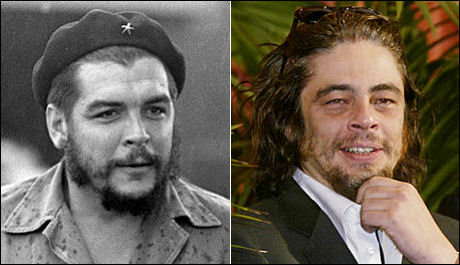
The scripts, both dated 10.4.06, are “awfully damn good — a pair of lean, gritty, you-are-there battle sagas, one about success and the other about failure. Together they comprise a strong and properly ambiguous whole.
“Obviously political and terse and rugged, they’re about how living outside the law and fighting a violent revolution feels and smells and chafes on a verite, chapter-by-chapter basis. They’re about sweat and guns and hunger and toughing it out…friendships, betrayals, exhaustion, shoot-outs and trudging through the jungle with a bad case of asthma. What it was, how it happened…the straight dope and no overt ‘drama.’
“If Soderbergh does right by what’s on the page, The Argentine and Guerilla (which Focus Features will apparent not distribute, I’m told — there’s talk about Warner Bros. stepping in) will have, at the very least, a Traffic-like impact.
“The films will almost certainly be Oscar contenders, and you have to figure that del Toro, playing a complex, conflicted hero who ends up dead (i.e. executed in a rural schoolhouse by a drunken Bolivian soldier), will be up for Best Actor. The Guevara role is too well written (nothing but choice, down- to-it dialogue from start to finish) and del Toro is too talented an actor — it can’t not happen.
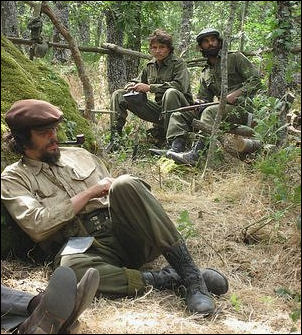
“In fact, I can easily imagine critics comparing Soderbergh’s two-part saga to Francis Coppola‘s The Godfather and The Godfather, Part II — not necessarily in terms of quality or emotional-impact issues but because they convey two distinct and disparate sides of Guevara’s saga, the up and the down, in the same way that Coppola’s films are about the youthful ascent and malignant, middle-aged descent of Al Pacino‘s Michael Corleone.
“Another analogy is the first half of Lawrence of Arabia vs. the second half.
“The Argentine is about Fidel Castro and Guevara’s forces leading their small anti-Batista army from their arrival on Cuban shores in 1956 until their victory in late ’58. Guerilla is about Guevara’s failed attempt to spark a subsequent revolution in Bolivia in 1967. The former is about struggle, strength and triumph, and Guerilla is its opposite number — the same fight minus the wind in the sails.”
One Good Scene Saves It
Among Joe Queenan‘s choices of the worst films ever made, he puts Futz (’69), about a man who falls in love with a pig, at the top of the list, followed by La Grande Bouffe, A Walk With Love and Death, Pier Paolo Pasolini‘s Salo, or the 120 Days of Sodom (“as vile as any film I have ever seen”) and Sydney Pollack‘s The Way We Were for being “as treacly and flatulent as any movie I know of.”
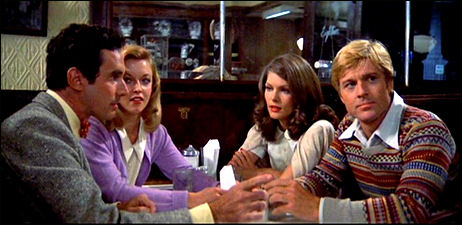
I’ve also found portions of Pollack’s 1973 film grating — I want to reach out and strangle Bradford Dillman‘s character every second he’s on-screen, I’ve always hated songwriters Alan and Marilyn Bergman‘s title song, and Marvin Hamlisch‘s score has always strike me as way too stringy and MOR. But Queenan has an arterial blockage if he doesn’t get that the curious spiritual tension between Robert Redford‘s Hubbell and Barbra Streisand‘s Katie is one of the most intriguing undercurrents ever used in a mainstream romance film.
As drippy as their union may seem to Queenan in other ways, it is based upon spiritual emptiness (in Streisand’s character also) and a need to try and fill the void with what the other has. Redford plays a talented but relatively shallow writer whose attraction to Streisand is based upon her possessing the fire and conviction that he lacks, and her belief that he has more depth than he himself believes is there. Perhaps not the most profound idea to ever animate a film of this kind, but it’s dramatized intelligently and with a certain old-school delicacy and poise. This alone means Queenan can’t condemn TWWW as one of the all-time worst. It’s sloppy critical thinking.
And you can’t dismiss a film as a legendary stinker, even by curious personal standards, if it has a single great scene, which The Way We Were clearly does. You can’t say the rapprochement-outside-the-Plaza Hotel scene at the very end doesn’t work. Not when Streisand first meets Redford and his new shiksa wife, but when he comes back the second time, alone, and says, a little sadly, “You never give up, do you?” That is what’s known in movie-lover circles, whether or not you hate Redford or Streisand or Hamlisch or anyone or anything else connected with this film, as “good stuff.”
Which means that The Way Were cannot be dismissed in Queenan-type fashion. One of the most elemental Movie God laws states that any film that has one effective scene must always be afforded at least a measure of respect. Even if 95% of it is awful or mediocre, the presence of one great scene always saves it.