Feel Nine’s Pain

Poor Nine came in eighth place this weekend, beaten by The Princess and the Frog but ahead of Did You Hear About The Morgans? It made $5,544,000, or an average of $3926 at 1412 situations. And this just doesn’t seem right. It feels like an overly harsh verdict.


a Criterion Bluray frame-grab of Marcello Mastroianni in Federico Felllini’s 8 1/2

Nine is a reasonably decent, sometimes better-than-decent musical with its own scheme and attitude and (for me) a pair of ace performances from Daniel Day Lewis and Marion Cotillard. It’s not Cabaret, Sweet Charity or Chicago, but the terms “not half bad” and “moderately appealing” could definitely be applied. And yet it’s been clubbed right out of the gate. My heart goes out.

I know, I know — that’s the world we live in. There’s no such thing as a decently made, moderately appealing film making decent or moderate coin. For the most part movies are either instant superhits or they die like dogs — damn few seem to manage a middle road to success. It wasn’t “right” that Steven Soderbergh‘s Che died either. Scores of films obviously fail to cut it theatrically every year. Theatrical is a very costly, very tough sudden-death game.

One of my initial reactions to Nine is that it was ballsy of Harvey Weinstein to produce it in the first place, as he had to realize from the get-go that a film about Federico Fellini‘s “beautiful confusion” (i.e., the initial title of 8 1/2) wouldn’t play with the older Eloi mom-and-pop mall crowd in the same way that Chicago did. That elite mid ’60s Euro-vibe with black shades and cigarettes and coastal Italian villages isn’t a place they call home.

Will Polanski Skate?

I missed Steven Mikulan‘s 12.23 Wrap story that claimed the evil Polish dwarf is almost out of the woods regarding that 31 year-old unlawful sexual conduct beef. So much anti-Polanski hate and vitriol was expended on this site last September by the pitchforkers that it seems appropriate to address it again before the year concludes. Nothing is over until it’s over, of course, but if I were a pitchforker…

“The most important news about Roman Polanski has been nearly lost in the swirl of stories this week about the state appellate court’s rejection of his motion to dismiss the 32-year-old rape charges against him,” Miklulan wrote.

“It’s almost all over. Polanski is nearly home free.

“In rejecting the case, the court of appeal also strongly suggested that the Superior Court release the auteur on the basis of the time he’s already served behind bars.

“As TheWrap reported Monday, the court suggested that he can remedy his plight by formally requesting L.A. Superior Court Judge Peter Espinoza to hand down his sentence in absentia. That would then allow Espinoza to sentence Polanski to the time he’s already served in two jails – the 42-day stretch in Chino back in 1977, and the recent 70-day staycation in a jail near Zurich.

“Bingo: get out of jail, and out from under a three-decade-long cloud of scandal.

“What’s not been measured yet is how foolish District Attorney Steve Cooley will look before all the winking and nodding is over in this messy, sordid case.

“Had he not forced the issue by re-issuing a warrant for Polanski’s arrest, none of this would have happened. And Cooley probably made that move because, as legal commentator Jeffrey Toobin recently wrote in the New Yorker, Cooley only moved to have Polanski arrested by Swiss authorities last September “because [Polanski] seemed to have a real possibility of winning in the courts.”

“Now an appeals court has drawn the director a map out of the legal maze he’s been in.

“To be fair, Cooley has only been working with the disastrous case that was left to him by the late Judge Laurence Rittenband, a publicity-seeking jurist who, in 1977 and 1978, attempted to stage-manage the public actions of Polanski’s attorney and prosecutor as though they were actors in a dinner-theater production.”

Remember all that ugliness three months ago? “There seems to be something almost fetishistic about this case for some people,” I wrote at the time. “A weirdly lopsided and enduring sense of vengeance that the haters feel a need to pursue. There’s something oddly primal going on here. Some kind of metaphor they’re reading into it.”

I’m not trying to tweak the haters but Mikulan did report what he reported and things do seem to have gone Polanski’s way. What are they feeling about this? All that pent-up rage stretching back three-plus-decades and hater justice coming so close, and then phfffft…what happened?

I wonder what Polanski getting a get-out-of-jail card and avoiding extradition (if and when this finally happens) will do to Marina Zenovich‘s Polanski-doc sequel? She was in Switzerland and on the case just after the arrest happened three months ago. It would have been much more dramatic for the film’s purposes if RP had been flown back to the States and had faced whatever awaited.

Capitalist Tool

“Hugely expensive, extravagant, lavish and a clear statement of what’s possible when great vision is united with the means to deliver the unprecedented, Avatar would never exist without capitalism. James Cameron has not merely innovated or improved — he invents to create something wonderful and new. In other words, he has done exactly what the high priests of capitalism — from Adam Smith and Alexander Hamilton to Milton Friedman and Alan Greenspan — have always preached: allow daring, vision and capital to find one other and the extraordinary can emerge” — AbilTo CEO (and non-film critic) Michael B. Laskoff writing for the Huffington Post.

Polite Words

Soft non-conclusive reading — that’s what you’d have to call Peter Wilson‘s profile of artist and Nowhere Boy director Sam Wood in The Australian. All of the basic story points, and no hint about how Nowhere Boy has actually settled in thus far. I have no idea what Wilson means when he calls it “a well told, conventional treatment of a story that has an important part to play in Western popular culture,” but I can put it more bluntly, if you care to read.


Sam Taylor Wood

Nowhere Boy, I wrote on 10.29.29, is “a marginally effective, vaguely muffled chick-flick account of John Lennon‘s teenage years in Liverpool, circa 1956 to ’60. I’m not calling it dull, but ‘somewhat underwhelming’ is a fair way to put it, I think. I respond best to films about transcendent, climb-out-of-it responses to problems rather than ones that mainly portray the muck and the glue and the grief of things. And Nowhere Boy‘s somewhat feminized, all-he-needs-is-love story just didn’t turn me on.”

Wilson indicates why Wood’s movie more or less de-balls Lennon and turns him into a looking-for-love girlyman. Like Lennon, Wood also had a vanished mom who turned out to be living not far from the home she was raised in. Wilson also reports that she once exhibited a collection of photos called “Crying Men,” showing an assortment of Hollywood guys getting all sniffly.

But he doesn’t even glance at Wood’s decision to cast Thomas Brodie Sangster — a pint-sized, pencil-necked, chipmunk-faced actor — to play Paul McCartney. This, trust me, is one of the most appallingly “off” casting decisions in motion picture history.

Mainly Wilson’s piece is about bing, bing, binga-binga, bing. Wood has done this, and formerly did that. Highly regarded gallery artist, blah, blah. Married to that rich guy, divorced, and now engaged to this younger one. Been there, now here. Blah, blah, blah, blah. Give me a day and I could tap out an imaginary profile piece of anyone in this vein. I could write a profile of Lee Harvey Oswald without gussing anything up — I would just omit reportings about his alleged activities on 11.22.63 and his murder on 11.25, and it would be more or less the same kind of article as the one Wilson has written.

With Nowhere Boy playing Sundance 2010, Wood and her star-fiance Aaron Johnson will presumably attend.

When Avatar Was Young

In a piece that summarizes James Cameron‘s Project 880, the 113-page scriptment that eventually became Avatar, CHUD’s Devin Faraci points out a difference in a certain scene that really got me. I’d skimmed through an ADD version of the scriptment two or three years ago, but I’d forgotten this.

In Avatar, the paraplegic Jake Sully (Sam Worthington) isn’t just excited by having the use of his legs again when he first awakens inside his new ten-foot-tall blue Avatar body — he’s exalted and blissed out, and impulsively bolts the laboratory so he can run outside and feel the new muscles. The reigning emotion is “whoo-hoo testosterone!”

But in Project 880, says Faraci, Jake — Josh in the scriptment — “can barely stand, and his motor skills are weak. But when he gets on his feet and begins walking he has a very different reaction than Jake Sully — he cries. It’s a beautiful character revelation. Jake acts like a kid who had finally been let out of a car after a long ride; Josh acts like someone who never thought he would walk again.”

I was impatient and almost irritated with the Avatar version when I first saw it in San Diego, and while I understand Jake’s feelings of exuberance I doubted that he would act so rashly, like some 16 year-old kid driving a muscle car for the first time. But I would have bought his weeping with joy and relief if Cameron had chosen to dramatize this instead. I’m sorry that he didn’t.

The plot of Project 880 is much denser than Avatar‘s, with many more characters and tangents and a fair amount of back-story. As Faraci acknowledges, if Cameron had filmed all of the extra material Avatar would have probably run five hours — and would have probably cost $450 or $500 million to make instead of $300 million or whatever Avatar actually cost.

Faraci’s summary of the Project 880 plot points are as follows:

* Earth and its environmental problems are explored

* There is no unobtainium beneath Hometree. The military just wants to wipe out the local Na’vi to send a message to all the tribes that they must be obeyed.

* We see Josh Sully’s Avatar being born

* It’s revealed the Avatar program exists to train Na’vi to be an indigenous workforce for the corporation, as it’s so expensive to send human workers

* There are more humans, including a bioethics officer on the take, a video journalist, a head of the Avatar program and a second military dickwad

* There is an Avatar controller who is burnt out because his Avatar died with him in it. He committed Avatar suicide because he had fallen in love with a Na’vi girl who had been killed by the military

* The Avatars have a Na’vi guide named N’Deh, who’s slipping the high hard one to Grace.

* Grace survives the soul transfer

* Sully gains the Na’vi trust by being a member of the community. He also excels in a major hunt

* Sully shows his leadership not by taming a dragon but by leading a raid on Hell’s Gate to rescue Na’vi prisoners

* Sully isn’t the only Na’vi to ride a big dragon

* Pandora is a conscious entity that sees the humans as a virus, and which has been mobilizing the plants and animals to attack all along because it wanted to force the humans to leave.

“I would liked to have seen a movie version of Project 880,” Faraci writes. I too would have enjoyed more of what the scriptment has, but not too much more. I mean, I wouldn’t want to sit through a futuristic, ass-punishing Lord of The Rings: Return of the Avatar running four or five hours.

You have to understand where scifi-fantasy geeks like Faraci are coming from. One of the reasons they went hog-wild for Peter Jackson‘s Rings trilogy was its expansiveness. These guys live for length, texture, details, exposition and subcurrents in exotic imaginary worlds. They love layered and dense…yum! The more characters and extra subplots and backstory, the better. Throw it all in there, pile it on, explore the tangents, etc.

“I can’t say for sure why Cameron so severely streamlined his own story, but 880 feels like a Cameron film,” he writes, “while Avatar feels like the footnotes of that.

“Many of the problems I had with Avatar‘s story are addressed in Project 880‘s scriptment. I like Josh Sully better than Jake, although I suspect my biggest problem with the character lies in Sam Worthington. But other characters have more flesh, and the story unfolds at a pace that feels interesting and not like it’s on rails.

“Obviously this scriptment would have made a five-hour movie. Things needed to be cut. I just wish Cameron had been able to keep the decent story and rounded characters along with his deeply designed world. But when you’re spending that much money, it’s the story and characters that get canned before the FX.”


Enemy Activity

Because a team of airport screeners failed to stop Umar Farouk Abdulmutallab from carrying an explosive substance called PETN (i.e., pentaerythritol) aboard a Detroit-bound airliner, the Transportation Security Administration is determined to make worldwide travellers suffer delays worse than ever before. TSA officials are reactive bureaucratic ninnies whose jobs are not precisely dependent on keeping terrorists off airplanes as much as putting on a show of attempting to do same. It’s all theatre and all tedium. I can honestly say this evening that I fear the TSA more than I do Islamic fundamentalist terrorists.

Shortchange

Abby Cornish delivers a vibrant, full-hearted performance in Jane Campion‘s Bright Star, but Greig Fraser‘s cinematography is arguably the film’s most transporting aspect. Which makes it seem odd if not strange that Sony has chosen to bypass releasing a Bluray version on 1.26.10, when the DVD is due for release.


Abby Cornish in Jane Campion’s Bright Star.

What could the thinking possibly be in deciding against a Bluray release? It costs $100 grand, I’m told, to properly master a film in the high-def format but if any film warrants this treatment in terms of visual rewards alone, Bright Star qualifies. My guess is that somebody calculated that the expected home video revenues wouldn’t justify the Bluray expense.

Record Falling?

“Due to the surprising performance of Avatar and Sherlock Holmes, the total domestic haul for the 12.25 to 12.27 weekend could surpass the record-breaking weekend of July 18-20, 2008, which saw the release of The Dark Knight and Mamma Mia!,” reports boxoffice.com‘s Phil Contrino.

Weekend grosses could exceed $270 million by Sunday night, which would easily top the $260 million earned over the Knight/Momma weekend.

By Sunday night Avatar will have made $72 million for the weekend and $209,268,053 since it opened on 12.18. The mostly loathsome and despicable Sherlock Holmes will have pulled in $70,000,000 (two million less than Avatarhah!), Alvin and the Chipmunks: The Squeakquel will have $45 million in the bank. It’s Complicated will end up with $22,500,000, and Up In the Air with $13 million for the weekend and a $25,762,000 cume. The Blind Side will pocket $12 million for a $184,658,000 cume.

“Estimates have a tendency to fall on Monday,” Contrino cautions, “which means if some of the weekend’s strongest performers suffer a decline when actuals are released on Monday the ’08 record would hold. Either way, 2009 is ending with a bang.”

Looks The Part

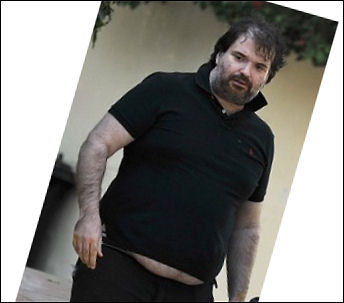
Alleged conman Simon Monjack, who’s come to be widely despised in the wake of the recent death of his late wife, Brittany Murphy, has spoken to the Daily Mail‘s Paul Bracchi in a 12.26 article, which has been echoed/reflected in a 12.26 Daily News piece by Soraya Roberts.


Simon Monjack

Both articles use George Hickenlooper‘s HE-posted opinion about Monjack (which appeared on 12.20) as a prosecutorial centerpiece.

People everywhere have been guessing/presuming that Murphy’s death was somehow Monjack’s fault. The thinking as I understand it is that no good can come of a marriage to an overweight scumbag with thinning hair and beard stubble, and that somehow Monjack’s allegedly skanky ways (nefarious wheeler-dealing, stealing from Peter to pay Paul, etc.) poisoned Murphy’s body or soul, and that in some curious roundabout way this contributed to her having a heart attack in the shower and dying soon after.

“My problem is that I do not look like Ashton Kutcher,” Monjack told Bracchi.

And he’s right. If you look like an undisciplined fatass people are going to presume the worst if — a big “if” — you hook up with a slender young actress. People are going to say, “Look at that bloated fat-ass…what’s his story? Why in God’s name would a famous actress hook up with a guy like that? Look at him! What is he, some compulsive cheez-whiz eater looking to advance his prospects by marrying her?”

Hollywood types also “don’t like the fact that [Brittany] married someone who was not famous,” Monjack added. “Here, stars like stars to marry other stars.”

There are reasons to consider that Monjack is some kind of scumbag apart from the fact that he looks like one. The lesson is that if Monjack did look like Kutcher, he’d be a lot better off reputation-wise. People see sloth and they assume the worst.

A Fragile Reed

Listen to this “Old Jews Telling Jokes” guy, Larry Greenfield, take a whack at the old lumberjack joke, and then watch Warren Beatty tell it in Reds. A joke is the most delicate thing in the world. If you don’t tell it exactly right (and I mean with exactly the right attitude and timing and pace), it dies.