Humpday Fence-Sitting

My initial inclination regarding Humpday, a Sundance Dramatic Compettion movie about two 30something buddies who decide to fuck each other on camera as a kind of amateur-porn Zack and Miri art project, was to shine it. Any and all movies involving the spreading of male butt cheeks generally gets a pass from me. (And I don’t want to hear any homophobic dings about this. Saying “later” to the watching of gay boning in Park City isn’t quite the same thing as putting it down or condemning it, God forbid.)
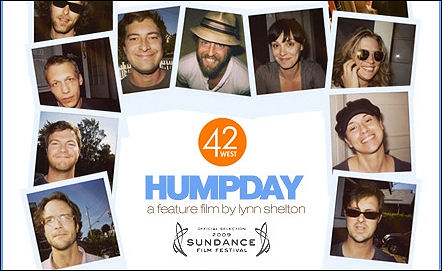
But now I’m thinking “maybe, I don’t know, possibly” due to two factors.

One, a form of semi-infectious enthusiasm coming from the “friends and colleagues” of Spoutblog’s Karina Longworth, who recently wrote that it’s “definitely the domestic narrative competition feature that’s come up most in conversation.”

And two, my having been invited this morning to a Humpday party and a press day, which…I don’t know, conveys a certain confidence and a suspicion that the film, directed and written by Lynn Shelton, might not be a huge problem. Staking a claim to respectability with a party can sometimes mean something. In the same way that it made sense, conversely, that Thinkfilm’s Mark Urman decided against throwing a party for Zoo, the horse-fucking movie that played at Sundance ’07.

I still say “trust no one” and “caveat emptor” when it comes to any kind of smallish Sundance movie looking for attention by pushing any kind of sexual-behavior envelope. Because, as we all know, any kind of “whoa, haven’t seen that before!” buzz tends to turn heads. And the ability to turn heads means next to nothing. Okay, it means something.

Polanski Helped By Victim

Respect, compassion and admiration for 45 year-old Samantha Geiner, the unwilling and way-underage recipient of Roman Polanski‘s predatory lust 31 years ago, for standing up and telling the Los Angeles County district attorney’s office where to go yesterday. Back off, enough already, stop your prosecutorial bullshit and bring this protracted case to an end.

Geimer filed a legal declaration asking that the charge against Polanski be dismissed in the interest of saving her from further trauma as the case is publicized anew, and claimed she’s being victimized again by prosecutors’ focus on lurid details of what happened to her. She also said that the insistence by prosecutors and the court that Polanski must appear in person to seek dismissal “is a joke, a cruel joke being played on me.”

A hearing is set for 1.21.09 on Polanski’s motion for dismissal. But prosecutors have said he must appear in person — an act which would risk his arrest. “If Polanski cannot stand before the court to make this request, I, as the victim, can and I, as the victim do,” Geimer said in the declaration, which was signed at her home in Kilauea, Hawaii.

“Unmistakably to its plinth”

Steven Soderbergh‘s Che “begins with a pair of boots. More than four hours later, that is pretty much how it ends, too. The first boots belong to Che Guevara (Benicio Del Toro), who is wearing them, together with his trademark combat fatigues, while being interviewed in Havana, in 1964. He wears the same outfit later that year, in New York, as a way of indicating, to the United Nations and to any bien-pensants who can gaze at him without drooling, that even in this city of chatter he remains an undaunted man of action.

“The second pair of boots, by contrast, is the last thing he sees, as he dies on the floor of a Bolivian hut; they belong to the officer who has come to check that Che, caught and shot, has finally given up his troublesome ghost. The visual echo is a fitting one, since, whatever the private impulses that fired this work, there is no doubting Soderbergh’s desire to shoot at ground level — not to linger on the loftiness of political ideals but, instead, to get down amid the dirt, sweat, and despair of putting them into practice.” — from Anthony Lane‘s New Yorker review, dated 1.19.09.

The ’30s Again?

“I won’t be surprised if studios start telling themselves that when money’s tight, it’s time to greenlight some feel-good stories,” L.A. Times/”Big Picture” columnist Patrick Goldstein wrote earlier today. “But trying to second-guess moviegoer tastes is like trying to time the stock market.

“Both the movies and the market are driven by irrational forces beyond anyone’s control. Everyone knows that moviegoers want good movies but no one has ever been able to figure out how to patent that secret formula. It’s too tricky a recipe: A great book can make a bad movie and a bad filmmaker can ruin a good script, but sometimes the most chaotic mess turns into a marvelous souffle.

“All we really know is that we know a good movie when we see one, whether the Dow’s scraping bottom or running with the bulls.”

Poor John

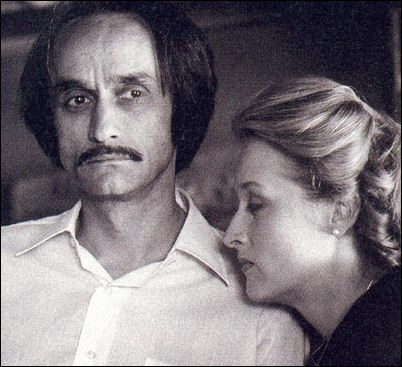
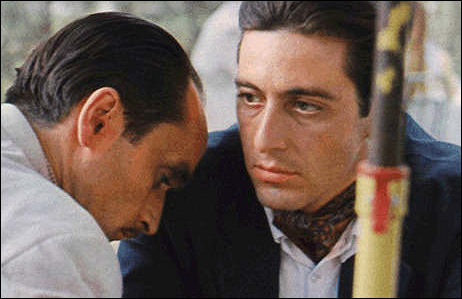
Richard Shepard‘s I Knew It Was You is a longish short (40 minutes) about the late great John Cazale. He was a brave, talented, funny-looking character actor with a big forehead who didn’t last very long. His masterwork was creating the legendary Fredo — a pathetic but touching figure — in the first two Godfather films. He also played the psychotic, fruit-loopy Sal in Dog Day Afternoon, a guy named Stan in The Conversation, and another guy named Stan in The Deer Hunter.

And that was it. Five films. A career cut short due to the 42 year-old Cazale dying of cancer right after shooting his Deer Hunter scenes in April 1978. Tough break and horribly sad.

But Cazale is remembered by people who know) from great acting, by fans of classic ’70s films, and obviously by his friends and co-workers, most of whom appear in Shepard’s film — onetime girlfriend Meryl Streep, costars Al Pacino, Robert DeNiro, Gene Hackman; directors Francis Coppola and Sidney Lumet ; and modern admirers Phillip Seymour Hoffman and Brett Ratner (who’s also one of the producers).

I Knew It Was You, destined for HBO and due to play five or six times during the Sundance Film Festival, isn’t what I or anyone else would call a shattering work of game-changing genius. It’s just a straight, honest and eloquent remembrance of a very worthy and gifted man. Neat, trim and clean. Anyone who remembers and treasures the way Cazale made Fredo into one of the saddest and most pathetic little men of the modern cinema needs to see this.

Nobody explains in the doc why Cazale’s Conversation and Deer Hunter characters were both named Stan.

The way Cazale crumpled down to a curb, hung his head and cried out “Papa! Papa” after Marlon Brando‘s Vito Corleone was shot on a street in Little Italy is one of the most memorable character-revealing moments in ’70s cinema.

Like all great artists, Cazale drew from his own hurt and history and put it right out there. Hiding and pretending and putting on a slick movie-actor front weren’t in his vocabulary. He was a man of respect, loyalty and courage. Think of what he might have done if cancer hadn’t come along.

Gilmore Re-worded

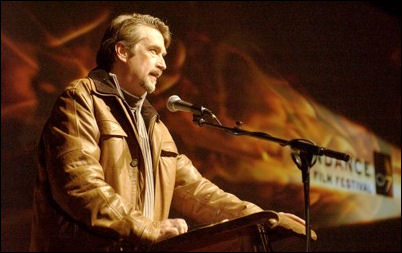
Sundance Film Festival director Geoff Gilmore has written a state-of-things piece for the new Indiewire called “Evolution vs. Revolution.” Here’s a taste with commentary interspersed:

Gilmore: “Audiences are changing. The over-30 audience is the target for much of the independent arena.” Wells: Because a significant portion of the over-30s (more like the over-50s) have a habit and a history of reading reviews in magazines and newspapers. Most of the under-30s glance at the scores on Rotten Tomatoes. Maybe. The majority just watch trailers online or in theatres, and that’s it.

Gilmore: “Whereas the new generation represents an interesting contradiction. There is no question that the current college audience is much more sophisticated about cinema — about art film or international and independent work than my generation was 30 years ago.” Wells: Yes, they probably are. But we’re talking about a small percentage of this group — i.e., the early adopter film-savvy sector. A fairly small slice of the pie.

Gilmore: “But frankly they seem to have less interest in it.” Wells : Could this have anything to do with the fact that many under-30s have the attention spans of gnats? That chronic ADD is fairly rampant among them?

Gilmore: Or at least they have a greater range of activities to engage in and thus are more selective and demanding about how they are going to spend their hard-earned dollars.” Wells: Fair enough.

Gilmore: “It’s difficult to say whether the new generation will continue to harbor the passion for film that we had.” Wells: Difficult to say? Obviously the movie passion among most under-30s is much less than it was 20 or 30 years ago. 40 years ago is like 400 years ago. No bearing whatsoever on the present. They’re into whatever’s going — online videos, video games, TV series, a movie at the plex, ESPN, Nickleodeon, etc. But almost never an “old” movie — i.e., a film made before 1990. And forget absolutely looking at anything in black and white.

Gilmore: “Independent film has broken a lot of ground and had a lot of success in the last two decades. But what was innovative then is now familiar. Whether new audiences can be intrigued by innovative independent work, coaxed by critics, and motivated by marketing, whether they will be interested by new subjects and artistic invention, remains to be seen.” Wells: If you know anything about the term “remains to be seen,” you don’t need me to explain it. But I will anyway. It means that things are doubtful, don’t look good, don’t count on it, etc.

Don’t Say It

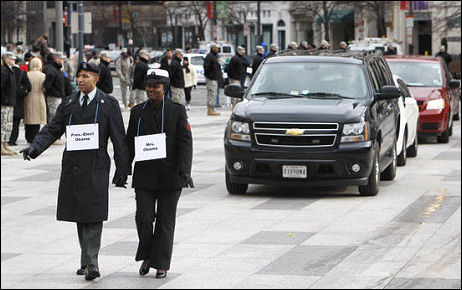
There was a big dress rehearsal in Washington, D.C. yesterday for the various inauguration events and festivities. Army Sgt. Derrick Brooks stood in for President-elect Barack Obama and Navy Yeoman 1st Class LaSean McCray stood in for Michelle Obama. But honestly? The photo below gave me pause.

Deal With It

After 30 Rock‘s Tina Fey used her Golden Globes acceptance speech to bash neg-head posters on TheEnvelope.com‘s message board, The Envelope‘s Tom O’Neil offered an apology. But why apologize for snarky mean things said by talk-backers? It’s part of the digital rough-and-tumble out there. Apologize for your own words and deeds and that’s all.

Winslet’s Double Win

In a weird roundabout way the Golden Globes seem to have a bit more integrity this morning due to last night’s double-awarding of Kate Winslet — a Best Supporting Actress award for her performance in The Reader and a Best Actress trophy for her work in Revolutionary Road. But in another way the HFPA looks like the same old shop of whores.

We all believe that the Hollywood Foreign Press Association — the ultimate organization for obsequious celebrity suck-upping — “cooks” their nominations so as to ensure as many big names as possible showing up for the GG telecast. By this I believe that the ratings-mindful membership knows exactly who to nominate — no homelies, no dull indie-realmers (or as few as possible), and mostly big-name glamour types.

I don’t think the HFPA “cooks” the winners, but if I’d been tabulating this year’s votes I might well have gone to HFPA president Jorge Camara and said, “Jorge — why does Kate Winslet have to win two awards? Isn’t this a bit much? How does anyone figure her role in The Reader was supporting, for one thing? And what about the wonderful Viola Davis in Doubt? Or Penelope Cruz in Vicky Cristina Barcelona? Those were fierce blazing performances. It just seems excessive to give two awards to Winslet…no?”

But the fact that she got two tells us nobody went to Camara and said,”C’mon, man…let’s fix this.” It tells us that the left hand didn’t know what the right hand was doing. Nobody cooked anything. Anyone trying to fix the results would have thought like the rest of us — that Kate didn’t have to win twice and that Davis and Cruz really deserved their moment in the sun.

But it also tells us that the HFPA are huge bend-overs in that they totally bought the “Kate is finally due after all those years of being nominated and not winning an Oscar” argument. They wanted to be the good guys who turned things around — they knew it would be a big emotional moment. They clearly wanted to be the first to show her some awards love in a way that would result in headlines and goose the Academy members who haven’t yet voted to follow suit.