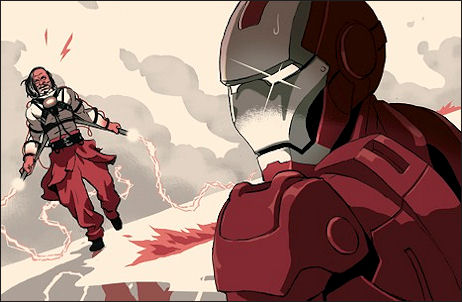
"Melted Alive in Acid"

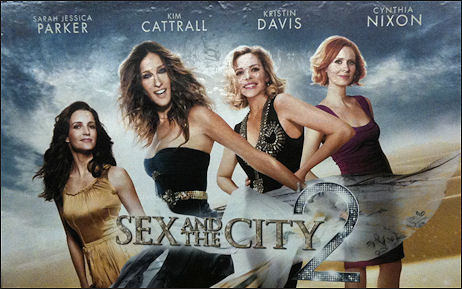
Could there possibly be a more toxic symbol of the utter nowhereness of girlie America than the forthcoming Sex and the City 2 (Sony, 5.27)? What could have better inspired that jerkoff who tried to blow up Times Square the other day? Wallowing in the backwash of the Bernie Madoff and Goldman Sachs-styled profiteering that brought the U.S. to the brink of economic disaster, Carrie and the girls are glaring symbols of everything that was excessively rank about the pre-meltdown 21st Century economy.

If it weren’t for the sexual component there’d surely be a price on their heads. To me the visual import of this poster, which is starting to show up in NYC subways, is no different than, say, photos of naked obese winos defecating on the sidewalk. You think it’s just an HE thing? How then to explain this clip from a parody video on theonion.com?

Duelling Lovelaces

The news about Lindsay Lohan intending to star in a Linda Lovelace biopic called Inferno is not some idle threat. The project, to be produced by The Killer Inside Me‘s Chris Hanley and directed by Matthew Wilder, will reportedly be officially “announced” at the Cannes Film festival. (With what — a billboard?)

So in addition to gathering a rep as a self-destructive burnout druggie who’s ruined her career, Lohan wants to portray a tragic oral sex queen. Brilliant career move! And classy! On everyone’s part! Let’s see….can’t be hired, heading down the tubes, an obit waiting to happen…I know, let’s hire her to simulate blowjobs and clean up in Asia and Russia and Eastern Europe!

The Inferno announcement means there are now two Lovelace projects, the other being a forthcoming drama from Howl‘s Rob Epstein and Jeffrey Friedman and screenwriter Merritt Johnson.

May 3, 1941

Go to the six-minute mark in this clip from Sullivan’s Travels and watch until it ends. And then read this apparently legit copy of Preston Sturges‘ screenplay for this scene, but with deletions included. Veronica Lake: “Is Hitchcock as fat as they say?” Joel McCrea: “Fatter.” Lake: “Do you think Orson Welles is crazy?” McCrea: “In a very practical way.”

Au Hasard Joey

I would have respected Steven Spielberg‘s ambition if he’d decided to remake Robert Bresson‘s Au Hasard Balthazar (1966), a classic Christ parable about the suffering of a donkey as he’s transferred from owner to owner and is mostly treated with cruelty. Spielberg would have added the usual sentimentality, of course, but it would have been ballsy to step onto Bresson’s turf — I for one would have saluted — and it would have played into Spielberg’s strength as a distinctive helmer with keen mise-en-scene instincts.


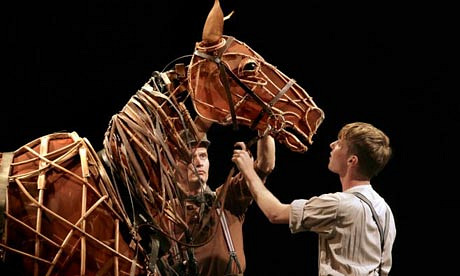
A scene from the 2009 London stage production of The War Horse.

Instead, Spielberg has decided to direct The War Horse, a film version of a 2009 London play about a poor put-upon horse named Joey as he’s transferred from one owner to another during the time of World War I — from a British farm boy to the British cavalry to the German army and back again.

Nick Stafford‘s play, which is based on a children’s novel by Michael Morpurgo, is closer to Spielberg’s natural wheelhouse. It’s an anti-war piece that has simple strokes, and which was aimed at kids to begin with. Plus it has ample sentimentality — (a) a kind of Lassie Come Home story about a boy and his horse being separated, (b) a scene with German and British soldiers impulsively ceasng hostilities in order to save the wounded Joey’s life, and (c) a finale that some book reviewers have described as contrived and cloying. Plus it will also allow Spielberg to half-riff on Bresson’s film without having to acknowledge this, and to try and out-shoot the trench-warfare scenes in Stanley Kubrick‘s Paths of Glory.

So that’s the deal with The War Horse — a possible lunge at Oscar-level kudos, a Spielbergian hack move, another attempt at mass emotional manipulation, a sprinkling of art-film pretension, and yet a chance for Spielberg to show his stuff as a strongly visual storyteller who doesn’t need the engine of dialogue.

Plus it’s another way for Spielberg to avoid directing the Abraham Lincoln movie, which he’s always been intimidated by regardless. He wouldn’t pull the trigger on this project for years on end, presumably because it didn’t look commercial enough to the studios, and is now cowering even deeper in the closet with Robert Redford‘s The Conspirator having stepped in as a similar-type period drama about Lincoln’s assassination.

When I think of Spielberg these days, I think of a rich bearded toad wearing spectacles and a baseball cap.

Thinking Man's Disaster

I wasn’t initially intrigued by the news of Summit’s acquisition of The Impossible until I realized it’s from director Juan Antonio Bayona (The Orphanage). That changes everything. That plus it being a $45 million drama “based around a true story set during and after the Indian Ocean Tsunami in 2004 that incorporates mystery, horror and fiction.” Naomi Watts and Ewan McGregor costar. I’m there.

The last intelligent disaster movie involving a big wave was Peter Weir‘s The Last Wave.

Just A Beard

Every guy knows that growing a beard is a way of saying “fuck it…I’ve just been through a searing drama or trauma of some kind and I’m kinda sick of keeping up with the clean-cut appearance so, you know, I need to go boho for a while.” Some guys grow beards and keep them for years (or all their lives) because they look good and it fits who they are — a different deal altogether. But temporary beards are about expressing emotional recovery, or in some cases an urge to announce a different attitude.


Watch CBS News Videos Online

I grew whiskers after losing my job with People magazine in March 1998. I still had my L.A. Times Syndicate column but my Mr. Showbiz column didn’t start until October and I was kind of upset about losing the People income. Growing a scraggly Bob Dylan beard (which is all I’ve ever been able to manage) felt right under the circumstances.

Last night the Hollywood Reporter‘s Andrew Wallenstein opined that in yesterday’s 60 Minutes appearance Conan O’Brien came across as more tragic than comic…a deeply hurt individual licking his wounds for all to see.” Well, sort of but not really. Hurt, yeah, but not deeply. He seemed okay to me, but the beard pretty much said it all.

Early Departure

I’m sorry that Lynn Redgrave has passed at the age of 67. It’s a raw deal to be taken out by breast cancer at a relatively young age, and another jolt for the Redgrave family after the loss of Natasha Richardson (i.e., Lynn’s niece, Vanessa’s daughter) last year and the death of Corin Redgrave, a brother, last month.

Lynn Redgrave was nominated, of course, for Best Supporting Actress in 1999 for her colorful housekeeper turn in Bill Condon‘s Gods and Monsters, and then 32 years before that for her performance in Georgy Girl, which came out in 1967. She had her very first role in Tony Richardson‘s Tom Jones, and — this isn’t exactly significant but it bears mentioning — was the first name actress to engage in a strongly suggestive (if off-screen) oral-sex scene in a mainstream film, i.e., Sidney Lumet‘s Last of the Mobile Hot Shots (1970).

I always thought of Lynn Redgrave more in terms of being respected and well-liked than shall we say incandescently gifted. But whom among us can claim this? In any case my sincerest sympathy and regrets.

London Pallies

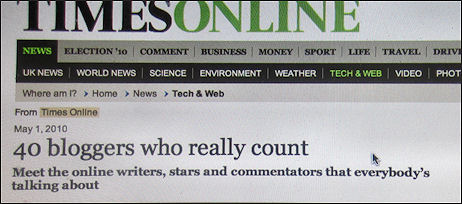
Last weekend the Times Online‘s Ben Machell and Killian Fox posted a piece called “40 Bloggers Who Really Count,” and in so doing declared that Hollywood Elsewhere and Nikki Finke‘s Deadline.com dominate in the Hollywood realm. A decent plug if I do say so myself.

“A good Tinseltown blog needs a dash of eccentricity, and Hollywood Elsewhere, home of veteran movie reporter Jeffrey Wells, is deliciously entertaining as well as informative and insightful,” they wrote. “When not goading his legion of readers with fiercely opinionated posts on everything from the Oscars to cinema-going etiquette, he’s airing strongly held political views and curious details from his everyday life. Posts come thick and fast, and he’s as conversant with world movies and classics as he is with the latest 3-D Hollywood juggernaut.”

Seriously, guys — thanks much.

"Weight of Dead Plot"

The Iron Man 2 filmmakers and characters “are so plainly enjoying the ride that to watch [the film] slow and stall, under the weight of dead plot, is a cause for regret,” writes New Yorker critic Anthony Lane.

Director Jon Favreau, screenwriter Justin Theroux and the cast “have a mind to attempt what no other team has done: to take the built-in hyperbole of the genre and treat it as food for laughs. Iron Man’s aspirations are as puffed up as those of Batman, Spider-Man, Watchmen, Fantastic Four, and the rest of the gang, but the telling of his tale feels more leavened and less savage than theirs, and it’s a pity that Favreau didn’t go the whole way and toss out the creaky narrative junk.”

Robin vs. Martians?

Ridley Scott‘s Robin Hood (Universal, 5.14) will have its bicoastal all-media showings on 5.10, but the first peek-out happens tomorrow (same day as the Iron Man 2 all-media screenings). And none too soon for I’m feeling genuine confusion about what the plot and theme may actually be about.
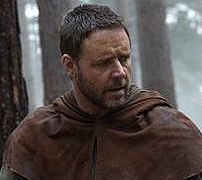

Russell Crowe’s Robin Hood vs. George Pal’s Martin sentinels = potential cinematic bliss.

A 5.2 L.A. Times piece by John Horn, which quotes Scott and producer Brian Grazer and screenwriter Brian Helgeland, states that the basic theme is about throwing the bums out — ridding England of “a king with little concern for his subjects — and “[taking] the country back.”

Except Russell Crowe‘s Robin Hood and his merry band of men “are far less interested in redistributing the wealth than making sure King John (Oscar Isaac) focuses on the people in England,” Horn writes.

But “focuses” in what way exactly? What other issue could there be in the 12th Century except the availability of ample food, clothing and shelter for the general populace? Hasn’t economic inequity been the driving theme of all Robin Hood sagas since the days of Douglas Fairbanks? And yet Horn suggests that King John’s primary failing is about not adequately protecting England from French invaders. One indication of John’s corruption, Horn writes, is that he’s “in cahoots with a villainous adviser (Mark Strong‘s Sir Godfrey) who purports to be English, but he’s as French as foie gras.”

And yet on 4.10 Crowe seemed to tell the Sydney Morning Herald‘s Peter Fitzsimons that economic unfairness is the key element.

“Robin is not a superhero,” he explains. “He doesn’t have a cape. He’s normal. He’s just a bloke. But he’s a man who’s seen a lot of things and understands how it all works. [Going back and forth to the Crusades] he’s been through France, been through Italy, seen the control of the church, been through Greece and he understands that democracy works. He’s seen all of the great empires of his time, come back to his own country and realizes that his own people are the poorest of all, and that things must change.”

In other words, Robin believes that England’s 12th Century poor must stand up to greedy royalists and demand a fairer economic shake — isn’t that what Crowe seems to be saying? So how does this square with Horn’s statement that Robin and the boys are “less interested in redistributing the wealth”? And on top of all this the French are invading?

You know what might work? If Robin and King John and the French had a common enemy — i.e., invading aliens from another planet. That, at least, would result in a clear line. We have Cowboys and Aliens coming out next year, and there’s that Pride and Prejudice and Zombies book. Clearly the current direction is to blend history with the fantastical. A Robin Hood-meets-War of the Worlds flick would have been inspired.