Winning Stripes

Speaking of Mike NicholsSilkwood, I recently read a story about Cher going to see the film’s trailer at a theatre in Westwood (which would have been sometime in the fall of ’83) and feeling crushed when the audience laughed upon realizing that she was a costar. She called up Nichols in tears and he said “don’t sweat it, hang in there…it’ll all change when they see the film.” And it did. Two years later she did Mask, and then she won her Oscar for Moonstruck in ’87.

I’m trying to think of another professional slumper or go-alonger who was looking to boot things up, and who got lucky by landing a role in an above-average film, and then turned in an acclaimed performance. Right now I can only think of only two — Frank Sinatra and Greg Kinnear.

Sinatra’s turn as Pvt. Maggio in From Here to Eternity saved his life. His singing career had been dwindling since the late ’40s, and by the time he made Eternity in ’52 he was regarded as being all but over. Kinnear was been a lightweight actor who was mainly known for hosting E’s Talk Soup (’91 to ’95) and NBC’s Later (’95 to ’96). He finally broke into the serious-actor ranks by playing “Simon the fag” (i.e., in the parlance of Jack Nicholson ‘s character) in James L. BrooksAs Good As It Gets (’97).

I guess Steve Carell‘s hailed performance as a morose gay uncle in Little Miss Sunshine qualifies. His comedy career had been going great guns since he broke through in Anchorman: The Legend of Ron Burgundy (’04) but Sunshine gave him serious-actor cred and the option to go the Adam Sandler route — i.e., make one smalish quality-level film every three or four years while mostly cranking out audience-friendly crap. But since Sunshine Carell has done only one other smallish good film — Dan in Real Life.

Who else?
Sit Down, Stand Up

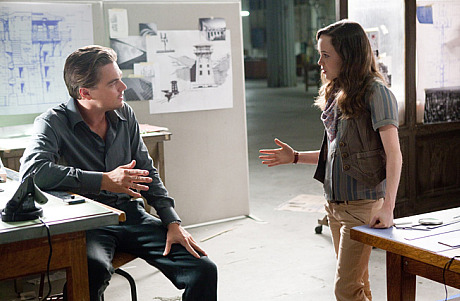
When an actor sitting down is almost eye-level with an actress who’s standing up, and the actress isn’t playing his six year-old daughter and the actor is slumping a tiny bit in order to compensate, you’re talking about a fairly unusual physical dynamic in a movie. You do have to admit that. Perhaps this isn’t even a frame-capture from the film, and therefore a moot point. Directing 101 says to never compose a shot that emphasizes radical physical disparities, and Chris Nolan is no dummy.

Thankfully, Leonardo DiCaprio and Ellen Page play colleagues in Inception and not lovers. (If they had it would have meant a repeat of the bizarre body disparity between Page and Michael Cera, who looked almost Richard Kiel-sized when he stood next to her.) I realize that 6’8″ guys sometimes go out with women who are 5’2″ and who weigh a good deal less (120 or 130 pounds), but it’s still weird to visually consider the idea of two adults being this different in size and yet conjoined in some way, even professionally.

I discussed Page’s size issue ten and 1/2 months ago.

Burden of Brains

Now that the word is out about a certain upcoming film possibly being too smart for the room, I’m trying to recall which other films have earned this distinction.

Obviously it’s an honorable thing for a mainstream film to be accused of dealing cards that only the A students are going to fully appreciate. Lord knows that most films cater to C and D students on the theory that they cast a wider net.

Critics as a rule don’t like to even acknowledge the existence of “too smart” movies because to do so implies that perhaps they themselves didn’t get it, and that may lead to their editors getting ideas and maybe canning their ass down the road. I’m one of the few critics or columnists to have actually admitted to feeling intellectually challenged by a film. On 3.7.09 I openly stated that I wasn’t smart enough to fully understand Tony Gilroy‘s Duplicity.

All I can say is that the public sure as hell recognizes “too smart for its own good” when it happens, and woebetide the movie that gets painted with this brush.

There are some films, I imagine, that shoot themselves in both feet by being too smart and too hip for the room at the same time, although I can’t think of a good example at the moment. David Fincher‘s Zodiac, one of the greatest films of the last decade, possibly qualifies in this regard. It’s much more common to be described as simply “too hip or the room,” although hearing this about a film makes me want to see it immediately.

Grindhouse was obviously no intellectual puzzle movie, but it was definitely too hip for the room. Michelangelo Antonioni‘s wonderful early-to-mid ’60s hot streak was rooted in the chic allure of being too hip for the room — he was a genius at this. By refusing to tell the audience what happened to the missing girls, Peter Weir ‘s Picnic at Hanging Rock became this sort of film in a very admirable and dazzling way. Michael Haneke is a brilliant fellow, but he’s always out-smarting himself, I feel. Pretty much every Coen Bros. film ever made has been too hip for the room — that’s their badge of honor — but their movies are never confounding. Greenberg was too hip for the room.

But what others besides Zodiac were too intellectually complex and too off on their own aesthetic-attitudinal beam to attract at least a fair-sized audience?

Know-How

Fred Ward tells a joke — familiar now, not so much then — in this scene from Mike NicholsSilkwood (’83). It starts at the 6:18 mark. I’ve told this joke myself for the last 26 or 27 years, but I can never quite tell it with just the right timing and emphasis. The singer, not the song. I made this same point last December.

Cake Frosting

I love the way David Lynch says “When you don’t have final cut, you stand to die the death….die the death.” I don’t like that look of solemn de-emotionalized conviction on Catherine Breillat ‘s face. I’m irritated by the gray-white streaks in Agnes Varda‘s dyed red hair (either embrace au natural or do regular salon visits). And it’s great hearing John Sayles say that “New York-area Hispanics do talk loudly but we don’t like to talk about this.” And I love blonde hair.

Which is a way of saying that I watched Great Directors again last night and really enjoyed the leisurely vibe of it. It’s like going to a party on a Sunday afternoon with several fascinating film directors and everyone not being seized with being funny all the time. If there’s one thing more loathsome than various people sitting around a table and feeling the urge to make each other howl with laughter (and obliging in kind when a table-mate makes the effort), I’d like to know what it is.

Yes, I’m kidding about the Sayles quote but I couldn’t resist.

Just Not Done

This is a minor thing I’m about to complain about, but yesterday I was watching a video of Leonardo DiCaprio talking about shooting portions of Inception in Paris, except he called it “Pair-iss.” And at that moment the ghosts of Arthur Rimbaud, Honore de Balzac, Edith Piaf and Yves Montand howled in unison.

DiCaprio was raised in East Hollywood, Los Feliz, and Echo Park areas of Los Angeles, and has a kind of twangy, flagrantly non-boarding-school accent. I’m not trying to make this into a huge thing but as soon as I heard “Pair-iss” I said to myself, “Good God…that’s as bad as saying Eye-rack or Eye-talian.” It’s as bad as American grunts going to Paris in World War II and calling Pigalle, the Parisian prostitute district just south of Montmartre, “Pig Alley.”

For those smirking because they themselves say “Eye-rack,” the way to pronounce it (for the eighth or ninth time) is either “Uhr-rahq,” which is how the natives say it, or “Ihr-rahq,” which is how I say it. And with the accent on the second syllable. Anyone who says “Eye-rack” needs to get a clue because they sound like Clarence P. Muckle from Hayseed, Nebraska.

I’m Not There

There’s a certain kind of mannered “attitude acting” among under-30 actresses that’s been driving me vaguely nuts for the last decade or so. Megan Fox heavily relies on this affected speaking style (as the video below indicates) but real actresses like Amanda Seyfried and Zoe Kazan resist it. It’s a style of delivery and a tone of voice that basically conveys mock-haughty, insolent smirk and contemptuous put-on.

It’s basically an underlying attitude that says “what you’re saying right now is, like, such a turn-off for me? It’s such a total turn-off, I mean, that I’ve decided to eliminate even the faintest trace of emotional sincerity in my reedy Minnie Mouse voice? As in, like, I’m saying the words but you’re not there and, uhm, neither am I?

“Even when I’m relaxed among friends and just, you know, talking shit and killing time because nobody cares and we’re all hangin’ back? Even then I’m going to use these ‘no way…you’re sitting there and telling me you’re actually serious?’ inflections. Because I can’t help it. It’s part of me and my friends and our whole generational ‘you are so not getting through to me’ attitude.

“So when things get dramatic and confrontational in a movie I’m going to just, like, cock my head and arch my eyebrows and speak in a beyond cynical, convulsed-with-disgust ‘I can’t believe I’m lowering myself to even speak to you’ sing-songy tone and pretend to be someone else in a ‘how dumb or disgusting can you be because I’m, like, so pretending to be someone else right now’? sort of way.

“Or else I’ll faintly smile and use one of those serene-robot gazes as I pledge loyalty or compliance or obedience. Which we both know is total bullshit but it’s fun to pretend to be a fake Stepford wife as a way of letting you know that’ll never happen.

“Because my contempt for you and guys who always seem to say the kind of stuff you’re saying has become, like, extra-refined. I’ve got an attitude shell that you’ll never penetrate…forget it. Even when I’m throwing my head back and laughing with my friends at Starbucks, it never leaves.”

This speaking style is so persistent and widespread that it obviously comes from within in a cultural-generational sense that’s almost, well, genetic. It’s noticable among both genders but particularly, or so it seems, among younger women. It’s related to generic Minnie Mouse mall-speak, which you never used to hear in the ’70s or ’80s or ’90s but is absolutely ubiquitous now.

If I was an acting teacher I would tell my female GenY students to completely rid themselves of this “I’m not there” tone in their speaking manner — to identify it and slaughter it and bury the carcass deep. I would make them watch DVD clips of real actresses letting go in a real way until the differences between emoting from the heart (or at least from an intelligent mind with the use of a sizable vocabulary) and smugly mannered squeak-squeak “attitude acting” is coming out of their ears.

Stalloney

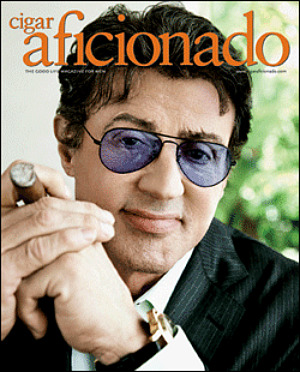
Marshall Fine has written a profile of Expendables auteur Sylvester Stallone for Cigar Afcionado, the super-slick, exuding-the-’90s older-guy magazine that doesn’t believe in offering online samples or one-time-only online access. Fine was good enough to supply the first 400 or so words.

“Sylvester Stallone aims a remote-control device at the flatscreen TV in his Beverly Hills production office, and an image pops up from a documentary about the making of his newest film, The Expendables.

“It shows Stallone — still in remarkable shape at 63 — being body-slammed into a brick wall in the catacombs of what is supposed to be the capital of a Latin American island republic. Stallone, a solidly built 5-foot-10 with what looks to be about 4 percent body fat, is the slammee – and the slammer is the massive Stone Cold Steve Austin of World Wrestling Entertainment fame, a daunting 6-foot-2 and 250 pounds of manhandling brutality.

“A cloud of dust rises — and as it settles, Stallone calls cut, then says, “Shit,” puts a hand to the back of his neck, and walks off the set.

“Back in his office, Stallone hits pause on the remote, then reaches into a drawer in his desk, rummages around in a file and comes up with an x-ray: his neck, with what looks like a small clothespin on one of the vertebrae.

“‘I’ve got a bolt in my neck where he cracked the vertebrae,’ Stallone says. Then he flicks the DVD back into action: It’s Stallone, looking at an MRI of his shoulder from the same hit, with a doctor telling him he needs surgery to correct the blown rotator cuff he also suffered.

“‘I knew it was really fucking bad,’ Stallone says, indicating the image on the TV screen. ‘The doctor wanted to fix my neck and my shoulder right then. But that would have meant closing down the movie.’

“Stallone eventually had a quartet of surgeries to repair the damage that comes from doing 90 percent of your own stunts – but not until after filming was complete. The Expendables, set to open in mid-August, never halted production for Stallone to have his injuries repaired.

“‘I just wanted to do something original, something physical, something that would keep me young in the brain – so I don’t have to admit I can’t do this anymore,’ Stallone says with a rueful smile.

“Still, he has another message as well: I’m human. When Stallone escapes Austin’s clutches and gets back to his own men, one of them asks, ‘Where have you been?’

‘Getting my ass kicked,’ comes the reply, with an ‘at least I survived’ shrug.

“As Stallone points out, his first paying job as an actor was in 1970 – which means that, as of 2010, he’s been in the business for 40 years. But in all that time, a Sylvester Stallone character had never uttered those words.”

Fine has seen a rough cut of The Expendables but can’t share, so there.

In and Out


Independence Day decoration on a 19th Century home in Redding, Connecticut — Saturday, 7.3, 12:30 pm. Love those half-moon flags.

Lobster flip-flops — Saturday, 7.3, 8:15 am.

The opening two paragraphs from Truman Capote’s Music for Chameleons.

“What’s Your Name?”

I paid $30 dollars earlier today for a Taiwanese DVD of Eliza Kazan‘s Viva Zapata, which has never been on a legitimate domestic DVD. The packaging was low-grade, the copy was crudely written, and the word “remastered” across the top smelled of bullshit. But to my great surprise, this 1952 film looks tolerable. Second-generation, not detailed enough, jumpy action footage, etc. But it could have been much worse. It would be wonderful someday to see a Bluray created from good elements.

Last of Elegant Breed

I didn’t know Ed Limato, the admired ICM, William Morris, ICM and finally WME talent agent who’d had emphysema for a long while, and who slipped away earlier today. Limato apparently wasn’t one to consider, much less invite or nurture, relationships with journalists. But like everyone else I knew his rep as a classy, elegant fellow. Here are tributes by (a) WME story editor Christopher Lockhart, and (b) Indiewire‘s Anne Thompson.

“Limato was old-school,” Thompson writes. “He was courtly, well-mannered, well-spoken, charming. He was blind-sided when Michelle Pfeiffer left him for CAA, but took her departure gently, told her that he understood and that if she changed her mind, he would welcome her back with open arms, no questions asked. He cared. He fussed. He threw tantrums. He apologized. He was not a Sammy Glick. In fact, he was himself — not one of those faceless foot soldiers that have come to populate the streets of Wilshire Boulevard.”