Dreaded Socialism

“Let’s create a luxury tax for Hollywood,” Marshall Fine has suggested, “comparable to the one Major League Baseball invokes whenever a team tries to buy itself a pennant by stocking up on expensive star players.

“Except, in the case of Hollywood, this would be a tax that Hollywood would charge itself every time it makes a movie that costs $100 million or more. There would be a tax of X amount of dollars — let’s say 10 percent — for every $10 million over the $99-million mark a movie’s budget goes (and I’m including the cost of advertising and marketing, which can double a movie’s price-tag). And we’d round up, from $101 million.

“That money, in turn, would go to a not-for-profit fund to help underwrite less affluent artists. It could be used for grants for low-budget independent films. Or perhaps — given Hollywood’s reputation as a hive of liberalism — it could be earmarked for the National Endowment for the Arts, which always has a bulls-eye painted on it by conservatives, targeting it for elimination.”

There’s no question about one thing: 93% of the time a smaller budget always results in greater creativity. Yes, 7% of the time an expensive movie will seem to be worth the cost with most of the the dough having been spent wisely and excitingly. Okay, make it 10% or 12% of the time. But the rest of the time big-budgets just smother the spirit.

Bygone

Remember the old days when DVDs would deliver boxy, full-frame versions of films shot at standard Academy ratio of 1.37 to 1 (but which are routinely masked off at 1.85 to 1 when they’re shown in theatres)? Those are pretty much gone, and I kinda miss ’em. I like height (i.e., lots of headroom) and I love boxiness. But the 16 x 9 fascists have pretty much killed that aesthetic. Old studio-era films (mid-1950s and older) are still mastered at 1.37, of course, but that’s the extent of it.

Some day boxy frames will be regarded with the same damp-eyed nostalgia that old-time record collectors feel for 45 and 78 rpms.

Defect?

Three months ago author-critic Richard Schickel told L.A. Weekly interviewer Richard Wasson that Martin Scorsese, the subject of a then-new book, “has an utter inability to say anything bad about any movie. I’d say, ‘You know, this is a turkey, Marty,’ and he’d say, ‘Yeah, yeah, I know. But there’s this shot in the third scene…’ It’s almost comical. I think that’s the little kid in awe of the image on the screen, buttressed by the fact of how he knows how difficult it is to make a good movie.”

Which reminds me: whatever happened to Fake Schickel? The guy stopped posting a month ago.

Covert Op

I don’t like tweets in which journalists talk about being at a press junket without saying for what movie or especially what city or country. Travel always generates a slight quickening of the pulse, and I don’t see why a traveller wouldn’t want to share the particulars. It’s not like they’re working for the CIA. I’m guessing this is related to the Moscow junket for Transformers 3. Others are just saying, “Moscow…yeah!”

Very Good Longworth

“At least Bad Teacher offers opportunities to ponder an evergreen pop-culture conundrum: At what point do professional performers with evident talent and a proven ability to make smart choices realize they’re trapped in a film that — due to lazy writing, style-free direction and visual design, and a general refusal to aim above the lowest common denominator — simply can’t be good?

“What compels someone like Justin Timberlake — so charismatically contemptible in The Social Network, so often a saving grace on SNL — to take a role centered on a cringe-worthy set-piece involving him dry-humping his real-life ex-girlfriend? Are actresses like Cameron Diaz and Lucy Punch really cool with punishing material based on the worst male-invented stereotypes of the way women deceptively control men and compete with one another? If they’re at all conscious of what they’ve gotten into, did they try to make it better, or did they submit to mediocrity because, you know, fuck it — the check cleared?

“Are they so far inside that they can’t possibly gauge what the fix they’re in might look like from the outside?” — from Karina Longworth‘s L.A. Weekly review.

Answer: The cast of Bad Teacher submitted to mediocrity because, you know, fuck it….the check cleared.

Falk

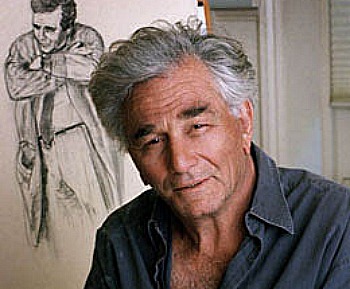
I was milling around a Hollywood hardware store sometime in the early ’80s, looking for a screwdriver or something, when I heard raised voices. Two or three Joe Sixpack-type meatheads were having fun at the expense of Peter Falk, who was poking around like me, just wandering down the aisles. “Aaaaay…Detective Columbo!,” one of them was saying with the rest joining in. They just had to treat Falk like some kind of visiting celebrity alien. They couldn’t be decent about it. They had to be assholes.

And I remember how the perturbed Falk walked right by me as these jerks were taunting him and making their little lame-ass cracks, and how he was trying to ignore them but at the same time was fiercely cussing and not all that quietly, going “Jeezus!….Jeezus!” I remember thinking to myself and trying to telepathically say to Falk, “Yes, yes…keep going! Turn around and let’ em have it! You can do it, Peter!”

Did Falk ever have a movie role in which he hit it out of the park? Did he ever even hit a long triple? Yes — in Raymond De Felitta and Paul Reiser‘s The Thing About My Folks (’05). Which nobody saw, of course. He was also memorable in a relaxed and settled and kindly way in Wim WendersWings of Desire (but less so in Far Away, So Close). And he was especially fine (and perhaps delivering his career best) in John CassevettesHusbands and A Woman Under The Influence.

Falk’s peak run was from ’69 to ’74, when he was 42 to 47 years old. He began the streak in ’69 when he costarred as Sgt. Ross in Sydney Pollack‘s Castle Keep, and then played Archie Black in Husbands (’70) and did A Woman Under The Influence (’74) , and all of this while starring as Lt. Columbo from ’68 to ’03.

Oh, yes…The In-Laws (1979)! Of course! Make that a ten-year streak.

I saw him play the desperate Shelley Levene in an early ’80s Hollywood stage production of David Mamet‘s Glengarry Glen Ross. It wasn’t entirely successful as Falk didn’t seem to understand or accept that you can’t play around with Mamet’s dialogue — you have to say it exactly as written.

The poor guy began to succumb to the vicious destroyer known as Al Z. Heimer a few years ago. Not an easy way to wind things down. Getting old isn’t for sissies. Falk was a very fine artist in his time and place, which, as it turned out, was pretty much his whole life.

To this day I can’t remember which eye was the glass fake and which was real.

Rayfiel

Legendary screenwriter David Rayfiel, whom I had the honor and pleasure of interviewing about 15 years ago, died yesterday at 87. He was without question one of the greatest writers of adult romantic-emotional dialogue in film history, but he mostly worked as an uncredited pinch-hit guy for Sydney Pollack. Even in Pollack’s lesser films there are portions that have a gently eloquent seep-in quality, and Rayfiel had a hand in most if not all of these.

The Gene Hackman-Jeanne Tripplehorn scene at the Grand Caymans bar in The Firm. The finale of The Way We Were between Robert Redford and Barbra Streisand, outside the Plaza hotel. The railroad farewell scene between Redford and Faye Dunaway in Three Days of the Condor. Those satisfying intimate moments between Redford and Jane Fonda in Electric Horseman . Those portions of Sabrina and Random Hearts, even, that deliver a wise, resigned, sadly touching quality.

Rayfiel was more of a colorist — a caster of mood spells — than a full-on screenwriter. And he always had a very delicate but precise touch. If you wanted him to write a love scene with shadings of mauve, Pollack once said, he would give you exactly that.

How many screenwriters today know or even care what mauve dialogue is?

Rayfiel also worked with Bertrand Tavernier (Round Midnight, Death Watch), Sidney Lumet (The Morning After) and Ingmar Bergman (The Serpent’s Egg).

A director-screenwriter pally wrote a few minutes ago to say “if you have time, check out Rayfiel’s war record. I believe he was a distinguished hard combat veteran in both WWII and Korea.” To which I replied: “It’s funny but Pollack never mentioned that to me (or so I recall) and Rayfiel himself never brought it up either when we spoke two or three times in the ’90s.

“That generation never talked about WWII….they never raised the subject unless you pressed them, and if you did they’d say as little as possible. Rayfiel was a great writer. Nobody around like him right now….or is there?”

I’ve longed all my life to be able to talk to highly desirable women with just a little bit of the “English” that Rayfiel’s dialogue had.

Rayfiel sample #1 (Three Days of the Condor):

Faye Dunaway: You…you have a lot of very fine qualities.

Robert Redford: What fine qualities?

Dunaway: You have good eyes. Not kind, but they don’t lie. And they don’t look away much, and they don’t miss anything. I could use eyes like that.

Redford: But you’re overdue in Vermont. Is he a tough guy?

Dunaway: He’s pretty tough.

Redford: What will he do?

Dunaway: Understand, probably.

Redford: Boy. That is tough.

Rayfiel sample #2 (Three Days of the Condor):

Cliff Robertson: Do you miss that kind of action, sir? [referring to joining and working for the CIA during World War II]

John Houseman: No, I miss that kind of clarity.

Rayfiel sample #3 (The Firm):

Gene Hackman: You know I have a very bad reputation.

Jeanne Tripplehorn: What do you do?

Hackman: I run around.

Tripplehorn: Why do you do that?

Hackman: I think it’s because….my wife understands me. Fact is I love my wife, but she…well, I guess she’s lost interest in me. I know I have. And I haven’t cared for anyone since. I’d like to though. I miss it.

Tripplehorn: My, you lay a lot on a girl for a first date.

Hackman: Is that what this is?

American Idiot

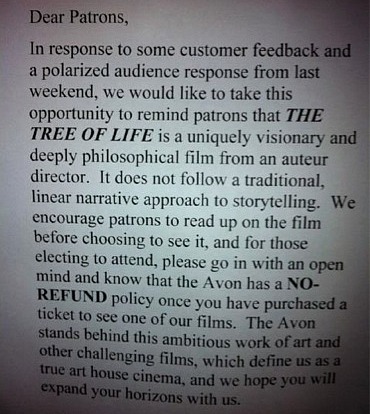
HE reader Phil Garcia had a somewhat annoying time watching The Tree of Life in Scottsdale, an affluent suburb of Phoenix, at the Harkins Camelview on East Highland. But not because of his own reaction to Terrence Malick‘s film. Here’s how he tells it:


Sign at Stamford’s Avon theatre, posted yesterday (6.23) by Movie City News‘ Ray Pride.

“I just finished listening to Oscar Poker # 36 where you comment that you cannot imagine anyone hating The Tree of Life,” he writes. “Well, I went to a 6 pm screening on opening day. The theater was jam-packed, mostly with a geriatric crowd. The movie started out okay, but once the ‘creation of life’ sequence started the crowd went south in a hurry. There were no less than 25 walk-outs.

“I’ve been in movies where a few people have walked out of the theater, but I’ve never seen such a mass exodus in a movie. There were people talking all through it. ‘I don’t get this.’ ‘Do you understand what’s going on?’ ‘This is terrible.’ This went on and on. People were still walking out when there was only ten minutes left.

“And it’s not as if the ‘creation of life’ sequence is that esoteric or incomprehensible, right? Perhaps it’s a matter of context. If the same images were a part of some IMAX documentary about the origins of the universe people would not care. Plop the same images in what is suppose to be narrative cinema and people lose their minds.”

Good Trick

I’m sure I’ll eventually read how they digitally pasted Chris Evans to the face of a ten year-old kid but if anyone has the lowdown, please inform. I presume it’s the same technology that allowed Brad Pitt to become a dwarf-sized codger in Benjamin Button and Armie Hammer‘s face to replace a stand-in’s in The Social Network.

Wait…Oren Moverman?

Four days ago I reported on an LA Film Festival screenwriter seminar in which Diablo Cody said that her dream project would be a biopic of Brian Wilson. (Which seemed like a cool idea.) And today River Road Entertainment announced it has secured the Wilson’s “life rights” (as well as those of his wife Melinda Wilson) and is actively developing a feature film about the legendary singer, songwriter and leader of The Beach Boys with Oren Moverman (director and co-writer of The Messenger) handling the script.

What’s done is done…fine. But I could feel the passion in Cody’s words and eyes when she said she’d love to write a Wilson biopic, and I’ve read Young Adult since last Sunday and I’d say her writing is a bit sassier and more layered and more believably angst-ridden than the writing in The Messenger (even though, yes, Moverman got an Oscar nomination for it). If I was Pohlad I’d definitely try to bring her in to polish or punch up Moverman, to lend a little spritz or spunkitude or marquee-power.

The Messenger told me that Moverman basically does gloom and need and hurt, but Wilson’s life story is drenched in that stuff from the get-go. A movie about Wilson needs someone who can inject some wiggy flavor and attitude that would make it play a little nuts in a way that mirrors Wilson’s head. I’ve met Wilson and I’ve heard the stories. He’ll never be sane, and that’s a good thing.

If you were Bill Pohlad, head of River Road, and you had an either-or choice between Moverman and Cody, would you honestly choose Moverman? Okay, maybe you’d want someone to lay down the framework and the architecture, but the story of a guy losing his grip and getting obese and succumbing to a downward-swirl syndrome needs a touch of wackitude and surrealism, a sense of the absurd…or maybe a sense of the ever-present balance between nutbaggery and genius. You can’t just glumly and dolefully “tell the story”…this happens and that happens and blah blah.

Cody had to know about the River Road/Moverman deal when she mentioned her interest last weekend right?

"Battle Royale"

You can agree with Movieline‘s Christopher Rosen and suggest that Transformers 3 star Shia LaBeouf is shilling insincerely by saying that “the last hour of this movie is the greatest action sequence of Michael Bay’s career, which would put it on the same level as the greatest action ever made.

“You don’t breathe for the last hour. There’s just no letup, but it’s also not completely overwhelming and disconnected, as the second movie was. You didn’t know what was fighting what or where you were geography-wise. There was no way to be able to tell a story, whereas this is very Black Hawk Down action. The geography is very clear. There’s only four or five dudes you need to be following. The enemy is very clear. The second movie was so…complicated. The best movies are simple.”

So I asked a friend who’s seen it, and he says LaBeouf isn’t wrong.

The last 40-plus minutes of Transformers 3: Dark of the Moon amount to “the mother of all battle sequences,” he says. “It’s truly a Battle Royale. Nonstop mayhem battle….and your mouth is open that he did this. It’s really noticably epic…a big selling point.

“Except it’s a Transformers movie, you know, and it’s 2 and 1/2 hours or maybe even a bit longer. They had told me it was 2 hours and 20 minutes when I walked in but I don’t know [about that].

“And there was a guy who got up at the beginning of the screening and said they were trying to show a new brighter 3D process…there’s a highlight aspect, a brighter image in mind…the whole goal is to show it brighter so the glasses don’t darken the image. They’re going to show this in theatres that are equipped to do this, this special version. If they want to save 3D at all they need to do this.

A recent Variety story said that Paramount and Bay “have gone beyond simply asking exhibs to turn their lamps up to proper brightness [for Transformers 3]…Par is taking the unprecedented step of releasing a special digital print aimed at delivering almost twice the brightness of standard 3D projection — even more than the dual-projector IMAX Digital theaters.”

Flunk

Jake Kasdan‘s Bad Teacher (Sony, 6.24) isn’t funny. It’s horrible, in fact. I’m sorry to be judgmental but any film critic who’s given this catastrophe a pass or called it…you know, amusing or enjoyably raucous (and there are plenty who have) really does have to be sent to detention and regarded askance. Some people can’t be trusted with comedies, and anyone who looks at this film and says “yeah, has some funny bits, not bad” has truly questionable values, not just as a cineaste but as a human being.

Because the first 44 minutes of this movie really and truly stink. The remainder of it, mind, might be the greatest second half of a motion picture ever made. In fact, let’s give it the benefit of the doubt and say that again, loudly. For all I know the second half of Bad Teacher might be absolutely miraculous. Please see it because of this very realistic potential. For all I know Jake Kasdan, the 37 year-old director, might be an astounding comic wizard and Gene Stupnitsky and Lee Eisenberg might be amazing screenwriters….of films that suddenly become good after the first 44 minutes.

It. Doesn’t. Make. You. Laugh. Ever.

Cameron Diaz plays a bone-dumb, past-her-prime, ferociously empty ding-dong who couldn’t wangle an interview to be a junior-high-school teacher if she handed out brown bags filled with $25,000 in used bills to each and every person on the educational food chain, plus blowjobs to all the guys. She gets away with stuff that no teacher could begin to get away with, but that’s what funny about this thing, right? She guns her car in reverse on the school grounds, going 40 or 45 mph like Steve McQueen in Bullitt and risking hitting some kid. Hah-hah-hah-hah-hah-hah-hah!

I haven’t seen Friends With Benefits but Justin Timberlake, who plays a hot guy teacher whom Diaz wants to hook up with, has totally blown the good will he acquired by playing Sean Parker in The Social Network. Jason Segel plays a gym teacher who likes to get high….forget it. I don’t want to discuss him any further because all I could think about was how heavy he is and will be down the road.

The fundamental comic idea in Bad Teacher is that everyone on the junior-high teaching staff is either dippy or slow-on-the-pickup or a contemptible idiot or emotionally retarded, and all the students are relatively sensible and adult-minded and matter-of-fact. The other basic idea is that the motivations of the teachers are almost entirely transparent. If they’re thinking fiendish thoughts, they walk around with a ten-foot-square illuminated sign on the top of their heads that says ‘THINKING FIENDISH THOUGHTS.”


Justin Timberlake, Cameron Diaz in Bad Teacher.

All I know is that during the first 44 minutes I sat there with my mouth open, aghast. I watched and watched and waited and waited. Nothing in this film is funny, I kept muttering to myself. I mean, it has a teacher character named Miss Squirrel (Lucy Punch), and when she’s introducing herself to Diaz she actually pretends to be a little squirrel, holding her paws up and chewing on an acorn and going “chuck, chuck, chuck.” C’mon!

Some comedies just know how to turn the key in the lock and click…it all just kicks into gear. Don’t ask me how to explain it but the first 44 minutes of Bad Teacher are pretty close to sickening. It doesn’t have the first clue about turning a key or even about the existence of keys or locks or tumblers or anything in that realm. It asks you to believe in relentlessly stupid motivations and shovels shite dialogue and idiotic occurences, and I finally just couldn’t take it. Really.

So I bolted, and on my way up the escalator I met a Sony publicist. “Jeff…you’re leaving so soon?” Yes, I’m sorry but it’s just not funny and I can’t take it any more. “Oh…well, I’m sorry.” I’m sorry too, I said, but on the other hand I’m on my way out of the theatre so I’m starting to feel better!

I’m sorry but that’s it for Kasdan. I didn’t like Orange County or Walk Hard all that much, and now he’s in Hollywood Elsewhere movie jail and will stay there until he finagles a “get out of jail card” by making something half-decent. Plus he’s only 5’6″ tall. He’s done. And that’s it for Stupnitsky and Eisenberg too. They’ll probably become huge successes in this town over the coming years and live like sultans and buy expensive motorcycles and have great-looking girlfriends, and they’ll just be living out another chapter of “When Good Things Happen to Bad People.”

I told several people (including publicists and agents) at the Better Life party later that night that I’d just seen Bad Teacher and hated it, and to a man they all said, “Yeah, I heard it doesn’t work” or words to that effect.