Please Redefine “Loser”

Newsday‘s Lewis Beale has posted a piece about the biggest winners and losers of the summer movie season, which ends on Labor Day. Two of his losers are Sofia Coppola and Steven Soderbergh, so named because their respective films, The Beguiled and Logan Lucky, whiffed at the box-office. After 49 days The Beguiled has earned a lousy $10,576,669 domestic (maximum theatre count: 941) and $16,656,888 worldwide, and over the last 7 days Logan Lucky has generated a meager box-office of $9,316,933, albeit in three times as many theatres (3,031).

The problem with Beale’s verdict is that The Beguiled was a reasonably decent period drama (I called it a better film than Don Siegel‘s 1971 version with Clint Eastwood), and Logan Lucky is a bone dry, brilliantly fine-tuned redneck caper flick. Both films proved that Coppola and Soderbergh are pros who know their stuff, and it hardly makes them “losers” simply because ticket buyers decided they weren’t interested. If you ask me it’s the ticket buyers who lost.

Was it commercially savvy to re-make a gothic Civil War-era melodrama involving sex and dismemberment but with most of the sex taken out? Perhaps not. Did it make sense to re-make Ocean’s 11 in a bumblefuck milieu, minus the big stars and a Las Vegas setting? Okay, maybe Logan Lucky couldn’t have become a hit no matter what. But Soderbergh and Coppola did their jobs well. They made a pair of engaging, first-rate films. They brought honor upon themselves.

Beale’s other losers: 1. Universal Pictures for the wipe-out of Tom Cruise‘s The Mummy (HE agrees). 2. Michael Bay‘s Transformers: The Last Knight (ditto — HE only saw Cinemacon product reel, decided against attending). 3. Pirates of the Caribbean: Dead Men Tell No Tales (shitty reviews, $166 million gross vs. $230 production cost). 4. Baywatch (crappy reviews, audiences weren’t sold). 5. Will Ferrell for the embarassing failure of The House. 6. French comic books — i.e., the complete cratering of Luc Besson‘s Valerian and the City of a Thousand Planets. 7. Kathryn Bigelow and Mark Boal‘s Detroit. 8. Halle Berry for the barely noticed failure of Kidnap.


Likable, Affecting, Poignant

Unless this trailer is highly deceptive, I’m half-convinced that Richard Linklater‘s Last Flag Flying (Amazon/Lionsgate, 11.8) is going to work with both critics and ticket-buyers. It’s a “Last Detail sequel” but with different characters.  (Yeah, I know — go figure.). Bryan Cranston is playing his own Badass Buddusky, it seems, but with his own name — Sal Nealon. (Somewhere up in the hills Jack Nicholson is scratching his head, wondering if Nealon is somehow related.). Larry Fishburne seems to be channeling Otis Young‘s Mulhall (i.e., “Mule”), except his name is Mueller. Steve Carell has retained the quiet sensitivity of Randy Quaid‘s Larry Meadows, but with a different name — Larry “Doc” Shepherd. Directed and co-written by Linklater with Darryl Ponicsan, author of the 2005 source novel as well as the 1971 novel that led to Hal Ashby‘s The Last Detail. All eyes on the 9.28.17 premiere at the New York Film Festival.

Back Pages

It’s sad that the print edition of Village Voice is going away, sure, but I can’t honestly say I’m devastated. I never pick up a newspaper. Nobody does. But I’ve always liked — hell, cherished — the fact that the Voice is there. If I could guarantee that the print edition would survive by snapping my fingers three times, I would do that. Who wouldn’t? I’m just as sentimental as the next guy.

The newsprint Voice is an atmospheric artifact — a tangible remnant of the Manhattan that I lived and struggled and sometimes barely survived in from late ’77 to mid ’83. When I think of the effort and feeling and discipline that have gone into each Voice issue, even recently, even with me living in West Hollywood, and what its absence will do to downtown culture, etc. Not that anyone under 40 will notice all that much.

I was a New Yorker when the Voice definitely mattered. Reading the new issues of it and the Soho Weekly News at the Village Bowl (a little diner on West 13th near 8th) back then — what an affinity that was. I would take the issues home, leave them at my Sullivan or Bank Street apartments, carry them with me for something to read on the subway.

But I almost never pick up print these days, and when I do it’s only for a fast skim. My reaction would be the same if the L.A. Weekly, which has been printing since ’78, were to turn into an online-only publication. I picked up a copy at Amoeba last week, and that’s saying something. But I’m not saying anything nervy here. The printed Voice launched almost 62 years ago, on 10.26.55. I’m sorry.

Read more

New Rider of Purple Sage

Hand of Fate #1: “So you’ve had a bad couple of months. Well, I’m sorry, but I’ll tell you what you need to do and it’s no different if you’re J. Paul Getty or Irving the Tailor — you ride it out.” — Lawrence Tierney‘s “Joe Cabot” in Quentin Tarantino‘s Reservoir Dogs.

Hand of Fate #2: “And what is that, John? What? Bad luck. That’s all it is. I pray in your life you will never find it runs in streaks. That’s what it does, that’s all it’s doing. Streaks. I pray it misses you. That’s all I want to say.” — Shelley “the Machine” Levene in Glengarry Glen Ross.

[Initially posted just shy of ten years ago, on 7.4.07.]

Rushmore Stands Tall

If Fox Home Movies can celebrate the 19th anniversary of There’s Something About Mary, Hollywood Elsewhere can celebrate the 19th of Wes Anderson‘s Rushmore, which opened at the New York Film Festival on 10.9.98. I had just begun my Mr. Showbiz column that month, and boy, was I delighted with Rushmore when I saw it out at the Disney lot one night! I was floating when it ended. Wes, whom I’d known since he hit town with Owen Wilson in ’94, had allowed me to read a copy of the script roughly a year earlier, when I was miserably working at People, and I was pretty happy with it. But the film version represented one of the very few times in my life that a movie turned out to be significantly better than the script. (It usually works the other way around.) When I posted HE’s 150 Greatest American Films list on 7.24.15, I ranked Rushmore as my #8, and I meant it. I still do.

Read more

Endurance of Sid Krassman

There was once a literary fiction tradition in which character names seemed to reflect or sound like who they were deep down. In The School for Scandal, a 19th Century play, author Richard Brinsley Sheridan created Sir Benjamin Backbite, Lady Sneerwell, Mr. Snake. Nathaniel Hawthorne did the same in The Scarlet Letter with a physician named Roger Chillingworth. Not to mention Charles Dickens‘ Ebenezer Scrooge, Oliver Twist, Miss Havisham and Mr. Fezziwig.

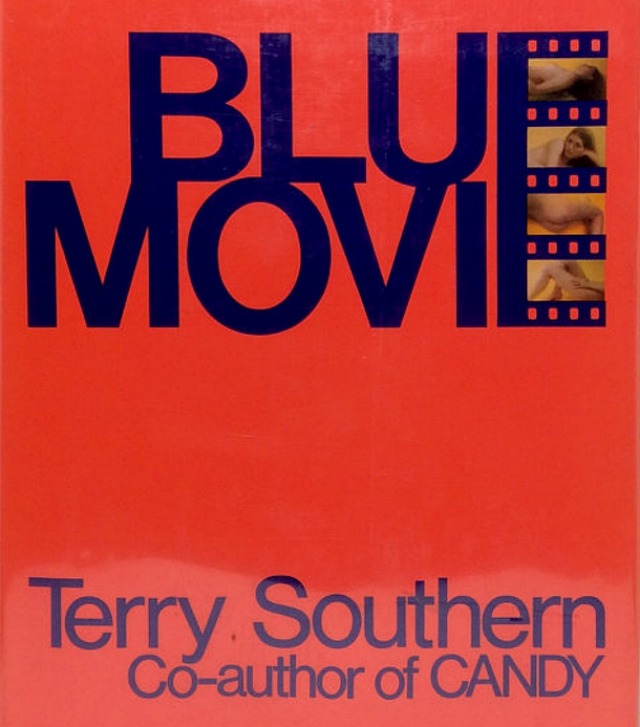
Flash forward to the early 1960s and the names that screenwriter Terry Southern gave to some of the Dr. Strangelove characters — Gen. Buck Turgidson, President Merkin Muffley, General Jack D. Ripper, Group Captain Lionel Mandrake. But my all-time favorite Southern invention was Sid Krassman, a coarse, sexist, ethically indifferent Hollywood producer with endless reserves of hustler bullshit. Krassman was pretty much the main character in Southern’s “Blue Movie“, which I read sometime in the early to mid ’70s. (The other principal character was a director named Boris Adrian, who was a stand-in for Stanley Kubrick.) I’ve never forgotten “Sid” in the decades since. Why? Probably because of the simple sound of the name.

The only character-reflecting names we’ve had since the Southern era are Sammy Stud names — names of macho types with an abbreviated manly sound — Josh Randall, Walker, Bronk, Jack Reacher, Lew Harper, Ethan Hunt, Ram Bowen, etc.

Best Actress Spitball

I’m obviously unable to come to any semi-final decisions about which actresses might end up as the leading 2017 Best Actress contenders, but I’d be more than a little surprised if the finalists don’t boil down to the following: (1) Frances McDormand, Three Billboards Outside Ebbing, Missouri; (2) Emma Stone, Battle of the Sexes, (3) Meryl Streep, The Papers; (4) Sally Hawkins, The Shape of Water; (5) Kate Winslet, Wonder Wheel; and (6) Judi Dench, Victoria and Abdul.

I know next to nothing about Annette Bening‘s performance as Gloria Grahame in Film Stars Don’t Die in Liverpool. Talk to me after it screens in Toronto, but right now my gut says…okay, a definite maybe.

Women under pressure, embarked on life-changing journeys, seeking resolutions and satisfaction. McDormand’s character demanding answers and finding closure. Stone and Streep as famous, real-life women subjected to tests of character and mettle in the early ’70s. Hawkins doing it silently, all with her face and eyes. Winslet going through the pains of hell in early ’50s Brooklyn. Dench’s Queen Victoria bridging culture gaps.

Remember — it’s not just about stirring, eye-opening performances, but the quality of the films that these performances are woven into.

Right now I’m not feeling it as much for Jessica Chastain in Molly’s Game (uncertain fate awaiting Aaron Sorkin’s film + same brittle tough-girl performance Chastain gave in Miss Sloan?); Jane Fonda in Our Souls at Night (out-of-competition slot for Souls in Venice Film Festival creates question mark — undeniable nostalgia factor for fourth Fonda-Redford teaming), Diane Kruger, In the Fade (not happening), Jennifer Lawrence, mother! (Aronofsky doesn’t seem to be courting Oscar voters this year, at least not by the standards they live by); Carey Mulligan, Mudbound (Mulligan is always good but acting-wise the film belongs to Jason Mitchell and Mary J. Blige); Saoirse Ronan, Lady Bird (haven’t seen it….zip); Michelle Williams, All the Money in the World (no idea, not a hint).

Night of the Living Roger

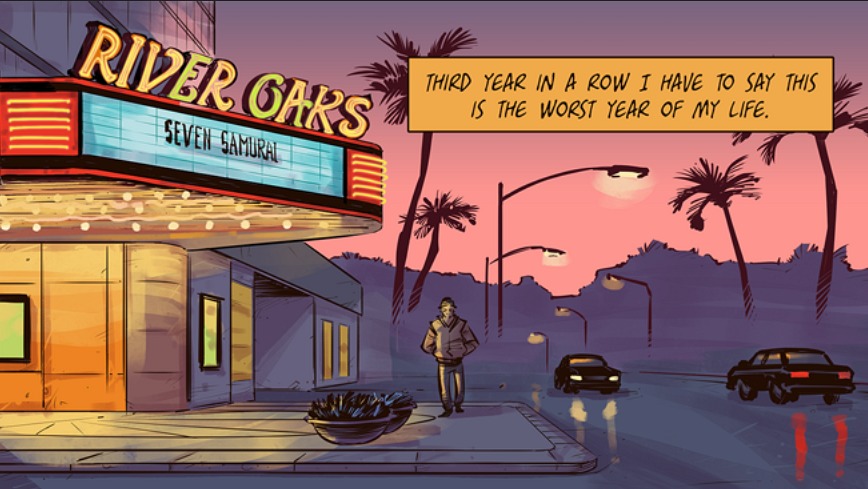
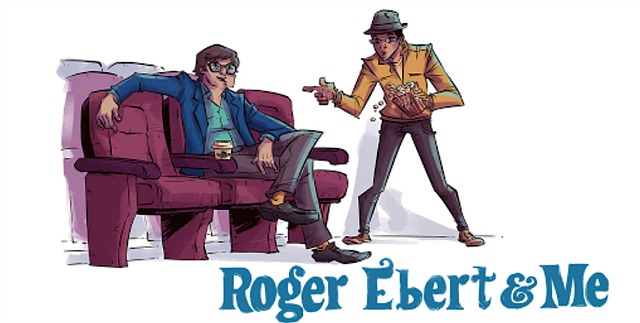
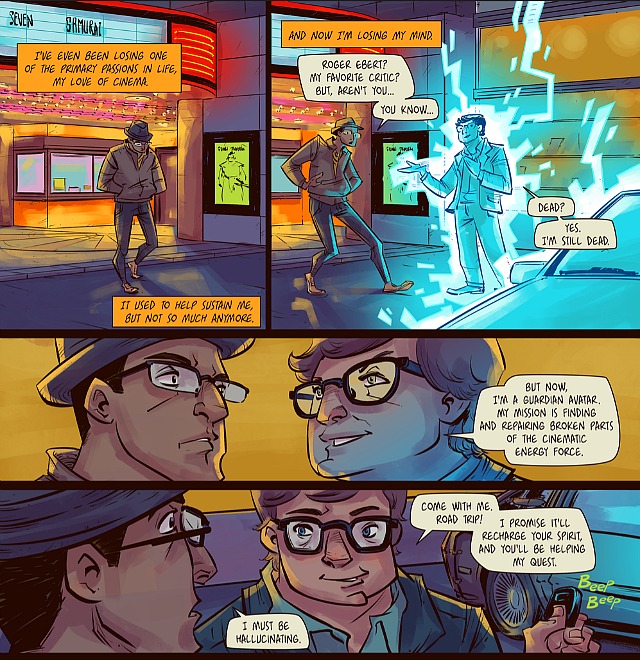
Milton Lawson to Jeffrey Wells: “Longtime fan of the site, here to show you a new short story you might enjoy called ‘Roger Ebert and Me‘. It’s a short 10-page comic about a true Movie Catholic enduring a crisis of faith. Filled with cinematic easter eggs. I know you’re not the biggest fan of the comics medium but sometimes it can be put to great use beyond the spandex superhero realm. Check it out? Here it is.

Wells to Lawson: It’s perfect up until the moment where your character talks about his mother, and Roger says she wouldn’t want you to give up hope. That’s fine, but it goes off the rails after that. Roger is not the Silver Surfer. He cares and has great insight, but he doesn’t have special cosmic powers, and he’s not the bringer of perfect, inspired solutions. He was just a brilliant critic who died too soon. You can’t put him on too high of a pedestal.

What needs to happen is this: You and Roger visit the diner where the Looper scene with Bruce Willis was shot. (Or the Baltimore diner from Barry Levinson‘s Diner.) As you’re walking toward an empty table, Roger notices Gene Siskel talking to another young cineaste like yourself.

Roger: “Uhh, Gene? The hell are you doing here?”

Gene: “Well, I’m dead too so I can do anything I want. And I can dispense life wisdom as well as you can, Roger, and probably a little better.”

Roger: “You never quit, do you, Gene?”

Gene: “Oh…Roger, this is Kevin Zackey, by the way. Kevin? Roger. Kevin’s going through a rough patch.”

Read more

Belushi Delivers Award-Worthy Turn in Woody Flick?

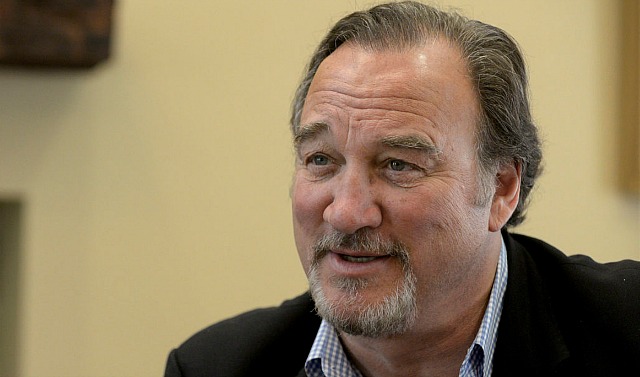
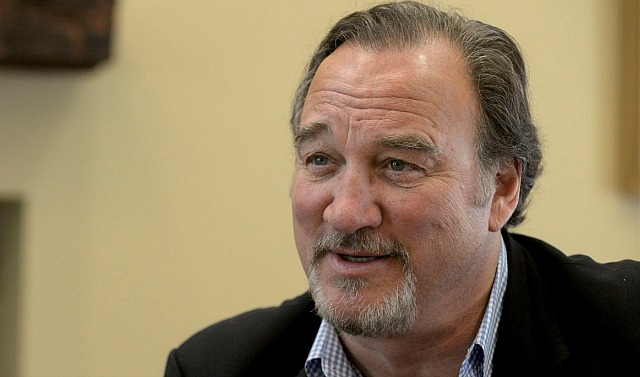
I’m told that Kate Winslet isn’t the only one who delivers a grand-slam, award-worthy performance in Woody Allen‘s Wonder Wheel (Amazon, 12.1). Unexpected as it may sound, Jim Belushi scores strongly and sympathetically as Winslet’s schlubby-nice-guy husband who grapples with some kind of Chekhovian anguish when her waitress character, Ginny, takes up with Justin Timberlake‘s Mickey, a Brooklyn lifeguard.


Has Jim Belushi scored with an Oscar-calibre supporting performance in Woody Allen’s Wonder Wheel? As Marcus Licinius Crassus said in Spartacus, “Time will solve that mystery.”

A tipster believes that Belushi’s turn will probably generate Best Supporting Actor talk after Wonder Wheel debuts at the New York Film Festival on 10.14. Which, of course, would constitute a huge career rebound for Belushi, who’s been steadily working since his ’80s and early ’90s heyday (Red Heat, Salvador, K-9, Thief, Curly Sue) but in an under-the-radar, off-the-grid fashion. Or at least the grid that I pay attention to.

If the talk turns out to be valid, Belushi will have a perfect Oscar-season narrative along with a much-admired performance — riding high in the ’80s, loses the big-screen mojo, quietly plugs away for the last 25 years, does pretty well on TV (including his According to Jim series from ’01 to ’09, as a co-lead in The Defenders, a comedy series with Dan Aykroyd in 2010 and ’11 + a recent four-episode role in Twin Peaks) and is now suddenly back in the big game as a possible Oscar contender at age 63.

How did Belushi happen to land the role? Why him and not any number of higher-profile character actors who were probably considered? Last summer Woody was quoted saying that he cast Belushi because he was “absolutely perfect for it.”


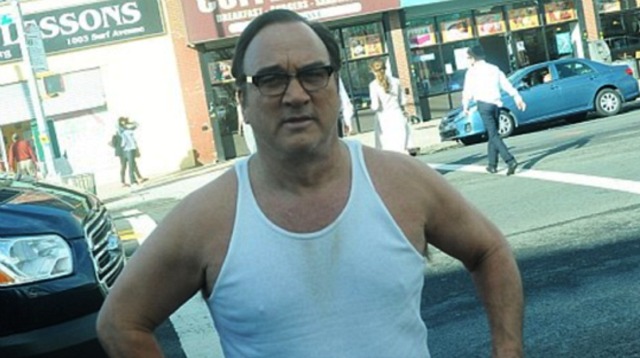
Belushi as he appears in Wonder Wheel, as Kate Winslet’s cuckolded husband.

Trump’s Very Own

From 8.23 Washington Post story, filed by Katie Mettler and Lindsey Bever: “At a number of political rallies over the past year, a character calling himself ‘Michael the Black Man’ has appeared in the crowd directly behind Donald Trump, impossible to miss and prompting widespread fascination. Almost always, he plugs his wild website, Gods2.com, across his chest. Variously known as Michael Symonette, Maurice Woodside and Mikael Israel, he’s [a] radical fringe activist from Miami who once belonged to a violent black supremacist religious cult, and he runs a handful of amateur, unintelligible conspiracy websites. He has called Barack Obama ‘The Beast’ and Hillary Clinton a Ku Klux Klan member. Oprah Winfrey, he says, is the devil. Most curiously, in the 1990s, he was charged, then acquitted, with conspiracy to commit two murders. But Michael the Black Man loves President Trump.”

Hidden Mother

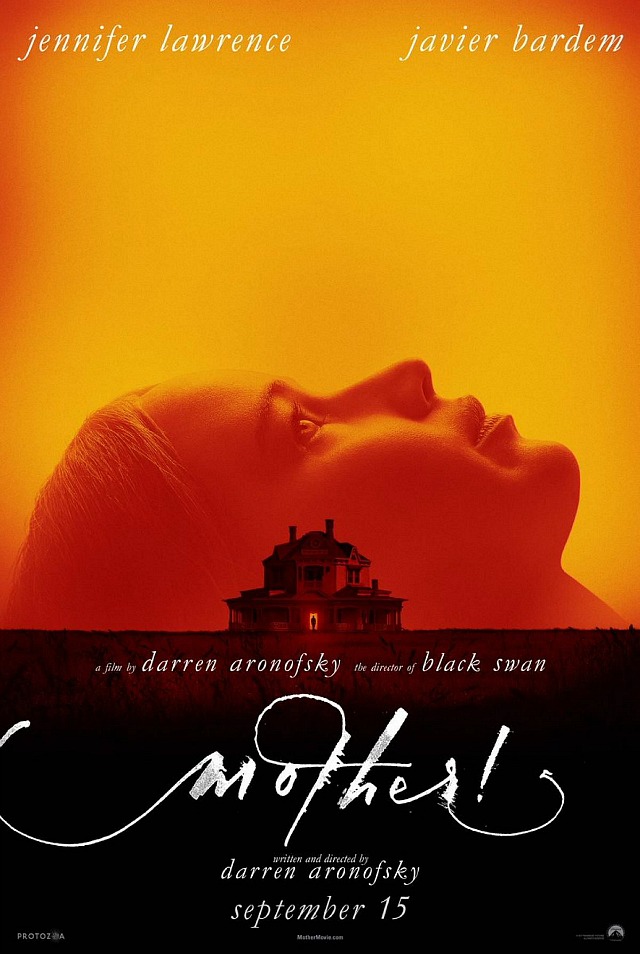
Like I said on 8.7, mother! may be “some kind of pervy, bloody-lightbulb descendant of Rosemary’s Baby. JLaw is Rosemary, Javier Bardem is Guy Woodhouse, and Ed Harris and Michelle Pfeiffer are sexualized versions of Roman and Minnie Castevet.” Yesterday’s release of this poster obviously emphasizes the Ira Levin connection.


Arguably one of the greatest New Line releases ever — a brilliant concept (slimey bug alien takes over a series of human hosts, turns them into heavy-metal freaks with a lust for hot cars and high speeds) that fed into a kind of lunatic horror comedy, and one that not only captured or reflected the mood of late ’80s indie-fuck-all Hollywood but the general coarsening of the culture.  Credit is due to director Jack Sholder before anyone else.  The Bluray is coming from Warner Archive.

Rough Road for Female Veterans

Last night’s screening was Lysa Heslov‘s Served Like A Girl, which did well review-wise at South by Southwest ’17. Five women veterans who’ve endured serious trauma in the military create a shared sisterhood to help the rising number of stranded homeless women veterans, etc. It’s basically about women persevering, surviving and sticking together through thick and thin. Particularly mothers and daughters. Sad but stirring. Edited, scored with spunk and polish. I felt it. It got me.


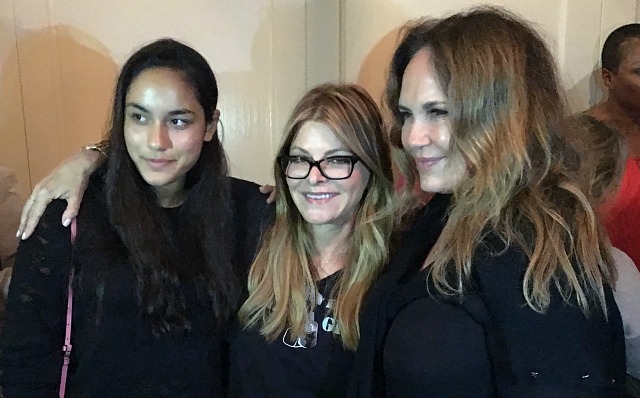
Lysa Heslov, director & co-writer of Served Like A Girl, flanked by Catherine Bach (Dukes of Hazzard) and daughter following Monday’s screening at the London West Hollywood.

From Shari Linden’s THR review: “Glamorous gowns are definitely involved, and yes, there’s a talent contest, but the Ms. Veteran America competition is no beauty pageant in the conventional sense. The gutsy women who vie for the title come in all shapes and sizes. They’ve served in Afghanistan and Iraq, some have suffered dire injuries, and they’ve all weathered plenty on the home front as well. The participants profiled in Heslov’s documentary are the epitome of resilience, but they’re also disarmingly honest and funny as hell. In a word, they’re irresistible.

“Focusing on seven women involved in the 2015 competition (the fourth edition of the event), Served Like a Girl takes a while to find its groove. But as it sheds light on these women’s experiences and the larger issue of homelessness among female vets, the film grows deeply engaging. Whatever the perceived or real political and social divisions between military families and the rest of us, this rousing nonfiction feature by Heslov, a producer making her directorial debut, suggests there’s far more common ground than many might suspect.”

Read more