Mad Genius Meets Dafoe Transcendence

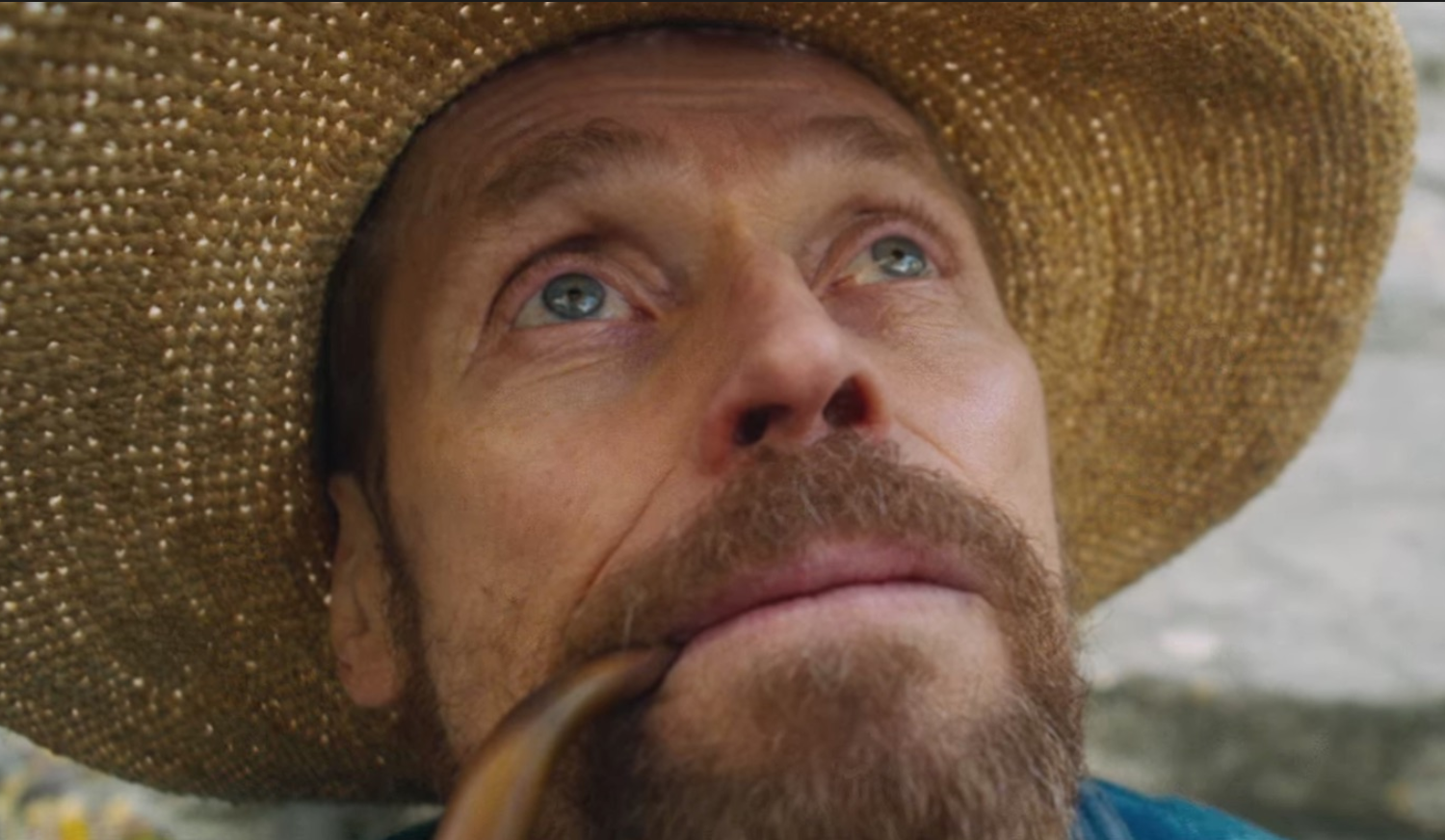
Last weekend I sat for my second viewing of Julian Schnabel‘s At Eternity’ Gate (CBS Films), which I’ve come to regard, no lie, as the finest Vincent Van Gogh flick ever made.

The difference between it and, say, Vincent Minnelli and Kirk Douglas‘s Lust for Life or Robert Altman‘s Vincent and Theo is a gentle but absolute communion with Van Gogh’s inner light. It’s not a tourist’s view of the man, but a portrait of an artist by an artist — a “you are Van Gogh” dreamscape flick.

In the view of many Willem Dafoe‘s performance of this gentle, conflicted, angst-ridden impressionist is his best since playing Yeshua of Nazareth in Martin Scorsese‘s The Last Temptation of Christ (’88).

When I say “many” I mean the National Society of Film Critics, who yesterday morning celebrated Dafoe’s performance as a top-tier achievement. That’s quite the ringing endorsement when you think of the competition. Dafoe’s Van Gogh also won the Volpi Cup for Best Actor at the Venice Film festival, and he’s currently nominated for Best Actor prizes with the Broadcast Film Critics Association (i.e., Critics Choice), Alliance of Women Film Journalists and the San Francisco and Toronto Film Critics associations.
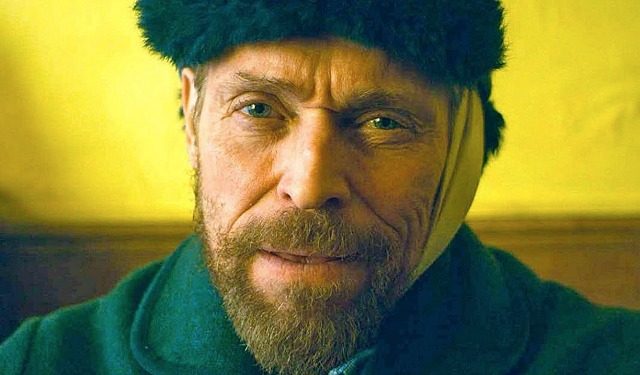
Let no one forget that Dafoe is a three-time Oscar nominee for his performances in Oliver Stone‘s Platoon (Sgt. Elias), E. Elias Merhige’s Shadow of the Vampire (Max Schreck) and Sean Baker‘s The Florida Project (the hapless Bobby Hicks).

From Manohla Dargis‘s N.Y. Times review of Schnabel’s film: “Few actors can look so frightening or so beatific in such rapid succession. Dafoe’s thin, coiled physicality suggests both fragility and determination, while his tensile face flutters with an astonishment of emotions that, by turns, suggest a yielding or off-putting sensibility. [And] Vincent’s agonies render moot the age difference between the character and actor; Dafoe is 63, and his deepest creases can seem like evidence of Vincent’s current and past suffering.”

At Eternity’s Gate is essentially a channelling of the dreams and torments that surged within Van Gogh during the final chapter in his life, when he lived in Arles and St. Remy de Provence. The film is more into communion than visions — intuitions, intimacy, revelations.

“Rather than a movie about Van Gogh, I wanted to make a film in which you are Van Gogh,” Schnabel said during a NY Film Festival presser that I attended.

Read more

What’s Happened to VF’s Big Oscar Issue?

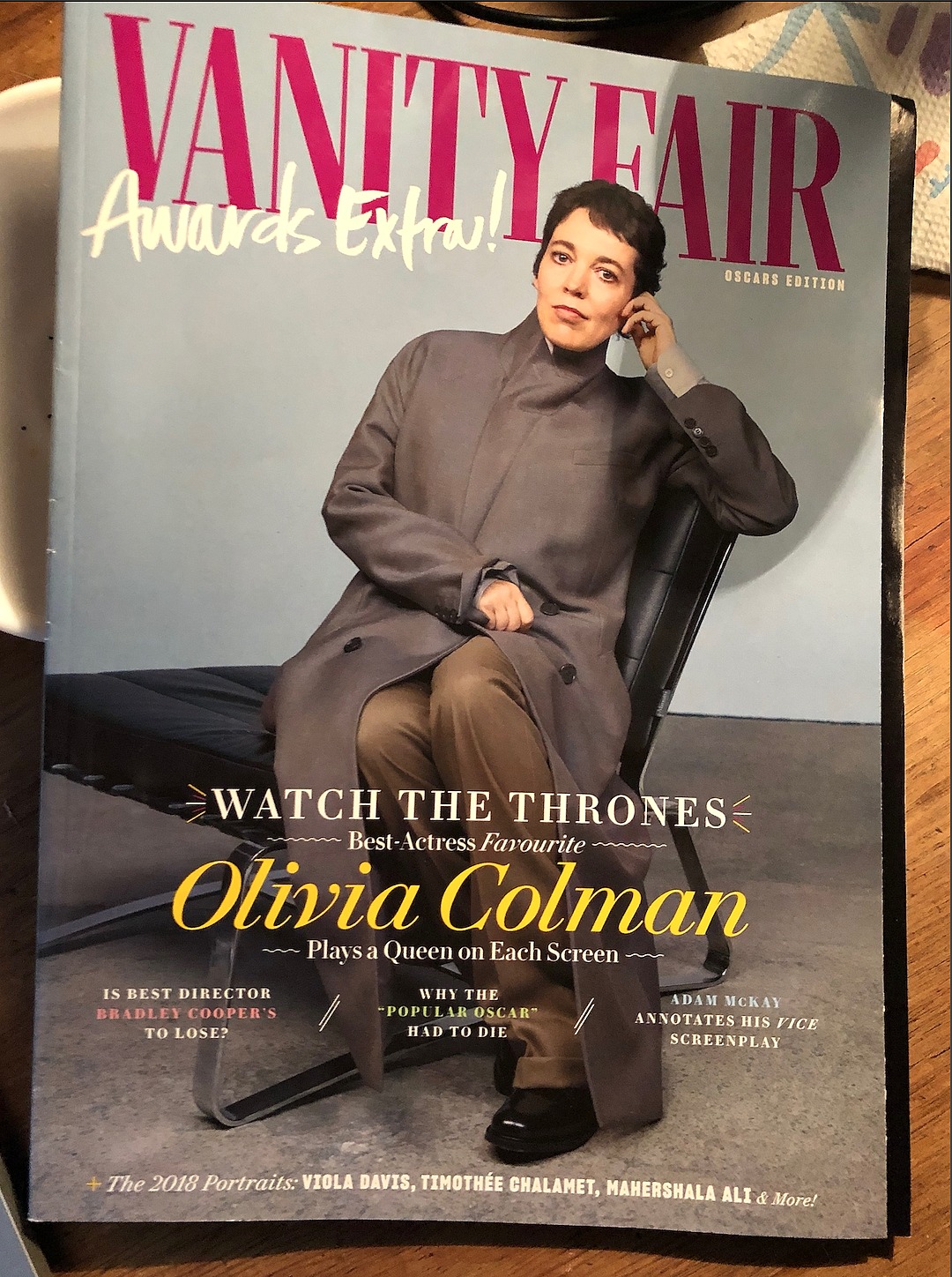
Yesterday I received a Vanity Fair “Awards Extra!” supplement issue that seems — emphasis on the “s” word — to be the definitive 2019 “Oscars edition”. The issue is 76 pages and feels like an echo of what used to be, and the cover photo of the great Olivia Colman feels dull and pedestrian — no style.

Is this some kind of teaser, this thing? Will a real-deal Vanity Fair Hollywood issue publish in early February, or is this it?

Remember the years when the special Vanity Fair Oscar/Hollywood issues would be stuffed with ads, and with all the biggest stars posing in a big en masse fold-out? What happened to that swanky attitude, that “we own the world and everybody wants to join our club” vibe?

Remember when Annie Leibovitz was the default, blue-chip photographer for the super-stylish, cost-was-apparently-no-object, all-the-cool-kidz-of-Hollywood photo spread?

Remember the years when there would always be at least one if not two fully researched, seductively written, looking-back-at-the-glory-days piece by Peter Biskind or Sam Kashner or one of the other heavy-hitter writers? The calamity of Ishtar, when Mike Nichols went kerflop with The Fortune, when Clint Eastwood found his romantic directing mojo with The Bridges of Madison County, the making of William Wellman‘s Star Is Born…that line of country.

Obviously things are not what they once were. The current “Awards Extra!” issue (whether it’s some kind of teaser or not) is like some kind of mildly okay Hollywood Reporter supplement. It’s fine as far as it goes, but it doesn’t exude that top-of-the-world AAA bucks-up vibe that the Vanity Fair Hollywood issues had…what, only three or four years ago?

On top of which the subhead for Richard Lawson‘s Best Picture lay-of-the-land piece (“This Race Could Change Everything”) reads “Oscar bait like First Man is in the game — but so are more tantalizing possibilities.” I hate to say this because I’m a serious admirer, but poor First Man isn’t in the game at all except for Justin Hurwitz being up for Best Musical Score and maybe a tech award or two. It breaks my heart but it’s true.

I’ve been complaining about the Vanity Fair downswirl for a few years now. When Graydon Carter left and VF basically became a kind of glammy “woke” fashion magazine…that was kind of what did it for me.

It just feels as if things are limping along in a scaled-down way.

Read more

Saved By A Blonde

This, to be honest, is how First Reformed ends and what it’s essentially saying. All the cares and aches and horrors of the world melt away when a beautiful blonde wants to have sex with you. I’m very sorry — I know this is a terrible thing to say out loud and that only pigs and dogs have thoughts along these lines. But at least with Paul Schrader I’m in good pig-dog company.

Bullet Train

Hollywood Elsewhere is now operating at roughly 450 Mbps, or more than double the download speed I’ve been using for the last three or four years. There was nothing wrong or especially lacking about 200 to 220 Mbps, but 450 is amazing. A Spectrum guy just installed the new system (including a superspeed modem)

DGA Noms Shaft “Black Panther,” “The Favourite,” “Beale Street”

Everyone understands that Roma‘s Alfonso Cuaron is going to win the 2018 DGA award for feature film directing…right? You know that, I know that, we all know that.

Cuaron was nominated this morning for Roma along with A Star Is Born‘s Bradley Cooper (hangin’ by a thread!), Green Book‘s Peter Farrelly, BlacKkKlansman‘s Spike Lee and Vice‘s Adam McKay.

Cooper also landed a second nomination for best first-time director, which he’ll almost certainly win in a post-Golden Globes debacle sympathy vote.

The next big bellwether will be the January 13th announcement of the Critics Choice Awards.

Harris Needs To Black Up For ’20 Campaign

When asked about Donald Trump‘s blizzard of bullshit about “the wall”, Sen. Kamala Harris, who’s definitely running for President in 2020 (hence the new book “The Truths We Hold”), said, “I was a prosecutor for many years including California attorney general, and I specialized in trans-national criminal organizations…that wall ain’t gonna stop them!”

The last six words got a huge response from the View audience, mainly because Harris briefly broke out of her tough prosecutorial persona and said them like an earthy, no-bullshit woman of color.

How black is Harris? The answer is “partly to somewhat.” She’s the daughter of an Tamil Indian mother, Dr. Shyamala Gopalan Harris (1938–2009), a breast cancer researcher and daughter of an Indian diplomat, and a Jamaican-American father, Donald Harris, a Stanford University economics professor. You certainly can’t call her “street.”

A Gay Man Among Men

This week’s bravery badge has been earned by The Stranger‘s Christopher Frizzelle, author of “I Am a Gay Man, and I Liked Bohemian Rhapsody“:

“Did you know Freddie Mercury died of AIDS? Did you know he lived in a time when gay sexuality was criminalized in most jurisdictions? Did you know he liked gay sex? Did I mention he died of AIDS?

“Those are the only important things to know about him, according to the cool kids. Vox’s review gave the movie 1.5 stars out of 5. Why? ‘Bohemian Rhapsody was made with the cooperation of Queen’s surviving members, but they reportedly were only willing to sign on if it wouldn’t be R-rated, and thus it’s scrubbed clean of much of the content that might round out a film more committed to accuracy regarding the lifestyle of its characters.” Shorter version: needs more gay sex, needs more AIDS.

Memo to the moral crusaders: Mercury did not want to be known as an AIDS icon. He wanted to be known for his art. Your insistence that he is an AIDS icon, that what was meaningful about him was his AIDS, and that only a movie that dwells on his AIDS and how he got his AIDS is acceptable is frankly disgusting.

“The sub-headline of a negative Stranger review: ‘It’s a ballad of tragic gay cliches.’ Actually, it’s not. It’s a movie set in a time before you were born; there’s a difference. And if you want more AIDS, more bathhouses, more dick, more repression, more orgies in the dark, etc., well, you’re asking for more ‘tragic gay cliches,’ not fewer.”

From “Straight-Washing Concerns,” filed by yours truly on 11.3.18:

“There are some fellows who are a bit irked that Bohemian Rhapsody doesn’t depict Freddie Mercury‘s amorous escapades in franker terms. It’s not gay enough, they mean. Too sanitized. Why not a heifer-ramming scene or a splooge shot a la Taxi Zum Klo?

“There’s no question the film feels a bit chaste — it probably needed to be a bit ruder, darker, crazier. And maybe a little Mine Shaft action. Hard to say. Then again if Bohemian had been shot in a way that would have been gotten a Guy Lodge stamp of approval it probably wouldn’t have earned nearly $50 million this weekend.”

Exceptional Rushfield on Deranged Commentariat

All hail and all heed the following just-posted Golden Globes commentary from The Ankler‘s Richard Rushfield:

“I’m sorry to break it to Oscar Twitter, but Bohemian Rhapsody is a genuine international phenomenon. And the audiences don’t seem to care that it was partially made by a director over whom there is a cloud; you’re free to tell them they are wrong. For a musical biopic to do numbers rivaling a mid-range Marvel film is astonishing, and for people to suggest that this is something Hollywood should turn their backs on, rather than taking the good and leaving the bad, shows you how deep into the internal narrative the commentariat has driven itself.”

This next paragraph in particular should be printed out, framed and hung on office walls all over town:

“And while we’re at it: if you wanted to show visitors from the future what the atmosphere was like in and around and about Hollywood in 2019, you’d only have to show them Green Book and tell them that this likable, good-hearted film provoked the biggest, fiercest backlash of the year.

“With both these films, there has been this complaint that they are soft-peddling their respective social issues — i.e., not giving audiences the full, unwashed bleakness of the true situation. It’s this continuing sense that giant mega-conglomerate entertainment producers should be making movies to satisfy the farthest thresholds of the sensibility of the media elite class; that there is nothing to be gained in finding a broadly digestible version that will draw in audiences in the tens and hundreds of millions.

“To that end, I noticed a little boomlet among in the Oscar Twitter last night, suggesting that the Academy now needs to respond to the outrages perpetrated by the HFPA’s best pic awards by unequivocally, by acclamation, bestowing the Best Picture award on Roma.

“Now, I liked Roma [quite a lot]. It might (or might not!) by my personal favorite of the nominees.. But if anyone thinks that Oscar getting in the habit of giving its big prize to tiny intimate films seen by a handful of people is a long-term or even medium-term strategy to Save Our Show…they are off their rockers.”

The Roma diss aside, Rushfield is saying in effect that most of the critics who are wringing their hands over Bohemian Rhapsody‘s Golden Globes win and particularly the haters who went the extra mile to try and torpedo Green Book (Variety‘s Guy Lodge, L.A. Daily NewsBob Strauss, Vox‘s Alissa Wilkinson, The New Yorker‘s Richard Brody, Globe and Mail‘s Barry Hertz, A.V. Club‘s A.A. Dowd, N.Y. Times A.O. Scott, Slate‘s Ingkoo Kang) have, for lack of a better term and at least as far as mildly populist over-35 sensibilities are concerned, encamped themselves inside their own anal cavities. They are all filing from inside a very deep and dark politically correct cave.

All That Relationship Jazz

Definitely an interesting Fosse/Verdon trailer. Smokey-red lighting, sultry backstage atmosphere, a series of carefully placed static shots, fast cutting, Cabaret-like. Partly a stylistic nod to Fosse’s dance-montage sequences in All That Jazz, partly a recalling of Fosse’s Sweet Charity.

We’re talking about an eight-part limited series, debuting on FX in April. Sam Rockwell as the legendary dancer, choreographer and film director; Michelle Williams as red-haired Broadway superstar and Fosse’s longtime partner Gwen Verdon.

Please include a sequence in which Rockwell and Williams perform “Who’s Got The Pain?“, just like Fosse and Verdon did in Damn Yankees.

Based on Sam Wasson’s 2014 biography, Fosse/Verdon will chronicle the couple’s tumultuous relationship — flirtation, collaboration, love affair, marriage, infidelities, uppers, etc.

Filming began two months ago; still shooting as we speak. The apparent director of at least half of the episodes is Thomas Kail. Exec produced by Kail, Steven Levenson and Lin-Manuel Miranda.

Read more