How Dumb Is Rick Dalton?

There are three things that bother me about Leonardo DiCaprio‘s Rick Dalton, the former TV star whose career is slipping and downswirling in Once Upon A Time in Hollywood.

The first is his yokel twang, which I hate the sound of — he sounds like a blend of Jim Nabors, Buck Owens and Clem Kadiddlehopper. The second is the proven fact that he’s bone stupid. And the third is that moment on the western TV set when he throws a styrofoam coffee cup onto the dusty main street.

But let’s focus on the dumb. How else to describe a TV actor who’s played a starring role in a hit TV series (i.e., Bounty Law), and then, after the series has been cancelled, has segued into playing a series of bad guys on this and that TV show, and somehow doesn’t realize that he’s degrading his image by doing so?

Every ’60s-era TV star in the industry knew it was better to be the cool guy who wins fights and shoots bad guys than to play guys who lose fights and get shot by the hero…c’mon!

Steve McQueen might not have been Albert Einstein, but at the very least he knew that after playing Josh Randall on Wanted: Dead or Alive the worst thing he could have done was to play bad guys on The Fugitive, The FBI Story and such.

McQueen knew that, but somehow Dalton didn’t. Because Dalton’s brain-cell count was simply too low.

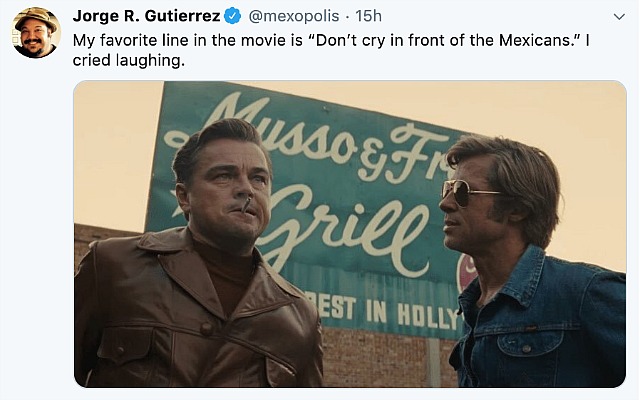
It was only when Dalton met his agent Marvin Schwarz (Al Pacino) for lunch at Musso and Frank in February ’69 that the clouds parted. Schwarz explained very calmly and logically that repeatedly getting beaten up and killed will condition the audience to think less of Dalton the ex-bounty hunter, and that it will be very tough to play a hero again.

Dalton has been playing TV bad guys for four or five years at that point, and yet somehow the reality hadn’t sunk in. It’s only when Schwarz says this isn’t the wisest career strategy that Dalton finally realizes “holy shit…things aren’t going so well!”

This, to me, is one dumb-as-a-fencepost actor. Especially one who can’t stop drinking or smoking or littering. Which is why I found Dalton a bit of a pain to hang with. Brad Pitt‘s Cliff Booth, on the other hand, is eternally cool.
More “Mindhunter”

Season 2 of David Fincher and Joe Penhall‘s Mindhunter series returns to Netflix on August 16th. Based upon or at least inspired by (I’m presuming) “Mindhunter: Inside the FBI’s Elite Serial Crime Unit” by John Douglas and Mark Olshaker. Season 1 was set in 1977. Season 2 is set two or three years later and covers the Atlanta murders of 1979–81. It also includes an encounter with Charles Manson, once again played by Once Upon A Time in Hollywood‘s Damon Herriman.

As with season 1, Fincher has directed four of season 2’s 10 episodes.

Mindhunter Finality,” posted on 10.27.17:

I finally finished watching Netflix’s Mindhunter last night. All ten episodes. Wow. Precise, patient, unnerving, character-rich, exacting dialogue, blissfully intelligent. By far the most engrossing Netflix thing I’ve sat through this year, and that includes Okja, First They Killed My Father, Mudbound and The Meyerowitz Stories.

I’m really glad the second season has been approved as I couldn’t get enough of season #1. Really and truly riveted. A perfect thing to watch at the end of a long, vaguely depressing, anxiety-ridden day consumed by writing and researching and…you don’t want to know the rest.

Though Mindhunter I’ve come to know four…make that five actors I’ll never forget and want to engage with again — Jonathan Groff (Holden Ford), Holt McCallany (Bill Tench), Hannah Gross (Debbie Mitford), Anna Torv (Wendy Carr) and even Joe Tuttle, who plays God-fearing, goodie two-shoes FBI agent Gregg Smith, who ignominiously rats out Groff when he sends a Richard Speck interrogation tape to a pair of FBI internal affairs investigators.

Read more

Silver-Toned Sea Fable, Tinged With Lunacy

Robert EggersThe Lighthouse “is an absolute masterpiece — a tale of slowly burgeoning madhouse by way of isolation, booze, demons and nightmares. It contains Robert Pattinson‘s finest role and performance ever, but Willem Dafoe‘s old bearded sea dog matches him line for line, glare for glare, howl for howl.

“This 35mm black-and-white masterwork (projected in a 1:1 aspect ratio) is really about a battle of performances as well as a fight between earthly duties and the madness of shrieking mermaids and visions of King Triton. Nightmares au natural but full of ancient myths and fables. Totally 19th Century in terms of atmosphere, set design and especially in the Melville-like dialogue, co-written by Egger and his brother Max. Jarin Blaschke‘s cinematography is an instant classic in itself.” — from “This Way Lies Madness,” posted from Cannes on 5.19.19.

A24 will release The Lighthouse on Friday, 10.18.

Indiewire‘s Zack Sharf has written that the film will be presented “in Academy ratio,” which would mean 1.37:1. But this is incorrect.

Update: A24 informs that “in Cannes The Lighthouse was shown at 1.19:1” — an aspect ratio introduced in 1926 — and that “the trailer aspect ratio is 1.20 which matches the dailies. 1.37 is actually inaccurate.”

Wokesters to Jorge: “Not Cool, Bruh!”

I’m told that an emergency video conference was called earlier today by some major Los Angeles-based wokester Stalinists to discuss the betrayal of Mexican heritage by animator Jorge Gutierrez, not to mention his repugnant embrace of wokester pariah Quentin Tarantino. The conference was audio recorded. Here’s an excerpt:

Wokester #1: “Gutierrez obviously has to be cancelled…we have to ruin his life, make him unemployable, run him out of town. But we can’t do this without assistance from top-tier animation producers. Who can we call to help us in this regard?” Wokester #2: “I agree 100% that Gutierrez needs to be cancelled, but I’ve already spoken to a couple of animation producers and they don’t share our views.” Wokester #1: “What?” Wokester #2: “I was surprised also, but that’s what they said. In fact, one producer said we’re assholes for thinking this way, and that we should grow a sense of humor.” Wokester #1: “What producer? Let’s cancel him also!”

Kanamit Vittles

Written by Rod Serling and directed by Richard Bare, “To Serve Man” originally aired on 3.2.62 on CBS. The story is based on Damon Knight‘s same-titled 1950 short story. Narration: “Respectfully submitted for your perusal — a Kanamit. Height: a little over nine feet. Weight: in the neighborhood of three hundred and fifty pounds. Origin: unknown. Motives? Therein hangs the tale, for in just a moment, we’re going to ask you to shake hands, figuratively, with a Christopher Columbus from another galaxy and another time. This is the Twilight Zone.”

Lumpy Prose Mixed With Midrange Woody Praise

Woody Allen‘s A Rainy Day in New York opened in Poland last weekend. London-based freelancer Matt Thrift apparently travelled to Poland to see it (or just happened to be there). His awkwardly written review, posted on Little White Lies, is a struggle to get through, but the film, he says, is “a funny, amiable riff on The Great Gatsby and The Catcher in the Rye.”

The film is “hardly top-tier Allen”, Thrift maintains, but it’s a shame that the “wonderful” performances by Elle Fanning, Timothy Chalamet and Selena Gomez “are unlikely to receive the wider attention they deserve.”

“Following Wonder Wheel’s nods to Eugene O’Neill” (not Tennessee Williams?), “Allen has returned to the American literary canon, this time [blending] The Great Gatsby with The Catcher in the Rye for a contemporary riff on the facades of money and power.

“Chalamet plays Gatsby Welles, student at upstate Yardley college and scion of ‘a farrago of WASP plutocrats’ whose autumn bash he’s desperate to avoid. His moniker makes for something of a red herring, even if F. Scott Fitzgerald’s narrative comes fully to bear on the film’s final act, with Gatsby more equatable with the ‘hostile rebellion’ of J.D. Salinger’s Holden Caulfield.

“His girlfriend Ashleigh (Fanning) is travelling to New York to interview filmmaker Roland Pollard (‘Up there with [Jean] Renoir and [Vittorio] De Sica…lots of emotional probing, never a decent toilet joke’) for the college paper, and Gatsby, ‘a wannabe Sky Masterson,’ has promised to show her the sights, flush with cash following a poker game.

“As Ashleigh arrives at an upmarket hotel to interview Liev Schrieber’s helmer, Gatsby bumps into Shannon (Gomez), the younger sister of an old flame, on a student film shoot. Gatsby is roped in to kiss Shannon on-camera just as the heavens open. Meanwhile Pollard, his writer (Jude Law) and star (Diego Luna) make passes at the naive 21-year-old Ashleigh,” who’s a bit of a “Daisy Buchanan proxy.”

“Fanning brings most of the funny,” says Thrift, adding that she “brings to mind Mira Sorvino’s Oscar-winning turn in Mighty Aphrodite, her ‘sexually conflicted’ hiccups and desperate-to-impress guilelessness stealing a series of comic set-pieces from her older cast members.

“Chalamet is equally impressive as he bites into the ends of Woody’s prose. Gatsby’s self-indulgent journey appropriates scenes from Salinger wholsesale, but he’s afforded a beautifully tender moment at the piano, gently crooning his way through ‘Everything Happens to Me’ — more Chet Baker than Frank Sinatra.

“Gomez’s twist on Phoebe from The Catcher in the Rye provides the film’s level-headed emotional center and its romantic payoff, while Cherry Jones’ as Chalamet’s mother-with-a-secret brings us squarely into Fitzgerald territory come the final, recriminatory scenes.

“There’s no dancing around Woody’s usual ‘what is it about older guys that’s so appealing to women?’ schtick, but there’s little arguing with the melancholy charge of his [rain-soaked] New York, especially when shot through car windscreens by Vittorio Storaro, who alternates the honeyed-glow of an embarrassed sun with the reflective silvers of a persistent, lyrical deluge.”

Yes, Virginia, Woke Terror Is An Actual Thing

“In the wake of the mass hysteria that followed after the horrifying Harvey Weinstein assaults came to light, Hollywood is still awash in the jitters. Fear and trepidation now clouds every thought and word and deed — fear of saying or doing the wrong thing, fear of associating with the wrong people, fear of supporting the wrong artists, fear of being called out by a Twitter swarm, fear of getting fired, banned, cancelled. Whatever potentially sensitive topic pops into our conversations and timelines, fear casts a pall over us all.” — from Sasha Stone‘s “Tarantino’s Once Upon a Time in Hollywood Opens to $40 Million and Almost as Many Hot Takes,” posted on 7.28.

The thrust of the piece is that the Stalinist p.c. twitter goons need to think twice about threatening this or that high-profile filmmaker for pushing envelopes, being temperamentally brazen and perhaps having said a couple of wrong things in the past (or said right things in the wrong way).

Goin’ to New York for “The Irishman”

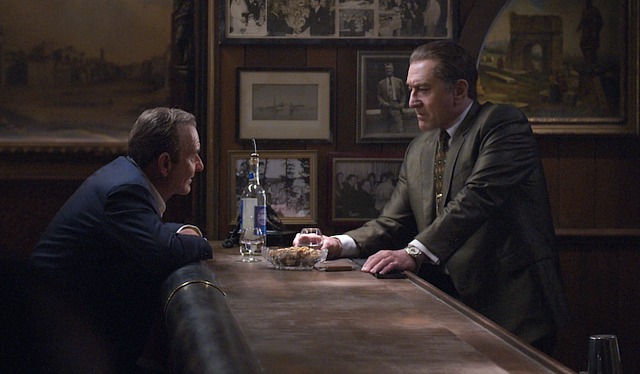
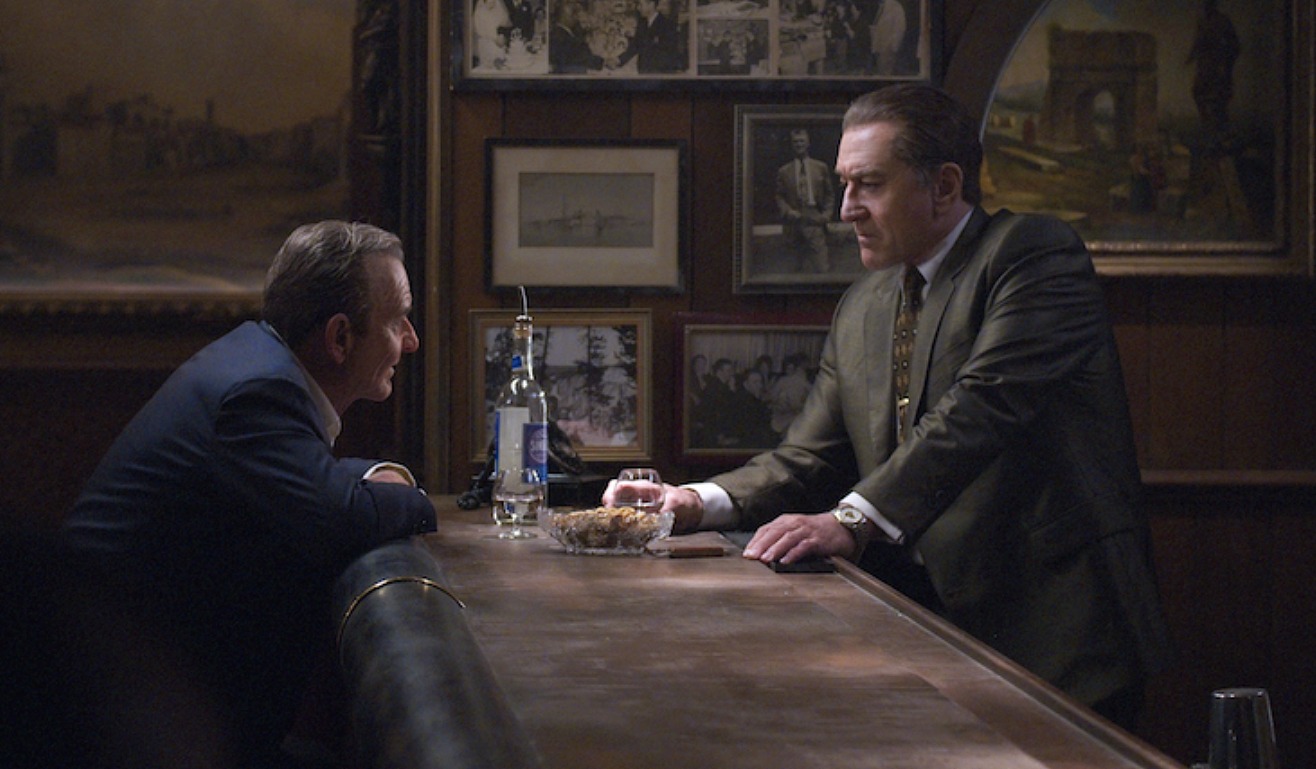
The 57th New York Film Festival will premiere Martin Scorsese’s The Irishman at Alice Tully Hall on Friday, 9.27 — i.e., opening night. Hollywood Elsewhere will be there for the NYFF press screening, and also at the Friday night public screening if I can swing it.

The Irishman will be released in select theaters “later this year”, according to a release, followed by Netflix streaming.

It’s a $200 million, decades-spanning saga of the life and times of Frank Sheeran (Robert De Niro), a labor union leader and alleged hitman for the Bufalino crime family.

Earlier this month I read a very early draft of Steven Zaillian‘s Irishman screenplay. On 7.9 I wrote that it conveyed a tone of finality, and that it reminded me of the ending of Goodfellas as well as the last few minutes of The Godfather, Part II.

Excerpt: “It really does seem to be a melancholy summing-up of the whole Scorsese criminal culture exploration that began 46 years ago with Mean Streets. A fascinating assessment of what this kind of life amounts to, and what it costs in the end.”

Joe Pesci stars as Pennsylvania mob boss Russell Bufalino, with Al Pacino portraying Teamsters president Jimmy Hoffa. The film will utilize extensive de-aging technology to tell its time-spanning story. Scorsese’s intention from the get-go, of course, was that these and other actors would de-age without the “uncanny valley” effect.

Statement from NYFF festival director Kent Jones: “The Irishman is so many things: rich, funny, troubling, entertaining and, like all great movies, absolutely singular. It’s the work of masters, made with a command of the art of cinema that I’ve seen very rarely in my lifetime, and it plays out at a level of subtlety and human intimacy that truly stunned me. All I can say is that the minute it was over my immediate reaction was that I wanted to watch it all over again.”

Low-Key Rotoscoping + Deadpan Cosmic Humor

I was a major fan of Richard Linklater‘s A Scanner Darkly and Waking Life, and sight unseen I’m totally down with Undone, an eight-episode half-hour Amazon Prime seres that begins on 9.13. Created by writer-producer Kate Purdy, executive produced by Raphael Bob-Waksberg and starring Rosa Salazar and Bob Odenkirk, it’s about a vaguely depressed woman, Alma, who’s suddenly able to talk to her dead father, Jacob, after enduring a traumatic car accident. Costarring Daveed Diggs, Siddharth Dhananjay, Constance Marie.

Perfectly Honed Paranoid Thriller

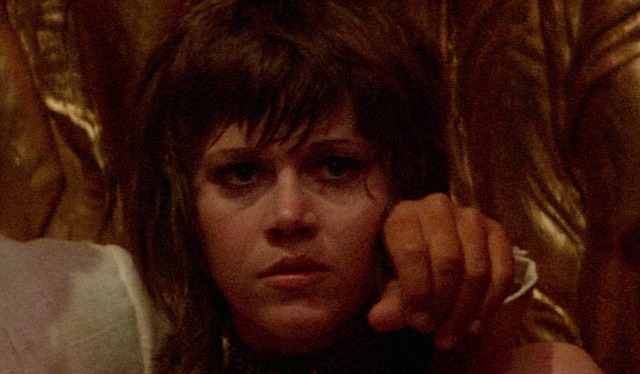
Two nights ago I watched the new Criterion Bluray of Alan Pakula‘s Klute (’71). For me this fascinating noir has always been a 50/50 thing — half about Jane Fonda‘s brave, naked, brilliantly anxious performance as Bree Daniels, a brittle, self-isolating call girl in a cold, predatory city save for the steady, somewhat doleful presence of Donald Sutherland‘s Pennsylvania detective, and half about Gordon Willis‘ smooth, swoony cinematography and particularly his mineshaft blacks…those inky shadows and crisp capturings just take me away, I’m telling you.

I was in hog heaven during those 114 minutes, and I could probably watch it again next weekend without the slightest hesitation. It’s so honest, believable, restrained, focused, whipsmart. And it was so hard to get right. Sculpting a good film is always an uncertain, touch-and-go process, and doubly or triply so, I imagine, when the final product is a masterpiece.

There’s a nicely written Mark Harris essay in the little booklet, “Trying To See Her,” but as far as Fonda’s journey of self-doubt and pain is concerned, I prefer this excerpt from the Klute Wikipage:

“To prepare for her role as Bree, Fonda spent a week in New York City observing high-class call girls and madams; she also accompanied them on their outings to after-hours clubs to pick up men. Fonda was disturbed that none of the men showed interest in her, which she believed was because they could see that she was really just ‘an upper-class, privileged pretender’. She had doubts about whether she could portray the role and asked Alan Pakula to release her from her contract and hire Faye Dunaway instead, but Pakula refused.

“Eventually Fonda turned to her memories of several call girls she had known while living in France, all of whom worked for the famed Madame Claude. Three had been sexually abused as children, and Fonda used this as an entry to her own character, and as a way to understand Bree’s motivations in becoming a prostitute.”

You’d think that the guy playing the titular character would be an essential part of the conversation, but Sutherland, steady and true as his performance is from start to finish, is fourth-ranked. He’s completely fine, but Klute is dominated by Fonda, Willis and Pakula, in that order.

Read more

Seven Devastating Paragraphs

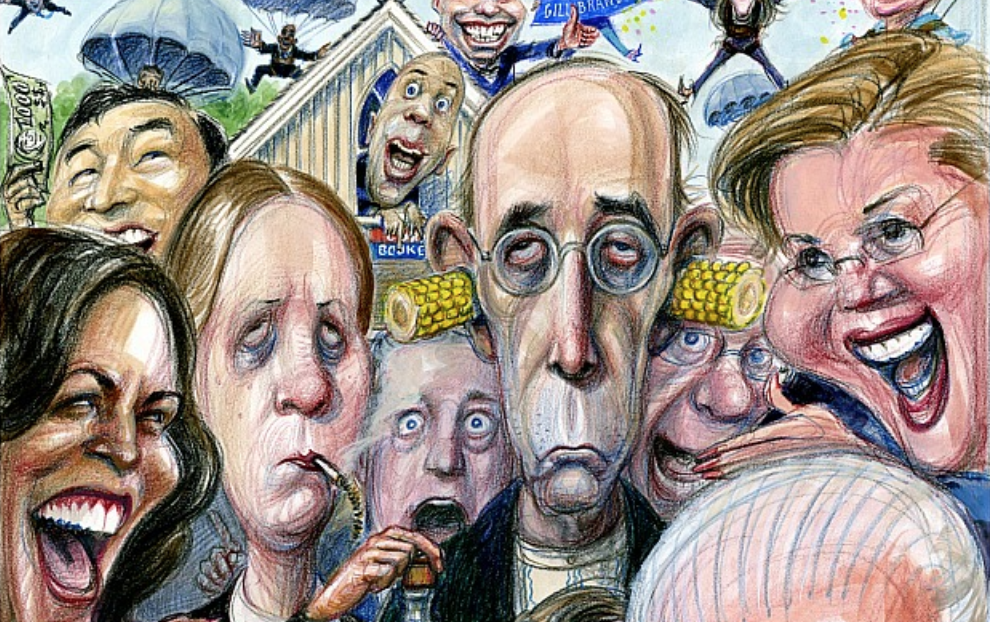
The terrible envelopment of intractable dark fate, that horrible sensation of sinking into mud and unable to wade or climb out of it…this is how “The Iowa Circus“, Matt Taibbi‘s 7.26 Rolling Stone article about the Democratic contenders, makes you feel. It’s so disheartening, so depressing…it’s actually fucking awful:

“Traveling hundreds of miles across Iowa, passing cornfields and covered bridges, visiting quaint small town after quaint small town, listening to the stump speeches of Democrat after would-be Donald Trump-combating Democrat, only one thought comes to mind:

They’re gonna blow this again.

“Imagine how it looks to Republicans. If that’s too difficult or unpalatable, just look at the swarm of 24 Democratic candidates in high school terms.

“The front-runner — the front-runner! — is septuagenarian gaffe machine Joe Biden, who started running for president in the eighties and never finished higher than ‘candidacy withdrawn,’ with a career delegate total matching John Blutarsky’s grade-point average, i.e., zero point zero. The summer’s ‘momentum’ challenger is California Sen. Kamala Harris, who spent all year sinking in polls but surged when she hit Biden with ‘I don’t think you’re a racist but…” on national TV.

“A third contender is Sen. Elizabeth Warren, a famed red-state punchline who already has 10,000 Pocahontas tweets aimed at her head should she make it to the general. Her ‘I have a plan for that’ argument for smarter government makes her a modern analog to Mike Dukakis — another Massachusetts charisma machine whose ill-fated presidential run earned him a portrait alongside the Hindenburg in a Naked Gun movie.

“A fourth challenger, Bernie Sanders, is a self-proclaimed socialist born before the Pearl Harbor attack who’s somehow more hated by the national media than Trump. A fifth, Pete Buttigieg, mayor of South Bend, Indiana, has never earned more than 8,515 votes in any election. The claim to fame of a sixth, Beto O’Rourke, is that he lost a Senate bid to the world’s most-hated Republican. It goes on.

“The top Democrats’ best arguments for office are that they are not each other. Harris is rising in part because she’s not Biden; Warren, because she isn’t Bernie. Bernie’s best argument is the disfavor of the hated Democratic establishment. The Democratic establishment chose Biden because he was the Plan B last time and the party apparently hasn’t come up with anything better since. Nothing says ‘we’re out of ideas’ quite like pulling a pushing-eighty ex-vice president off the bench to lead the most important race in the party’s history.”

Read more

Painted Into A Corner

In a 7.25 piece called “Tarantino Spoiler Policy”, I wrote that “I don’t know when it will be fair to start discussing the final 20 to 25 minutes” of Once Upon A Time in Hollywood “but I would think that an ‘olly olly in come free’ policy could be instituted as of…what, Monday morning? Is it realistic to expect that people will keep their yaps shut any longer than that?”

Actually the cat scampered out of the bag earlier today with Owen Gleiberman‘s 7.28 Variety think piece **, titled “Once Upon a Time in Hollywood: Let’s Talk About That Ending“.

Owen basically says two things — that he doesn’t care for the ending at all, but that he also realizes that Quentin Tarantino had pretty much painted himself into an impossible corner when he decided to make this Hollywood-in-the-late-’60s, Manson-shaded film, and therefore understands why he did what he did. Because everyone would have been sickened by a recreation of what actually happened to Sharon Tate and her housemates on that horrible night, and that an alternative fantasy was necessary to make the film palatable.

I began predicting this narrative approach in early ’18, and in fact said the following in a 4.24.18 piece titled “Tarantino’s Not-Manson Flick Will Deal Escapist Cards“:

Read more