Getting This

Yes, I’m still a sentimental physical-media fool. The ardor has cooled over the last five years, but I’m still inclined to plunk down $20 on almost any decently remastered 4K Bluray of a respected, large-scale ’50s film. The key issue is whether or not it was shot in the VistaVision process. Which The Ten Commandments (’56) definitely was. How much better can it look? Will it deliver a significant bump over the 2011 Bluray version? My head tells me “maybe” but my gut says “naahh, probably not that much…okay, maybe a bit.”

Alfred Hitchcock‘s North by Northwest and To Catch A Thief were shot in VistaVision — what’s the hold-up? And what about the legendary Ben-Hur (’59), which was shot in Camera 65**? I’ve been “hearing” about a 4K version of William Wyler‘s multi-Oscar winner for several years now. The 60-year anniversary came and went two years ago.

Read more

Bend The Language

A couple of websites that post rock-song lyrics don’t understand what the female chorus is singing in Sting‘s “We’ll Be Together.” But I do, and I think it’s genius because it makes up its own and runs with it. Like in The Wizard of Oz, for example, when Ray Bolger‘s scarecrow sings “I’d unravel every riddle / for any individdle / in trouble or in pain.” Or the Cowardly lion rhyming “rhinoceros” and “impoceros.”

The second verse of Sting’s 1987 song goes as follows: “To have you with me I would swim the seven seas / I need you as my guide and my light / My love is a flame that burns in your name / we’ll be together / we’ll be together tonight.”

And then, according to genius.com, the chorus chimes in with “we’ll be together…yeah!”

That’s definitely not what they’re singing. They’re repeating Sting’s love mantra (as in “tell it to her, Gordon…shout it from the rooftops”), but abbreviated. They’re not singing “together” and certainly not “we’ll be together” — way too many syllables. They’re singing “togaahhhh” — as in “together” but with the last four letters abandoned and the middle “e” changed into an “aahh.”

When Sting and the chorus singers were rehearsing, he said “you’ll be repeating my central pledge but three syllables kills it, so just sing ‘togaahhh‘ and give it everything you’ve got.”

Read more

“CODA” Confidential

Hollywood Elsewhere saw Sian Heder ‘s much-adored, Sundance award-showered CODA this morning. It’s moderately appealing and nicely made for the most part. Understand, however, that it’s an “audience movie” — aimed at folks who like feel-good stories with heart, humor, romance and charm.

It’s about a shy Gloucester high-school girl named Ruby (Emilia Jones) with a decent if less than phenomenal singing voice. She’d rather attend Boston’s Berklee College of Music than work for her deaf family’s fishing business, we’re told. The film is about the hurdles and complications that she has to deal with in order to realize this dream.

CODA is one of those “real people struggling with life’s changes and challenges” flicks, but given the fishing-off-the-Massachusetts-coast aspect it’s fair to say it’s no Manchester By The Sea — trust me. It’s a wee bit simplistic and schticky and formulaic -— okay, more than a bit — and contains a fair amount of “acting.”


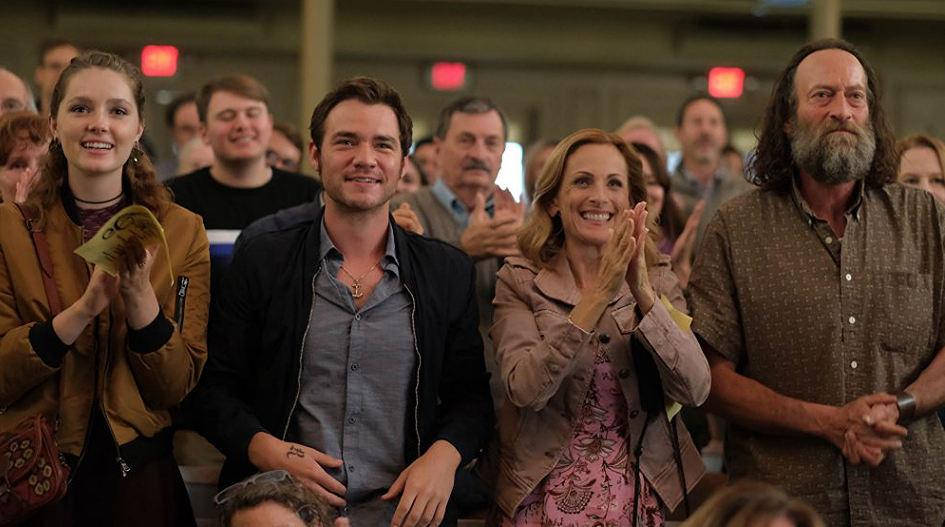
Emilia Jones in Sian Heder’s CODA.

For my money Jones overplays the quiet, withdrawn, still-waters-run-deep stuff, but it’s an honest performance as far as it goes — she has an appealing, unpretentious rapport with the camera. Eugenio Derbez‘s performance as an eccentric, Mexican-born music teacher is probably the film’s best single element. Bearded, baggy-eyed Troy Kotsur and 54 year-old Marlee Matlin are engaging as Ruby’s live-wire parents.

Matlin and Kotsur are the source, actually, of some clunky sexual humor (frisky parents noisily going at it during the late afternoon, randy Kotsur urging chaste Ruby to make her boyfriend wear “a helmet” during coitus, that line of country). Except the jokes don’t really land, or at least they didn’t with me.

In a phrase, CODA is not a Guy Lodge film.

But CODA is an okay film. It works here and there. It didn’t give me a headache. I can understand why some are enthusiastic about it. It deserves a mild pass. Heder is a better-than-decent director.

Friendo: “It’s a by-the-numbers family romcom with an added progressive-minded openness for the deaf.”

(Posted from iPhone while waiting in line at the Tijuana border, heading back into the States.)

Netflix Leads in GG Noms; “Da 5 Bloods” Blanked

7:01 am Update: I have to stream a film within a narrow three-hour window starting right now, so I’ll have to complete and clean up my HFPA story late rthis morning.

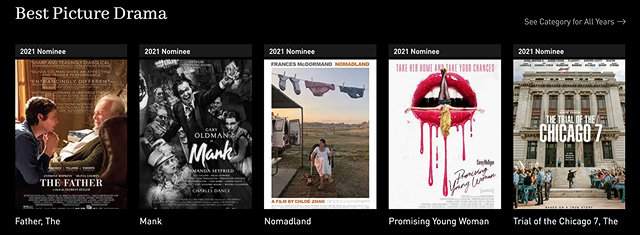
Earlier: Netflix is proudly brandishing the top two most-nominated Golden Globe features — David Fincher‘s Mank and Aaron Sorkin‘s The Trial of the Chicago 7. Fincher’s Hollywood-based period drama has corralled six GG nominations — the most of any film. Sorkin’s political courtroom drama is the second most nominated film with five noms.

Spike Lee‘s Da 5 Bloods, a popular film among zeitgeist-influenced critics and the top vote-getter in a Best of 2020 critics poll from World of Reel‘s Jordan Ruimy last July, has been stiffed by the Hollywood Foreign Press Association. I’d heard that the HFPA membership wasn’t big on Lee’s film, but I didn’t think they’d blow it off entirely.

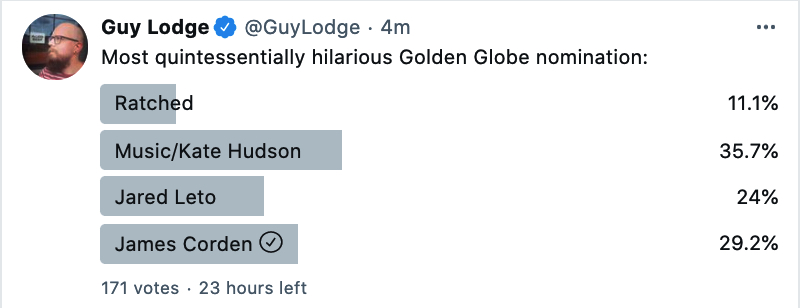
Help me out here…James Corden‘s flamboyant performance in The Prom is competing for a Golden Globe against Sacha Baron Cohen‘s standard-schtick performance in Borat Subsequent Moviefilm and Andy Samberg‘s overpraised Palm Springs performance…what is this?

Cohen was also nominated for a Best Supporting Actor Golden Globe for his Chicago 7 turn as Abbie Hoffman…fine. Judas and the Black Messiah‘s Daniel Kaluuya was also nominated in that category for playing Fred Hampton, despite LaKeith Stanfield‘s performance as William O’Neal being far more worthy.

Best Motion Picture – Drama / “The Father” (Sony Pictures Classics), “Mank” (Netflix). “Nomadland” (Searchlight Pictures). “Promising Young Woman” (Focus Features), “The Trial of the Chicago 7” (Netflix)

Best Actor in a Motion Picture – Drama / Riz Ahmed, “The Sound of Metal” / Chadwick Boseman, “Ma Rainey’s Black Bottom” / Anthony Hopkins, “The Father” / Gary Oldman, “Mank” / Tahar Rahim, “The Mauritanian”

Best Actress in a Motion Picture – Drama / Viola Davis (“Ma Rainey’s Black Bottom”); Andra Day (“The United States vs. Billie Holiday”); Vanessa Kirby (“Pieces of a Woman”); Frances McDormand (“Nomadland”); Carey Mulligan (“Promising Young Woman”)

Read more

Fan Mail

In 1996 at age 23, Joanna Rakoff was hired at the storied New York literary agency Harold Ober Associates, which looked after the interests of the notoriously reclusive J. D. Salinger. Rakoff’s responsibilities included responding to the large volume of fan mail that Salinger was sent, Rakoff would respond with a generic response (i.e., “Salinger doesn’t read fan mail”). She eventually began composing thoughtful replies instead.

Her second novel, “My Salinger Year” (`14), is about Rakoff’s Ober/Salinger experiences. Philippe Falardeau‘s film adaptation, which premiered 11 months ago at the Berlin Film Festival, stars Margaret Qualley as Rakoff and Sigourney Weaver as her boss, Margaret (based on Salinger’s actual agent, Phyllis Westberg).

Warning: My Salinger Year currently has a tepid 68% Rotten Tomatoes rating.

“The gleaming presence of up-and-comer Margaret Qualley bolsters an otherwise mildly entertaining reheating of The Devil Wears Prada story template, only here built around the enduring mystique of J.D. Salinger.” — Jim Schembri.