Bee-Bee-Beeduhlee-Bee

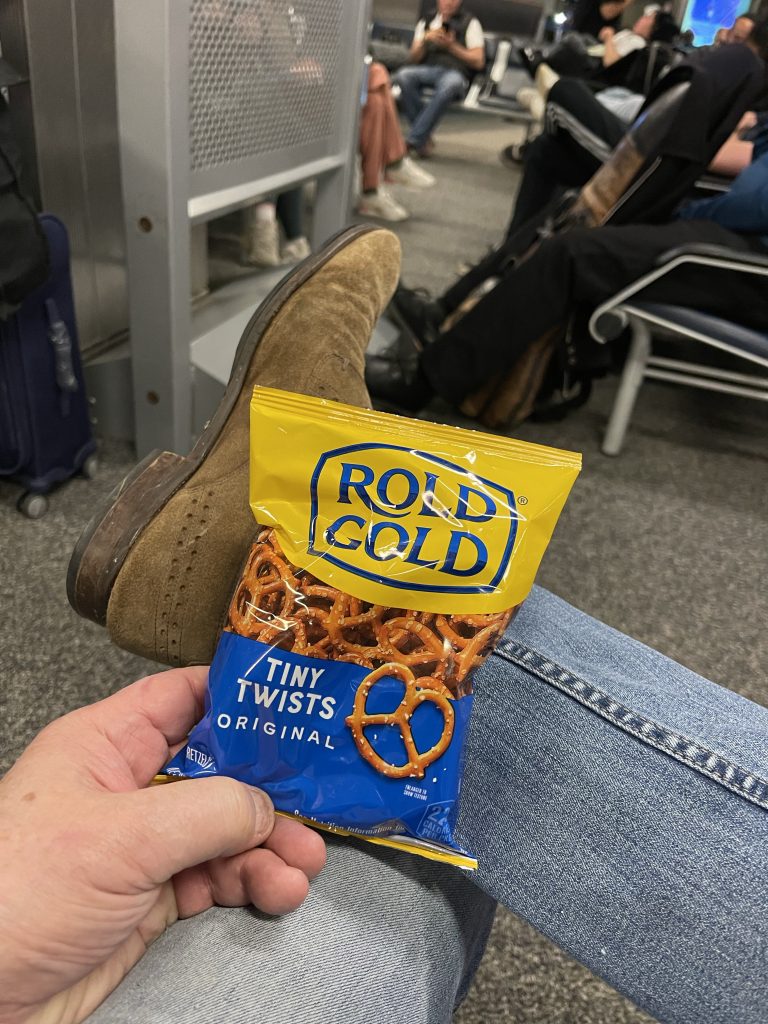
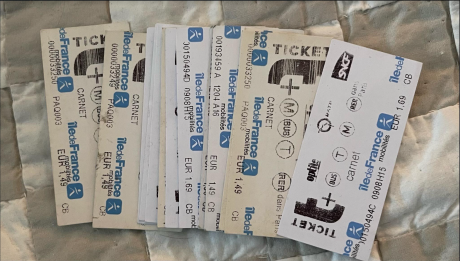
I’d just come through security and was collecting all my stuff — leather computer bag, jacket, elephant hide wallet, two laptops, shoes, scarf, belt, pocket combs. In my haste I unthinkingly scooped up what I thought was my black iPhone 12 (Max Pro).

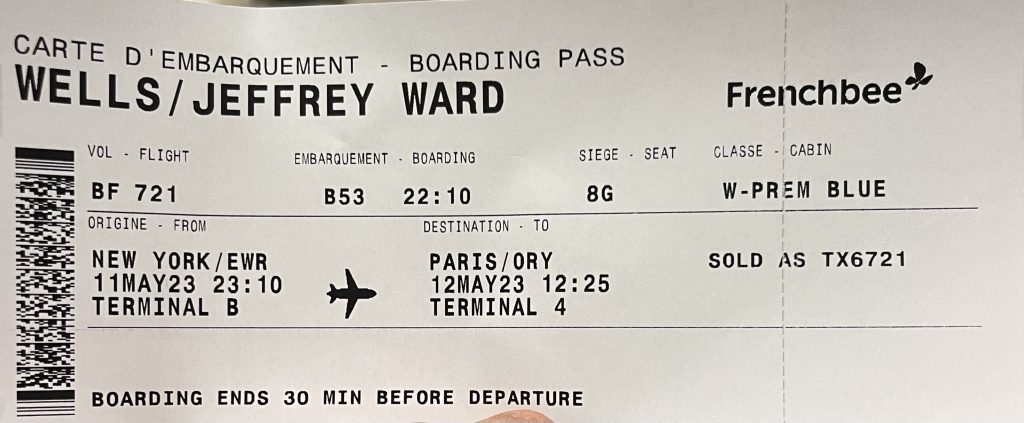
Ten minutes later I was sitting near gate 53, and discovered I had two black iPhones in my inside vest pocket. I ran back to security and promptly found the distraught guy (gray-haired, blue T-shirt) whose phone had strangely vanished. “Sorry, man…stupid mistake…sorry,” I told him as I restored his life and sanity. He was euphoric, levitating.

James Cagney: “You’re furious after I’ve just gotten you out of jail?”

Horst Buccholz: “You got me into jail!”

Cagney: “So we’re even.”

Read more

Five Years After

Five years after and in the cold light of day, it must be acknowledged that Spike Lee‘s BlacKkKlansman was never that persuasive and is, in fact, pretty much unbelievable in dramatic situational terms.

You could even apply the term “goofily plotted.”

The Focus Features release received a euphoric (i.e., over-hyped by shill critics) response when it premiered on 5.14.18 at the 2018 Cannes Film Festival.

I called it “Lee’s strongest since Inside Man, and before that The 25th Hour, and easily his most impassioned, hard-hitting film about the racial state of things in the U.S. of A. since Malcom X.”

The excitement was mainly due to the film’s final five minutes when Lee recalled the venality of 2017’s “Unite the Right” really in Charlottesville, which ended with the death of protestor Heather Meyer. It reminded viewers that Donald Trump‘s “very fine people on both sides” remark showed who and what he is, and made for a seriously pumped-up finale.

It opened on 8.10.18, and some of the reviews were almost laughable in their over-praise. Read A.O. Scott‘s 8.9.18 review and try not to smirk.

The truth, which I tapped out in my 5.14.18 review, is that BlacKkKlansman, despite being fact-based, is flimsy and hard to swallow. I’m not questioning the facts; I’m saying the action doesn’t “play” from an audience perspective.

“[Praising the finale] doesn’t change the fact that BlacKkKlansman is basically a police undercover caper film, based on Ron Stallworth‘s 2014 novel (“Black Klansman: Race, Hate, and the Undercover Investigation of a Lifetime”).

“Nor the fact that tonally it sometimes feels like Starsky and Hutch, or even to some extent like John Badham‘s Stakeout, especially as it involves the main cop protagonist falling in love with a girl (in this case an Afro’ed black activist, played by Laura Harrier) who shouldn’t know what he’s up to, but whom he eventually confesses to.

In this sense John David Washington‘s Stallworth is Richard Dreyfuss in the Badham film, and Adam Driver, as partner Flip Zimmerman, is Emilio Estevez.

“At times the film also reminds you of some Clarence Williams III‘s scenes from The Mod Squad.

“Set in 1972, pic isn’t literally about Stallworth joining the Ku Klux Klan but a stealthy undercover investigation of the Klan, initiated when he was the first black detective in the history of the Colorado Springs Police Department.

“After initial correspondence with the Klan, Stallworth received a call in which he was asked if he wants to ‘join our cause.’ Stallworth answered affirmatively, and in so doing launched an audacious, fraught-with-peril undercover inquiry.

Right away you’re telling yourself, “Yes, I know this actually happened and that Lee is using the facts in Stallworth’s book, but it made no sense for Fallworth to be heavily involved in this operation.” And it just feels crazy as you’re watching one silly incident after another.

Problem #1 is that throughout the film Stallworth talks to KKK members on the phone (including wizard David Duke, played by Topher Grace) and so Zimmerman, pretending to be the Real McCoy, has to sound like Stallworth as much as possible.

“Except this is a dicey game that’s unlikely to fool anyone. Early on a local KKK leader tells Stallworth that his voice sounds different, as it obviously is.

“If I was Stallworth’s supervisor I would tell him he’ll make a mistake sooner or later and that he’s too much of red flag, and that the smart move is for Zimmerman to carry the ball alone.

Problem #2 comes when a KKK member spots ‘a black guy’ (i.e., Stallworth) behind the wheel of a car that’s following as he drives with Zimmerman. Brilliant tactical maneuvering, Stallworth!

Problem #3 happens when Zimmerman is told by a suspicious klan member to submit to a lie-detector test, and so Stallworth, knowing that Zimmerman’s in a tough spot, runs up to the KKK member’s house and throws a rock through a window. It just seems nuts for Stallworth to have done that, given the likelihood that the klan might wonder why a black guy happened to be nearby.

Problem #4 occurs when the same looney-tunes KKK member looks up Stallworth’s address in the phone book and pays him a visit. Stallworth answers the door and invents a falsehood, but for a couple of minutes he and the KKK member eyeball each other.

Problem #5 happens when a Colorado Springs police supervisor insanely orders Stallworth to provide security for David Duke during a visit to their city. Before you know it Stallworth is in the same room as the same KKK member who knocked on his door, his identity protected only by a pair of shades. And then he takes them off before posing for a Polaroid photo. It’s just crazy — no undercover cop would behave this way.

“All this aside, BlacKkKlansman is semi-edgy and half-involving as far as it goes, and occasionally quite funny from time to time. It’s a reasonably good film, and I love that Lee shoots Trump between the eyes at the end, but people calling it ‘great’ need to calm down.”

No Bald Boyfriends

If I were bald and “in the market” I would naturally adopt a positive attitude. I would tell myself that I’m the new Yul Brynner, and that I’m just as much of a boudoir conquistador as Brynner was when he was putting it to Marlene Dietrich in the 1950s.

But if I were gay or a woman of a certain age, I would definitely steer clear of baldies as a general rule. Not a prejudice but a matter of personal taste. There’s nothing “wrong” with baldfellas, of course. Like Hedy Lamarr’s “Delilah”, I just happen to prefer a healthy head of hair, natural or Prague-fortified.

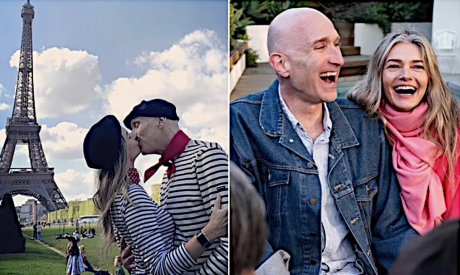
The subject arose after reading that Paulina Porizkova is happily entwined with Will & Grace exec producer & writer Jeff Greenstein. (The six-foot-seven-inch Greenstein also created State of Georgia.) Finding genuine love is always a blessing. HE wishes both parties all the best.

This is not a negative post. From a sexual standpoint I just feel vaguely creeped out by the Mr. Clean/Jeff Bezos look. Remember that ’80s line about bald guys looking like “dicks with ears”?

That aside I mean “none harm,” as Sir Thomas More once said. No offense, to each his own, life is short, etc.

Read more

“Oppenheimer” vs. Academy Inclusion Standards?

HE: “One wonders if the all-white** Oppenheimer (Universal, 7,21) will be excluded according to the Oscars’ about-to-take-effect diversity/inclusion rules. They’ll probably be okay given the last two rules, but they definitely don’t pass the first set of rules with that mostly all-Anglo cast.”

Friendo: “I’m sure Oppenheimer will slip through because nothing won’t pass from a major studio.”

HE: “Major studio releases can sidestep the diversity/representation standards because of their sizable economic footprint?”

** As we all know, the term “all-white” generally refers to a seeming absence of African Americans, at least in a visually prominent sense. Technically speaking Oppenheimer‘s cast includes Skyler Pierce and a trio of Middle-Eastern cast members — the Oscar-winning Rami Malek (son of Egyptian parents), Aamir Yusuf and Yaser Al-Nyrabeah.

Costello Over Warwick

Six months hence “Anyone Who Had A Heart” will be 60 years old. Composed by Burt Bacharach and Hal David. Dionne Warwick recorded the melancholy love song in one take at Manhattan’s Bell Sound Studios (237 West 54th Street). The session happened a week or two before JFK’s murder. And then along came Elvis Costello‘s collaboration with Bacharach in the late ’90s, and I’m sorry but his version of “Anyone Who Had A Heart” just blew Warwick’s away.

Affleck Moment (1.23.16)

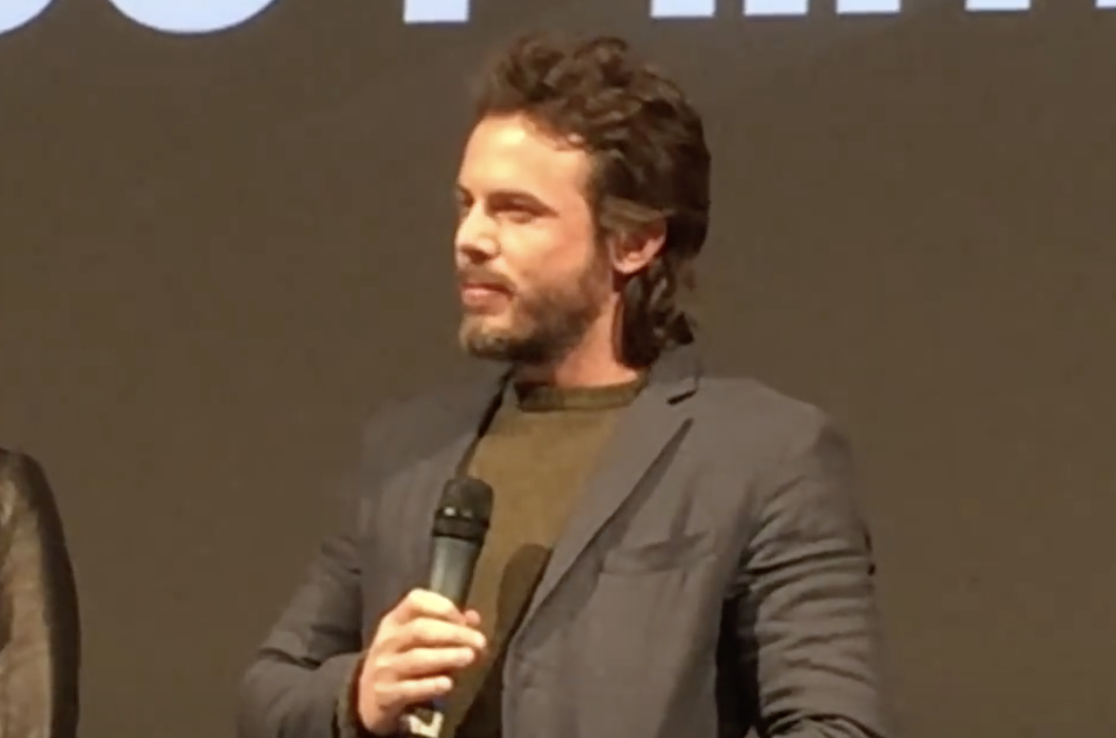
HE’s hand-held iPhone footage, captured around 10:15 pm on a Saturday evening (1.23.16) at Park City’s Eccles Theatre — the Sundance Film Festival launch of Kenneth Lonergan‘s Manchester By The Sea.

Casey Affleck was asked by an audience member how playing Lee Chandler had affected him personally, and one of his first reactions was “that’s a good question” — which meant he was unsure about how to best answer it.

Amazon/Roadside wouldn’t open the film for another ten months (11.18.16), but when you’ve got an absolute winner nobody worries about starting too early. Everyone knows it works, and they can’t wait to share it.

Manchester opened a year before the first stirrings of the woke plague, and today, seven and one-third years later, early ’16 seems like such a tranquil or even a magical moment. We didn’t know what we had until it all began to slip away.

Will “Oppenheimer” Depict Japanese Horror?

We all understand that Chris Nolan‘s Oppenheimer (Universal 7.21) will primarily focus on the Manhattan Project and particularly J. Robert Oppenheimer‘s recruitment by the U.S. government in the early ’40s to run the Los Alamos Laboratory, which ultimately resulted in the climactic Trinity explosion — the first-ever nuclear blammo on 7.16.45.

We also know that the film will focus on the Oppenheimer security hearing of 1954, and how the mercurial physicist came under fire for allegedly harboring ambiguous or disloyal attitudes regarding the development of advanced nuclear devices, and how he was more or less broken by the scorn of this investigation.

I was thinking yesterday that it will seem strange if not anti-climactic if the dropping of atomic bombs upon the Japanese cities of Hiroshima (8.6.45) and Nagasaki (8.9.45) is not also dramatized. And yet the word around the campfire is that Nolan’s movie doesn’t depict the Japanese maelstroms.

We also understand that the Los Alamos team wasn’t diverse. To the best of my knowledge no people of color were involved. Will wokesters bitterly complain that Oppenheimer is unacceptably white and therefore racist, or will they exude smug satisfaction by saying “obviously this is what white people are best at…causing terrible death and destruction and mass murder,” etc.

Continuing 1.85 Heartaches

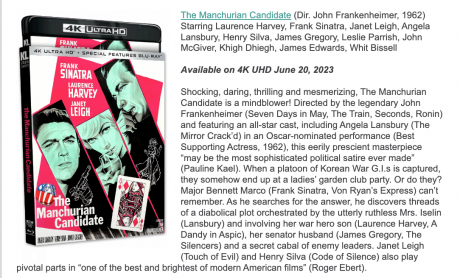
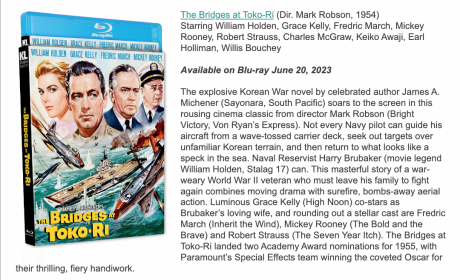
This morning Kino Lorber announced a new Bluray of Mark Robson‘s The Bridges at Toko Ri (’54); ditto a forthcoming 4K Bluray of John Frankenheimer‘s The Manchurian Candidate (’62). I immediately wrote KL’s Frank Tarzi, who became a true HE hero nine years ago after releasing a boxy (1.37:1) Bluray of Delbert Mann‘s Marty, and asked him what the aspect ratios would be.

Tarzi’s reply broke my heart.

Despite a wonderfully boxy, extremely handsome version of Toko Ri having streamed on Vudu for several years, Kino Lorber’s forthcoming Bluray will be presented at the dreaded 1.85. Hearing this was like getting stabbed in the chest with a ballpoint pen. As one who greatly respected Tarzi’s decision to release that boxy Marty Bluray, I was naturally hoping that KL’s Toko Ri Bluray would be issued at 1.37 or at the very least 1.66. Aaagghh!

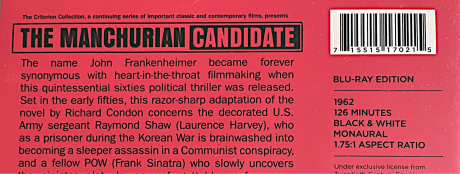
The Manchurian Candidate was mastered at 1.66 for many years, and then, for no reason whatsoever, was slightly cleavered down to 1.75:1 by Criterion when they issued their Bluray in late 2015.

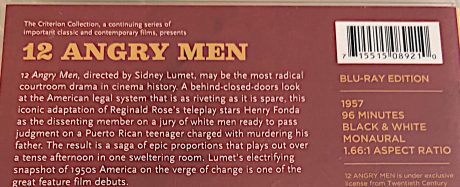
Tarzi: “KL’s Bridges at Toko Ri, The Manchurian Candidate, 12 Angry Men and Night of the Hunter are all presented at 1.85:1. That’s how they played in theaters. We have the needed documentations for all.

Kino’s Marty re-release (’22) included both 1.37 and 1.85 versions.

“As far as Juggernaut is concerned, the master is the same 1.85 master we had previously released. The packaging had said 1.66, but that was a typo. It’s the same transfer but encoded at a higher bit rate and on a dual-layered BD50 disc, giving the feature 30mbps or more. So it should look better than the previous release that was on a BD25 single layered disc. We also added a TV Spot.”

HE reply: “Frank, you’ve broken my heart. 12 Angry Men was shown at 1.85 in theatres in ‘57, you say? So the Criterion guys who cropped it at 1.66 are…what, improvising or irresponsible?

Manchurian began its home video life with a 1.66:1 aspect ratio. Then Criterion whacked it down to 1.75. Now Kino has chopped it down further to 1.85. Terrific.

Toko Ri is drop-dead beautiful at 1.37. You’ve decided to eliminate…what, 30% or 35% of that 1.37 image?

“What can I say, Frank? I thought you were a bro, at least as far as that 1.37 Marty Bluray was concerned. Now, it appears, you’ve gone over to the dark side. You’ve apparently been Bob Furmanek’ed.

“It really doesn’t matter what aspect ratio panicked theatrical distributors went with in 1954 or ‘57. All that matters is how good and true the film looks by today’s whatever-works standard. We can choose any aspect ratio that seems right and pleasing to our eyes, as you did with Marty.

“It is my conviction that Bob Furmanek is a sworn enemy of HE’s concept of pictorial big-screen beauty. He only cares about what distribs we’re scared of…about uncovering historical documentation that shows they were projecting with 1.85 aperture plates.

Loyal GriggsToko Ri cinematography was clearly framed or protected for 1.37. Paramount was a 1.66:1 studio in ‘54, as you know. If you had to whack it down, you could have at least held yourself to 1.66. But cropping it to 1.85 is unconscionable.”

Read more

Cancel Paul Newman

Now that the HE wokerati have properly condemned Laurence Olivier, Pauline Kael and Richard Dreyfuss to an eternity of excruciating pain for directing, acting in or speaking positively about Oliver’s Othello, it’s time to address Paul Newman‘s performance in Martin Ritt‘s The Outrage (’64).

The trailer speaks for…makes that chokes on itself. Newman’s Mexican character, Juan Carrasco (whose last name should have been changed to Tabasco), is nothing short of breathtaking — a greasy-haired, makeup-covered, gravely-voiced rapist from the ninth circle of Anglo casting hell.

The film, based on Akira Kurosawa‘s Rashomon (’50), was a stinker, but that doesn’t make Newman’s performance any less criminal. HE is proposing that Newman be permanently cancelled in absentia…his reputation needs to be tarnished from here to eternity. For his lack of sensitivity and all the pain that he’s caused, Newman needs to be forgotten entirely, I mean…his name should be wiped clean from the pages of film history. Somebody needs to immediately inform Ethan Hawke, and if he squawks, cancel him too.

Ritt needs to be cancelled also; ditto any critics who gave a good review to The Outrage. Lash and then hang ’em all.

HE nominates Jeremy Fassler and Eric M. Byrne to co-chair the board of inquiry into all major white guy casting crimes of the last 85 to 90 years.

It goes without saying that Orson WellesOthello (also black-faced in his 1951 film version) needs extreme condemnation. Ditto Marlon Brando for playing Mexican revolutionary Emiliano Zapata in Viva Zapata (’52) and Sakini, an Okinawan translator, in Teahouse of the August Moon (’56). Ditto Sean Connery for playing a Moroccan bandit-warrior in The Wind and the Lion (’75) and a Saudi Arabian character, Khalil Abdul Muhsen, in Richard Sarafian‘s The Next Man (’76). Ditto Alec Guinness for his dark-skinned ethnic performances in Lawrence of Arabia and A Passage to India. Ditto Fisher Stevens for playing an Indian engineer, Ben Jabituya, in Short Circuit (’86). Ditto white-assed Willem Dafoe for playing the Hebrew-born Jesus in Martin Scorsese‘s The Last Temptation of Christ (’88). Ditto Al Pacino for playing a Puerto Rican in Carlito’s Way. Ditto Angelina Jolie for playing an Afro-Cuban woman in A Mighty Heart (’07). Ditto Johnny Depp for playing Tonto in The Lone Ranger (’13). The list goes on and on.