Three Faces of Evelyn

The new Salt Unrated Edition Bluray (out tomorrow) actually contains three versions of Phillip Noyce‘s spy thriller — the original theatrical cut (95 minutes and 54 seconds), an extended version (96 minutes, 56 seconds) and a director’s cut (99 minutes and 48 seconds). The longer cuts are said to be worth the purchase price in themselves.

The extended version is the original cut before Noyce went back to shoot a new ending (Jolie leaping out of chopper, splashing to the Potomac, running into the woods, etc.) and the action scene in the middle of the film in which Salt kills her Russian mentor and his cohorts on a barge. The director’s cut is Noyce’s extended unrated version of the material that made it into the theatrical release.

The theatrical version with the re-shot ending was preferred by the studio because it left the door open for a sequel.

In his 12.17 review, Den of Geek‘s Mark Pickavance opines that the director’s cut “has significantly more balls in delivering a less-than-perfect ending. The extended cut is also interesting, because in it the death of one character, Daniel Olbrychski‘s Orlov, happens at an entirely different point, which alters things quite dramatically, and results in a totally different ending.” And that taken together, these two new versions “fix a number of plot holes that the theatrical release suffers [from].

“One question everyone I asked about the theatrical cut is why Evelyn Salt runs at the end. Well, if you watch the director’s cut you find out why, and also possibly why Orlov’s plan actually works, although it’s not the plan as presented in the theatrical version.”

Come again?

“What appears to have happened is that the studio liked the movie, but the [extended] cut doesn’t really allow for a sequel, so it got altered to make that possible,” Pikavance writes. “I won’t spoil what ultimately happens, but [in] the extended cut the death of Orlov happens at an entirely different point, which alters things quite dramatically, and results in a totally different ending.

“If you liked this movie then you’ll want to see both of those cuts, because even if the running time differences are in the region of four minutes, those are minutes that put some much needed edge on what is essentially a by-the-numbers spy thriller.”

This YouTube video (recorded by an American guy) from Japan explains some of the differences between the cuts. The extended cut is “way more interesting,” he says, than the theatrical version.

An Amazon reader’s assessment, passed along by a person close to the film and therefore presumably accurate, agrees that the director’s cut “makes the most sense plot-wise, and includes some better character development.”

Differences between the theatrical vs. director’s cut:

(1) Evelyn Salt’s opening interrogation scene in North Korea is longer and more brutal. The soldiers force a tube down her throat and subject her to more intense questioning, followed by several kicks to the abdomen.

(2) Extended scene of Orlov training little kids who will be future sleeper agents. As the kids finish a race through the woods, Orlov asks which kid was first, and which was last, whipping the last kid with a riding crop.

(3) Abduction of Michael (Salt’s husband) by Orlov’s thugs is shown.

(4) Additional scene where Michael tells Salt about a new species of spider that he has discovered.

(5) Childhood scene between Salt and [somebody] at Orlov’s training camp.

(6) Salt’s husband is not shot in the director’s cut; rather, he is slowly drowned and Salt is forced to watch. Michael’s death is much more harrowing in the director’s cut.

(7) Salt kills Orlov with a broken bottle, and the stabbing is shown in more detail, rather than off-screen.

(8) Salt’s rampage through Orlov’s freighter headquarters is more graphic.

(9) Gunfights depict more bullet holes and blood, but nothing overly gory.

(10) Liev Schreiber‘s Winter kills the president in the director’s cut, whereas in the theatrical cut, Winter only knocks him unconscious. Some have noted that the theatrical cut never made much sense, because the President would easily be able to identify Winter as the traitor.

(11) At the end of the movie, there is a voiceover that subtly suggests that the vice president is actually one of Orlov’s sleeper agents, setting the stage up for a sequel. This voiceover is not present in the extended cut.

Differences between the extended cut vs. director’s cut:

(1) The changes listed above in the director’s cut are also done in the Extended Cut, with the exception of the differences below.

2) The President is only knocked unconscious in the theatrical cut (and killed in the director’s cut). In the extended cut, Winter attempts to make his way towards the unconscious President, who is being wheeled away on a stretcher, in order to kill him.

3) The biggest difference in the extended cut is that Salt doesn’t kill Orlov until the end of the movie. So the entire sequence in the theatrical and director’s cuts where Salt annihilates Orlov’s thugs on the barge is missing.

At the end of the extended cut, she is being interrogated by Peabody (Chiwetel Ejiofor), where she fakes suicide and is taken to a hospital. She subsequently escapes from the hospital, finds Orlov (back in Russia somewhere), and kills him.

Officially

Last Friday I wrote that the existence of those 17 minutes of cut footage from 2001: A Space Odyssey, sitting in a vault in Hutchinson, Kansas, has been known to Warner Bros. for the last 42 years, and is therefore no discovery, and that re-integrating the footage into the standard 139 minute cut that’s everyone’s familiar with would probably be a bad idea.

This morning a statement from Warner Bros. arrived: “The additional footage from 2001: A Space Odyssey has always existed in the Warner vaults. When [director Stanley] Kubrick trimmed the 17 minutes from 2001 after the NY premiere, he made it clear the shortened version was his final edit. The film is as he wanted it to be presented and preserved and Warner Home Video has no plans to expand or revise Mr. Kubrick’s vision.”

Okay, fine…but what about including the unseen footage being included on an extras menu on a subsequent Bluray down the line? Where would be the harm?

All Over Bertolucci

The Museum of Modern Art’s Bernardo Bertolucci restrospective kicked off 12.15, and runs until 1.12.11. (I’ll be revisiting La Luna, 1900 and The Spider’s Stratagem, and catching Serge July and Bruno Nuytten‘s Once Upon a Time: Last Tango in Paris, a doc about the landmark Marlon Brando-Maria Schneider film showing on 12.27). Bertolucci’s The Conformist has four days left at the Film Forum. And a new Bluray of Last Tango in Paris streets on 2.15.

For me, getting lost in Bertolucci will be a way of combating Christmas-holiday gloom. It’s the holiday per se, but the fact that almost everything shuts down and nothing’s doing for about a ten-day period (12.23 to 1.3). I always get through it okay, but God, what a relief when things finally start up again.

Here’s a Hollywood Reporter interview with Bertolucci about the MOMA thing. And here’s a personal story about Bertolucci in Bilge Ebiri‘s blog as well as a “Vulture” slideshow in which Bertolucci discusses certain key scenes from his films.

I Dream of Greenberg

If Todd McCarthy is ripping Little Fockers (Universal, 12.22) a new one (“focking dismal…nothing but a paycheck project”), so can I. This is a franchise-killer for the simple reason that it’s just not funny. To watch it is to slowly succumb to a kind of corporate poison that spreads through your veins like embalming fluid, causing your skin and your soul to turn gray. Never again will I watch a Focker film…ever. It’s not family fun. It’s not some kind of half-okay Christmas hoot. It’s narcotized horseshit.

Robert De Niro getting buried under a truckful of sand isn’t funny. DeNiro with a raging hard-on isn’t funny. Ben Stiller stabbing his father-in-law’s erect member like he’s Norman Bates killing Marion Crane isn’t funny. Intra-family insinuations and putdowns and one-upsmanship about a lack of money or generosity or potency are not funny. Stiller slicing his hand with a carving knife and splattering at least a half-pint of blood all over his wife (Teri Polo) and parents-in-law (De Niro, Blythe Danner) is not funny. A film that won’t stop smothering its audience with images of affluent comfort and abundance is about as funny as George Orwell‘s Big Brother. And on and on. You get the idea.

“This is definitely the least and hopefully the last of a franchise that started amusingly enough a decade ago but has now officially overstayed its welcome,” McCarthy writes. “Still, this won’t stop quite a few folks from parting with some bucks in search of some holiday season yucks, the majority of them from jokes that could have originated on men’s room walls.”

Oscar Poker #12

Today’s Oscar Poker (#12) included credentialed-pally critic Marshall Fine along with boxoffice.com‘s Phil Contrino. Tron: Legacy did okay but How Do You Know (“Sold as a comedy, not a comedy!”) was DOA. Black Swan and The Fighter did pretty well, but what about poor Rabbit Hole? And what about that curious Kids Are All Right love from the New York Film Critics? Do GenY filmgoers have the ability to appreciate films like Somewhere? Here’s a non-iTunes link.

Verdict?

At the very least, Water for Elephants (20th Century Fox, 4.15.11) has been handsomely shot by Rodrigo Prieto (Brokeback Mountain, Babel, Biutiful). That seems fairly evident. A young man falls in love with a blonde under the big top, etc. Period trappings, heart, amber, romantic conflict, refuge of the road. Director Francis Lawrence previously made I Am Legend, which wasn’t half bad.

Purchase Required

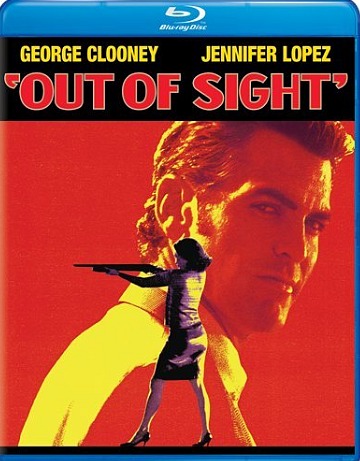
I have a slight Out of Sight problem. I can’t remember much of the basic story, only story pieces. George Clooney goes back to jail at the end but he meets an expert jail-breaker in the paddy wagon — I remember that. And Clooney and Jennifer Lopez talking and half-flirting in the car trunk, and talking at one point about Robert Redford “when he was young.” I remember Michael Keaton‘s not very bright FBI agent, Ray Nicollette. And a fat criminal falling on the stairs and accidentally shooting himself.

I remember Dennis Farina‘s character, a lawman who’s Lopez’s dad, noticing that Keaton is wearing a T-shirt that says “FBI” on the front and saying “Hey, Ray, do you ever wear one that says ‘undercover’?”

Except the Bluray doesn’t even come out until March 1st. That kinda sucks.

Out of Sight was released 12 years ago. Time flies. Clooney looks young with the bop haircut and all.

Clooney: “I know a guy who walks into a bank with a little glass bottle. He tells everyone it’s nitroglycerine. He scores some money off the teller, walks out. On his way out, the bottle breaks, he slips on it and knocks himself out. The ‘nitro’ was Canola oil. I know more fucked-up bank robbers than ones who know what they’re doing. I doubt if one in twenty could tell you where the dye pack is. Most bank robbers are fucking morons.”

Adams Over Leo

The Detroit Flm Critics got it right when they defied conventional wisdom by giving The Fighter‘s Amy Adams their Best Supporting Actress prize, and not her costar Melissa Leo, whom everyone else has cited. I love Leo personally, and if she wins the Oscar, fine. But she’s playing a momma monster who grates a bit with a second viewing, and who turns rancid when you catch The Fighter a third time.

It’s not just the performance that people vote for; it’s also the character. Do you feel this person has been written and portrayed in a filled-out, real-enough way? They may be flawed, perhaps tragically so, but do their actions square with your understanding of what people are like and how the world is? Or do they seem alien and/or repellent? Would you like this person or want them for an acquaintance or friend if you met them in real life? These are questions that people kick around.

Fair warning to spoiler whiners: Leo’s braying, chain-smoking mom looks again and again into the damaged life of her ex-boxer son Dicky’ (Christian Bale), sees him jumping out of the second-floor window of the crack house he lives in, mentally realizes he’s an addict, and yet emotionally pushes it aside, refusing to actively deal with it (by urging rehab, say) and she still favors him over her other non-addicted son, Mickey (Mark Wahlberg). This is how parents are, I know. They have favorites. But still…

Leo sees nothing other than “family, family, family” as the cornerstone of her life and her son’s boxing career, and yet it’s obvious that to her “family, family, family” means “me, me, me” in terms of holding onto power and pushing and coddling Dicky to the point of absurd and ridiculous denial. What is that scene when she’s watching the HBO special and she says to Wahlberg, “Are you watchin’ this?” She didn’t get what was going on with Dicky because she didn’t want to get it, because Dicky had to be the champ and the big brother who ruled the roost…Dicky, Dicky, DIcky.

Amy Adams walks into Wahlberg’s life, takes one look around and said, “What the fuck is this? Your career is on the verge of going down the toilet because your older brother is a junkbag and they’re putting you into fights that you shouldn’t be fighting.” This, of course, is what the audience has been thinking almost since the film started. They’re also asking themselves, “What is Melissa Leo’s blockage?” We get it, Amy Adams gets it and Leo refuses to until the HBO show comes on, and even then she favors Dicky. She’s a textbook example of a malevolent mother.

That’s why Adams should win the nomination and the Oscar, I feel, because she’s easily as good as Leo, chops-wise, and just as strong and scrappy as Leo’s character, only you can really identify with and believe in Adams while Leo’s mom is just, like, “forget it.” The more I think about her, the more repellent she seems.

Get Todd Phillips!

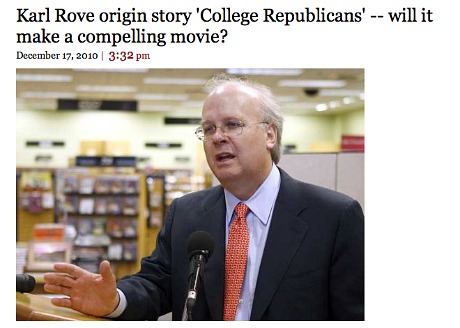
I requested, received and read Wes JonesCollege Republicans yesterday, and the thumbs-up consensus is absolutely correct. This is a very smartly written, character-rich, darkly humorous tale of an actual 1973 road trip taken by infamous Bush strategist and Fox News scumbag Karl Rove, then 23, and the late Republican attack dog Lee Atwater, then 22, as they campaigned and dirty-tricked their way across the south in order to get Rove elected chairman of the College Republican National Committee.


(l. to. r.) young Karl Rove, Shia LaBeouf, the late Lee Atwater, Paul Dano.

But what this is, boiled down, is another Due Date mixed with politics and, in a manner of speaking, horror. Because it’s an origin story about the wily and colorful beginnings of two scoundrels who made their bones as the architects of rightwing attack-and-subvert politics — guys who not only put two Bushes into the White House but injected a vicious and reprehensible strain into American politics that not only thrives today but has in fact metastasized.

And yet it’s funny and entertaining, and the Atwater character is a likable good-old-boy, part snake and part horndog, and Rove is a brilliant but snarly schemer who believes in Machiavelli and getting revenge. And it’s got rowdy episodes and wild shenanigans (sexual seduction, colorful language, sudden fisticuffs, rummaging through garbage cans, being chased by dogs and cops and hopping over fences) and a scrappy and suspenseful third-act climax that works in the same way that hundreds of other films have worked — i.e., everything comes to a head and the characters fulfill their fate.

Do I have to say it? Material of this sort is right up the alley of director Todd Phillips (Due Date, The Hangover, Road Trip), and yet the largely fact-based, dark-political-metaphor aspect would expand Phillips’ resume. Anonymous Content, the project’s producers, doesn’t need to be told this. It’s a no-brainer.

But in his 12.17 review piece, L.A. Times guy Steven Zeitchick has apparently heard the wrong information about who might potentially play Rove and Atwater. He reports that Anonymous wants Shia LaBeouf to portray Atwater and Paul Dano to inhabit Rove. And that can’t be. If anything, it’s gotta be LaBeouf as Rove and Dano as Atwater. Zeitchik’s casting doesn’t allow for the slightest physical resemblance between the actors and the real guys, but you could easily imagine the opposite.

And if they can’t get LaBeouf, fine. Because Emile Hirsch would have a total field day as Rove. He’s not as commercial as LaBeouf, agreed, but he’d knock it out of the park. And it’s really too bad Seth Rogen looks so much older than he is (born in 1982, doesn’t appear a day under 38) because he’d also be awesome as the future Bushian power-broker. But there’s no way audiences could buy him as a 23 year-old.

Zeitchik goes off on a weird tangent when he calls College Republicans “a tricky commercial prospect…the stuff of great drama but not necessarily great box office [because] it’s far from a sure thing that the large number of Americans who consider themselves Republicans would embrace a Hollywood take on Karl Rove.”

Zeitchik is serious? Firstly, College Republicans is a story about a couple of smart (if slightly satanic) young guys on the make who take down their enemies and attain power, and if that’s not an American success story then I don’t know what is. Secondly, take out the comic schtick and some of the antics and the story is essentially truthful. (Most of it is recounted in James Moore and Wayne Slater‘s “Rove Exposed: How Bush’s Brain Fooled America.”) And thirdly, the only Republicans who know or care about Rove these days are over 55 and live in the hinterlands. Rove is a back-room guy who’s not at all liked, I’ve read, by Sarah Palin or the Tea Party-ers, and while he’s a Fox News commentator he clearly lacks the bully-boy charisma and popularity of Glenn Beck or Rush Limbaugh. And — hello? — Rove is generally regarded as a demonic figure who operated the marionette strings of George Bush, swift-boated John Kerry, was involved in outing Valerie Plame, mis-advised Bush on Hurricane Katrina, etc. If you can’t portray or satirize a guy like Rove in a darkly humorous way, who can you stick it to?

Weekend Reading

Here I am the last to speak up, but after reading Stephen Zeitchik‘s 12.17 L.A. Times piece about Wes JonesCollege Republicans, I’m intrigued. If any HE script pallies have a PDF, please send along. College Republicans was recently praised as the most popular of the hot newbie scripts by Franklin Leonard, the creator-manager of the Black List.

Leonard has placed Noah Oppenheim‘s Jackie in second place, right behind College Republicans, as the second most admired Black Lister with 47 votes. I beg to differ, as I explained on 4.15.10.

Incidentally: I also wouldn’t mind snagging a copy of Carrie Evans and Emi Mochizuki‘s Boy Scouts and Zombies.

Note: My apologies to HE commenters, but I was obliged to delete and repost this story, which originally ran Saturday morning, due to a ridiculous server clock/time stamp issue created by the geniuses at Softlayer/Orbit the Planet, which is HE’s internet service provider for the time being. As a result (and I really couldn’t help this) all of yesterday’s comments were wiped out

Most Dependable

Four days ago Fair Game director Doug Liman responded to a falsehood-filled attack on his film’s credibility by former N.Y. Times reporter and alleged neocon mouthpiece Judith Miller, which appeared in the Wall Street Journal on 12.9. Liman also alludes to a 12.3 Washington Post editorial, also penned with a dimissive and inaccurate neocon conviction, that attacked his film.

I should have posted this earlier — sorry. Read Liman’s piece on the Columbia Journalism Review website or, if you prefer, here. I’ve pasted the whole thing because it’s important, and because the people who’ve been attacking this film are, I believe, agenda-driven liars. William Burroughs said it decades ago: “Some people are shits.”

Editor’s note: Last Thursday, Judith Miller penned a column for The Wall Street Journal in which she accused the new film Fair Game of pushing “untruths” in its telling of the outing of former CIA agent Valerie Plame.

Miller described the film, which focuses on the relationship of Plame and husband Joe Wilson, as “brilliantly acted,” but a “gross distortion of a complicated political saga.” She challenges seven of what she calls the film’s “untruths”; among them, claims that Plame played a “key role” in the CIA’s counterproliferation division, charged with gathering evidence on Iraq’s WMD programs, and that Plame was involved in missions to provide safe havens to Iraqi scientists. Miller also takes issue with a subplot in the film in which Plame, played by Naomi Watts, recruits an Iraqi-American woman to visit her scientist brother in Iraq, where is working on the country’s WMD program. CJR approached Fair Game director Doug Liman (Swingers, Mr and Mrs Smith, The Bourne Identity) for comment. He wrote back with this response to Miller’s piece:

Judith Miller demonstrated in her recent WSJ story about my film, Fair Game, the same cavalier attitude towards the facts that led to her departure from The New York Times in disgrace. And we should never forget that Scooter Libby outed Valerie Plame to Miller in June 2003 — more than two weeks before Richard Armitage outed Plame to Novak. Somehow Miller neglected to mention that in her op-ed piece.

But she also forgot about that before — in her early grand jury testimony — until she was forced to come clean about it in a subsequent grand jury appearance and under oath at Libby’s trial. Miller’s belated testimony helped convict her “source” Libby, but not until she did everything she could, as a forceful proponent of the war in Iraq, to avoid telling the truth to the American public.

And so here we go again.

Judith Miller writes that her supposed anonymous sources told her that Valerie Plame did not play a “key role” in the CIA’s effort to penetrate Iraq’s presumed WMD program. In truth, Valerie Plame was head of operations for the CIA’s Joint Task Force on Iraq (JTFI). My sources: former Director of Central Intelligence George Tenet and U.S. attorney Pat Fitzgerald.

Valerie’s specific actions as head of operations for the JTFI were and still are classified. Valerie Plame, a loyal intelligence officer from a military family, has always honored and continues to honor the secrecy agreement she signed when she joined the Agency more than twenty-five years ago. As filmmakers, we did the best job we could to piece together her activities in covert CIA operations specializing in nuclear counter-proliferation. This is not easy, especially since Valerie was a NOC, a form of deep cover operative with no official ties to the U.S. government. To be drawn into debating what this deep cover operative may or may not have done is to miss the big picture — this was no “glorified secretary” who was outed by the White House. Far from it.

Special Counsel Fitzgerald submitted a memorandum to the district court in the Libby trial spelling out in detail Valerie’s undercover role overseas, covert status, and senior positions at the CIA leading counter-proliferation teams and searching for WMD in Iraq. It is disgraceful that Miller and others like her continue to demean Valerie and the dedicated women and men who serve our country as operations officers and risk their lives to keep armchair warriors like Miller safe from harm.

Regarding the Iraqi scientists that are the focus of a sub-plot in Fair Game, Judith Miller seems to blur the line between opinions and indisputable fact. This much we know to be fact: the CIA made a criminal referral because of Plame’s outing. I doubt that the CIA and its director George Tenet — someone who bent over backwards to protect the Bush Administration — would have allowed that to occur if the consequences to national security weren’t serious and the damage to intelligence operations severe.

Obviously WMDs remain a sore subject for Miller, who wrote many erroneous stories that badly misled the American public about their existence in Iraq in 2003. Fair Game doesn’t much focus on the WMDs, except to recount an episode showing the dangers of politicized intelligence, which is now common wisdom on both sides of the political aisle. Indeed, Fair Game doesn’t even state an opinion about the war itself, however disastrous its consequences are in hindsight. Rather, Fair Game is about the president of the United States lying to the American people, and what happened to the people who challenged him. The wagons were circled around the president of the United States on the trust issue.

And while Judith Miller seems to downplay whether there was a conspiracy in the White House to out Valerie Plame, the published explanation for her hasty and forced exit from The New York Times refers to the unfortunate role she played as “one of the reporters on the receiving end of the anti-Wilson whisper campaign.” As a key witness, Miller didn’t attend every day of the Scooter Libby trial the way my screenwriters did. Remember that this was not some witch-hunt: the special prosecutor Pat Fitzgerald is universally respected and was a Republican U.S. Attorney appointed by President Bush. And the jury was unanimous in its conviction of Scooter Libby on all five counts with which he was charged.

As for Miller’s rehash of old arguments about Armitage, here again she’s got it wrong. Armitage was not an innocent Boy Scout, as wrongly portrayed by Miller and The Washington Post editors in their recent editorial. Armitage twice attempted to out Plame as a CIA officer, first to Bob Woodward (just about the most famous reporter in Washington), then, when unsuccessful with that, to Bob Novak, the syndicated self-proclaimed “Prince of Darkness.” Armitage famously confessed his “foolishness,” but that isn’t an explanation. Once may be careless, but twice is not careless, it’s either intentionally foolish, on purpose, or worse.

The truth is that Armitage is no peacenik and probably never was, no matter what Miller wishes were true to cover her tracks. Anyone looking at a timeline of who did what and when can see that Armitage tried to be an “army of one” by blurting out about Plame to two different high profile inside-the-Beltway reporters. But the trail of how Armitage came to know about Joe Wilson and his wife — a covert CIA NOC — appears to lead straight back to Libby.

Libby met with Armitage in June 2003, shortly after confirming that Joe Wilson was the unnamed ambassador sent to Niger by the CIA to find out about the now infamous “yellowcake” uranium claim. A few days later, Armitage first told Bob Woodward about Wilson and his wife, but Woodward kept silent. So Armitage’s first effort to out Plame failed. But weeks before Armitage got his second chance to out Plame, Libby had already outed Plame to Miller at the end of June 2003. Then Libby outed Plame to Miller again in early July 2003, right before Armitage blabbed to Novak about Plame and her husband, Joe Wilson.

In case Armitage’s second attempt failed, Libby knew that Miller was standing by. With Miller as a backup and Karl Rove standing by to confirm Armitage, Novak outed Plame as a CIA operative wife of Joe Wilson. Miller says nothing about her role in this affair in her op-ed piece. The Republican controlled Justice Department in fact found that Libby and Rove personally outed Valerie Plame to multiple members of the news media, including Robert Novak, Judith Miller, Matt Cooper, Walter Pincus, and Bob Woodward. Plame was going to be outed even if Armitage didn’t succeed with Novak.

So although neither Miller nor Armitage are in the film Fair Game, both of them were involved in the whole sorry episode up to their eyeballs. Actually, I would have loved to have included Richard Armitage, Dick Cheney and others in Fair Game, had Scooter Libby not obstructed the investigation, for which a unanimous jury convicted him on five serious counts with jail sentences.

So was there a conspiracy in the White House to punish Joe Wilson for speaking out? The film leaves that up to the viewer to decide. Pat Fitzgerald did say “there’s a cloud over the Vice-President, a cloud over the White House.” People can go see Fair Game this holiday and decide for themselves who was naughty and who was nice.

Note: My apologies to HE commenters, but I was obliged to delete and repost this story, which originally ran Saturday morning, due to a ridiculous server clock/time stamp issue created by the geniuses at Softlayer/Orbit the Planet, which is HE’s internet service provider for the time being. As a result (and I really couldn’t help this) all of yesterday’s comments were wiped out.

Snapshot

The fact that Tron: Legacy isn’t a very good film will, I presume, have no effect on its earnings this weekend. It made around $18 million yesterday and will finish tomorrow night with $45 to $47 million. Nobody wants to hear about Yogi Bear 3D…get outta here. The Fighter will do fairly well by Sunday night with a likely $12 million in 2500 theatres, but let’s keep in mind that pre-Christmas weekends are always soft with everyone travelling and buying gifts. (Boxoffice.com’s Phil Contrino assures it’ll hold up very well next weekend.) Nobody wants to know about Narnia 3D…scoot. How Do You Know is a vessel that has sunk beneath the waves — $8.7 milllion in 2483 theatres, dead. Black Swan did well within its 959-theatre exposure, especially with younger women, bringing in a projected $9 million by Sunday night. And nobody cares about the rest.

Note: My apologies to HE commenters, but I was obliged to delete and repost this story, which originally ran Saturday morning, due to a ridiculous server clock/time stamp issue created by the geniuses at Softlayer/Orbit the Planet, which is HE’s internet service provider for the time being. As a result (and I really couldn’t help this) all of yesterday’s comments were wiped out.