A Little Help

What’s the deal with the True Grit fellatio handed out by Vulture‘s Lane Brown in the latest (12.3) Oscar Futures chart? Really…where is this coming from? Brown hadn’t seen Grit when he typed this up but thoughtful reactions have been mixed from the get-go. I understand the reflexive instinct to cream over any new Coen Bros. film (and I say this as one who’s done so many times), but Brown and others need to come down to earth about this thing.
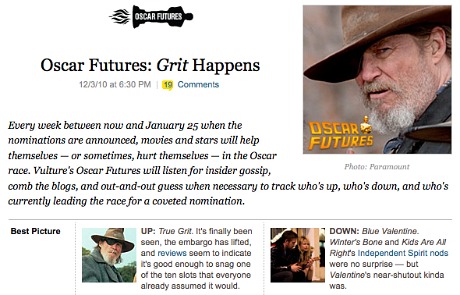
Brown Fallacy #1: “Matt Damon steals the movie.” Retort: Sorry, but he doesn’t. At all. He just acts in it. The one who steals the film is Dakin Matthews.

Brown Fallacy #2: Jeff Bridges is “allegedly better than he was in Crazy Heart, or better than John Wayne was in 1969’s original Grit.” Retort: Nope. Bridges just frowns and barks and growls his way through it, and there’s really nothing all that great about this, trust me.

Brown Fallacy #3: The Coen brothers are “‘at the top of their game’ or working outside of their usual idiom with nice results.” Retort: Nope. They chose a story that says nothing other than the fact that life was tough and brutal in the Old West, and which has nothing whatsoever to bequeath thematically about our own world. The Coens have made a holding pattern artistic-exercise film that ranks near the bottom of their list along with The Man Who Wasn’t There and The Ladykillers.

Brown Fallacy #4: True Grit reviews “seem to indicate it’s good enough to snag one of the ten slots that everyone already assumed it would.” Retort: Blatantly untrue due to the HitFix Drew McWeeny orgasm factor. The fact that McWeeny called True Grit “one of the most crowd-pleasing films I think the Coens have ever made, accessible and simple and mythic and beautiful” tells you without question that it’s probably an artistically curious thing that’s doomed to fail with Joe Popcorn. McWeeny is a brilliant fellow, but experience has taught me to never trust his love spasms. “Crowd-pleasing”? Maybe in spurts, but this film is going to die very quickly when it opens.
First Significant Critics Awards

In Contention‘s “The Circuit” has revealed the winners of the Washington, D.C.-area film critics’ association, and for the second time in a row (following last week’s NBR awards) The Social Network has swept the table in the top categories, winning for Best Picture, Best Director (David Fincher) and Best Adapted Screenplay.

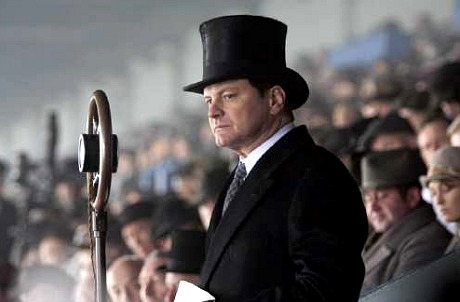
The D.C guys gave their Best Actor award to The King’s Speech headliner Colin Firth instead of TSN‘s Jessie Eisenberg, who was the NBR’s choice. They also handed their Best Actress trophy to Winter’s Bone‘s Jennifer Lawrence and bestowed two wins upon David O. Russell‘s The FighterChristan Bale for Best Supporting Actor and Melissa Leo for Best Supporting Actress.

In Contention‘s Kris Tapley has claimed that Christopher Nolan‘s Inception “was the big winner over all [due to] taking four awards including Best Original Screenplay.” That’s actually bullshit — an original screenplay award plus three tech awards (Best Cinematography, Best Art Direction and Best Score) amounts to four wins, but it’s the big-gun categories that matter. If anything, Inception‘s D.C.-area honors point to a likelihood that people are generally viewing it as an original, technically dazzling film that didn’t quite deliver where it really counts. If you want to be really blunt about, these awards are actually an indication that Inception is pretty much finished as a Best Picture contender. If you admire but don’t really love a film, shower it with below-the-line awards.

A majority of the D.C.-area critics choosing Jennifer Lawrence‘s performance over Natalie Portman‘s in Black Swan may be a bellwether in itself. As Lawrence’s character is steady and steely, Portman’s is frenzied and anguished. There’s no question that Portman delivers more of a knockout perf, and yet Lawrence’s brave determination won the day.

[The above Social Network promo is a new 60-second TV spot that Sony ran last night during Leslie Stahl‘s 60 Minutes interview with Mark Zuckerberg.)

Hit Job?

Scott Feinberg reported earlier today that an 11.28 “Vulture” article by Claude Brodesser-Akner has ignited the beginnings of what feels like a suspiciously-timed smear campaign against The King’s Speech. It basically has to do with an eight-year-old Guardian article about Hitler-kowtowing on the part of Colin Firth‘s King George character.

It suggests not so much an anti-Semitic attitude on George’s part as an indifference to the plight of European Jewry at the start of World War II. Maybe so, but things weren’t as cut and dried as they seem from today’s perspective.

Two days ago Feinberg received a letter from “an Academy member” who claimed “there are a LOT of us who won’t vote for King’s Speech” due to the following Brodesser-Akner passage:

“Seeing as Speech is Oscar bait in extremis, this blogger feels morally compelled to note that while the film largely glosses over the Nazi-sympathizing past of the tongue-tied monarch (Colin Firth) and deals with his relationship to an Aussie-born speech therapist (Geoffrey Rush), when it came to actively working to stymie Jews fleeing Hitler’s Germany, George actually communicated quite eloquently.”

Brodesser-Akner was referring to an April ’02 Guardian piece by Ben Summerskill called “MPs Want Quick Release of Queen Mother’s Papers.” It includes the following reference to a public domain document:

“In the spring of 1939 George VI instructed his private secretary to write to Foreign Secretary Lord Halifax. Having learnt that ‘a number of Jewish refugees from different countries were surreptitiously getting into [British] Palestine’, the King was ‘glad to think that steps are being taken to prevent these people leaving their country of origin.’ Halifax’s office telegraphed Britain’s ambassador in Berlin asking him to encourage the German government ‘to check the unauthorized emigration’ of Jews.”

How commonly known in 1939 was the Third Reich’s plans to exterminate European Jews? My understanding is that some of pertinent facts were conveyed to President Franklin D. Roosevelt (and presumably other heads of state) in the early ’40s, but who knew for sure in 1939?

Here’s another wrinkle, which is also contained in Summerskill’s article:

“Support for appeasement of Hitler was common among the British establishment during the 1930s,” he wqrites. “Conservative MPs who publicly opposed the policy, such as Winston Churchill, were threatened with de-selection.

“The historian Andrew Roberts believes that Prime Minister Neville Chamberlain‘s appeasement policy ‘commended itself to the royal family on a number of levels. It was, correctly, considered axiomatic that another war would spell doom for the British Empire.'”

In other words, support for Hitler among the British establishment in the late ’30s was the reigning herd instinct among the tepid and the cautious. Now, what other herd instincts that led to massive disasters can we think of? How about U.S. Congressional support for the 1964 Gulf of Tonkin Resolution, which led to the Vietnam War and was based on total bullshit? Or support by the vast majority of U.S. Senators and Congressmen for invading Iraq in ’03 based on the belief that Saddam Hussein was harboring weapons of mass destruction?

That said, this alleged-Nazi-sympathizer thing could — let’s face it — hurt The King’s Speech among older Hollywood Jews if it’s not quickly turned around. I always thought it was the former King Edward (played by Guy Pearce in the film) who was the alleged Nazi sympathizer, not Bertie.

Malkovich

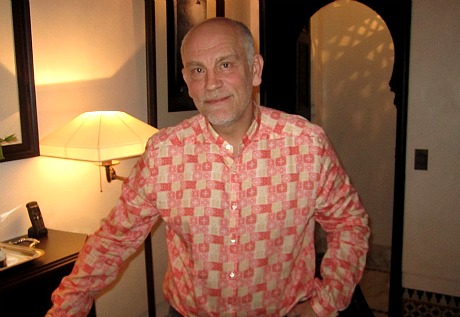
Myself and a group of six or seven sat down with Marrekech Film Festival jury chief John Malkovich late this afternoon at La Mamounia Hotel, which has to be the swankiest and most super-deluxe hotel in all of Marrakech. Malkovich seems so cool, so Zen, so quietly thoughtful. There’s no sense of urgency in the man — everything about him is measured and settled. Is he pretending, hiding? Not so you’d notice.


John Malkovich in one of the Riyahd bungalows at La Moumania Hotel — Saturday, 12.4, 6:15 pm.

He pulled out a Marlboro Light, tore off the filter, delayed as he talked a bit, and then lit it. (Marrakech has no indoor smoking bans.) And Malkovich, let me tell you, knows how to smoke with elegance and style, like Robert Mitchum in Out of the Past.

He mentioned his fashion line, technobohemian, which is available in a few stores in Europe and a few in the States. The New York outlet is Blue Tree (1283 Madison Ave), and the Los Angeles outlet is Church (7277 Santa Monica Blvd.).

I asked if the deflated indie-film economy has led to actors such as himself doing more paycheck roles vs. roles in quality fare, and Malkovich just shrugged out an answer that seemed honest and matter-of-fact and…whatever, that’s how I play baseball. Listen to the

WMA file to hear it. (I tried converting to mp3 but something wasn’t working.)

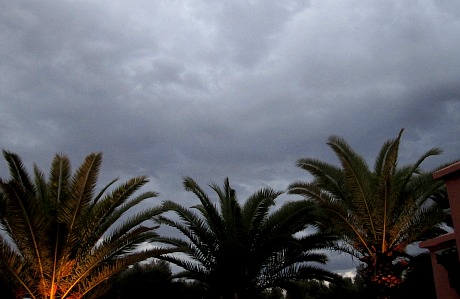
It was gently sprinkling as I waited for the interview to start. Hundreds of tiny droplets on the perfect blue pool water. The rosey terra cotta walls and dark gray clouds went well together. And then the rain stopped.

Big Hurrah

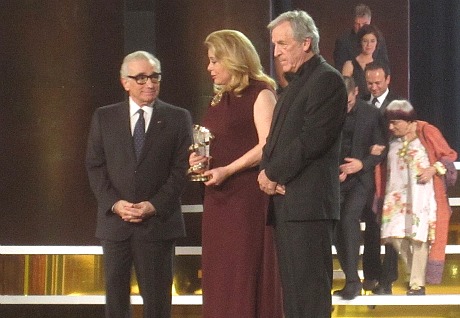
I attended a one-hour “Tribute to French Cinema” last night at the Palais de Congres. I was expecting to see a Chuck Workman-like tribute projected on the big screen, but it was mainly about cheers and glitter. Several French actors and filmmakers (Costa Gavras, Catherine Deneuve, Charlotte Rampling, Nicole Garcia, Marion Cotillard, Guillaume Canet, et. al.) came on stage and took bows.

Martin Scorsese, Catherin Deneuve, Costa Gavras — Saturday, 12.4, 8:55 pm.

Martin Scorsese, the nominal headliner, was the first to be introduced. He delivered some genteel boilerplate remarks about the history and importance of French cinema, and spoke about how he’s always considered Marrakech to be “a kind of home.” (He shot The Last Temptation of Christ here 23 years ago.) The folks in the audience seemed to enjoy it. I was enjoying a crane camera that slowly swooped right over peoples’ heads. Less than two feet away, I mean.

I took some video of the big finale. It took 90 minutes to load 60% of it this morning, and then the connection dropped and the upload was aborted. Naturally.

Sound The Retreat

Thank the Lord and praise Allah — I’ve booked myself a flight that leaves Tuesday morning. This is the beat that my heart skipped. The last time I was this desperate to escape a city was when I was in Fez with the kids in May 2009.

Wifi has been spotty since I’ve arrived at the Palace Es Saadi — weak, passable, fast, weak again — but this morning it’s been all but nonexistent. The concierge says it’s the city’s fault (“It’s bad on the weekend”) and the tech guy…let’s not go there. It’s tedious to read about this, but there’s really no point in being here with this level of service. I won’t be able to record Oscar Poker today because of this. The Moroccan atmosphere only goes so far.

On top of which access to talent isn’t as informal as I thought it would be. Press people have it pretty easy in Cannes, Toronto and Sundance in this respect, but they’re kind of relegated to the sidelines here. I suspect that talent isn’t that much into giving interviews; they’re here to kick back and sample the North African vibe, and I don’t blame them. (I’ve had opportunities to chat with Charlotte Rampling and Alan Parker, and I have a John Malkovich round-table at 5:30 pm.) And there’s not that much to discuss anyway.

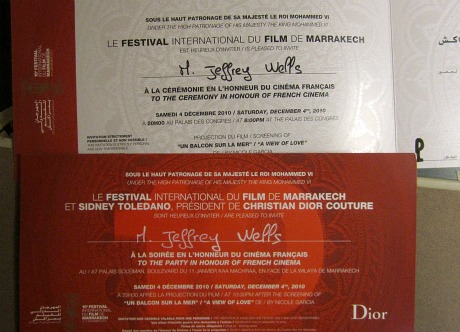
Like dozens of other peripheral big-city festivals around the world that aren’t really in the swing of it, the Marrakech Film Festival is — understandably — basically about itself. It’s about the rich swells attending black-tie events and the festival nurturing good relations with filmmakers and promoting tourism. And the events and venues are located all over town, and at considerable distances from each other, so you’re either a slave to taxis or you have to take a map and an iPhone and try to find them on your scooter. A lot of stopping and getting honked at, let me tell you.

I’m filing this from the Palais de Congres press room, where everything is wired just fine. Yes, I could scooter down here every morning and post new stories and photos, but if I did something else would go wrong. So far it’s been one ordeal after another with short little breaks of enjoyment.

Dog Has Its Day

You have to hand it to the Criterion Co. for creating DVD/Bluray jacket art that persuades (or at least suggests) that films regarded as nothing short of appalling if not calamitous during their initial release might not be all that bad. Perhaps the time has finally come to re-assess and recognize that Michael Lehman‘s Hudson Hawk…kidding! The art is from a site called Fake Criterions. Thanks to “Mr. F.” for passing it along.)

Traffic


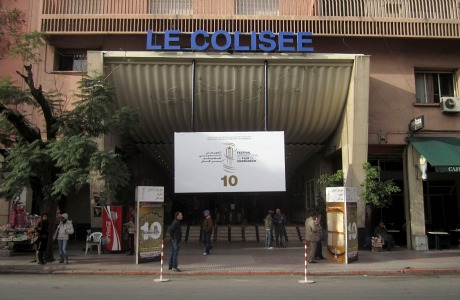
Colisee Cinema, where I caught a 2 pm screening of Robert Bresson’s L’Argent (’83). A very austere moralistic tale about crime and corruption. Inspired by Leo Tolstoy’s short story “The Forged Coupon.” Myself and six others were in the auditorium. I first saw it in ’84 in one of those awful shoebox theatres at the Beverly Center.

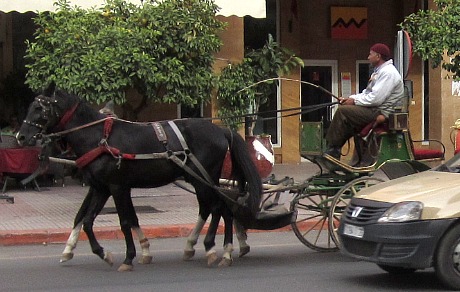
My Marrakech transportation rules, especially the color. The feeling of freedom and anxious excitement as you’re cruising along the streets and boulevards, swerving around pedestrians and slow bikers, getting honked at by fume-spewing taxis and buses, etc., is like nothing else. You’re a road warrior, a citizen of North Africa, and all cares and frustrations fall away.

Shoeshine guy — Saturday, 12.4, 3:55 pm. Corner of Rue El Moguouama and Avenue Med V.

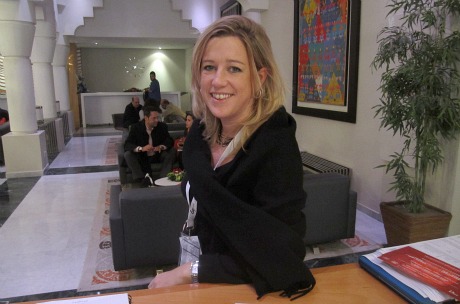
The extremely helpful and gracious Marrakech Film Festival publicist & organizer Pauliine Moss of Le Public Systeme Cinema. Taken at Mansour Eddahabi hotel — Saturday, 12.4, 12:45 pm. I had lunch around the Mansour pool. Nicole Garcia (or someone that looked like her) came down and joined a group of six or seven at a table close to mine.

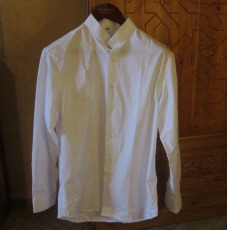
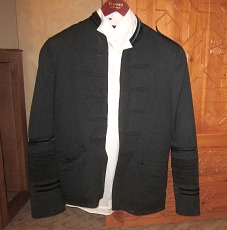
This afternoon I decided to suck it in and buy something evening wear-ish as a capitulation to Marrekech Film Festival standards. I went to five or six stores and couldn’t find a dress shirt with a small-enough Italian-style collar. (Big collars were the bane of my existence until small, slender ones came back.) So I bought this white shirt at a Lee Cooper store for 295 dirhams, or about 45 dollars. The collar is styled without room for a tie, but this plus my Sgt. Pepper jacket, black dress pants and black shoes will suffice.

Room #3112, Palace Es Saadi hotel — Saturday, 12.4, 6:30 pm.

I'm Not Here

The narration in this just-released trailer for Jodie Foster‘s The Beaver is deadly. The dopey-ironic copy and the narrator’s Jack-and-Jill tone is aimed at idiots. But Mel Gibson‘s hand-puppet voice is brilliant. It’s basically the voice of Ray Winstone. In interviews next year I’d like to hear Gibson doing Winstone at the beginning of Sexy Beast: “Oh yeah. Bloody hell. I’m sweatin’ here. Bakin’, boilin’, roastin’…”

Breznican Jumps Ship

USA Today guy Anthony Breznican announced a few hours ago that he’s becoming a film writer for Entertainment Weekly. So he was pretty much the movie guy at USA Today (along with Suzie Woz), and now he’ll be one of the guys at EW. Meaning, obviously, that he decided there was more of a future with the latter. Except EW is kind of like SS Brittanic (as in Richard Lester‘s Juggernaut) these days…no?

Slips Right In

Having now seen this booteg webcam version of the trailer for Terrence Malick ‘s The Tree of Life, I think I can answer Stephen Zeitchik‘s question about “what the to-do is about.” It’s basically saying that the cosmic light of the altogether is right out there and right within us, but the rough and tumble of survival (along with some brutal parenting at the hands of a guy like Brad Pitt‘s character) keeps us in a morose and damaged place. And what a sadness that is.

This is a very touching and trippy trailer, for what it is. It got to me. And I’m glad there are no dinosaurs. I still say that only problem with this film is that flat-footed title, which has always grated.

Kids who grew up in the ’50s and ’60s under the tough, gruff and goading fathers like Pitt’s character suffered significantly, and in many cases passed it along with interest. Dysfunction breeds dysfunction. Hurt people hurt people. Pitt’s character’s generational view was primarily shaped by the Great Depression and World War II, which told them that awful things happen to people who aren’t strong and resourceful and prepared, and awful things can still happen to good people due to bad luck and happenstance.