Favorite Tom Wilkinson Murder Scenes

I’m not a murder scholar but I do know or have certainly read that professional assassins like to “do the job” in a way that suggests it was some kind of heart attack or stroke or possible suicide. The idea is to throw the cops off the scent, and the quieter and more discreet the better.

Which is why I love the Michael Clayton scene in in which the two hit men-slash-surveillance guys (Robert Prescott, Terry Serpico) kill Tom Wilkinson‘s “Arthur” in a way that doesn’t look like murder. (I wish I could’ve found an HD capture of this scene with the proper aspect ratio — sorry,)

I also adore that earlier scene in which Tilda Swinton‘s Karen Crowder, an executive with U-North, suggests to Prescott that he needs to “contain” this problem (the problem being Arthur) and that one possible solution is one that she’s not thinking about, etc. I love this scene. Nobody ever wants to say it — they just want it implied, and the active agent to understand, and for the deed to be done.

The other rule of murder is that when an emotional killing happens (usually involving friends, family members or acquaintances from the same small town or social circle) there’s often an element of rage and suddenness. As in “yeah, I know that was the plan, I meant to to do it deliberately but…uhm, I couldn’t stop myself.”

How odd and striking that three of my all-time favorite murder scenes involve the great Tom Wilkinson — two actively, and one indirectly. Wilkinson is a measured, mild-mannered actor who never fails to dig in and deliver, but he’s not exactly known for playing characters who have a rendezvous with death (theirs or someone else’s).

Attaching Monetary Value

The trailer for Worth (Netflix 9.3) indicates quality — a thoughtful, low-key drama about the experience of Kenneth Feinberg (Michael Keaton), an attorney who was appointed to administrate the September 11th Victim Compensation Fund. His task was to decide which amounts certain families of 9/11 victims would be paid as compensation.

Feinberg followed a certain impartial formula (including, I’ve read, a refusal to evaluate individual suffering), some families received less than others, and there was some resentment about this.

The film is based upon a book Feinberg wrote a book about this experience, titled “What Is Life Worth?: The Unprecedented Effort to Compensate the Victims of 9/11.”

Keaton and Tucci costarred in Spotlight (although they didn’t share any scenes), and one of the Worth producers, Michael Sugar, had a producing credit on Spotlight.

Alas, after debuting at Sundance 2020 Worth received a 65% and 68% rating from Rotten Tomatoes and Metacritic, respectively. That was nearly 20 months ago.

On top of which the film’s screenwriter-producer, Max Borenstein, is best known for writing Godzilla (’14) and Kong: Skull Island (’17), and contributing to the story of Godzilla: King of the Monsters (’19) and Godzilla vs. Kong (’21). How do all these monsters square with compensating the families of 9.11 victims?

Besides Keaton, the cast includes Stanley Tucci, Amy Ryan, Tate Donovan, Laura Benanti, Talia Balsam, Marc Maron, Chris Tardio and Victor Slezak.

So May We Start?

…or will we wait a little bit?

I’m done with my condemnations of Leos Carax‘s Annette (Amazon, 8.6 limited). But I’m wondering if anyone caught it in a theatre last weekend, and what the reactions might have been. I recognize that most will probably wait for the 8.20 streaming date (i.e., a week from this coming Friday).

HE commenter Kristi Coulter (2 days ago): “Did I like it? I don’t know that it’s a like/dislike kind of movie. I’m not at all sorry I saw it; I’ll probably watch it again at some point. But I felt very emotionally distanced from it, and it’s at least twenty minutes too long.

“The NYT review describes Driver’s character as a man who can’t quite see other people as real, not even his own wife and child, but I’m not sure Carax sees her as real, either. She’s basically there to represent an idea of feminine goodness and warmth and there’s only so much Cotillard can do with that. And is it asking for too much realism to wish the movie had convinced me these two characters would ever have a first date, let alone get married?

“As for the ‘morally repellent’ question: well, Driver’s character certainly is morally repellent — and highly unpleasant to watch, too –but I didn’t find the movie itself morally repellent. Honestly, I think it would have to be more committed to a set of values beyond its own style for me to get worked up one way or the other over questions of morality.”

Caprice or Farce

Just under a month ago I bought a Kindle copy of Michael Wolff‘s “Landslide.” And in the pre-opening chapter (“Introduction”) I was struck by four well-honed paragraphs that seemed to sum up Trump’s mystique with unusual clarity — one of the most concise descriptions of that blustery, bullshitty thing that he’s done all along.

Read more

Forehead-Slapping Stupidity

Three days ago, the N.Y. Times posted a story by Nicole Hong titled “Inside One Company’s Struggle to Get All Its Employees Vaccinated.” The subhead reads, “At an optical business in New York City, it took months of coaxing, a cash bonus and a weekly testing mandate to persuade 90 percent of the staff to get a coronavirus vaccine.”

Every third or fourth paragraph is infuriating. Here’s a taste:

John Bonizio, 63, the owner of Metro Optics, was ecstatic when he learned in January that optometrists and their staff members would be among the first groups eligible for the vaccine. During the chaotic early days of the rollout, Mr. Bonizio found a hospital with plenty of vaccine appointments available and offered to schedule them for every employee.

“About half of the staff members rushed to get a shot. But because his employees interact with dozens of patients and customers each day, he wanted everyone to be vaccinated. When he called the employees to ask why they were hesitant, their answers foreshadowed the resistance that would unfold in the coming months around the country.

“Some people said they did not trust the government, citing false conspiracy theories that the vaccines contained tracking microchips planted by the authorities. Others noted that the vaccines had not yet been formally approved by the Food and Drug Administration and worried that getting vaccinated would interfere with their ability to have children. (Scientists have said there is no evidence that the vaccines affect fertility or pregnancy.)

“One employee said she was concerned because she thought a vaccine had caused the characters in the film I Am Legend to turn into zombies. People opposed to vaccines have circulated that claim about the movie’s plot widely on social media. But the plague that turned people into zombies in the movie was caused by a genetically reprogrammed virus, not by a vaccine.

“Talking to employees about the misinformation they saw spreading on social media was like walking on eggshells, said Brett Schumacher, 38, the company’s general manager. Trying to persuade a skeptical co-worker to trust the government and health officials in the middle of the workday can be awkward.

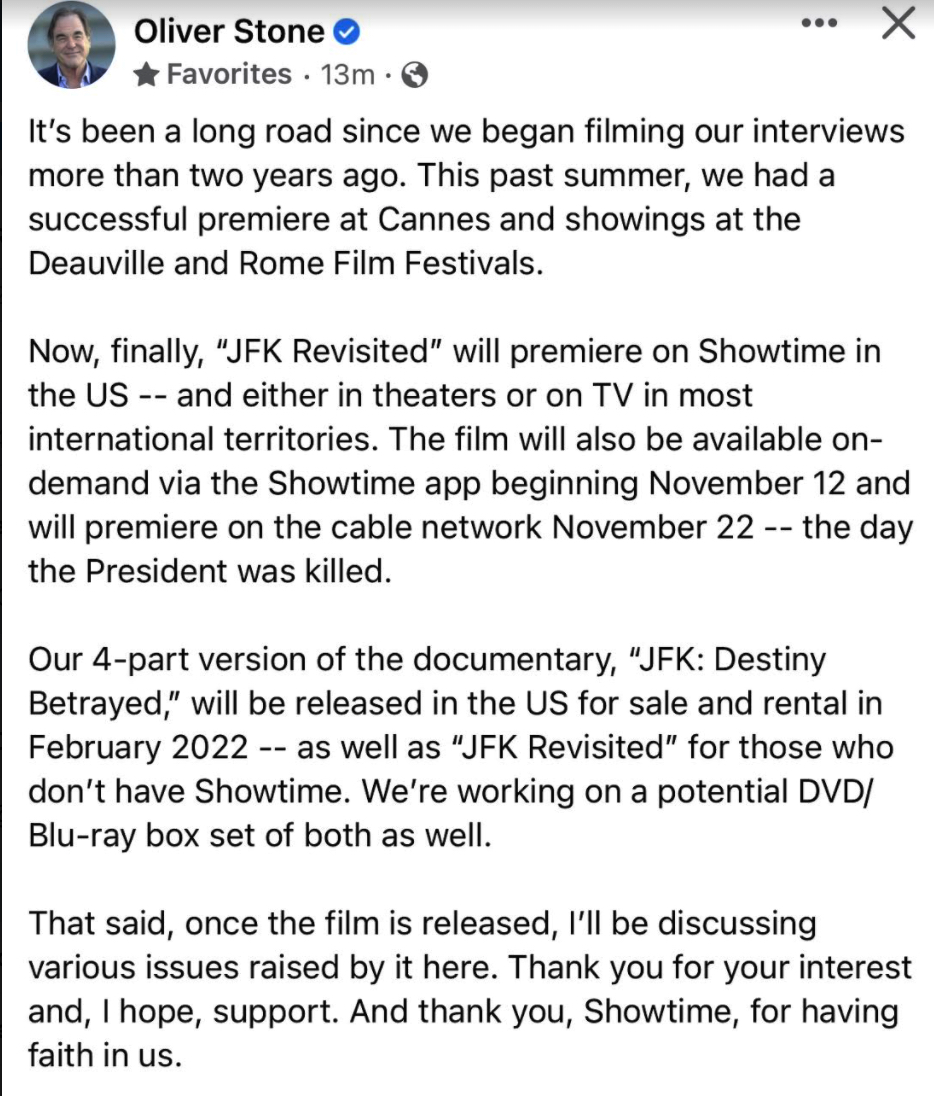
“’We do have one person who is just anti-vax, period,’ Mr. Schumacher said. ‘I didn’t get into the full reasons behind it because that kind of stuff just makes my blood boil.'”

Hong spoke to a Metro Optics employee named Tiara Felix, who said she’ll leave her job if faced with a vaccine mandate. “There’s no choice,” Felix told Hong. “I’ll have to quit.”

In short, Tiara Felix is rather stupid. There’s no other term for it, and there’s no known cure.

Read more

Gunn: “I Don’t Care That Much”

Variety‘s Adam Vary to The Suicide Squad director James Gunn: “With Peacemaker and The Suicide Squad both on HBO Max, you’re right at the heart of the massive changes the industry is going through with the rise of streaming. People don’t even quite know what a movie is anymore, or where they’re going to get exhibited. How do you see yourself fitting into all that moving forward?”

Gunn to Vary [following “long pause”]: “I don’t really care that much. I really just care about whatever the project is in front of me. The Suicide Squad is made to be seen first and foremost on a big screen [but] I think it’s gonna work just fine on television.

“Listen, movies don’t last because they’re seen on the big screen. Movies last because they’re seen on television. Jaws isn’t still a classic because people are watching it in theaters. I’ve never seen Jaws in a movie theater. It’s one of my favorite movies.

I…don’t want the theatrical experience to die. I don’t know if that is possible, but we also don’t know what’s going to happen. We’ve still got COVID, because people won’t get vaccinated, which, you know, they should. Hopefully — hopefully — that will not be a big deal to us in a year. And if that’s the case, what’s going to happen? We don’t know. Nobody knows.

“I care, because I would rather have people be able to go to the movies. But also, if they don’t, I’m not going to go slit my wrists. I don’t care that much. [Laughs]”

Hollywood Elsewhere feels the same way, after a fashion. I don’t want big-time movie exhibition to die, but when I think of the theatres that I really care about, I think of the Landmark chain and what the Arclight chain used to be, and of course the special theatres in Telluride and Cannes. Because I basically hate the gladiator movies that are occupying and dominating the magaplex stadiums these days. You go to these places to get thrashed and pounded.

Which is why it felt so weird to watch Stillwater at the AMC Century City recently. I was muttering to myself, “Jeez, I’m watching a carefully measured, character-driven adult drama inside theatre #9, which almost exclusively shows animal-level, wham-splat ear and eyepounders…odd feeling. Hey, where’s Amanda Knox?”

Gunn is right, of course, about certain well-reviewed movies and various classics of the past enduring via streaming platforms. Streaming is obviously how all great movies are being kept alive these days, as well as providing a platform for fresh discovery.

Yes, the exhibition industry has been losing steam for a few years now, in part because theatres have become a digital ghetto for noisy, high-impact, lowest-common-denominator fare.

But until late ’19, exhibition was still the primary place where all movies began. Theatres were the primary default launch pad. Big-screen exposure and promotion established their presence and cultural impact. Theatres mattered less, but they still mattered.

I’m somewhere between depressed and horrified by the idea of a movie realm without theatres. And not just my kind of theatres. As much as I despise the gladiator experience, I want it to survive, ironically, in order to keep exhibition going in general.

In short, I might care about theatres more than James Gunn does. Unless I’m misunderstanding him.

Gender Neutral Spread Sheet

Three days ago (8.5) the Gotham Awards announced that their acting awards will be (a) gender neutral and (b) will focus on lead and supporting — i.e., one in each category. I suggested that it would be fairer to male and female actors if they would hand out four such awards — two lead, two supporting.

On Friday, 8.6, I came upon a hill.com report along similar lines. The headline read that that “AMA doctors, experts recommend removing sex designation from birth certificates,” adding that “the move would protect against discrimination based on sex.”

Yesterday (8.7) Indiewire‘s Ben Travers and Libby Hill posted a discussion in which they called for other award-giving organizations (Oscars, Emmys) to also adopt a gender-neutral mindset.

Why exactly? The idea, apparently, is to make acting categories less discriminatory as far as transgender and non-binary-identifying actors are concerned.

The fourteenth paragraph in the Indiewire article, written by Hill, reads as follows: “As our collective understanding of identity grows, more and more individuals are opening up about their own relationships with gender and identity. This year’s crop of Emmy nominees featured Mj Rodriguez, who became the first openly transgender performer to be nominated in a lead acting category for her work on FX’s Pose, as well as several openly non-binary performers, including Emma Corrin, nominated in lead actress in a drama series for their work on Netflix’s The Crown and Carl Clemons-Hopkins, nominated in supporting actor in a comedy series for their performance on HBO Max’s Hacks.”

Journalists are encouraged to avoid stating what I’m about to state, but outside of your elite big-city woke communities there are tens of millions of people who feel — perhaps unfairly, perhaps incorrectly — that there are certain indisputable, day-to-day, biological distinctions that line up with conventional notions about males and females, and that such men and women, which is to say those who are comfortable with their gender and who identify as binary (including L, G & Bs) constitute over 99% of the population.

That’s not to deny or ignore the rights of transgender and non-binary persons, but to offer a sense of proportion and perspective.

Many people who live outside the Kingdom of Woke earnestly believe that last April’s Steven Soderbergh Oscar show was irksome and bizarre and bore little if any resemblance to the Oscar telecasts of yore, and in fact seemed to exist on a whole different planet. These same Average Joes will almost certainly regard the shedding of male and female acting categories as curious, and the bulk of these head-scratchers will probably call such a decision deranged.

Due respect to transgender and non-binary actors, but the vast majority of the country thinks that wokeness is a form of detached thinking and wackazoid progressivism, and if the Academy of Motion Picture Arts and Sciences wants to double down on the Steven Soderbergh effect, they should definitely adopt gender-neutral acting awards.

Please tell me what I’m missing here. I’m not trying to be dismissive or an obstructionist of some kind. It’s just that I seriously feel that progressive elites have lost their bearings.

Knox v. McCarthy Again

In an 8.6 HE riff titled “McCarthy Coolly Dismisses Knox Beef,” I linked to Janelle Riley’s 8.4 Variety interview with Stillwater director-cowriter Tom McCarthy.

McCarthy responded to the gist of Amanda Knox‘s complaint about Stillwater being fundamentally based on her 2008 murder conviction and subsequent exoneration, and her not having been consulted prior to filming. McCarthy also mentioned that her statements were somewhat undermined by the fact that she hadn’t yet seen the film.

Yesterday Knox posted a series of tweets about the McCarthy interview [excerpts after the jump], and made some reasonable points. However, she also tweeted the following:

HE response to friendo: “Seeing Stillwater would not be an ‘ideal date night’ and that’s why she still hasn’t seen it yet? But she would be amenable to seeing it, she said earlier, if Focus would invite her to a screening. The date night remark was playful, but she invites skepticism.”

Friendo to HE: “You have to admit that it’s hilarious when, in being asked at the outset in the new interview what his inspiration for the movie was, McCarthy says, ‘One inspiration was a relative of mine who had a fractious relationship with her father. I asked if she minded talking to me about it.” This after previously not being afraid to openly and preemptively acknowledge the Knox case was a springboard, before he had to worry [that Knox might be] endangering his Oscar campaign. Now Knox is incidental, he claims, while asserting that he was inspired by a friend. That kind of covering-one’s-ass (publicly and badly) is the hallmark of a really insubstantial person, or a scaredy-cat on the run.”

Read more

Spiritual Growth Awaits

Earlier today I asked a colleague about finding sources of supplemental income outside the film industry, given the possibility of a diminished ad-revenue situation that may manifest in three or four months. Maybe.

The colleague mentioned this and that option, and then added the following: “The good news for you is that many of these jobs do criminal background checks, but not reputation checks. That will be helpful for you, as this can be an opportunity for you to start fresh with new attitudes and a new perspective on life and those who are different from you. In these trying times we can find golden moments of opportunity — we simply have to know how to identify them.

“Being brought low is often the first step in standing back up better than ever, and I do hope that you meet your coming challenges with honor and that you allow your change in circumstance to be a transformational experience. I believe that no one is born bad, that they over the years accumulate dirt and scratches just like a film print. But just like a film print, I believe we can all be restored to a more pristine state that will allow our original colors and images to vividly manifest as they always should have.”

HE response to colleague: “Thanks for all this, [name]. Thanks for taking the time to think about this. Wise and knowledgable stuff. I appreciate your experience. So you seem to basically believe that while I wasn’t ‘born bad’ I have more or less become that, and that I could become less of a judgmental asshole by working at [jobs that involve mingling with Average Joes]. Because working with Average Joes will instill humility, having been ‘brought low’, and broaden my horizons. I will thereby learn to appreciate the value of tedious mindsets, vulgarity, stupidity, ignorance, terrible taste in movies and music and clothing, the joys of junk food and offering one’s allegiance to Donald Trump.

“Maybe you’re right. I’m certainly looking forward to understanding these things more fully, and becoming a better person for that. I sound like I’m being facetious, I realize, but I do deeply appreciate you taking the time to think about this and consider all the angles. Seriously. Thanks. If I can return the favor in some way, don’t hesitate to ask. Thanks.”

Read more

Decent Enough, No Great Shakes

A friend saw Leisl Tommy and Jennifer Hudson‘s Respect (UA Releasing, 8.13) last summer, and his basic assessment was “mildly okay Aretha Franklin biopic but with an excellent lead performance from Hudson, or at least excellent singing.”

So far Respect has managed a 63% Metacritic rating. You have to ignore the Rotten Tomatoes rating for now — too positive, obviously unreliable.

Jam Report‘s Doug Jamieson: “A paint-by-the-numbers biography…saved by the magnificent performance of Jennifer Hudson, impeccable production values, and the jukebox soundtrack.” Variety‘s Peter Debruge: “Flattering but flat, this overly respectful biopic steers clear of revealing the traumas that shaped the soul legend.”

Read more

JLaw-Mengers Project

Matthew Belloni‘s “What I’m Hearing” newsletter has mentioned a forthcoming biopic in which Jennifer Lawrence would play Sue Mengers, the ’60s, ’70s and early ’80s Hollywood super-agent.

Mengers was impersonated by Dyan Cannon in The Last of Sheila (’73) and literally portrayed by Bette Midler in I’ll Eat You Last, the 2013 B’way by John Logan. Logan has also written the screenplay for the JLaw project, which Paolo Sorrentino is attached to direct.

I’m not saying there’s a problem with JLaw-as-Mengers, but you have to at least consider the age and physical disparities. Born on 8.15.90, JLaw seems a bit young to portray a 40ish Mengers, who was born in ’32 and hit her professional peak in the ’70s. Midler was in her late ’60s when she played Mengers on stage, and nobody said boo. Plus Midler and Mengers were the exact same height — 5’1″ — while Lawrence is 5’9″.

The main point is that JLaw’s $20 million salary doesn’t seem commensurate with a character-driven biopic of an agent who reigned 40 to 50 years ago. Apple and Netflix are both “jockeying” to produce for the Lawrence-as-Mengers project, Belloni writes. The Apple bid is apparently in the $80 million range.

In traditional theatrical distributor terms an $80 million biopic of this sort wouldn’t really add up. As Belloni points out, Renee Zellweger‘s moderately approvable Judy represented a sensible economic gamble, having cost $10 million and earned $46 million worldwide with Zellweger winning an Oscar. The streamers are basically saying “we don’t care…we have our own economic system…we want JLaw as Mengers.”

Brilliant Monochrome Genre Blend

I’ve said two or three times that Jack Sholder‘s The Hidden (slithery monster aliens invading and taking over bodies of human hosts) should be remade. It’s too good and too hilarious of a premise to not rework it somehow. It came out nearly 35 years ago, which means that most Millennials and Zoomers have barely heard of it, much less seen.

On 3.5.18, or roughly three and a half years ago, I suggested that one way to remake The Hidden would be to blend it with This Gun For Hire. Use an early ’40s milieu and shoot it in black and white within a 1.37:1 aspect ratio, but with slimey, squishy monsters living inside the traitors.

I haven’t thought through the particulars, but the basic character would still be the half-psychopathic, half-sympathetic hit man Raven (Alan Ladd‘s role), and he’s been hired to rub someone out. But once he gets wind of a certain cabal of alien-controlled governmental figures his arc changes…he’s still a shady loner but in a pivotal position, and non-alienized cops begin to consider the possibility that he’s not the malevolent figure they had him pegged as.

Plus I love the concept of black-and-white CG monsters. To me that’s ice cream, cake and syrup. There were two or three monster-glimpse moments in The Lighthouse (King Triton, mermaid, demonic seagull) that really turned me on, and the idea of a ’40s monster noir in 1.37 feels delicious. I realize that 98% of the audience regards black-and-white CG as a fringe appetite at best. I still love it. This Gun For Hire With Monsters could be made for a price.

Read more