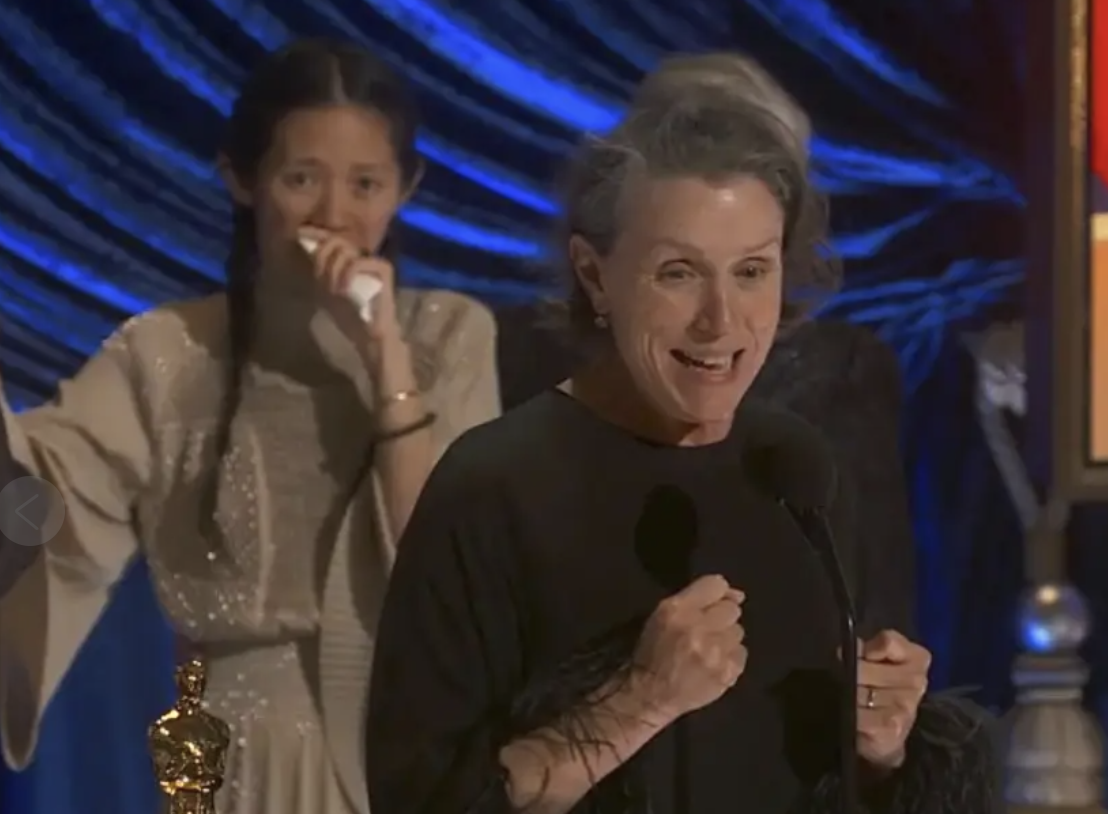
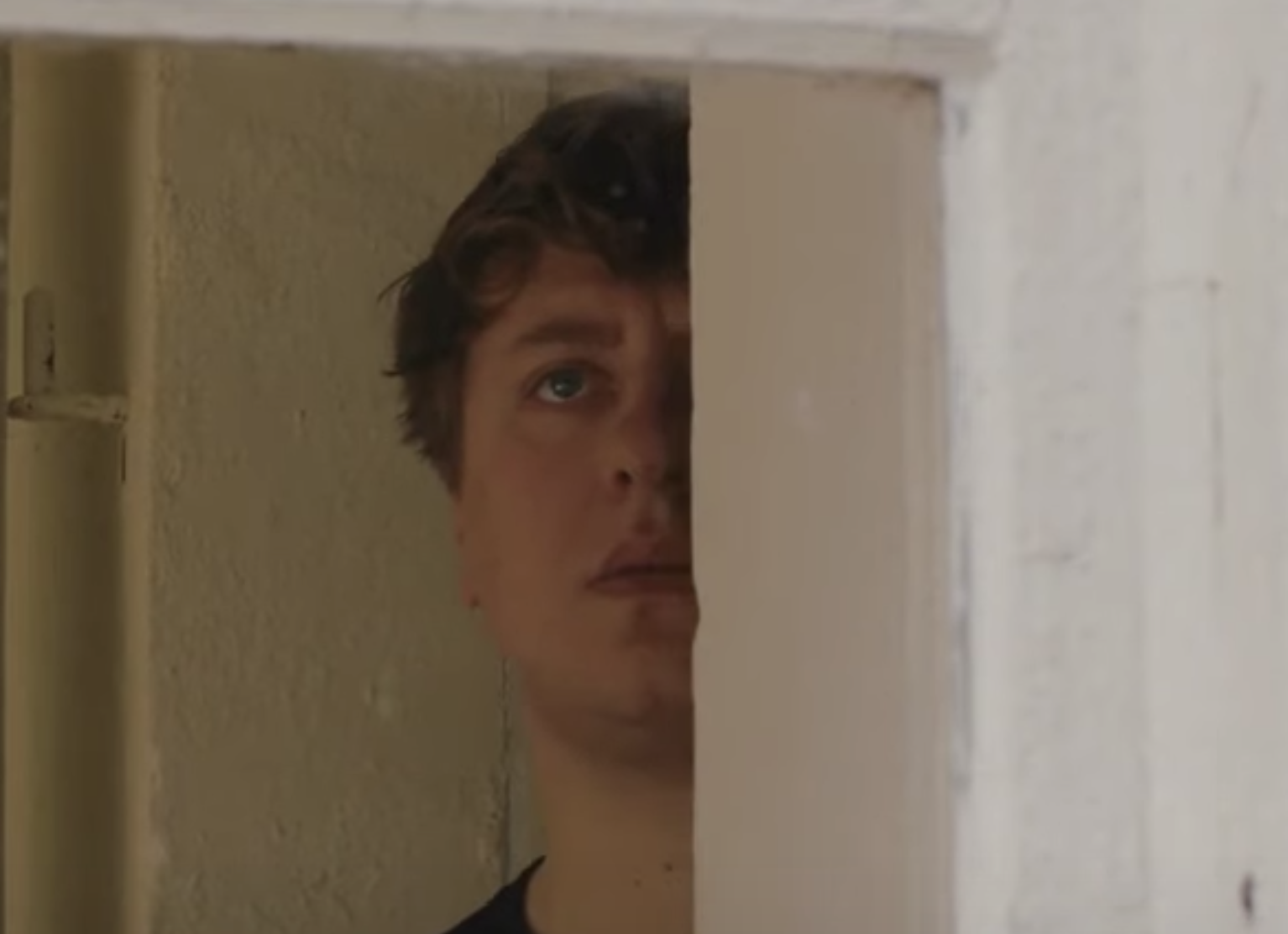
FrancesMcDormand‘s Fern was strong but mule-stubborn and at the end of the day self-destructive, and this stunted psychology led to an idiotic ending.
Her old white van was indisputably on its last legs, and 60ish DavidStraitharn, lonely but harmless, clearly would’ve settled for simple, no-big-deal companionship.
I’m sorry but there’s this notion out there that choosing a healthy or constructive path in life requires (a) not being a stubborn egoistic purist and (b) understanding that opting for common-sense security isn’t necessarily a death sentence or a prison term.
The curious ending of Nomadland refuses to acknowledge this. It basically says “better to die destitute and alone on a two-lane blacktop while shitting in a bucket in the middle of the night than to accept kindness and sensible adult friendship.”
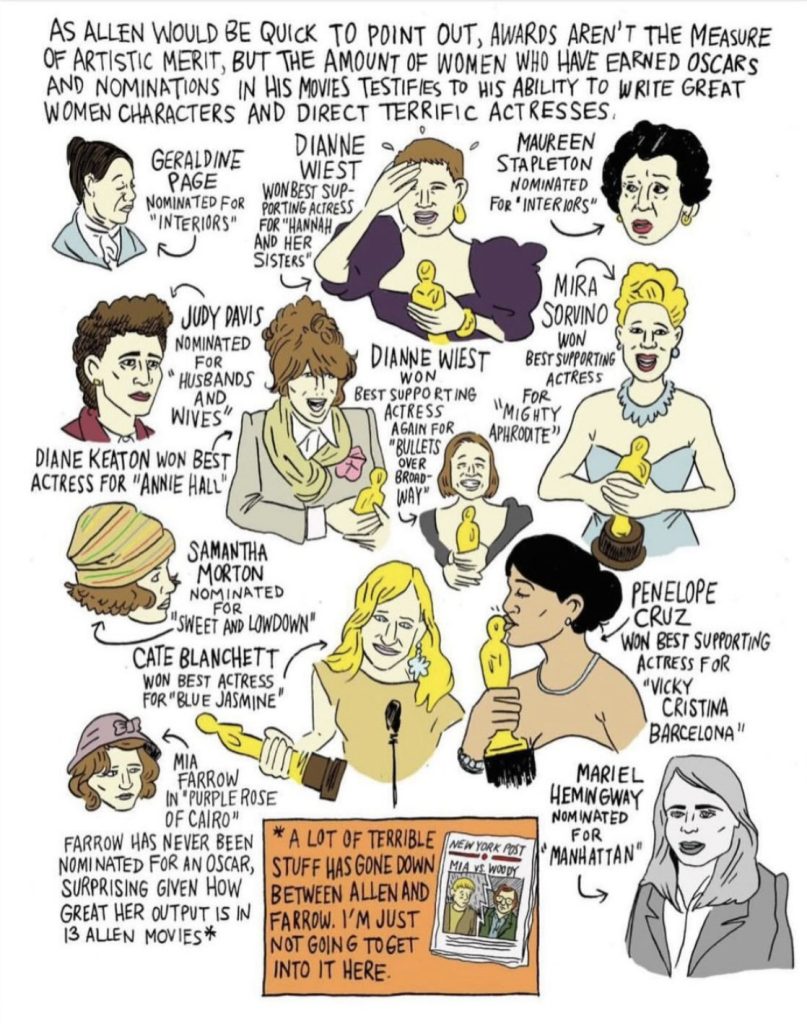
Can’t decide which performance is better, although I’ve always leaned toward Tina Vitale, her cynical New Jersey moll behind the shades, in the latter film, which opened almost exactly 40 years ago (1.27.84).
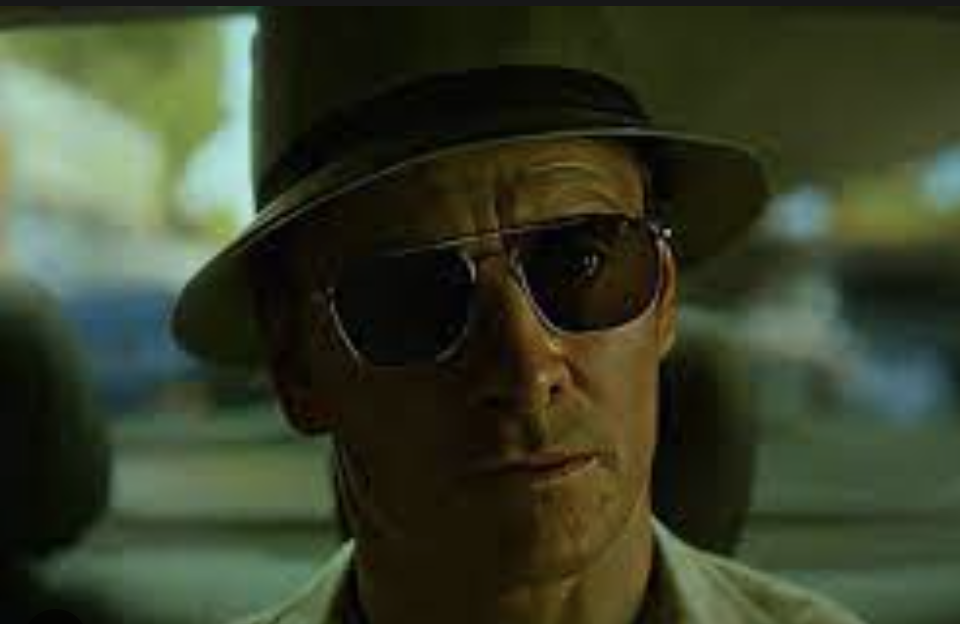
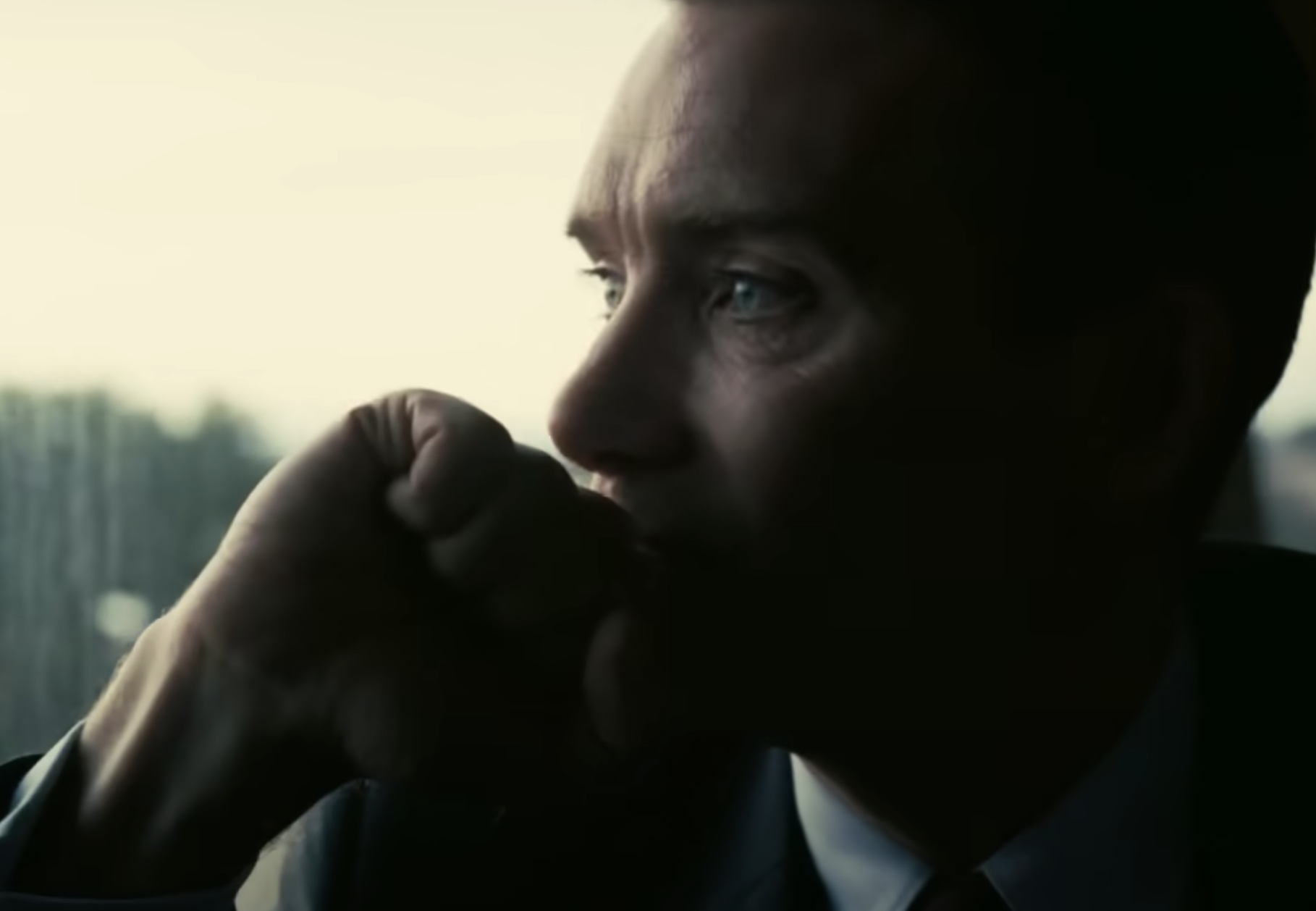
I loved David Fincher’s TheKiller (Netflix 10.27)…a great escape film if I’ve ever seen and felt one. It took me out of myself and dropped me into a higher realm, or at least my idea of one. It redefines the meaning of the word “chill” in a way that will either knock you out or, if you’re an ideologue or a shoulder-shrugger or a constipated, closed-off type, leave you with shards.
It’s first and foremost about the supreme comfort of living in a super-clean, perfectly crafted Fincher film, and about the joy of being a ghost and travelling alone like a nowhere man, and about the blissful solitude and curious joy of disassociative technique…about the existential solace and solitude of having a wonderfully endless supply of fake IDs, fake passports and fake license plates, and maneuvering through flush and fragrant realms and the zen of nothingness…about the almost religious high of not giving a single, solitary fuck.
Despite sitting in a too-small Paris theatre seat (I could barely move my legs) and despite Fincher’s film starting almost a half-hour late, I was in heaven start to finish. It’s all about eluding fate and slipping the grasp, about playing a fleet phantom game and, much to my surprise and delight, about chasing down several unlucky functionaries and nefarious upper-caste types and sending them to God.
It’s about a side of me (and of Fincher, of course) that loves being on the move and managing to slip-slide away like Paul Simon but in a GOOD way or at least an extremely cool one…about being blissfully free of conventional entanglements and concerned only with slick stealth and ducking out of sight and, despite suffering a bruise or two, gaining the upper hand.
TheKiller is about the joys of living a cold and barren life…it mainlines the hollow but feels like a kind of new-age opiate…it turned me on like Joni Mitchell’s radio, and I’m still feeling the buzz and humming the melody the morning after. I can’t wait to see it another two or three times, bare minimum.
Thank you, Mr. Fincher, for slipping me a great nickle bag of smack and what felt last night like the best meaningless-but-at-the-sane-time meaningful movie high I’ve had in a dog’s age.
Michael Mann’s Ferrari (Neon, 12.25) has turned out to be much better than I expected.
A portrait of aging Italian car magnate Enzo Ferrari struggling to keep his business and family afloat at a highly critical juncture, Ferrari is “better” in terms of recreating the past and a very particular cultural milieu (mid to late ‘50s, northern Italy) and generally radiating a certain textural, visual and emotional verisimilitude that is rather wonderful in its own studious, deep-dish way.
I’ve been reading since last summer that Ferrari is a period racecar drama that doesn’t follow the expected plot contours and certainly not in the fashion of James Mangold’s 2019 Ford vs. Ferrari, another racecar saga which involved the same real-life character (played by RemoGirone) while set in the mid ‘60s, or roughly eight years after Mann’s story.
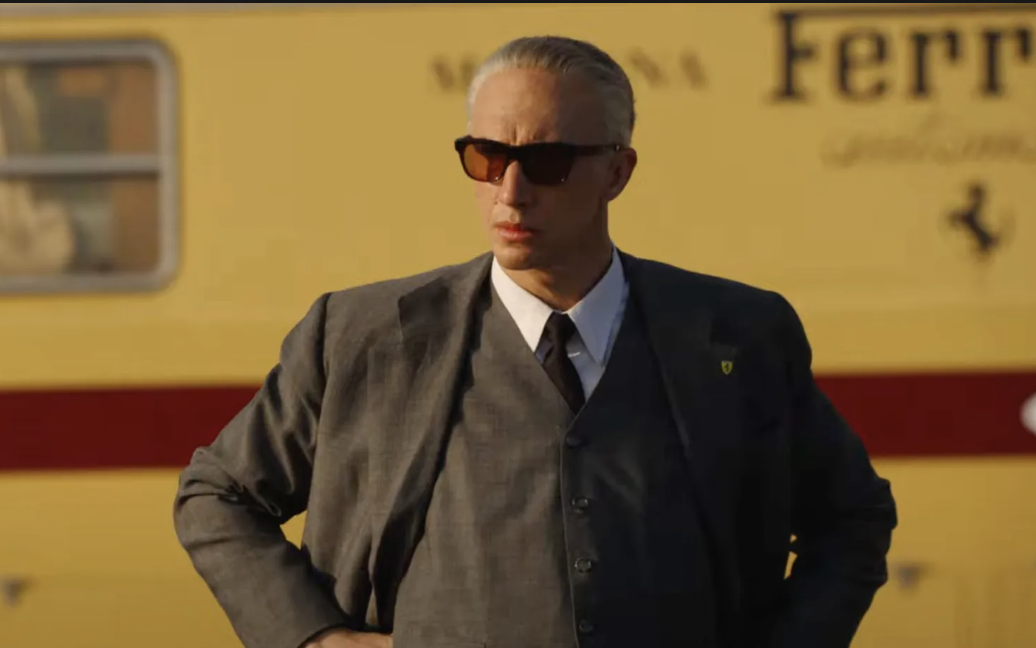
Ferrari is basically a torrid Italian family drama (Mann meets Luchino Visconti with a splash or two of Douglas Sirk salad dressing) about emotional and financial turmoil afflicting the embattled Ferrari, played by a nattily-dressed, white-haired, slightly paunchy Adam Driver.
Let’s not forget, of course, that two years ago a younger-looking Driver played another head of an elite, world-renowned, family-owned Italian company in Ridley Scott’s House of Gucci.
Let’s be honest — Joe and Jane Popcorn are going to say “this again?”
Given the Ferrari-Driver-Gucci overlap, I’m not sure how commercially vigorous Ferrari will turn out to be when it opens in late December. All I know is that despite the vaguely odd-duck, here-we-go-again factor, Ferrari works on its own compelling terms.
Ferrari is about an old man (Ferrari was born in 1898) entwined in a make-or-break struggle to keep his teetering car company afloat while preparing for a climactic, fate-defining cross-country race and while finessing a volatile family situation involving infidelity and conflicted loyalties.
It’s a great time-machine trip, intimate and low-key for the first three quarters but with a serious knockout finale. It’s culturally authentic (you really feel like you’re there) with a sturdy script and several nicely flavored performances…an ensemble piece that pretty much fires on all cylinders.
Ferrari really pays off over the last 35 to 40 minutes, which is almost all racing.
Penelope Cruz’s blistering, tough-as-nails, scorned-wife performance is a guaranteed Best Supporting Actress nomination lock.
EricMesserschmidt’s cinematography is wonderful — it reminded me of Gordon Willis’s lensing of the first two Godfather films and Part Two in particular.
It’s basically 90 minutes of fractured family drama and a knockout crescendo showing the 1957 Mille Miglia, a decisive, hair-raising event in the fortunes of Ferrari’s precariously financed car company.
The domestic side is basically about Ferrari’s hands being full with Cruz’s angry wife Laura, Ferrari’s mistress Lina Lardi (Shailene Woodley), and loads of financial pressure and numerous wolves at the door.
Mario Andretti: “[Ferrari] just demanded results. But he was a guy who also understood when the cars had shortcomings. He was one that could always appreciate the effort that a driver made, when you were just busting your butt, flat out, flinging the car and all that. He knew and saw that. He was all-in. He had no other interest in life outside of motor racing and all of the intricacies of it. Somewhat misunderstood in many ways because he was so demanding, so tough on everyone, but at the end of the day he was correct. Always correct. And that’s why you had the respect that you had for him.”
I can’t think of a kicker ending so what I’ve written will have to do.
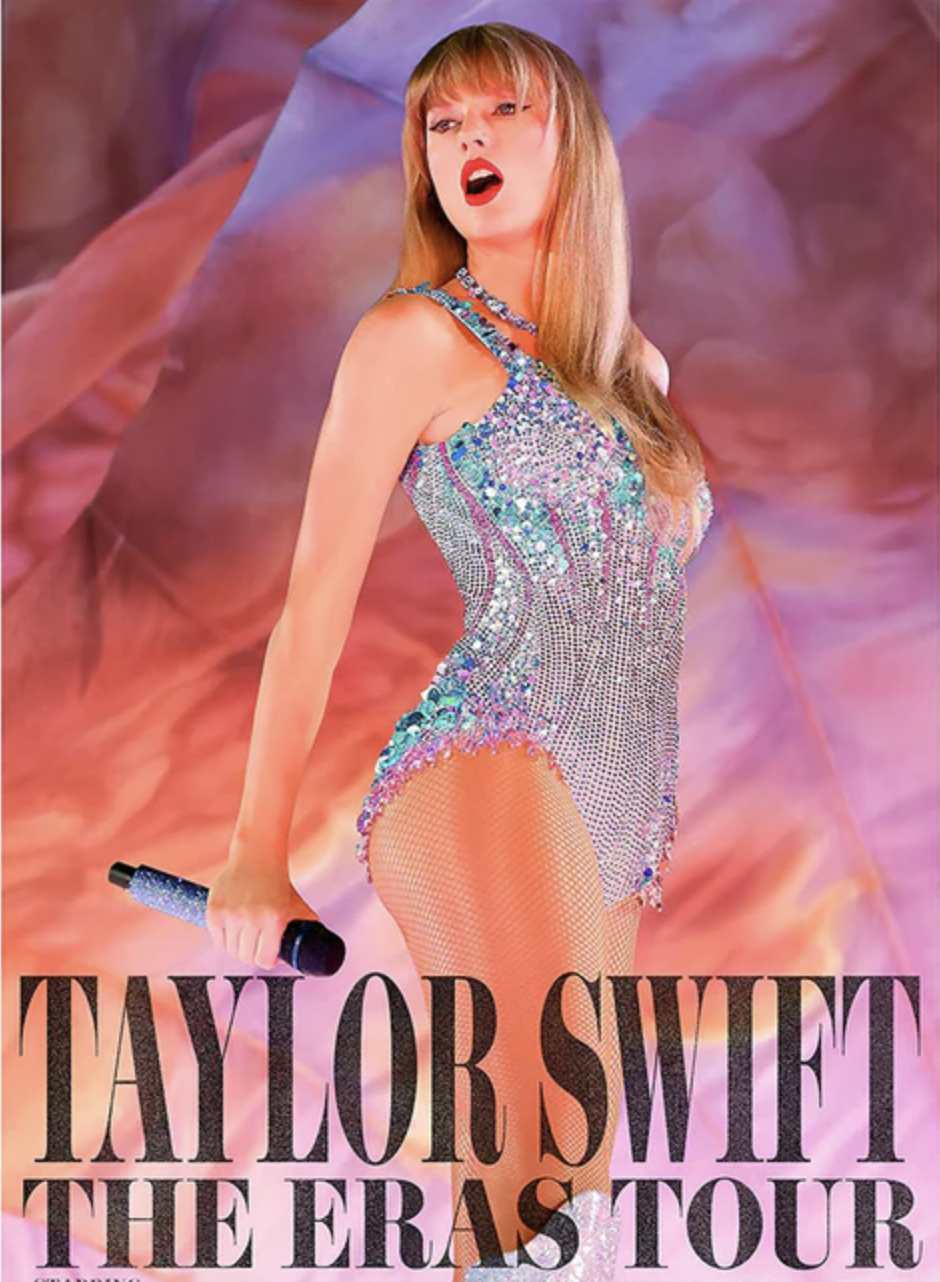
Last night I saw about 65 minutes’ worth of Taylor Swift’s TheErasTour, which runs 169 minutes. You can’t say I didn’t man up, buy the popcorn and give it the old college try. I didn’t hate it but it didn’t hook my heart or elevate my soul, and the more Swift sang and waved and strummed and strutted around and gave it up for her adoring, beaming and even tearful fans, the flatter I felt within.
As concert films go TheErasTour is quite the visual power-punch (first-rate photography, editing, choreography, lighting design plus considerable personal charm and audience rapport) but aside from the fan-rapture aspect (95%youngerwhitewomen) Swift’s act just doesn’t levitate. Or at least it didn’t in my situation.
I swear to God I sat down with an attitude of “okay, I’m here…let’s do it!” But it just didn’t connect.
Swift doesn’t have the greatest singing voice (it’s okay) and her country music origins put a damper on things. Hersongsareratherflatandpop–fizzy and lackingincatchy, inventivehooks…they all kinda sound the same…no rivers of soul (not even streams of it)…confessional lyrics (ruptured romances, shitty boyfriends) but rendered without much in the way of edge or unusual style or anything “extra”…imbued with anunmistakablybland, girly–girlcurrent, and a general lack of sophistication or complexity.
Swift is no Joni Mitchell-in-her-prime. Her songs seem to lack depth and intrigue.
I was engaged and studying the spectacle (which is fascinating in some respects) for the first half-hour but starting around the 45-minute mark Ibegantofeelnarcotizedandthendrained.
I nonetheless respect Swift’s energy and verve and swagger, and the Beatles-like following that she’s acquired over the last 16 or 17 years.
I was collecting my reactions in the AMC Westport lobby when a Manhattan-based journalist who’d also escaped at the one-hour mark (he’d been sitting two seats to my left) came over and said howdy. He’d been unable to snag a ticket to any Thursday night Manhattan showing and decided that a show in Connecticut was his best option.
We chewed things over for a half-hour or so. He felt roughly as I did about the film. “What’s the essence of Swift’s appeal?,” he asked. “Power,” I said. “The Swifties relate to who she is and where she’s been, and are really getting off on the bold persona and image…she’s a heroic figure in their eyes. It ties in, I think, with the Barbie explosion on some level.”
He had taken a Metro North train and then Uber-ed to the theatre, but didn’t want to see any more of the film. So I gave him a lift to the East Norwalk train station. Nice guy.
A respectful hat tip lo ErasTour director Sam Wrench, director of photography Brett Turnbull and editor Don Whitworth.
Shot last August at Inglewood’s SoFi Stadium over a period of three nights, TheErasTour is indisputably a huge cultural and commercial phenomenon. Swift-produced, Swift-starring, Swift-distributed (straight to AMC and Cinemark) and sure to pull down God knows how many hundreds of millions.
Everyone did a great job. It just wasn’t for me.
Friendo: “You’ve offered a reality-based corrective. The media is offering her a rubber-stamp rave. I think she’s got a number of very good songs like ‘Mean’, ‘I Knew You Were Trouble’ and ‘Shake It Off’ and — possibly her greatest — ‘Lover’.
“But you have to watch what you say if you have young daughters. You can’t come down on Taylor too hard, but I think her war against men is deplorable. And fundamental to her appeal. But I can’t say that in mixed company.”
HE: “I give her football player boyfriend (Travis Kelce) another couple of months. Okay, five or six months total.”
Friendo: “These men are just momentary accessories to her. Her message is basically ‘fuck men — they suck and we don’t need them’. In that sense, she’s doing her own bit to bring Trump back. All woke behaviors help the other side. Because the majority of people don’t want to vote for psychosis.”
Remember mumblecore? I’m kidding — of course we remember. But there’s an entire generation out there (Zoomers) that has never heard of it and certainly isn’t interested in knowing or asking questions or anything, and are content to just sit on their couches and inhale streaming content. I can’t believe the world has turned out as it has.
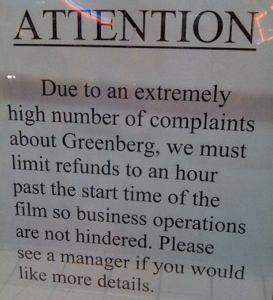
Does anyone remember Noah Baumbach‘s Greenberg, which is now 13 and 1/3 years old? Six years ago in Cannes I asked Baumbach about Greenberg and even he barely remembered it. Well, he remembered it but he didn’t really want to talk much about it because it was a huge bomb and because it pissed some people off.
I watched it again, and it’s still one of most daring, balls-to-the-wall, character-driven films I’ve ever seen or laughed with.
On 4.3.10 I posted a piece called “Big Greenberg Divide.” Key passage: “Greenberg is about what a lot of 30ish and 40ish X-factor people who wanted to achieve fame and fortune but didn’t quite make it or dropped the ball after a short burst…it’s about what these people are going through, or will go through. It’s dryly amusing at times, but it’s not kidding around.”
The second half of the article was a Greenberg defense written by HE correspondent “Famous Mortimer”:
“I think it is provoking such strong levels of resentment from viewers because it is a movie very much of these times but not made in the style of these times. It exposes the toxic levels of conceitedness and alienation today with the sincerity and empathy of ’70’s films by Ashby, Altman and Allen.
“First off, it’s a story about people. There is no high concept or shoehorned stake-raising set piece. Viewers either have the patience to connect with the human pain on display or they are lost. Unlike Sideways, there is no charming countryside setting or buddy comedy hijinks to punch up the mood.
“Second, the dialogue is the action. Only when the viewer is willing to think over the dialogue will characters’ seemingly ambiguous motivations and back-stories become clear. There’s no juicy monologue or nauseating flashback to convey these points. Instead, the viewer comes upon them over the course of the film in the form of passing references made by various characters. It is up to us to take these bits and pieces together and unlock the character revelations for ourselves. No more spoon-feeding cinema.
“Third, this film is a labor of love. That means idiosyncratic details are to be found at every level of its making. Only by thinking these details over and feeling the connections between them do we appreciate what the movie is trying to do. It’s a really thoughtful and heartfelt experience.”
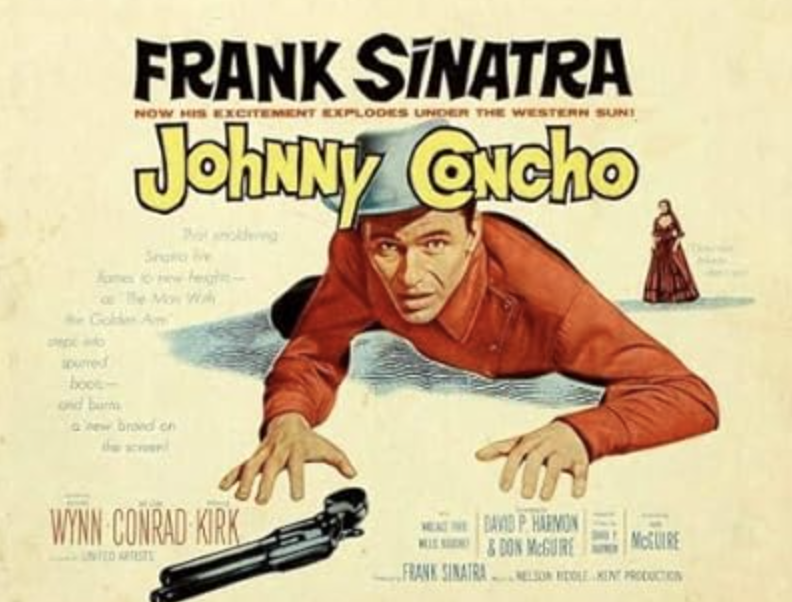
[Initiallypostedon7.16.15] This may not pass muster with traditional Western devotees (i.e, readers of Cowboys & Indians) but arguably one of the most influential westerns ever made is Johnny Concho (’56), a stagey, all-but-forgotten little film that Frank Sinatra starred in and co-produced. For this modest black-and-white enterprise was the first morally revisionist western in which a big star played an ethically challenged lead character — i.e., a cowardly bad guy.
The conventional line is that Marlon Brando‘s One-Eyed Jacks was the first western in which a major star played a gunslinging outlaw that the audience was invited to identify or sympathize with — a revenge-driven bank robber looking to even the score with an ex-partner (Karl Malden‘s “Dad” Longworth) who ran away and left Brando’s “Rio” to be arrested and sent to prison.
This opened the door, many have noted, to Paul Newman‘s rakishly charming but reprehensible Hud Bannon in Martin Ritt‘s Hud two years later, and then the Spaghetti westerns of Sergio Leone (beginning with ’64’s A Fistful of Dollars) and particularly Clint Eastwood‘s “Man With No Name.”
But before One-Eyed Jacks audiences were presented with at least three morally flawed western leads portrayed by name-brand actors. First out of the gate was Sinatra’s’s arrogant younger brother of a notorious gunslinger in Concho. This was followed in ’57 by Glenn Ford‘s Ben Wade, a charmingly sociopathic gang-leader and thief, in Delmer Daves‘ 3:10 to Yuma. And then Paul Newman‘s Billy the Kid in Arthur Penn‘s The Left-Handed Gun (’58).
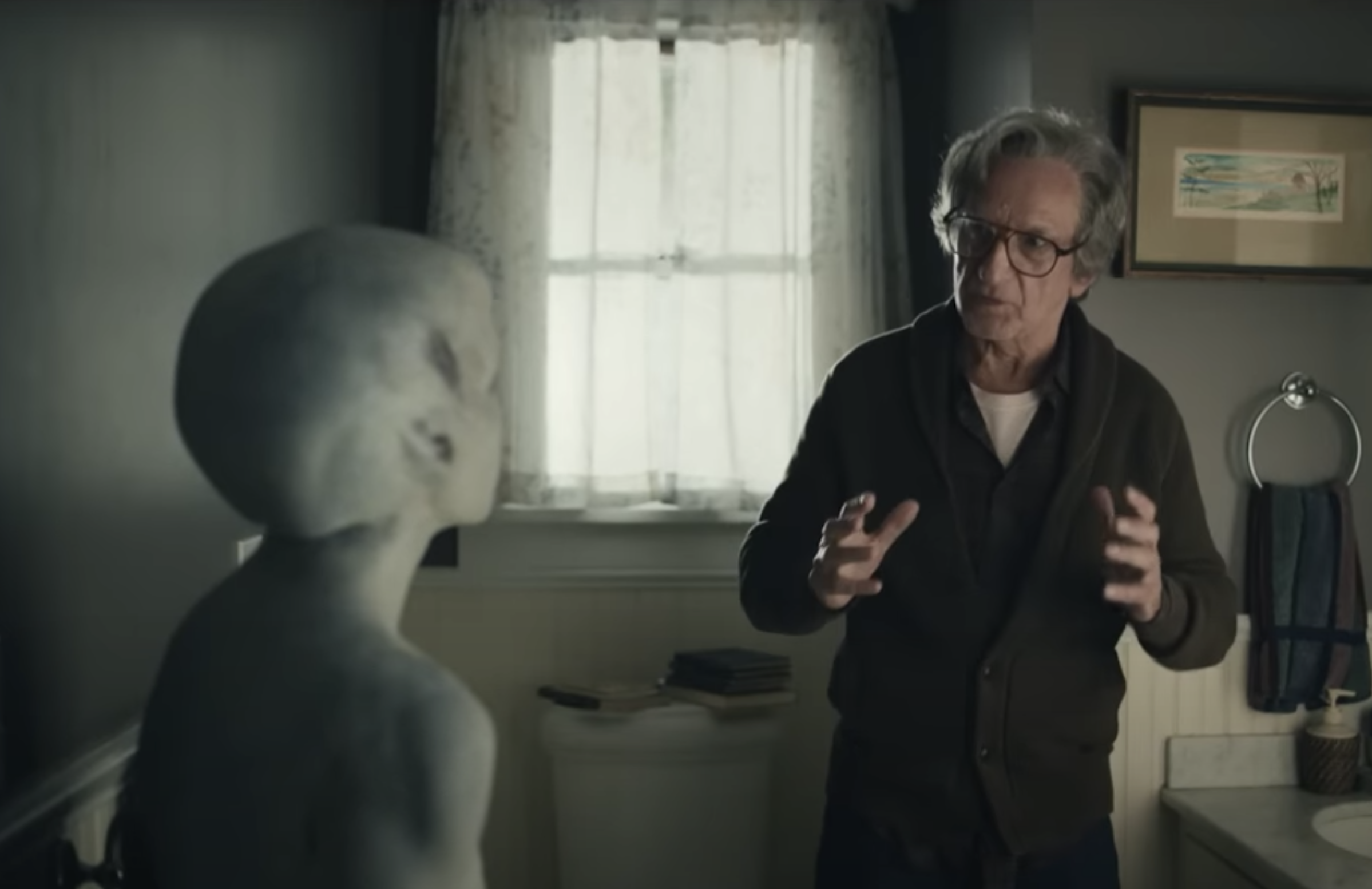
Last night Hollywood Elsewhere sat down with Marc Turtletaub‘s Jules (Bleecker Street), a quiet little fable about a vaguely flaky, absent-minded old guy (Ben Kingsley) who gradually blooms emotionally and spiritually when a smallish flying saucer crashes into his backyard garden and a wounded, pint-sized, shiny-skinned alien (Jade Quon) crawls out and lies on his brick patio, breathing but in need of care.
Kingsley’s Milton, whose longish, carefully styled gray hair looks exactly like a professional-grade wig, is so timid and small-minded that he waits a day to start caring for the poor, dark-eyed thing, who doesn’t seem to have a gender. (Let’s use the female pronoun.) At first Milt drapes a plaid blanket over the little gal, and then takes her inside and begins offering sliced apples for sustenance, and then shows Jules the guest bedroom and invites her to chill and watch TV.
After Milt’s friend Sandy (Harriet Sansom Harris) drops by and begins to warmly relate, the alien is given the “Jules” moniker (as in Jules Pfeiffer or a nickname for Julia). Milt and Sandy quickly become Jules’ parents, and then in short order they’re being assisted by Joyce (Jane Curtin), a vaguely neurotic acquaintance who starts talking to Jules as if she’s her therapist, sharing stories of her colorful youth in Pittsburgh (“I used to be an item”) and, in an odd detour, performing Lynyrd Skynyrd‘s “Free Bird” a capella.
Immediately all kinds of E.T.-type questions pop into your head. You have to assume that with all those consumed apples that Jules would use the bathroom from time to time or at least take an occasional leak outside, but details are never shared.
In no particular order: Does Jules take showers? What does she smell like? She has a smallish mouth plus, one presumes, a tongue, teeth, lungs and vocal chords so why doesn’t she mimic Milt with a little alien English, or perhaps speak in his/her own native tongue? Why was she travelling alone? What was the point of visiting earth in the first place? Is she fundamentally a woke type or does she view the human condition with (God forbid) the mindset of a Trump supporter? Is she broken-hearted over the recent death of an alien husband or child?
All we learn is that the enterprising Jules is looking to repair her spacecraft, and that she needs a few dead cats to accomplish this. We also see that she cares a great deal for Milt, Sandy and Joyce, and woe to any scurvy characters who might threaten any of them (think David Cronenberg‘s Scanners).
Last night I drove all the way to Pleasantville’s Jacob Burns Film Center (45 minutes) to see Christian Petzold‘s Afire. Then I had to drive back, of course — another 45 for a total travel experience of 90 minutes.
Afirereally isn’t worth all that time and gasoline. Because it requires the viewer to spend the entire running time (103 minutes) with one of the emptiest, most self-absorbed, clueless and physically unattractive characters I’ve ever hung with in my moviegoing life.
We’re speaking of Thomas Schubert‘s Leon, a fat, seemingly untalented, self-deluding writer for the first 85 or 90 minutes. And yet following a third-act tragedy that I won’t disclose, Leon suddenly becomes a gifted writer. Quelle surprise!
And so the film, we realize, isn’t as much about pudgy, fucked-up Leon as the difference between spinning your wheels for no discernible reason and writing true and straight about something real. And what improving your game can sometimes involve (i.e., a horrific inferno, the charring of flesh, the blackening of bones, being faced with terrible finality).
So the ending isn’t half bad but the first 85 or 90…God! Immature, pissed off, lost-in-the-proverbial-woods Leon obsessing about the highly attuned, rail-thin Nadja (Paula Beer) and never making any headway because he’s such a fleshy, mopey, self-deluding asshole.
Yesterday’s boilerplate: “While vacationing by the Baltic Sea, writer Leon (Schubert) and photographer Felix (Langston Uibel) are surprised by the presence of Nadja (Beer), a mysterious young woman staying as a guest at Felix’s family’s holiday home. Nadja distracts Leon from finishing his latest novel and, with brutal honesty, forces him to confront his caustic temperament and self-absorption. An encroaching forest fire threatens the group as Nadja and Leon grow closer, and tensions escalate when a handsome lifeguard and Leon’s tight-lipped book editor also arrive.”
If I was a film director I wouldn’t dare make a movie as thin, irritating and lacking in tension as the first two acts of Afire are. I was instantly annoyed and glancing at my watch and feeling sorry for myself, being stuck with this obviously not-very-good film and coping with air-conditioning that was too cold.
All I can say is thank God Schubert never gets naked, and double thank God he and Beers never do the actual deed. (Early on sex happens off-screen between Beer and another guy who’s mainly gay.) That’s not saying stuff doesn’t happen between them, or that their interactions aren’t faintly interesting from a certain perspective.
I was just grateful that Petzold respected the sensibilities of persons like myself. His discretion was gratifying. For he spared me the sight of Leon’s cashew-sized appendage…down on my knees!
In a comment HE reader Canyon Coyote tried to casually normalize beefalo + thin girl relationships, which he says are par for the course in his neck of the woods. I’ve spotted such pairings but c’mon, they were highly unusual before the obesity plague began to encroach roughly 20 years ago.
As I noted yesterday, Schubert is actually a bit heavier than John Belushi in Animal House and not that far from his appearance during his final Chateau Marmont cocaine speedball chapter, and only a few heaping plates of pasta short of obese. Just saying.
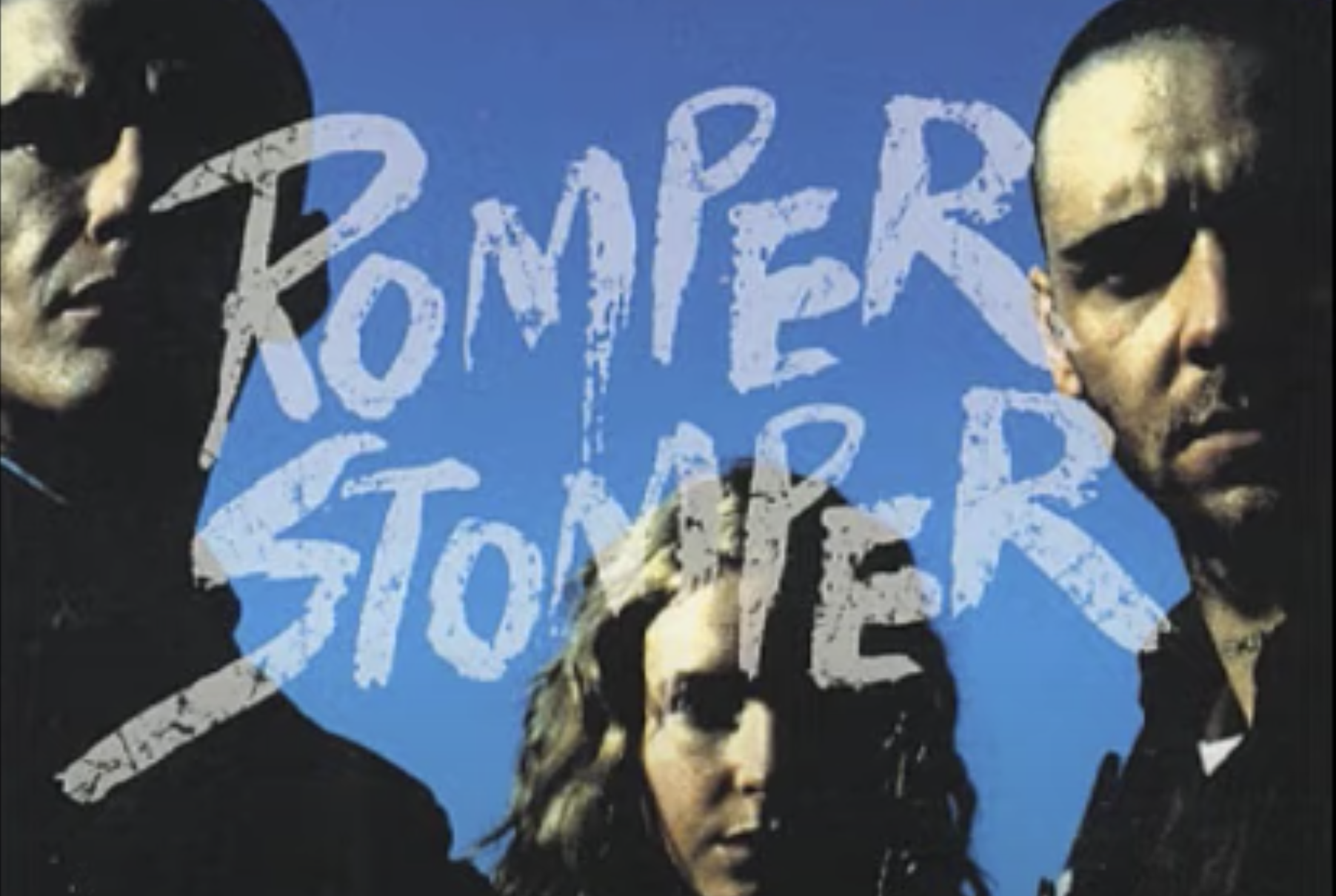
27 months ago I posted a six-and-a-half-minute version of the legendary gang fight sequence from Geoffrey Wright‘s Romper Stomper (’92), one of the most indelible, pared-to-the-bone, punch-kick-and-wallop flicks about hate groups ever made.
It starts with six or seven skinheads (led by an astonishingly young and slender Russell Crowe) beating up on three or four Vietnamese guys in a family-owned pub. But word gets out immediately, and a large mob of furious Vietnamese youths arrive and beat the living crap out of the skinheads. Hate in and hate out. Bad guys pay. Glorious!
Hashtags are well and good but, as Woody Allen said about Nazis in that MOMA-party scene in Manhattan, baseball bats really bring the point home.
I’ve just found a longer (15 minutes), much better looking version of the same sequence. It was posted 10 months ago by “Dunerat.”
Those who’ve never seen Romper Stomper are urged to do so.
One of the reasons Geoffrey Wright‘s Romper Stomper (’92) works as well as it does — an anti-racist, anti-skinhead film that isn’t afraid to dive right into the gang mind and pretend-revel in the fevered currents — is John Clifford White‘s score.
The main theme seems to simultaneously channel skinhead rage and, at the same time, deftly satirize it. I don’t know what kind of brass instruments White used on these tracks — tuba? trombone? — but the sound and mood are perfect. Just a clever instrumentation of a melodic hook and obviously less than complex, but once you’ve heard the theme you’ll never forget it.
During her 7.18 Oppenheimer screening in Burbank Sasha Stone was hugely bothered by a pair of 20something women who took out their phones around the half-hour mark and were pretty much texting all through it. They didn’t even turn down the brightness levels on their screens.
The first thing I texted Sasha when my Oppie screening ended last night at 10:20 pm was “as much as I condemn phone-surfing during a film and especially during a major blue-chip immersion like Oppenheimer, I understand why those women were texting.”
An unmistakably grade–Aexperience, Oppenheimer could be re-titled Oppenheimer: Interiors as it’s almost all super-smart dialogue, super-smart dialogue and more super-smart dialogue inside rooms (university classrooms, Los Alamos conference rooms, hallways, hotel rooms, dining rooms, the Oval Office).
Okay, the historic New Mexico test explosion of the first atom bomb (7.16.45. 5:29am) happens under an open-air nightscape and there are several other moments that happen outdoors, but still…
The likely truth is that if you’re not at least half in love with the Oppie legend going in — if you haven’t done your homework by having seen TheDayAfterTrinity (free on YouTube) and if you haven’t read “AmericanPrometheus” — your Oppenheimer experience may (emphasis on this word) feel like a big fat Alaskan grizzly bear sitting in your lap, or certainly right next to you.
It feels (and is) long and demanding, and at three hours is certainly a proverbial tough sit. And yet it’s undeniablyafirst–rate, grand–vision, smart–personmovie that absolutely surges with the spirit of semi-tortured genius (I was reminded of similar-toned portions of ABeautifulMind) and is highlychargedineveryrespect and is evenemotionallyengrossing during the persecution-of-Oppie finale (kudos to the “junior Senator from Massachusetts” for voting against the venal Robert Downey Jr.!!).
And I adored viewing this ChristopherNolan film on that tall-as-an-apartment-building, super-sized IMAX screen (I was sitting third-row center), but I’m afraid I’ll need to re-watch it at home with subtitles as I fully understood roughly half of the dialogue, certainly no more than two-thirds. That or I’m simply too fucking dumb to keep up with all the density and complexity.
Not to mention the fact that my poor right knee was aching and moaning in pain as I had no place to shift or maneuver within that tight IMAX seating area, and my knee massages began around the 45-minute mark and never stopped…one of the most challenging IMAX screenings I’ve ever endured.
At the one-hour mark I looked at my watch and said to myself, “oh, dear Lord, this is sobrilliant and dense and tightlywoven and sharplyfocused to a fare-thee-well, and God help me but there’s another two hours to go!”
And man, the Ludwig Goransson score is reallyloud in portions, and certainly during the final act. It throttles and hammers you into submission.
HEtofriendo: “You didn’t feel a tiny little ‘yay!’ surge when it’s mentioned that JFK voted against Downey? I did.”
FriendotoHE: “Naah, that was just a little fun grace note of JFK nostalgia.”
…as I’m waiting for the big-ass, 15/70 IMAX screening of Oppenheimer to begin at 7 pm…this is the best I can do on the fly…please forgive the repetitions.
Barbie is cheerful, ironic, smart…it’s colorful, pop-pop-pop feminist and male-despising propaganda in a fleet and funny way…it’s clever and snappy enough to make you say to yourself “okay, fine…men are the foolish morons in this thing and there will be no oxygen for steady, fair-minded viewpoints…just give into it, man…whatever. Because it’s zippy and fizzy and a fair amount of fun.”
Barbie really is fun and juiced for the most part…it’s sharp and clever and peppy as fuck and production designed to a fare-thee-well.
Red-staters will have problems with the basic Barbie attitude. This movie definitely tries to nudge the little girls and boys that will see it into the man-hating, male-pitying side of the discussion. Megyn Kelly, take note!
If you want to start your little girl (or your little boy) on a path to despising foolish and idiotic straight men, this is the film to take them to — trust me.
In a very good-natured and heavily ironic and often comedic way (except for the final 25 to 30 minutes, when it turns into one soul-baring speech after another about the burdens of being a woman and the necessity of men accepting their fundamental immaturity and subservient role, and the task of crafting and molding your own identity)…what was I saying?
In a very good-natured and heavily ironic and often comedic way Greta Gerwig‘s movie absolutely DESPISES men. It really does — it’s total propaganda to this effect.
But at the same time it’s giggly and brisk and breezy and funny and, I have to admit, a very well assembled satire of sorts. A woman-celebrating, man-pitying satire. Wheeee!
Never has a major studio film ever conveyed such uttercontemptforstraightguys…in its peppy and good natured way Barbie constantly belittles men and regards them as delusional little boys with selfish and thoughtless agendas.
But it does so with such brisk and perky energy & with such a persistent sense of nerve and extra-ness…a certain punching-through-the-fourth-wall self-awareness.
And it does have a great final line that is just about equal to the final line in Billy Wilder’s Some Like It Hot so you just have to roll with it and accept the male humiliation and the dominant species of Barbie-women.
This afternoon’s audience was like a midnight crowd at the Rocky Horror Picture Show in the early ’80s, or like the young-girl audience that first showed up to see the first Twilight on opening weekend…a lot of women (and a couple of trans guys!) dressed in pink and giggling and delighted with how the film made them feel. And a fair number of gay gays laughing and giggling and feeling the euphoria.
This is a cultural event, this film…it’s a celebration of the feminine wonderfulness of Barbieland and straight-male mocking and belittling, and a concurrent celebration of feminized gay males.
All The Kens are allegedly straight, you see, except they all look and dress gay. Go figure.
There are phony moments here and there. During her initial visit to the real world, Barbie sits next to an 80something woman and, despite having no frame of reference about older people or age or anything about real-world biology, she says to the 80something woman, “You’re so beautiful.” And the old woman chuckles and says, “I know.” Bullshit, doesn’t work.
My screening was crammed with Millennials and Zoomers…mostly women and a decent smattering of gay men. There was a guy sitting behind me who was giggling like a deballed falsetto Chihuahua…”hee-hee-hee-hee….ooh-hoo-hoo-hoo…hee-hee-hee-ee!”
At the very beginning a hot-pink Warner Bros. logo appears, and this same idiot was DEE-LIGHTED by this…”ooh-hoo-hoo-hoo-hoo…tee-hee-hee-hee-hee!!” I almost turned around and said to him, “Do you know what the term ‘easy lay’ means?”
First thing I wrote after Barbie ended: “I have to give Gerwig and NoahBaumbach credit for having created a fleet, zippy, self-acknowledging, hall-of-mirrors Barbie universe that mostly works.
“If you don’t mind the relentless humiliation that is heaped upon the stupid, self-deluding Ken men, the film holds together. It’s fully realized and precisely thought through and is quite the pink creation, quite the work of imagination…
“Even though it regards men as pathetic and immature and basically seven- and eight-year-olds…the Barbie women are the wise and the strong and way, WAY more commanding and visionary and competent….the Ken men are foolish, emotionally stunted infants, and woman know SO much more and are SO much wiser and more mature and they, henceforth, will lead the way. And are destined, it is fully implied, to run the real world once the men are fully deballed and schooled and feminized…”
No Clint Eastwood or Lee Marvin types allowed! And no Cary Grants or Jack Lemmons either! Only buff-bod gay guys who are pretending to be straight, or at least aren’t identified as queer.