Brad’s New Girlfriend

HE to friendo: I felt befuddled when it was reported that Brad Pitt was hanging out with Alia Shawkat. And then relief when it was announced they were just pallies.

Now I’m feeling even better. A 30-years-younger girlfriend (i.e., Nicole Poturalski) is the way to go…the way it should be for stinking-rich, top-of-the-world guys like Pitt. (Beat, beat) Yes, I’m kidding somewhat.

Friendo to HE: I thought you’d be happy to see he’s putting his fine genetic disposition to good use. Yes, I know you’re half-kidding.

HE to friendo: If I was in Pitt’s shoes and wanted to be with someone younger, for image purposes I’d probably restrict myself to, say, a 20-year age gap. No more than 25. Nicole wouldn’t be as much of a thing if she were, say, 30 or 35 years old. Just my two cents.

Friendo to HE: Yeah. If I was an older dude (mid 50s and up) I’d definitely date younger women if I could. Unless, you know, I’m also looking for deeper conversations.


Multiingual German model Nicole Poturalski.

Joe Finally Stands Up

In a short video released today, Joe Biden has condemned the “needless violence” in Kenosha, Wisconsin in the wake of police shooting Jacob Blake. “Protesting brutality is a right and absolutely necessary, but burning down communities is not protest — it’s needless violence. Violence that endangers lives, violence that guts businesses and shutters businesses that serve the community…that’s wrong.”

Read more

Standing In The Corner

Whenever I hear about something odd that falls outside my own experience, I try and think of a film that depicted same. Yesterday’s oddball thing (8.24) was Aram Roston’s Reuters story about the seven-year sexual arrangement between Jerry Falwell Jr., his wife Becki Falwell and “pool boy” Giancarlo Granda.

The arrangement began when Ganda was 20. He told Roston that for years he had sex with Becki while Jerry, former head of Liberty University and a staunch supporter of Orange Plague, looked on from the corner.

Right away I flashed on a scene from Paul Schrader‘s American Gigolo (’80). Richard Gere‘s Julian Kaye drives out to Palm Springs to attend to the wife of a wealthy financier named Rheiman (Tom Stewart). Rheiman asks Julian to have rough sex with his wife Judy (Patricia Carr) while he watches.


(l.) Judy Rheiman (Patricia Carr) and Julian Kaye (Richard Gere) during an ominous bedroom scene in American Gigolo (’80).

Standing in the corner just like Falwell allegedly did, the financier barks out orders….”slap that bitch!” or something equally repellent. Julian, sitting on the bed with Judy under a sheet, turns and gives this 50something creep a look that says “Jesus, man, who are you?”

Roston: “Granda says that he met Jerry and Becki Falwell while working as a pool attendant at the Fontainebleau Miami Beach hotel in March 2012. Starting that month and continuing into 2018, Granda told Reuters that the relationship involved him having sex with Becki while Jerry looked on.

“Granda showed Reuters emails, text messages and other evidence that he says demonstrate the sexual nature of his relationship with the couple, who have been married since 1987.

“’Becki and I developed an intimate relationship and Jerry enjoyed watching from the corner of the room,’ Granda said in an interview. Now 29, he described the liaisons as frequent — ‘multiple times per year’ — and said the encounters took place at hotels in Miami and New York, and at the Falwells’ home in Virginia.”

Feminist Holmes Fantasy for Girls

Let me guess…it turns out that 14 year-old Enola Holmes (Millie Bobby Brown) isn’t just a chip off the old block but in some ways smarter than her significantly older brothers Sherlock (Henry Cavill) and Mycroft (Sam Claflin).

It would appear that Enola Holmes (Netflix, 9.23) is a blending of Barry Levinson‘s Young Sherlock Holmes (’85) and Guy Ritchie‘s Sherlock Holmes (’09) but through a 21st Century female prism, and with the usual injections of arch attitude and ironic popcorn fantasy.

Based on Nancy Springer‘s Enola Holmes Mysteries, and directed by Harry Bradbeer (Fleabag, Killing Eve). Costarring Helena Bonham Carter, Fiona Shaw, Adeel Akhtar, Frances de la Tour, Louis Partridge and Susie Wokoma.

“She Sells Sea Shells By The Seashore”

I posted my first Ammonite riff (“Here We Go Again“) on 2.19.20….pre-COVID masks.

Observation #1: A close relation of Celine Sciamma‘s Portrait of a Lady on Fire, once again set near a beachy coastline in the distant past (Dorset in the 1840s), and once again about a lesbian love affair between tightly-corseted, socially restricted women who wear their hair in buns.

Observation #2: A bit of a May-December romance with 43 year-old Winslet (now 44) as the real-life fossil-searcher and paleontologist Mary Anning, who was born in 1799 and died in 1847. 26 year-old Saoirse Ronan (25 during filming) plays geologist Charlotte Murchison, whose husband, Roderick Impey Murchison, paid Anning to take care of her for a brief period.

Except the 1840s romance that allegedly occured wasn’t a May-December thing. Murchison was actually 11 years older than Anning, having been born on April 18, 1788. She was therefore in her early 50s and not, as the film has it, in her mid 20s. Furthermore Roderick Murchison wasn’t, as the film indicates, some kind of patronizing sexist twit who regarded his wife as a fragile emotional invalid who needed looking after. The Murchisons were actually partners in their geological studies; they travelled all over Europe together.

Charlotte Murchison lived to age 80; poor Mary Anning passed from breast cancer at age 47 or 48.

Ammonites are the extinct relatives of sea creatures that lived during the Jurassic and Cretaceous eras.

Ammonite will play at the Toronto Film Festival (so to speak) on 9.11.20.

The Great Estate

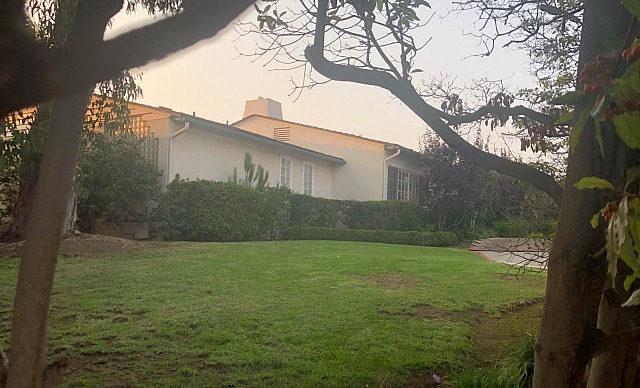
Last evening around 6:30 pm Tatiana and I embarked on another steep uphill hike. Yes, despite the heat. It was primarily for exercise, but our goal was the gates of Bella Vista, John Barrymore‘s sprawling, perfectly landscaped, Spanish colonial hilltop home at 1500 Seabright Place.

We began at the corner of Lexington Ave. and North Crescent. Due west, right on Hartford, up Benedict Canyon, right on Tower Road and then up, up, up to Tower Grove Drive and beyond. Panting, perspiring, wheezing, groaning.

The visit was more or less inspired by Drew Barrymore having confirmed a couple of days ago that following her grandfather’s alcohol-related death in 1942, his body was indeed stolen from a morgue by W.C. Fields, Errol Flynn and Sadakichi Hartmann “so that they could prop him up against a poker table and throw one last party with the guy”, according to an interview transcript.

Read more

Son of Brown Blood

On 3.11.11 I ran a piece called “Taxi Driver‘s Brown Blood“. It was about (a) Grover Crisp and Martin Scorsese‘s Bluray restoration of Taxi Driver (4.5.11). and more particularly (b) a technical question asked of Crisp by The Digital BitsBill Hunt.

Hunt asked about the brownish, sepia-tone tinting of the climactic shoot-out scene, which had been imposed upon Scorsese by the MPAA ratings board. Scorsese had always intended this scene to be presented with a more-or-less natural color scheme, in harmony with the rest of the film. Hunt to Crisp: “Why didn’t you and Scorsese restore the originally shot, more colorful shoot-out scene?”

“There are a couple of answers to this,” Crisp replied. “One, which we discussed, was the goal of presenting the film as it was released, which is the version everyone basically knows. This comes up every now and then, but the director feels it best to leave the film as it is. That decision is fine with me.”

HE response: “There can be no legitimate claim of Taxi Driver having been restored without the original natural color (or at least a simulation of same) put back in. The film was shot with more or less natural colors, was intended to be shown this way, and — with the exception of the shoot-out scene — has been shown this way since it first opened in ’75.

There’s nothing noble or sacred about the look of that final sequence. The fact that it was sepia-toned to get a more acceptable MPAA rating is, I feel, a stain upon the film’s legacy.”

Crisp explained that even if Scorsese wanted to present the natural color version, the original Taxi Driver negative is gone and there’s no way to “pump” the color back in.

Steven Gaydos 2011 comment: “Jeff’s right that it’s a shame a filmmaker had to alter his film in order for it to be seen in wide release, but according to my in-house expert (Monte Hellman, who oversaw the digital restoration/release of his 1971 film Two Lane Blacktop), if the negative is gone, as Crisp clearly says it is, then ‘you can put the color in but it will never look right, and certainly won’t look anything like the original footage.'”

And that was that.

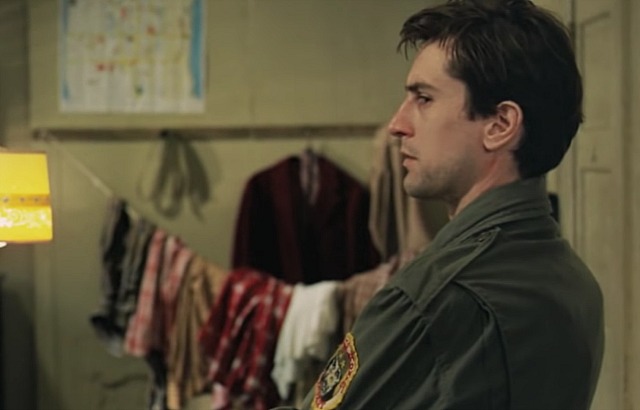
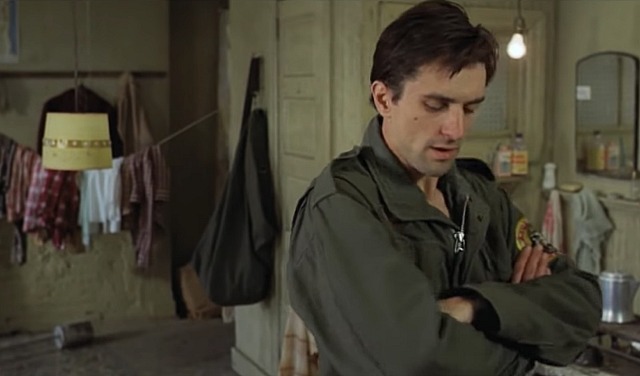
But two or three years later I came upon this image of the wounded Travis Bickle, and damned if it doesn’t look like the original probably did before the MPAA stepped in.

I wondered right away where it came from, and I asked myself “if someone could satisfactorily manipulate a single frame from that shoot-out sequence to make it look right and natural, why couldn’t someone manage the same trick for the whole sequence?”

Who’s Being Honest About “Tenet”?

It would appear that Chris Nolan‘s Tenet is widely admired — 88% and…wait a minute, only 71% on Metacritic? Okay, it’s mostly admired. Three out of ten in the negative column.

When it comes to assessing the pros and cons of any heavy-duty blockbuster from a major distributor, at least 90% if not 95% of critics will strive for some kind of generosity if not positivity, even if the critic in question wasn’t completely knocked out. Somewhere between 5% and 10% will speak more honestly. That’s simply the way it works. Now and then that percentage can extent to 15% or 20%

The most trustworthy reviews in the world are when you run into a friend in a parking lot who’s just seen it, and he/she gives you 75 or 100 words of straight dope. This is what I’ve always aimed for — parking-lot candor, no time for bullshit, etc. I’ve dropped the ball two or three times in that regard, but to err is human.


Robert Pattinson, John David Washington.

Indiewire‘s Mike Cahill: “Where did it all go wrong? Deep in the film’s tangled DNA, there are traces of an effervescent, boundless, city-hopping romp. Turn time back! Reopen cinemas! Save the world!

“But there’s zero levity in “Tenet”: Nolan simply reverses time in an effort to bring dead ideas back to life. And if he couldn’t have envisioned Saturday-night moviegoing being among them, it feels doubly sorrowful that a film striving to lure us all outdoors should visit this many locations and not once allow us to feel sunlight or fresh air on our faces.

“Visually and spiritually grey, Tenet is too terse to have any fun with its premise; it’s a caper for shut-ins, which may not preclude it becoming a runaway smash.”

From Catherine Shoard’s review in The Guardian:

“It’s no wonder Christopher Nolan thinks Tenet can save cinema. That’s a doddle compared to the challenge faced in his film, which, we’re frequently reminded, is a proper whopper. Prevent world war three? Bigger. Avoid armageddon? Worse. To spell it out would be a spoiler, but think 9/11 times a hundred, to quote Team America: World Police, a film Tenet faintly resembles.

“Lucky, really, because Tenet is not a movie it’s worth the nervous braving a trip to the big screen to see, no matter how safe it is. I’m not even sure that, in five years’ time, it’d be worth staying up to catch on telly. To say so is sad, perhaps heretical. But for audiences to abandon their living rooms in the long term, the first carrot had better not leave a bad taste.

“For all Tenet’s technical ambition, the plot is rote and the furnishings tired.

Read more

An Experience (Mostly) For The Young

“I know, I know you’ll probably scream and cry that your little world won’t let you go…”

Last night Paul Schrader asked his Facebook pallies if he should maybe drop acid. “When I was in college I refused to take LSD because I was so full of suicidal anger, [and] I feared the drug would unleash self destruction,” he wrote. “That of course was media propaganda. But now at 74 with little left to lose I would like to take a trip. Is it safe at my age? Where can I safely access it?”

HE reply, filed this morning at six-something: “I wouldn’t, Paul. Unless you’ve developed a notion that you’re ready to accept the mystical, which means putting aside the rational and in some cases judgmental constructs that you’ve been assembling for so many decades — all of those structural towers of intellectual, influential, scholastic, explorational and experience-based building blocks of your identity.

“LSD is a potential passport to satori and clear light. It’s all there and quite the wonder-realm, but you can’t really enter the kingdom without letting all that other stuff go…all of that material you’ve been accumulating and evaluating and sifting through since your early teens. None of that stuff really matters in the realm of the mystical. If you think you might be down with this or at least open to the possibility, go with God. But it’s a lot easier to allow this kind of ‘letting go’ transformation to happen when you’re 19 or 22 and made of much softer clay.

“LSD is a key, a door ajar, a gateway into a whole ‘nother territory. It isn’t really about therapy or psychology (sorry, Cary) or this or that terra firma, furrowed-brow examination or rumination. It’s about stepping off a kind of misty, moss-covered cliff or, if you will, deciding that the rules, restrictions and governances that you’ve been living by are just obstructions, and that a blue-sky realm awaits.

“I’m just saying that most (i.e., obviously not all) older people have invested too many decades and sorted through too much stuff to accept this kind of clarity, this kind of spiritual cleansing and refreshment. Some people are better off living in safe, sensible worlds that have worked for them…familiarity, recognizable borders, trial and error.

“A good satori book by Alan Watts (such as “This Is It“) would be good to have around. The lyrics of ‘Are You Experienced?’ [see above] are proof that Jimi Hendrix really knew whereof he spoke…“not necessarily stoned but beautiful.”

“All due respect and serious admiration, Paul, but I suspect that you’ll find this kind of newspaper-taxi adventure and temptation more unsettling than transformative.

“If you intend to do this, fine, but at least do so with a good supply of come-down medicinals at the ready (Ocxycontin, Tapendatol, Dilaudid).”