Calling Gentle Bullshit

In a video attached to Marc Malkin‘s 10.3 Variety piece about A Beautiful Day in the Neighborhood, Tom Hanks offers the following observation about the late Fred Rogers, whom Hanks plays in the film:

I do not have the skill that Fred had, which was to meet somebody and make it seem as though as if they’re the most important person in the world. Everybody that we met at KQED…they all said that ‘when you talked to Fred, you felt as though you were the most important person in the world.'”

Excuse me, but Hanks is talking about an elementary Hollywood skill that all successful actors are highly efficient at using for their personal benefit. It’s probably the second most essential skill in the game of creating a successful acting career, after knowing how to act. Many of them do it like absolute samurai pros.

I’ve been the recipient of this special kind of attention hundreds of times. Mostly from actors but sometimes from directors or producers. They look right into your soul and convey that you’re a special, fascinating, world-class person, and that your thoughts on whatever topic are truly spellbinding.

You know it’s an act, of course, but you can’t help feeling charmed and flattered.

Hanks is one of the absolute Zen masters of this routine. He’s one of the most likable human beings on the planet, and once you’ve sat in a hotel room with him for 15 or 20 minutes you become a lifetime convert.

Warren Beatty is another Yoda-like figure in this regard. I’ve never felt so enthralled and alpha-vibey as I did after Beatty and I had one of our first serious discussions back in…oh, ’92 or thereabouts. All he said was “how are ya?”, but the way he said it made me feel like some kind of inner lightbulb had been switched on. Even though I knew he was just turning it on like a gardener turns on a sprinkler system. Because he’s so good at it.

HE Favors DeNiro (Slightly) Over Robinson

Read the 10.3 N.Y. Times story, written by Julia Jacobs, about Robert De Niro and his ex-Canal Productions employee Chase Robinson suing each other over mutual dissatisfaction with work behaviors, and then consider the following HE assessments:

(1) Let me explain something. When you work for someone directly or personally, you’ll find out soon enough who they really are. And they’ll find out soon enough who you really are. And this familiarity will breed contempt. And then you’re stuck with each other until (a) you mutually build or create your way past this state of mutual loathing and/or disrespect, or (b) until someone quits or is fired. That’s life.

(2) Naturally Chase has accused De Niro of belittling behavior on his part — asking her to “button his shirts, prod him awake in his hotel room, doing his laundry and vacuuming — making her effectively an ‘office wife’ even as she was promoted…not to mention berating her, often while intoxicated, calling her names including ‘bitch’ and ‘brat’”…not to mention “gratuitous unwanted physical contact” (i.e., playing the #MeToo card).

(3) DeNiro seemingly resented what he regarded as Chase’s casual, profligate, laissez-faire attitude about her job. DeNiro seems to feel that she basically didn’t work hard enough. Too extravagant, too entitled, too many perks, too many extras. She loafed around, slacked off. Business-expense-wise, she spent waaaay too much money on pricey Italian restaurants, handbags, Ubers and whatnot.

(4) Chase was probably bored by her tasks. She felt resentful about an equal-status male employee being paid more. She undoubtedly resented the requests for back-scratchings and listening to DeNiro pee while talking to her. Too much information but here goes anyway (and De Niro should take note): If nature calls while I’m speaking to someone on the phone, I always sit down.

(5) Chase basically overplayed her profligate hand, her entitled approach to the job, and De Niro eventually asked himself, “Why am I paying her all this money and giving her this extravagant lifestyle? For what?”

(6) And what about that special N.Y. Times photo portrait of Chase that accompanies the article [after the jump]? Nice tasteful lighting. Nice green background. Nice antique-looking chair. Nice tasteful dress.

(7) And what about this recording, which happened in 2012? DeNiro was hugely pissed off, obviously — didn’t like her haughty attitude, declining to return his calls, etc. He was apparently on the verge of firing her, and yet their relationship recovered and she continued to work for him for another five years…odd.

Read more

Disciplined, Ruthless, Well-Armed

When I first saw it 39 years ago, I immediately decided that John Irvin‘s The Dogs of War was a great (if not the greatest) mercenary war flick, and my opinion hasn’t changed since.

But until today, I hadn’t realized (or paid sufficient attention to the fact) that there’s a 118-minute international cut along with the 104-minute version that I saw way back when. This is why I’ve bought the Eureka Entertainment Bluray (streeting on 10.14), which has both versions.

Tough, minimalist performances by Christopher Walken (whose facial features were quite lean and beautiful back then), Tom Berenger, Colin Blakely, Hugh Millais and Paul Freeman.

Based on the same-titled Frederick Forsyth novel; script by Gary DeVore, George Malko and uncredited Michael Cimino. Cinematography by the great Jack Cardiff.

The Dogs of War is streamable via Amazon Prime, but who wants the shorter version?

Genuine Art, Serious Madness, Real Anarchy

I don’t know how or why Warner Bros. got behind a film as nutso radical as Todd Phillips, Scott Silver and Joaquin Phoenix‘s Joker (10.4), but this is not corporate product. Make no mistake about the fact that this 122-minute film is propelled by misery, loneliness, alienation, despair, ennui, delusion and general social malevolence and madness. And it doesn’t back off from that.

I’m telling you right now that at least a portion of the Joe and Jane Popcorn crowd might have a problem with Joker. Because it’s not serving up the usual DC Comics oatmeal. At all. And to its credit. It’s an unsettling, challenging thing to sit through, but in a good way. This was my judgment, at least, and that of some guys I was speaking to at the after-party.

But I heard some other reactions on the way out of last night’s Chinese screening. “Some are going to like it, and some are not going to like it,” a woman journalist said. Another guy said negative reactions are going to dominate. (Which I doubt.) It was my post-screening judgment, if you wanna know, that many people didn’t even know what they’d just seen. Or didn’t care to know. Some were just saying “it’s fine…it’s going to make a lot of money,” blah blah. Well, yeah, but Joker is about a lot more than just that…c’mon.

Joker is entirely about the sad, imaginary and not-so-imaginary saga of Arthur Fleck (Phoenix), a mentally ill guy who’s been abused and kicked around, who lives in a ratty urban hell hole circa 1981, who works as a street clown, who imagines that he has a nice girlfriend (Zazie Beetz) who lives in the building but on some level not really, who goes from bad to worse and then much worse, from meds to no meds, and who finally cracks, and then really cracks by killing some people and then (in his head but to some extent actually) ignites anarchy and revolution.

This is a startling serving of truly inflammatory nihilist cinema. It’s way out there. Brand-wise, Joker represents the launch of DC Black, a series of DC-based standalone films. Uh-huh, whatever. “A film for our times!” a journalist pally said last night.

How crazy-good is Phoenix? As good as this sort of thing gets. An obvious Best Actor nomination, and perhaps even a win. Maybe.

Honestly? I think Phoenix is half playing Arthur and half just wigging out on his own wavelength. I think he’s portraying Arthur in the same way that Max Schreck “played” the vampire Count Orlok in F.W. Murnau‘s Nosferatu. Or more precisely the way Willem Dafoe portrayed Schreck portraying Orlok in Shadow of the Vampire.

Last night I called Joker a deranged art film in the tradition of Un Chien Andalou or L’Age d’Or — like some perverse creation from a latter-day Bunuel-Dali, except with stronger doses of hate and rage and all-around dystopian chaos. The world minus any semblance of civility or love or order…it’s about despising and hating the odious one-percenters…the rank and odious social order of the snooty swells. Fuck ’em!

Joker is a literal manifestation of insanity. Which is to say it delivers a searing portrait of a loose-screw type without judging or pulling back into some conventional corner in Act Three. Joker commits to Arthur — he’s the only guy you have to relate to, and I have to admit that when Arthur snaps on the subway after being taunted and beaten I wasn’t feeling all that horrified. On a certain level I was feeling a Death Wish-like surge of excitement and approval. But Joker doesn’t end there. Once the downward spiral begins, there’s no stopping it.

I don’t know where Arthur Fleck’s deranged fantasies begin or end, but this is a film about the demon seed…a film not just about crazy Arthur but about mass rage, mass madness. At the end of the day it’s not so much about Arthur going mad but the whole city, the whole world on a rampage. A good portion of which, I realize and accept, is happening inside Arthur’s grieving and miserable head. But not completely.

Please understand that Arthur’s revolution isn’t all imaginary, and that after a while it’s as real as anything else. Damn the odious social order! Everyone in authority is hateful and vile and deserving of death and destruction or a beat-down…at some point Arthur’s fantasy aspect goes out the window along with his meds. Pure anarchy.

Read more

Good Neighbor Fred

Marielle Heller‘s A Beautiful Day in the Neighborhood (Sony, 11.22) is all about the art and impulse (and to some extent the discipline) of being gentle and kind, however and whenever possible and even when it’s not. There’s no resisting the caressing vibe of this thing, and who would want to? It’s going to make a ton of money, and Tom Hanks‘ performance as the beloved Fred Rogers will snag a Best Supporting Actor nom. It’s not a brilliant film, but it’s an awfully nice one.

The gentle scheme is to present a mostly factual, real-life story — all about an evolving relationship that actually happened 21 years ago between a somewhat testy and suspicious writer and his serene-minded subject, and how it turned out for the better.

The glumhead was Esquire profiler Tom Junod (called “Lloyd Vogel” and portrayed by Matthew Rhys) and the subject was Rogers, the creator and host Mr. Rogers Neighborhood from 2.19.68 until 8.31.01.

The trick is that the film actually feels like — is — an episode of Mr. Rogers Neighborhood. It deals with angry adult workaholic stuff (i.e., mostly Vogel’s issues with his father, played by Chris Cooper) but adheres to the emotional tone and terms of this fanciful, tender-hearted kids show.

Hanks obviously owns this film, but it’s a little curious that Heller and screenwriters Micah Fitzerman-Blue and Noah Harpster decided to only portray the Fred Rogers of legend. I’m not saying Rogers was someone else deep down, but he’s so gently mannered and all. Did he ever swear or fart or snap at anyone…ever? And the film is soooo slowly paced and extra-double-triple gentle and quiet. There are sooo many close-ups and MCUs. So many actor-ish expressions of rage, surprise and buried anger on Rhys’ face. And that three-week beard…yeesh.

I don’t believe that the actual Tom Junod slugged his father during a wedding reception. Angry sons do this in movies; not so much in real life. Critic friend: “I think the slugging-the-father scene rings false even as a movie scene; but then, I think, A Beautiful Day recovers. There was a lot of criticism in Toronto about how the Matthew Rhys parts aren’t as strong as the Tom Hanks parts. I get that criticism, but what I think it misses is the way the whole film works together.”

Read more

San Vicente Bungalows…You Think?

A proclamation from The Hollywood Reporter‘s Alexandra Cheney, posted on 9.24.19: “In an industry where social and professional clout are often defined by access to exclusive spaces, San Vicente Bungalows stands out as the membership club you definitely want to be a member of.”

If you’re approved (and don’t think this is any kind of duckwalk), it’ll cost you $1800 upfront and $4200 annually. But first you have to be nominated by a standing member, and then be approved by a nine-person membership committee, which meets twice monthly.

SVB member: “It doesn’t matter if you have money”…obviously bullshit. “It matters if you’re interesting.” Translation: If you’re dull or under-educated or given to a certain entitled arrogance you might have a tougher time of it.

Cheney: “Officially, what stands in your way are just three simple questions that make up the application to Jeff Klein‘s 10-month-old hotspot in West Hollywood: What would your autobiography be called? What is your favorite restaurant and why? What would your unique contribution to SVB be?”

(1) Title of HE’s autobiography: “Beware Those Who Live In A Crowd — They Are Nothing Alone.” Subtitle: “Avoid All Well-Dressed People Who Smile Strenuously — You’ll Live Longer.”

(2) HE’s favorite restaurant: Pier Luigi in Rome. Because it’s elegant and unpretentious and located in a smallish cobblestoned piazza, and because the food and service are always perfect.

(3) Unique HE contribution to SVB: Showing up for special film-related events but otherwise avoiding the premises like the plague.

McCartney & Colbert Talk “Yesterday”…

…and, having just discussed John Lennon seconds before, they don’t mention Yesterday‘s most penetrating, head-turning scene? Because…what, they don’t want to spoil? The movie came out over three months ago. Spoiler whiners haven’t a leg to stand on after 90 days. I would have been completely fascinated to hear McCartney’s reaction.

From “Faker From The Heart,” posted on 6.29.19: “I did, however, like one thing about Yesterday. Tremendously, I mean. Around the two-thirds or three-quarters mark comes a scene that I hadn’t read about in reviews, and it totally blew my mind.

Read more

Beverly Walker’s Jackathon

It doesn’t seem like that far back when I attended the first big Academy screening of Prizzi’s Honor. But it happened 34 and 1/3 fucking years ago. Sobered by this realization, I started poking around yesterday, and eventually came across and re-read a fascinating Film Comment interview with Charley Partanna himself. Good reading, on point, nicely refined.

This morning I asked the author, Beverly Walker, whom I’ve known for eons, how it came about. The piece, she said, was derived from six hours of conversation, which happened in three installments. “Three separate interviews?,” I replied. “Wow, the access. Today all you can hope for is 20 minutes in a hotel room. Didn’t Jack’s publicist ask ‘Jeez, Beverly…how many sessions do you need?’ Can you give me a rundown about how and where it all happened?”

Beverly replied in less than an hour, and very tidily at that.

BW: “I had an acquaintanceship with Jack, having been introduced by Pierre Cottrell shortly after I moved to Los Angeles in 1970. Pierre — a producer with Barbet Schroeder of Eric Rohmer’s early films — had known Jack a long time; in fact, Jack had lived with Pierre and his wife, Edith, during a long sojourn in Paris in the ‘60s. Pierre had become a friend of mine during my years at the N.Y. Film Festival.

“This acquaintance with Jack was renewed when I handled NYC release publicity for The King of Marvin Gardens. I liked Jack a lot; I was fascinated by the huge difference between the guy I was around and his public persona. I knew how smart he was — how articulate — and thought he would be a great interview subject. Somewhere along the way, he said he would sit down with me for an interview,
During the filming of Prizzi’s Honor (which I worked on), he confirmed it.

“When shooting was finished, I went to his house on Mulholland on three separate occasions, for at least two hours each time, to talk with him. It was quite easy and informal. The second time, as I recall, he was distressed about losing most of his eyebrows, which were singed when a burner on his stove flared up**. It was scary, and he was in pain. Nonetheless, he carried on.

“Jack never had a publicist or an agent, just a manager. But the appointments were done through an assistant of his, whose name I regret to say I cannot recall, but whom I knew from being around the set on Prizzi’s Honor.

“We — Harlan Jacobson, editor of Film Comment at the time, and myself — had agreed to allow Jack to read the interview before publication. There was concern because Jack had indiscreetly talked so much about drugs and other inflammatory subjects; his position within the industry was a little iffy. I didn’t mind because I had no intention of addressing those subjects. I really wanted to allow him to show this other side of himself, which was largely hidden from the public.

Read more

“We Are Your Life”

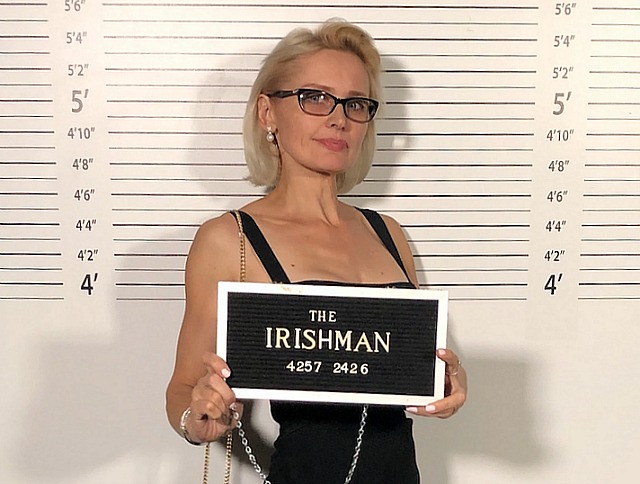
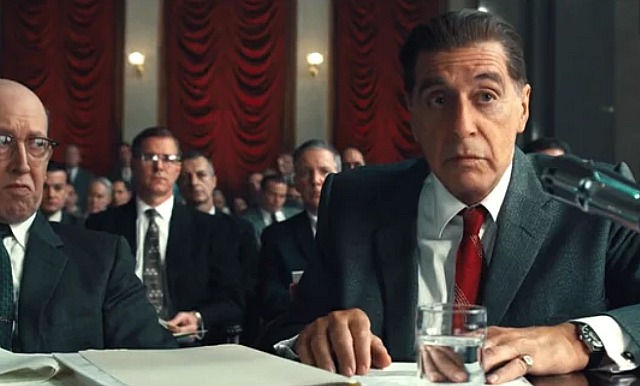
According to longtime Robert De Niro partner and Irishman producer Jane Rosenthal, Martin Scorsese‘s final gangster flick “is a slower movie. It doesn’t have the kind of intensity, the visual intensity, [of] a Casino or a Goodfellas. It is guys looking at themselves through an older perspective.”

It’s basically about “toxic masculinity” being the end-all and be-all of the life of mob hitman Frank Sheeran (Robert De Niro), Rosenthal says, “and what happens when someone chooses one family over their own nuclear family, and then tries to make repairs at the end of [his life]. What happens to men who make that decision.”

The Irishman will debut at the NY Film Festival on Friday, 9.27, or four days hence.

Can you imagine any old-time, bullshit-spewing producer in the Sam Spiegel or David O. Selznick or Harvey Weinstein mode calling one of his upcoming films “slower”? Rosenthal presumably means that The Irishman is sadder or more meditative, etc. But my God, in most people’s opinion “slower” is only a step or two removed from boring.

And the term “toxic masculinity”, of course, is straight out of your basic SJW feminist handbook.

Over the years most mobster types (including the ones in the first two Godfather films, Goodfellas and The Sopranos) have been portrayed as men who lived most completely in the company of their crime family paisans, and secondarily with their nuclear families, as a kind of fallback thing.

What was the final shot of The Godfather (’72) about, when Al Neri closed that door on Diane Keaton‘s Kay Adams? It was about Kay being shut out of the inner sanctum of Michael Corleone‘s gangster life, and realizing that she’ll always be kept in a restricted zone in which she’ll never really share or know what’s going on.

Remember the definitive line that Don Corrado Prizzi (William Hickey) says to Charlie Partanna (Jack Nicholson) in Prizzi’s Honor? They’re talking about unscrupulous hitwoman Irene Walker (Kathleen Turner), whom Charlie has recently married and loves deeply. The boss, however, wants her dead. When Charlie protests, he’s told that there’s no choice because the Prizzi family is everything. “She is your wife,” Don Corrado says, “but we are your life.”

How is this any different from what Rosenthal is talking about?

Is It Him Or Me?

There isn’t a guy alive who hasn’t dreamt about revelling in a three-way Satyricon thing, but a hetero menage a trois, trust me, is a lot more of a delicate struggle than you might think.

I wouldn’t normally mention that I lucked out with a couple of situations in my late 20s, but it seems allowable in the context of Svetlana Cvetko‘s Show Me What You Got, which is about a prolonged Jules et Jim-type relationship between a beautiful, dark-haired Italian woman (Christina Rambaldi) and a pair of spirited, medium-macho, ginger-haired dudes (Neyssan Falahi, Mattia Manasi).

Both times my threebies were between me and two women, and both were mixed experiences. On one level intimidating, on another level ecstatic, and on still another never truly open and equal and even-steven. Both times I found myself leaning towards one lassie over another, but I naturally didn’t want to convey this so I had to pretend as best I could that everything was everything and we all shine on. It was exhausting.

I decided early on that Show Me What You Got had to be about the fact that Rambaldi’s character would almost certainly prefer Falahi over Manasi or vice versa, and that the story tension would have to be about her choosing one over the other. Or perhaps getting pregnant but nobody knowing who the father is. Or (this was my favorite) her becoming pregnant by a third guy whom Falahi and Manasi haven’t met or even been told about. Preferably some super-rich, Porsche-driving guy a la Robert Redford in Indecent Proposal.

All good love stories need some kind of basic tension. They all require that the person with the most power in a relationship has to choose option A, B or C. They can’t just be about ongoing eros or gliding along.

Monochrome Moods

Yesterday afternoon, as Tatyana was exchanging her iPhone 6 for a new iPhone 8 Plus, I downloaded iOS 13.0 on my own iPhone 8 Plus, which I’ve had for about 18 months. Many cosmetic but agreeable changes (i.e., faster keyboard, dark mode, new photos tabs, tweaks of this and that) but I’m especially loving all the new visual adjustment options on the camera. I probably could have shot all kinds of mesmerizing black-and-white captures before yesterday, but I’m suddenly into it now because I was lazy before or whatever.

Read more