No One Loves Their Mirror Reflection…Not Really

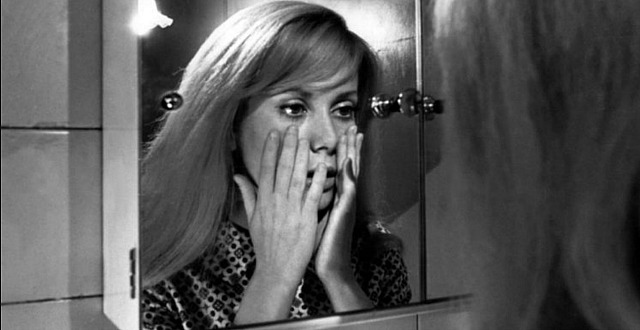
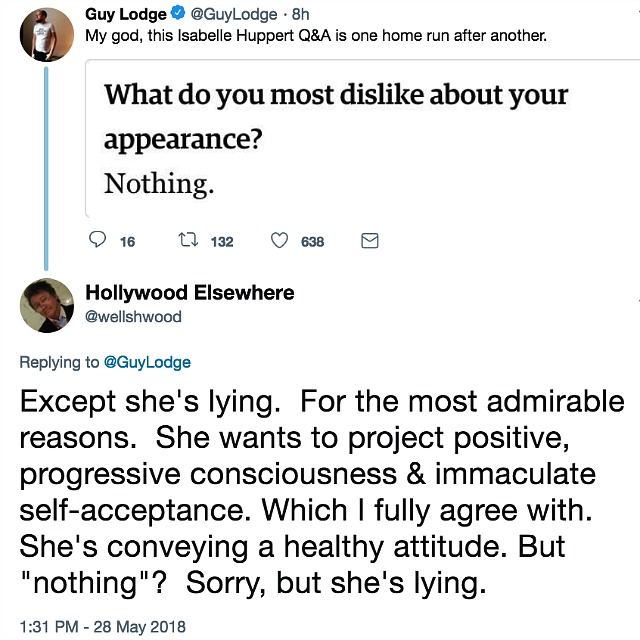
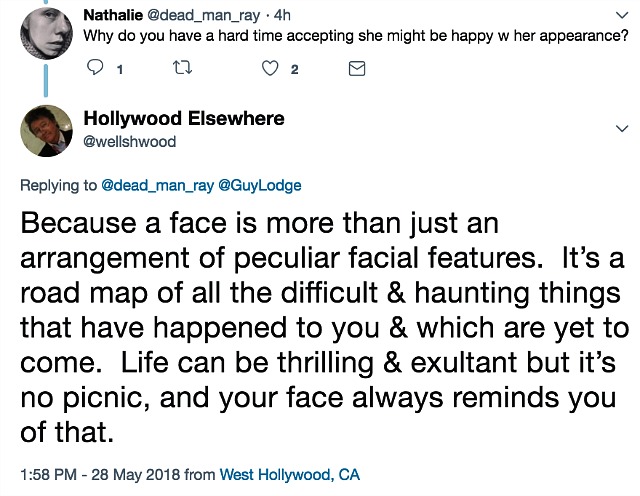
A woman you’ve just met can find you extremely handsome or fetching or fuckable, but you can’t be of the same opinion. You’ve been looking at yourself for too long, and you’re all too aware of the fears and anxieties and unsettling undercurrents that lie beneath those facial features. I applaud anyone who would say they’re completely pleased or at least at peace with their face because it conveys a good attitude — accept yourself and your life thus far without guilt or judgment, and keep the door open for better chapters around the corner. This is how I see myself, and so I completely get what Isabelle Huppert was saying when she said there’s “nothing” about her appearance that bothers her. She’s lying, of course, but in a healthy way.

Pesky Reality Factor

History has noted a fair number of female criminals and desperadoes (Bonnie Parker, Ma Barker, Belle Starr, Ulrike Meinhof, Sandra Avila Beltran, Phoolan Devi, Griselda Blanco, Shashikala Patankar, Seema Parihar) over the decades, but has there ever been an upscale, John Robie-styled female thief of any kind? More to the point, has there ever been a gang of women thieves? Or a female gang of any kind who joined forces to commit a major crime?

I’m just asking.

Lord knows there have been dozens of male gangs who’ve attempted this or that robbery, but to my knowledge women have never done this, not even once. If this presumption is in fact true, the natural question is “why not?” There have been loner lady outlaws over the decades, as noted, so why has there never been a gang of them? Update: Apologies — I’d overlooked Forty Elephants.

Conclusion: It would seem that in today’s context, no offense, that Ocean’s 8 is a masturbatory, patriarchal-pushback, Hollywood wish-fulfillment fantasy from the get-go, completely divorced from human behavior as observed and recorded by 20th or 21st Century journalists, historians and crime novelists. If I’m wrong, please inform.

Don’t Even Start

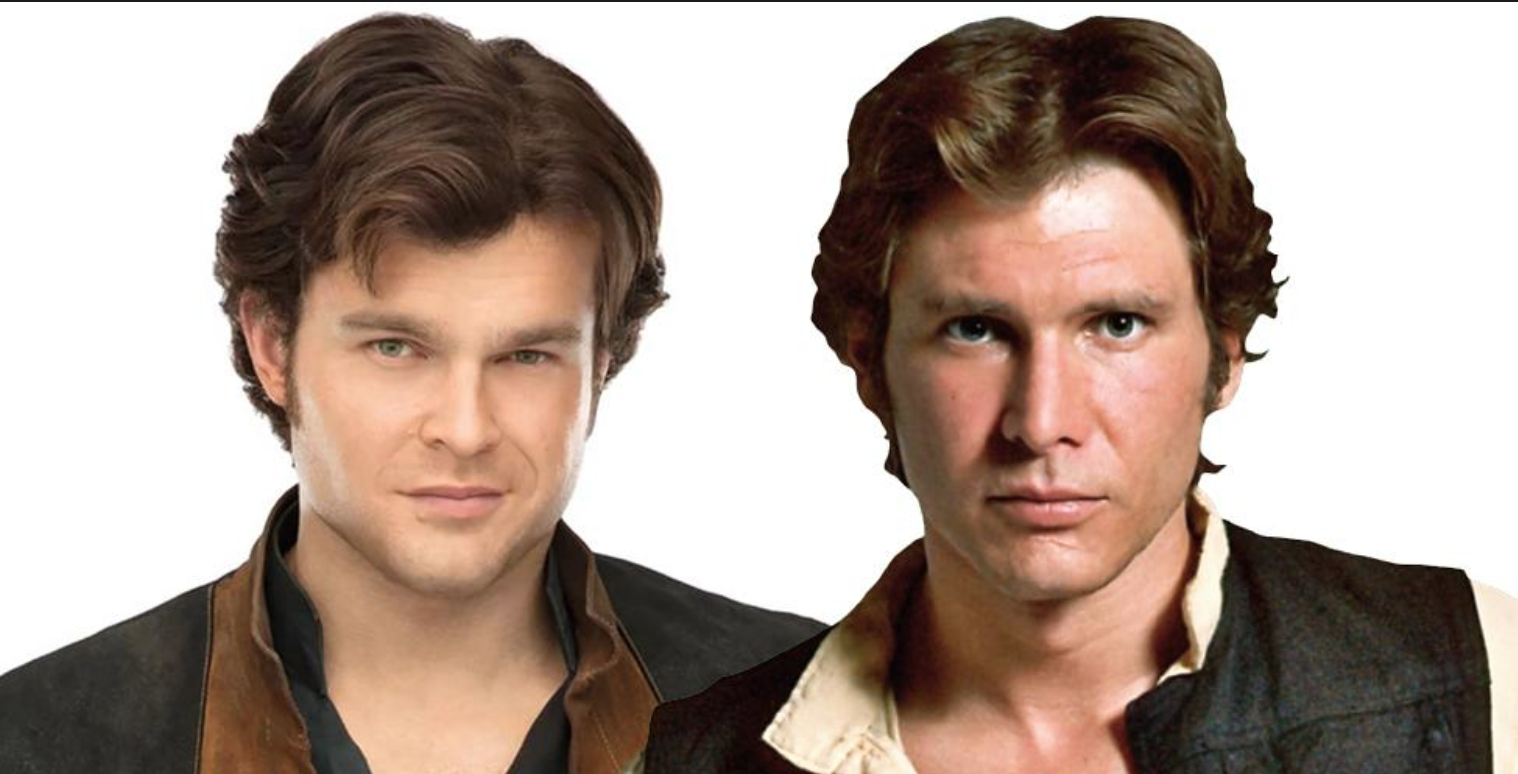
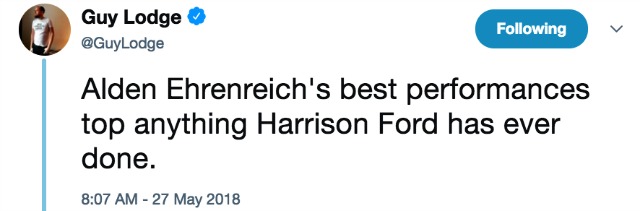
This morning Variety critic Guy Lodge tweeted that “Alden Ehrenreich‘s best performances top anything Harrison Ford has done.” “Performances”? I was under the impression that Ehrenreich’s only big score was his performance as Hobie Doyle in Joel and Ethan Coen‘s Hail, Caesar! Lodge is probably also alluding to Ehrenreich’s argument-in-the-rain scene in Beautiful Creatures (’13), which nobody saw or cared about.

Ehrenreich is a reedy-voiced, square-faced, pain-in-the-ass type who performs as best he can for the part he’s been hired to play, but he hasn’t a clue about delivering big-screen, laid-back presence and manly charisma, which is Ford’s metier. Ford delivers like a movie star, and that kind of delivery is worth its weight in gold.

Ford may be less emotionally agile or intense than Ehrenreich, but he was mythic during the carbon-freeze scene in The Empire Strikes Back and completely steady and sufficient in Blade Runner, Witness (perhaps his career-best performance), The Mosquito Coast, Working Girl, Patriot Games, Clear and Present Danger and — I’m being serious here — Hollywood Homicide. If Ehrenreich had somehow starred in any of these films, I would’ve hated them and probably walked out.

Read more

Almost Touching

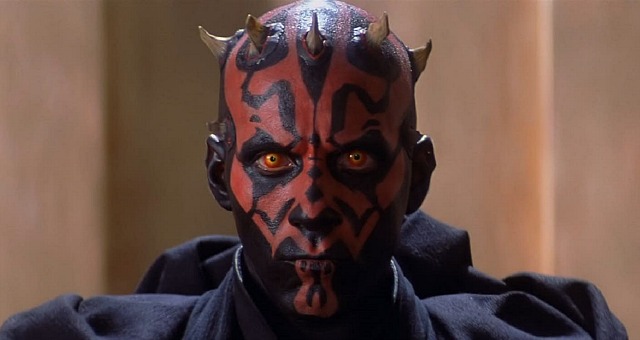
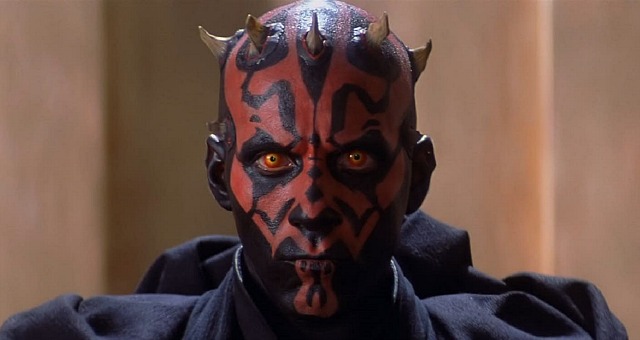
Sometimes columnists have to stray afield to find something to write about, so I’m not condemning Variety‘s Kris Tapley for delving into Darth Maul’s cameo in Solo: A Star Wars Story. Tapley isn’t an out-and-out fanboy but now and then he’s conveyed fanboy yearnings, and discussing the character path and backstory of one-dimensional asshats like Darth Maul is what turns these guys on.

It takes all sorts to make a world. I understand and accept this. But on the other hand…really?

To millions upon millions of Star Wars fans, Darth Maul is one thing and one thing only — the scowling, acrobatic, horn-headed, black and red tattoo-faced shithead with the double-headed lightsaber. As a “character” he’s nothing, nothing…less than nothing. He also reminds everyone of the deeply despised prequels and particularly The Phantom Menace (’99), in which DM appeared and then was sliced in half by Ewan McGregor‘s Obi-Wan Kenobi. (Which Monsieur Maul “survived”, by the way, because the makers of the animated Clone Wars series wanted to use him again in 2011.)

But if you’re a semi-fanboy like Tapley, Darth Maul is like “oohh, cool…let’s talk more about this guy!”

Tapley is all but fascinated by the Darth Maul saga, so much so that he describes a 10-year unaccounted for period in his story as “juicy.” From this point on, any further usage of the term “juicy” by Tapley will be regarded askance if not with skepticism. Rules of the game.

Too Fuddy-Duddy For Proverbial Sack

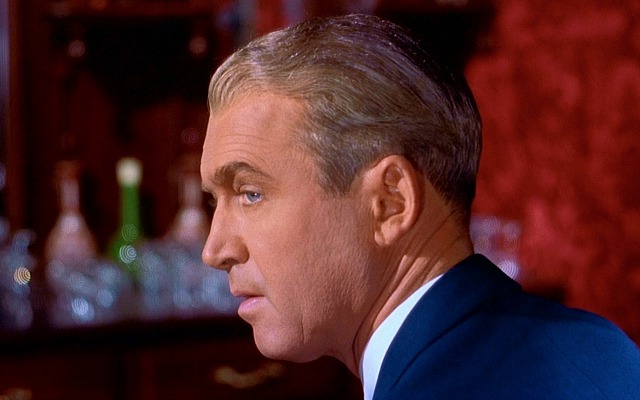
Several online forums have repeated an Alfred Hitchcock assertion, possibly sourced from his 1962 interview with Francois Truffaut, that one reason Vertigo was a financial failure was because the 49-year-old Jimmy Stewart looked “too old” to be the lover of Kim Novak, who was 25 during filming. (Vertigo was shot between September and December 1957.)

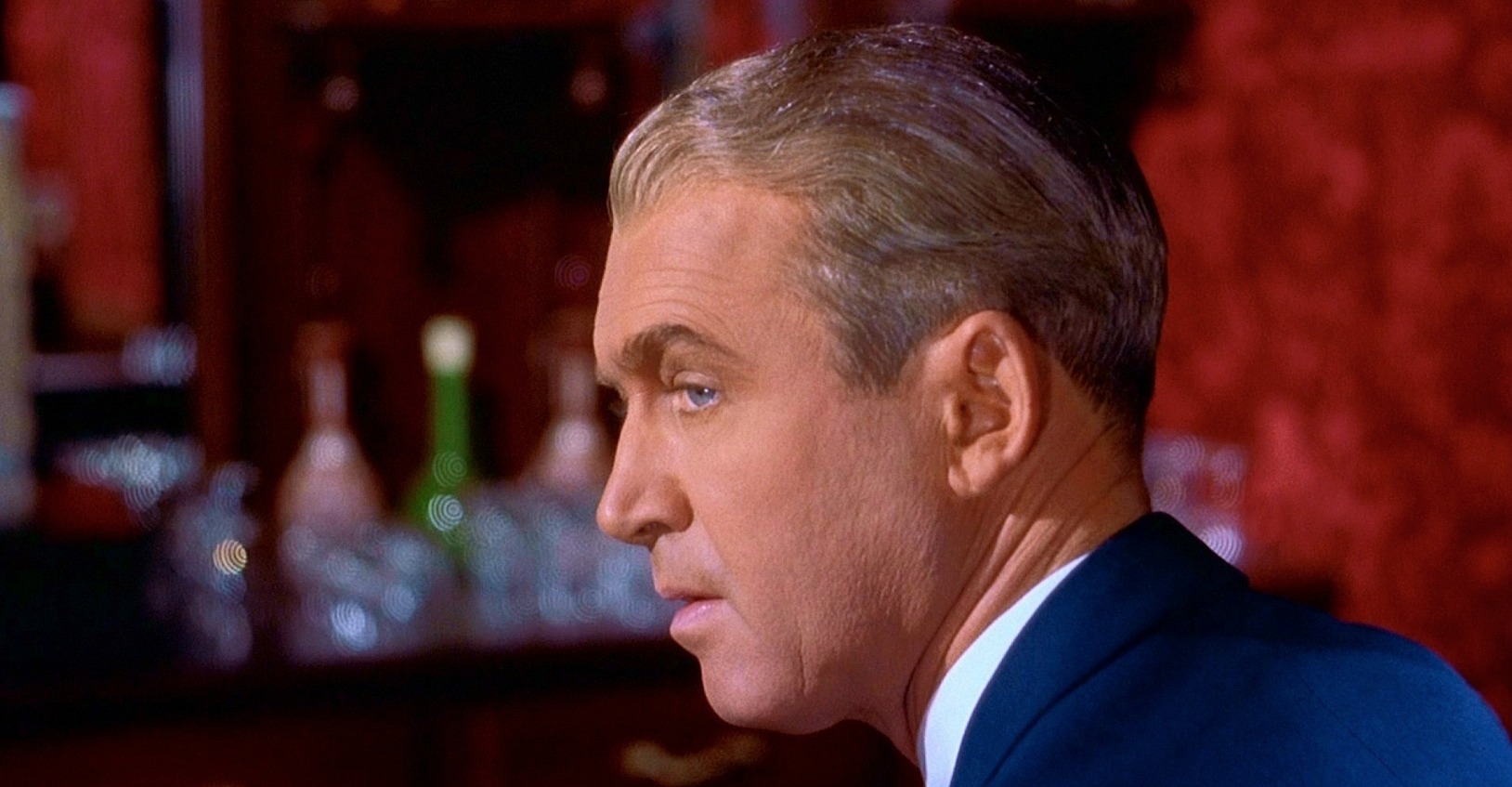
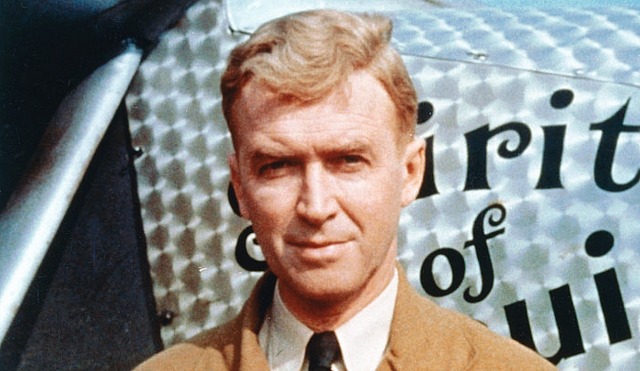
Stewart’s John Ferguson does in fact seem too rigid and stodgy for Novak, not just because of his mostly gray hair but a generally stuffy conservative bearing. (That awful brown suit, for example.) But Hitch could have easily made Stewart appear younger by giving him fair, blonde-tinted hair with a slightly longer, less conservative cut. Only a year earlier Stewart had worn a blonde, almost bushy wig in The Spirit of St. Louis when he played the 25 year-old Charles Lindbergh.

There was nothing loose or sensual or sexually upfront about Stewart in Vertigo. Nothing. He looked and behaved like a Republican governor of a midwestern state, or an Air Force colonel or a corporate real-estate broker. One glance at Novak and you could imagine her nude under satin sheets, but it’s impossible, really, to think of Stewart’s character in even a partial state of undress, much less buck naked and doing the deed. It feels creepy to even describe this, and I’m fully aware that in his youth Stewart was quite the randy fellow.


James Stewart in Alfred Hitchcock’s Vertigo (released in May 1958).

Stewart as Charles Lindbergh in Billy Wilder’s The Spirit of St. Louis (released in April 1957).

Read more

Cuffed, Pled, Bailed

Harvey Weinstein surrendered to the cops this morning, and was subsequently arrested “on rape, criminal sex act and other charges from encounters with two women.” Seven months have passed since the Weinstein allegations broke in the N.Y. Times and The New Yorker. The reports immediately transformed Harvey into toast and launched the #MeToo and #TimesUp movements. His attorney’s claim that Weinstein “didn’t invent the casting couch in Hollywood” is true, but hardly a defense. He’ll almost certainly do time.

Read more

Ron Howard’s Proudest Five

Solo: A Star Wars Story, which begins screening tonight, is not among Ron Howard‘s finest efforts. It’s rotely, routinely proficient — that’s the best you can say. But I will alway respect Howard, if nothing else a reliable craftsman, for having made what I regard as his five finest films, and in this order:

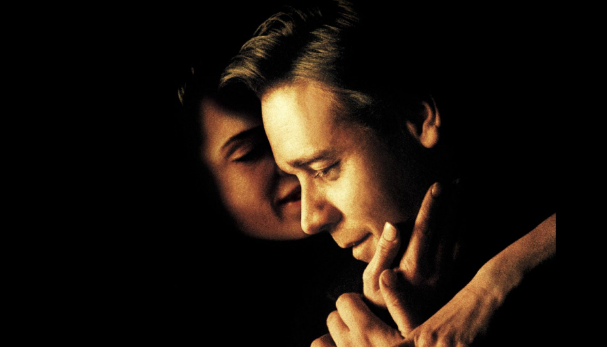
1. A Beautiful Mind (’01), which is well-acted (loved Russell Crowe‘s oddball John Nash) and emotionally satisfying (the pens scene) with a magnificent James Horner score; 2. Apollo 13 (’95) — a decently written, completely satisfying situational thriller within a bureaucratic framework; 3. The Paper (’94) — a big-time journalism movie that finessed several plot threads and delivered first-rate performances, and was reasonably engaging for the most part — a not-great but entirely decent effort; 4. Cinderella Man (’05) — a totally solid ’30s boxing drama (David Poland called it “Fistbiscuit“) with excellent performances from Russell Crowe and Paul Giamatti; and 5. Parenthood (’89) — a well finessed, nicely-written, emotionally centered yuppie family drama with an excellent Steve Martin performance.

How many of the above would I be interested in re-watching? All except Cinderella Man.

Pretty good, not bad, mezzo-mezzo or somewhat minor Howard: Frost/Nixon (’03), Splash (’84), Cocoon (’85), Night Shift (’82), Gung Ho (’86), The Dilemma (’11), Rush (’13).

Meh, not-so-good, irritating Howard: Far and Away, Willow, The Missing, The Da Vinci Code, In the Heart of the Sea, How the Grinch Stole Christmas, Ransom, Backdraft.

Didn’t see ’em, probably never will: Angels & Demons, Inferno, EDtv.

Moses Doubles Down: “Enough Is Enough”

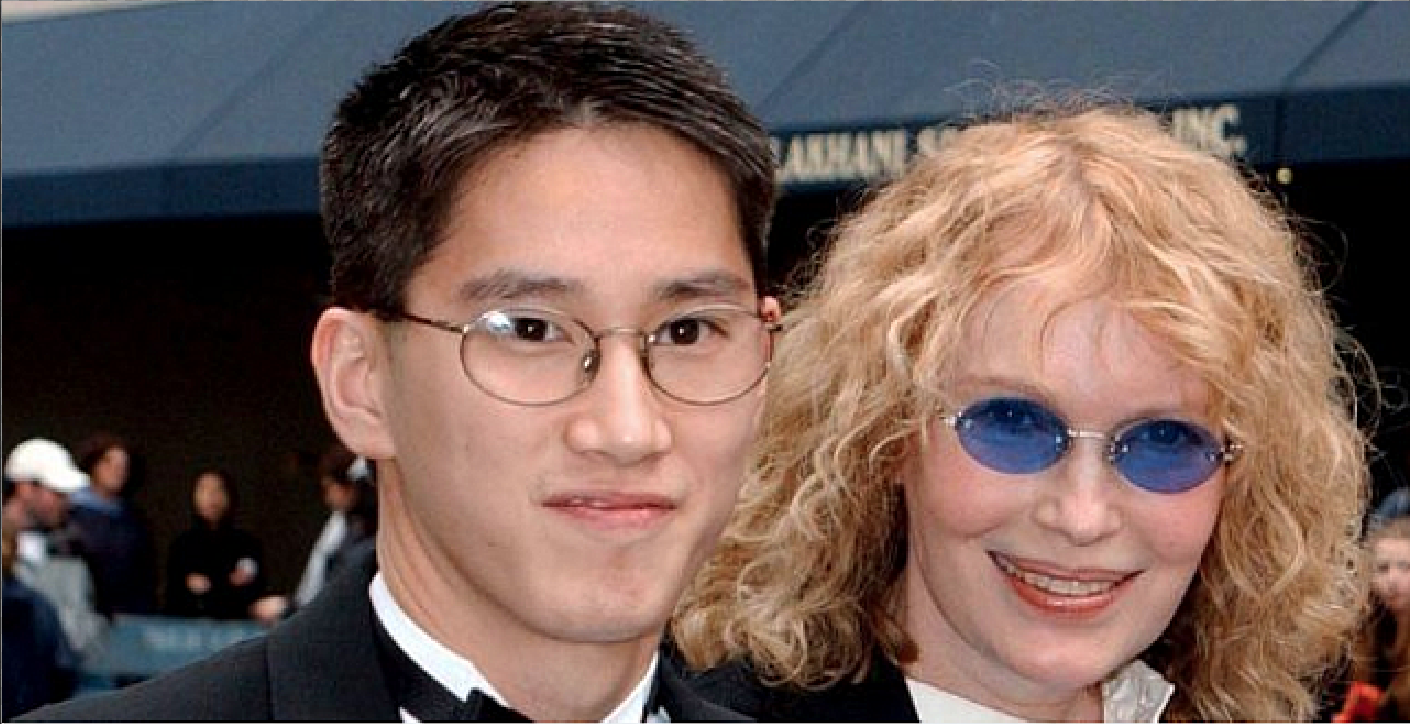
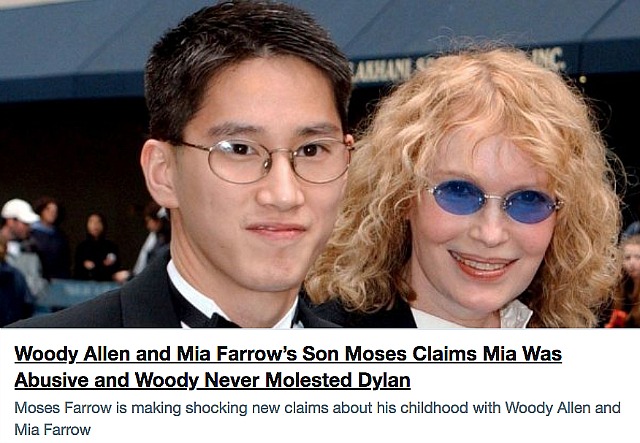
Even the semi-informed have known for some time that Moses Farrow, the adopted son of Woody Allen and Mia Farrow, has been dismissive of sister Dylan Farrow‘s claim about Woody having molested her in August 1992, and also disparaging of Mia for having been a highly intimidating control freak when he and his siblings were young.

Today Moses reiterated these views in a self-published essay titled “A Son Speaks Out.” He again questioned Dylan, defended his father, and claimed his mother was abusive towards him and his siblings.

Near the end of Moses’ essay: “To those who have become convinced of my father’s guilt, I ask you to consider this: In this time of #MeToo, when so many movie heavyweights have faced dozens of accusations, my father has been accused of wrongdoing only once, by an enraged ex-partner during contentious custody negotiations. During almost 60 years in the public eye, not one other person has come forward to accuse him of even behaving badly on a date, or acting inappropriately in any professional situation, let alone molesting a child.

“As a trained professional, I know that child molestation is a compulsive sickness and deviation that demands repetition. Dylan was alone with Woody in his apartment countless times over the years without a hint of impropriety, yet some would have you believe that at the age of 56, he suddenly decided to become a child molester in a house full of hostile people ordered to watch him like a hawk.

“To the actors who have worked with my father and have voiced regret for doing so: You have rushed to join the chorus of condemnation based on a discredited accusation for fear of not being on the ‘right’ side of a major social movement.” Are you listening, Timothy Chalamet and Greta Gerwig?

“But rather than accept the hysteria of Twitter mobs, mindlessly repeating a story examined and discredited 25 years ago, please consider what I have to say. After all, I was there — in the house, in the room — and I know both my father and mother and what each is capable of a whole lot better than you.”

Dylan has called the essay “an attempt to deflect from a credible allegation made by an adult woman, by trying to impugn my mother who has only ever been supportive of me and my siblings.”

Abdominal Snowman

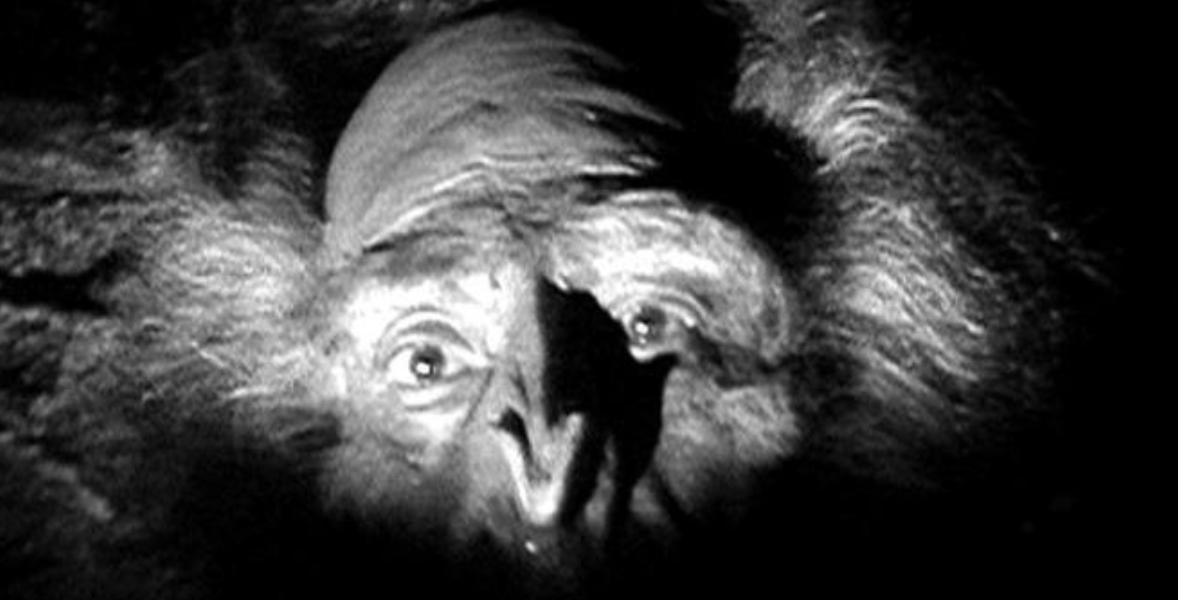
Trailers for ’50s monster movies often used hyperbole and sensationalism, but even by these standards the trailer for The Abominable Snowman of the Himalayas, a 1957 Hammer horror film, was comically over-the-top. The narration and especially the narrator’s style of delivery are so purple it’s hard to imagine that the marketing team was attempting a sincere sell. I’ve never seen the actual film, but apparently it wasn’t that bad. Director Val Guest came from comedy, but he also directed the highly respectable The Day The Earth Caught Fire. Wiki page excerpt: “Guest felt that the Yeti should be kept largely offscreen, bar a few glimpses of hands and arms, leaving the rest to the audience’s imagination [whereas screenwriter] Nigel Kneale felt that the creatures should be shown in their entirety to get across the message of the script that the Yeti are harmless, gentle creatures.”

Instant Haunting Classic

Worth repeating: John Krasinski‘s A Quiet Place, Robert EggersThe Witch, Jennifer Kent‘s The Babadook, Andy Muschietti‘s Mama and now Ari Aster‘s Hereditary.

Aster’s low-budgeter, which starts out in a sensible, unforced fashion before flipping the crazy switch around the halfway mark and going totally bonkers (and I mean that in the best way imaginable), is quite the brilliant horror-thriller. You can tell right away it’s operating on a far less conventional, far more original level of craft and exposition than a typical horror flick, or even an above-average one.

The best portions recall the classic chops of early Roman Polanski (particularly Repulsion and Rosemary’s Baby) as well as Jack Clayton‘s The Innocents, but I was just as impressed by the performances — three, to be precise — as the shock-and-creep moments, and that’s saying something for a ghost film.


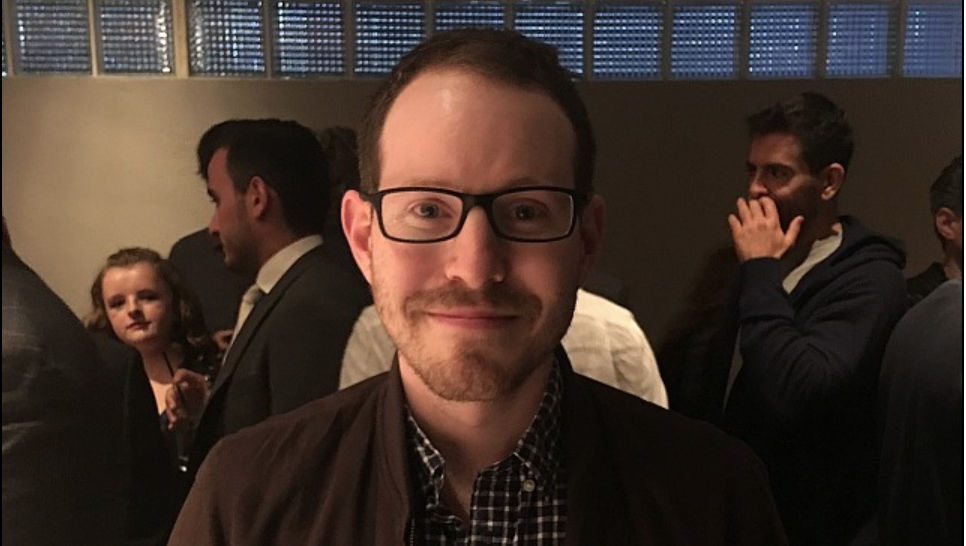
Hereditary director-writer Ari Aster during last night’s post-screening party at Neuehouse.
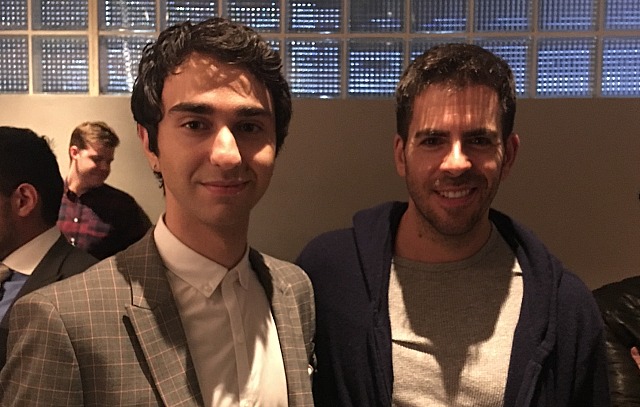
Hereditary costar Alex Wolff, director Eli Roth.

Hereditary begins as a suburban-milieu film about a family of five that’s just become a unit of four. Odd flickerings of weirdness begin to manifest, but nothing you can point your figure at. And then the number drops to three, and then the spooky-weird stuff kicks in a bit more. And then it goes over the fucking cliff.

The film is carried aloft and fused together by Toni Collette‘s grief-struck mom, Annie. It may be Collette’s most out-there performance ever. It’s certainly her most boundary-shattering in terms of connecting with the absolute blackest of currents. Collette convinces you that her character isn’t suffering a psychotic breakdown of sorts, that she’s going through her torments because it’s all 100% real, and at the same time allows you to consider that she has gone around the bend. Or that we may be watching a metaphor for the tortures of grief-driven insanity.

As the narrative advances Annie becomes more and more nutso, but relatably so. That’s quite the acting trick.

Nearly as effective is Alex Wolff as Peter, Collette’s guilt-crippled teenage son, and Ann Dowd as Joan, a kindly and sympathetic woman who meets Collette at a grief-therapy group. Gabriel Byrne is a little morose as Steve, Annie’s husband. The curiously featured Milly Shapiro is fine as Charlie — Peter’s younger sister, Annie and Steve’s daughter.

Read more

Greatest All-Time Movie Poster?

Poster designer Bill Gold, who passed yesterday at age 97, began in the advertising department of Warner Bros. The year was 1941, when Gold was only 20, and yet his Wikipage says he designed the poster art for Yankee Doodle Dandy and Casablanca, which both opened in ’42. I don’t know who was running WB’s poster design department back then, but some older person was. I’m not throwing shade, but how likely is it that a fresh-faced 21 year-old, straight out of Pratt Institute, was the sole poster designer for two major WB releases, one of which won the Best Picture Oscar?

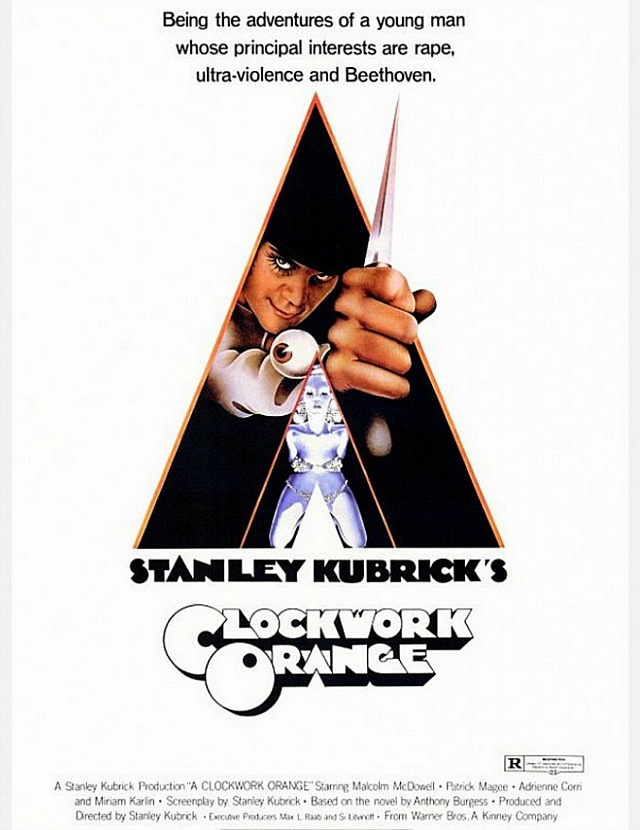
Gold was the art and concept guy for dozens of classic movie posters, but the Clockwork Orange poster, which he partially designed at age 50 or 51, was arguably his best. (The primary designer was Philip Castle.) Look at it — it doesn’t project lewd or grotesque vibes, but it almost makes the vague notion of ultra-violence and the old in-out, in-out by way of Alex DeLarge and his deplorable droogs seem almost delicious, like candy or ice-cream. Or at the very least slick and stylish, like album-jacket art for a cool band. I would argue that the Clockwork Orange poster is the greatest of all time. It’s perfect. One glance and there’s no forgetting it.

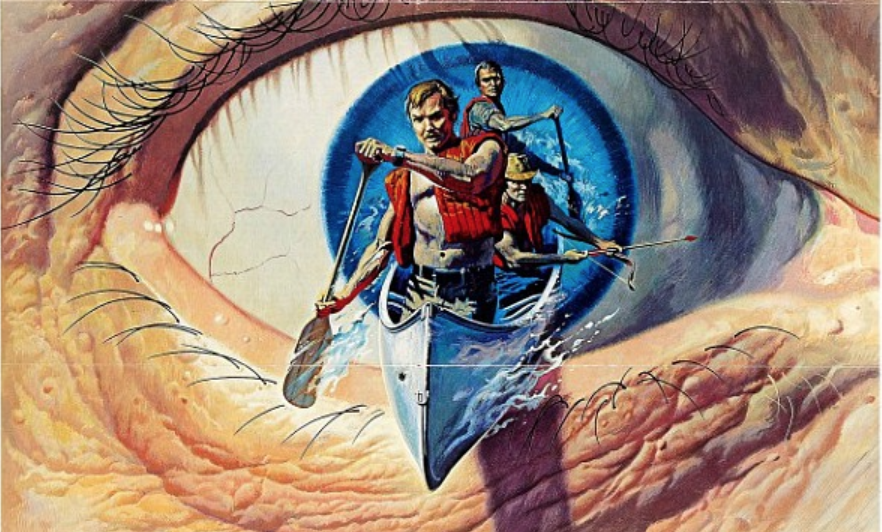
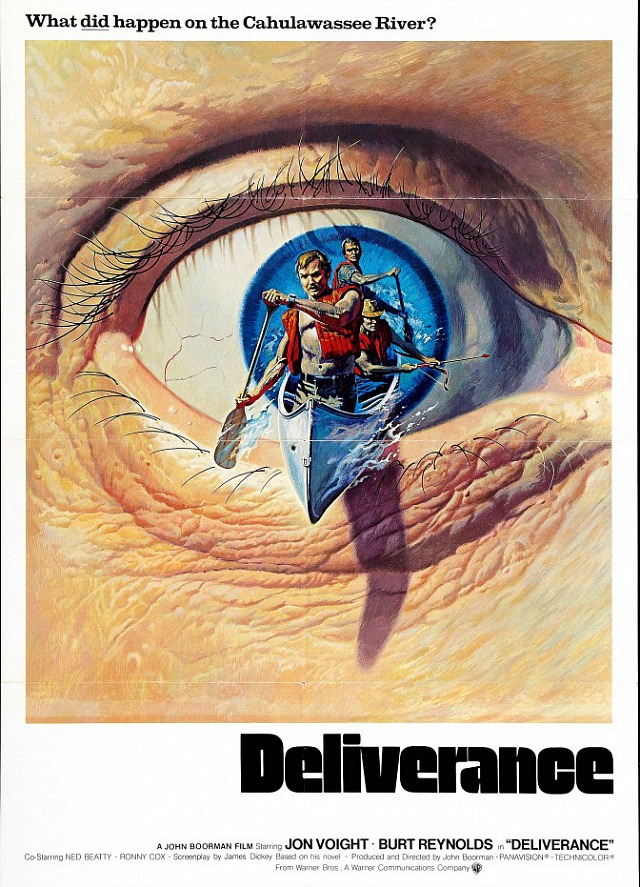
And yet Gold’s trippy one-sheet for John Boorman‘s Deliverance may be the most creatively mis-designed poster for a major studio release that I’ve ever seen. It suggests that what happened between Jon Voight, Burt Reynolds, Ned Beatty and Ronnie Cox on the fictional Cahulawassee River was a matter of individual interpretation or conjecture. Canoe-paddling out of a big eye suggests some kind of surreal or imaginary fantasy, which Deliverance certainly isn’t. The events that occur are absolutely real start to finish, and so the poster lies. Before today I’d never even seen it. So Gold gets one demerit.

Read more

Right Here, Right Now

I’m coping with the usual post-Cannes, L.A.-blues syndrome. I missed last night’s 7:30 pm JFK flight, took a 9:40 pm flight instead. Two compassionate Jet Blue reps took pity and didn’t charge me a penalty. Tennessee Williams and the kindness of strangers.

Missing the 7:30 flight was 35% my fault, 65% the MTA’s.

I was underneath Penn Station on the A and D train platform. An A train with signs that said “JFK” and “Howard Beach” pulled in. It didn’t seem to be going southbound, but I was just fatigued enough to question my own sense of direction. (MTA subway-stop signage doesn’t always clarify which way trains are heading.) I asked a sharp-looking 20something woman, “Excuse me but is this train going to JFK?” Yes, she said. “Really?”

It didn’t seem right but I got on regardless. How could it not be JFK-bound with that signage?

Fake-out! It was a northbound train, headed for Harlem. How could the MTA do this? What kind of fiendish, diabolical minds, etc.? I lost about 15 or 17 minutes, all in. Call it 20. The result was that when I finally got to JFK, I missed the plane by a nosehair.