Celebrating Farts At A Baked-Beans Convention

Does it really matter in the greater scheme, much less to the Movie Godz sitting in the shadow of Mount Olympus, if a larger mass of lemmings jumped off the Avengers: Infinity War cliff, and thereby overshadowed the blindly devotional swan dive made by millions of said critters two and a half years ago on behalf of Star Wars: The Force Awakens? Obviously it does to certain parties who will profit in various ways, but somebody needs to say “okay, fine, enjoy the champagne, but what are you actually celebrating?” It was reported this morning that Infinity War‘s $258.2 million opening weekend topped Force Awakens‘ $247.9 million set in December 2015.

A Worthy Bluray For It

Graphic Sexuality Landmark in Mainstream Hollywood Drama,” posted on 6.6.16: They Shoot Horses, Don’t They? (’69) is certainly Sydney Pollack‘s darkest film, but also his finest and flintiest, one could argue. Released a year after his almost-as-interesting Castle Keep, Horses was Pollack’s first and last truly ballsy ‘take it or leave it…life sucks’ drama. It was also the first big dramatic breakout film for Jane Fonda.

“Three years later Pollack began his swoony Robert Redford partnership with Jeremiah Johnson (’72), The Way We Were (’73) and Three Days of the Condor (’75). These set the tone for the undeniably well-crafted Hollywood mainstream films that followed — The Yakuza, Bobby Deerfield, The Electric Horseman, Absence of Malice, Tootsie, Out of Africa.”

I lamented back then that Horses wasn’t streaming or on Bluray — there was only a 2004 MGM/UA DVD. Still no streaming as we speak, but a handsome Bluray popped last September. [Note: Apologies for missing the Bluray’s availability a few hours ago.)

Read more

Refreshments With Mr. Vitali

Two weeks hence Tony Zierra‘s Filmworker, a brilliant tale of the life and times of Leon Vitali, will open at Manhattan’s Metrograph, and then a week later at West L.A.’s Nuart. I’ve been insisting for months that this is an absolutely world-class doc, not to mention the best inside-the-beltway, what-it-was-really-like Stanley Kubrick doc ever made.

Yesterday I sat down with Vitali at a Starbucks in Culver City. We shot the shit for 40 minutes or so, the only problem being that we sat outside on a patio, and that meant contending with the rumble of L.A. traffic — cars, trucks, ambulances, fire engines — not to mention a Starbucks cleaning person who kept generating that awful “aaahhhggg!” sound when you drag metal tables and chairs across concrete. So it might be a bit of a struggle to listen to our chat, but by all means have a go.

Leon Vitali, former actor (Barry Lyndon, Eyes Wide Shut), longtime Stanley Kubrick assistant, Warner Bros. visual consultant and star of Filmworker (Kino Lorber, 5.11).

Given the traffic noise and the difficulty in hearing each and every syllable, I asked Leon whatever came into my head, chatting more than interviewing really.

Vitali: “I did the color timing on the 2001: A Space Odyssey 4K Bluray, and 4K is so beautiful…the details, the shadows…looking at it on these very high resolution monitors. It looks great, everybody loves it, and I’m not blowing my own trumpet. HE: “What would you say is the difference between the forthcoming unrestored Chris Nolan version and the spiffed-up 4K Bluray?” Vitali: “The difference is that the 4K has more clarity and sharpness and detail.” HE: “So people seeing the Nolan version in Cannes will say, ‘This is wonderful…not as sharp or as clear as the 4K but it looks very good.'”

Sidenote: For some reason I developed an idea years ago, perhaps after speaking with Dan Richter, the guy who played the bone-tossing “Moonwtacher” in 2001, that the “Dawn of Man” sequence was shot early in the schedule. Vitali told me yesterday that it was actually the last thing to be shot.

HE: “Your voice has a softer quality right now, but there are passages in Filmworker in which it has that deep, resonant, gravelly sound…the kind of great-sounding voice that can only result from years and years of cigarette smoking. Are you smoking now?” Vitali: “Not as much. I’ve cut down. At my height with Stanley I was smoking three packs a day. Stanley [himself] would have one every now and then.”

HE: “I always loved the sound of Stanley’s voice. The timbre and the accent. The voice of a cultured, well-educated New York cab driver. A guy who grew up in the Bronx and knew all the angles.” Vitali: “He never lost that.”

HE: “The special groove of Filmworker for me, is that when you’ve found something that really matters to you…that for all practical and aesthetic purposes has become a source of profound satisfaction, as your work with Stanley became…for me it makes Filmworker such a sublime film, because it understands and conveys that special devotion.” Vitali: “I went to drama school [when young] and I met this guy who taught me how to harness a certain inner energy…it made me realize, once you really get into something, something that really seeps in and opens you up…you’re in there and it’s no contest…you know?”

Read more

Upping Her Game

Cinematographer Svetlana Cvetko, whom I’ve been referring to as “HE’s own” for several years, has become a bona fide hyphenate — a director-dp. After making the festival rounds last year with her doc short, Yours Sincerely, Lois Weber, she began directing a self-penned feature. Produced by Nick Sarkisov and shot in black-and-white widescreen (2.39:1), it’s called My Crazy Nature.

It’s about a menage a trois relationship between two guys and a girl. The portions I’ve seen (and the silky monochrome capturings are truly magnificent) reminded me at times of Francois Truffaut‘s Jules and Jim (’62) with a dash of Coline Serreau‘s Pourquois Pas? (’77).

Alas, Svetlana has had to recently interrupt this passion project (which has been filming locally as well as in Europe) to direct an indie-financed drama called Foreign Exchange, costarring Meet The ParentsTeri Polo and Niptuck‘s Dylan Walsh.

Svet’s dp credits, working backwards: Stuntwomen: The Untold Hollywood Story (post-production), Jonathan Parker‘s The Architect and several docs (including partial cinematography) — Silicon Cowboys, Brand: A Second Coming, Red Army, Inequality for All, Miss Representation and Inside Job.

Hex Me, Slam Me, Rough Me Up

Three months ago Hollywood Elsewhere saw the same sadistic Suspiria scene that director Luca Guadagnino screened earlier today at Cinemacon. The general reaction so far has been “whoa, that was intense.” Set in a rainy, chilly Berlin sometime in the ’70s, the scene happens inside a prestigious dance academy. Some kind of brutal hex decimates a middle-aged woman, apparently because she’s seen as an enemy of a witch’s coven that operates out of the dance school, and which is run by Tilda Swinton.

As a young American ballerina (Dakota Johnson) dances and twirls, the victim is slapped and pounded and walloped by some invisible voodoo-doll force.

I felt dazzled and jarred by this sequence. First rate, very well cut, etc. I was especially taken by a shadowy extreme close-up of a smiling witch face. I didn’t quite know what to do with the rainy Berlin atmosphere and especially all the sunlight that floods into the dance studio. Like everyone else on the planet, I associate horror with a dark, shadowy vibe — weird mood lighting, impressionistic designs, hints of blood and organs, a generally creepy feeling. This didn’t look like horror — it looked like matter-of-fact realism.

What I love about Guadagnino’s I Am Love, A Bigger Splash and Call Me By Your Name is that they’re all “Luca” — they all convey that lulling, sensual, sun-dappled northern Italian atmosphere — a way of being, living, tasting, feeling, etc.

Suspiria is obviously a departure from this — primarily about Luca adapting and expanding upon his reactions to Argento’s 1977 classic, and then blending this with his own instincts and dreamscapes.

Before I saw the Suspiria clip I had somehow imagined that Luca might integrate his “signature” style into the Argento realm and produce a chilling but sensual northern Italian horror film. Scary but with that special Luca attitude and chemistry. Something along those lines.

What I saw and felt lacked that familiar elegance, that warmth, that “this is who I am and how I live my life” feeling. Which obviously makes sense, given the witches-and-bitches subject matter.

As I didn’t know the victim character but presumed she was in a position to threaten the coven, I could only watch her agony as she was thrown around and contorted and began vomiting yellow liquid.

I’m not saying it’s unwelcome to see Guadagnino operating in a horror realm and igniting his imagination with fresh impressions, but it didn’t feel familiar in that sensual “welcome to my world” way that I’ve come to associate with his manner/vision/style.

Read more

Mercury Peek

Live-wire concert footage from Bryan Singer and Dexter Fletcher‘s Bohemian Rhapsody (20th Century Fox, 11.2) was screened a while ago at Cinemacon. Rami Malek (who really doesn’t look much like the Parsi-descended, Zanzibar-born Freddie Mercury) was shown performing the title tune plus “We Are The Champions,” etc.

Neither Singer nor Fletcher made an appearance, which is weird. Tell me how Singer doesn’t end up with the lion’s share of credit. He directed…what, 85% if not 90% of the film before Fletcher took over?

No one’s ever doubted that Malek wouldn’t channel Mercury to everyone’s delight, particularly Queen fans. A Best Actor Oscar nomination seems achievable if not likely. The question, as I mentioned in a 4.17 thumbnail appraisal of an early draft of the Bohemian Rhapsody script, is whether or not the finished film will seem a little too “family friendly” and/or lacking a certain adult edge.

See How Pratt Is Tipping Into Fat?

HE approves of any and all musical tributes to classic American TV culture. Remember the sing-along bus-ride sequence in Planes, Trains and Automobiles? That aside, the first thing that pops is that “Peter Quill” looks like Alex Karras (i.e., “Mongo”) in Blazing Saddles, Aldo Ray‘s “Sgt. Muldoon” in The Green Berets or post-2012 Gerard Butler. And what’s the reaction to Chris Evanslate ’70s/early ’80s gay-clone look (flattop, moustache)?

Read more

Tunics Unbecoming

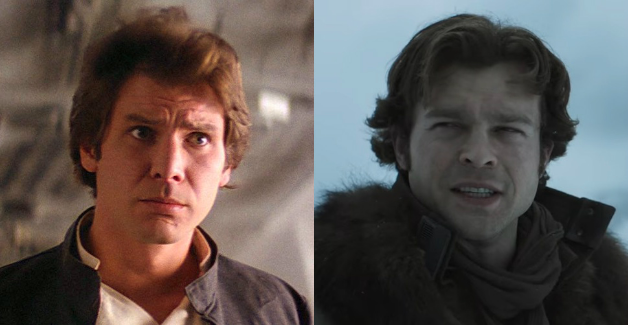
My first thought when I laid eyes upon that canary-yellow tunic worn by Solo‘s Lando Calrissian (i.e., Donald Glover) was that it’s…what, too flowery? Too lemon custard? Too Cliff Gorman from The Boys In the Band? I just don’t hold with dandelion shirts. And if that’s not enough of a dissuader, yellow Lando is way too close to William Shatner‘s yellow-mustard pullover that he wore during the first couple of Star Trek seasons. Even if you like the idea of Lando Calrissian channelling Paul Lynde on The Hollywood Squares, this kind of starship uniform was launched by Shatner and Gene Roddenberry. You can’t cross-pollinate between the Stars Wars and Star Trek universes! It’s just not done.

Read more

Pathetic Sock Embarassments

This photo of Boris Karloff and Bela Lugosi was taken, I’m guessing, right after the 1931 debuts of James Whale‘s Frankenstein and Tod Browning‘s Dracula, which put both middle-aged men on the map. (Born in 1887, Karloff was 44 when Frankenstein made him a star; Lugosi, born in 1882, was nearly 50 when Dracula premiered.) They were obviously at a formal gathering of some kind, but who wears gray socks with a tuxedo? I’m presuming that Karloff realized as he was dressing earlier that evening that his one lonely pair of black evening socks were being laundered — this in itself tells you his financial ship hadn’t yet come in. Lugosi’s sin is almost as bad — black evening socks that aren’t high enough or held up by leg garters, thereby revealing Lugosi’s bare calf. For men of that era, there were few sartorial failings worse than these.

Read more

Everyone’s Shilling For Cooper’s “Star Is Born”

Not sure when Warner Bros. decided to hold special celebrity screenings of Bradley Cooper‘s A Star Is Born (Warner Bros., 10.5), but I’m guessing sometime in early to mid March. All I know is that three big names — Barbra Streisand, Sean Penn and Robert De Niro — have spoken highly of it.

First it was Streisand (“Oh, I can’t say too much…I haven’t seen too much, but it’s good…it’s very, very good.”). Then Penn (“One of the most beautiful, fantastic, it’s the best, and most importantly commercial film I have seen in so many years”). And now De Niro, speaking during a Tribeca Film Festival discussion with Cooper (“It’s terrific and Bradley is excellent in it…the movie is wonderful…I hope it gets the attention I feel it should when it opens…Bradley learned to sing…he really worked hard and it paid off…you see all the hard work he did, it’s special”).

Hollywood Elsewhere to other celebrities who’ve seen it: We get it. You liked the film and you’re happy that Cooper’s debut effort turned out well — great. But that’ll do for now.

We Are, We Are Morons

In a 4.9 New Republic piece called “Will Hollywood Ever Make Another Children of Men?,” the answer is a simple “no.” Why? Because the apes have decided that theatres are CG funhouses, and that smarthouse, soul-stirring flicks are for streaming, and never the twain small meet.

The article is actually a chat between Alex Shepard and Wall Street Journal reporter Ben Fritz, author of “The Big Picture.” The book basically explains how it’s all turning to CG shit in theatres, but we’re actually in a golden age if you focus on non-theatrical.

Shepard: “2017 was an outstanding year for movies but it does seem like Oscar-bait movies are working on a smaller scale, for a smaller audience, in part because Hollywood has stopped investing in big budget Oscar-bait movies that aspire to a mass audience. In The Big Picture, you argue that three of my favorite recent movies — Michael Clayton, Captain Phillips and Children of Men — would have a much hard time getting made right now.”

Fritz: “That specialty market will certainly survive. If you live in a big enough city you’ll be able to see the next Ladybird in a few years. But most people won’t. They’ll see it on streaming or whatever. And that will be fine. But Children of Men, that’s a great example. I don’t know what it’s budget was — $80 million maybe. It’s not cheap to make that film. You’re making a film that’s really worth seeing on a big screen.

“But there’s no Children of Men cinematic universe. There’s no franchising. There are no tie-ins. There are no sequel possibilities. That’s a one-off film and that’s the type of thing that won’t get made anymore. It’s also the kind of thing that’s tough to replicate for a streaming service. It’s the kind of movie we’re losing and that’s a bummer.”

Bummer? For those of us who’ve been watching aspirational, high-craft, spiritual-deliverance movies in theatres for the last 30 or 40 years, this is a major cultural tragedy. It’s enough to make you think about getting into opioids, brah.

In an 11.20.06 HE piece called “Children = Guernica,” I wrote the following:

“Many critics were impressed by Children of Men‘s virtuosity and bravado,” writes Hollywood Reporter/Risky Biz blogger columnist Anne Thompson, “while industry types were seeing a downer film that’s going to lose money.

“The movie is a brilliant exercise in style, but it’s another grim dystopian look at our future — like Blade Runner or Fahrenheit 451 — that simply cost too much money.”

Read more

Criterion’s Teal-Tint Insanity

Last night I read some Bluray.com comments along with a review that made me gasp. Actually they made me fall out of my chair. The thread was about Criterion’s curiously re-colored, teal-tinted Midnight Cowboy Bluray (5.29), which I wrote about a couple of days ago.

The Criterion jacket says that the Midnight Cowboy Bluray is a “new 4K digital restoration, approved by cinematographer Adam Holender.”

To go by recently posted comparison shots, this is easily Criterion’s biggest Bluray boondoggle** since the Dressed To Kill calamity of 2016, when Criterion went along with Brian DePalma‘s request that the images be narrowed (i.e., horizontally compressed) and the colors tinted yellow-green without much of a black layer. Criterion gradually admitted to error and released a corrected disc.


Natural-looking capture from 2012 MGM Bluray.

Same shot rendered by Criterion’s “teal team.”

Many times I’ve gazed upon the green Atlantic Ocean while basking in the hot-sand warmth of Miami Beach.

In a 4.15 review, Bluray.com’s Dr. Svet Atanasov refuses to even acknowledge the teal-tint issue, which automatically makes you wonder what he’s up to. “The color palette [of Criterion’s Midnight Cowboy Bluray] is a lot more convincing,” he writes. “On the old release [the 2012 MGM Bluray] some of the primaries were not as stable and well saturated as they should have been and now the new 4K restoration makes this painfully obvious.”

What the hell is Atanasov talking about, “not as well saturated”? I own the six-year-old MGM Bluray and it’s totally fine, and it doesn’t have any space-alien tinting.

Please read this thread. It includes a few fair-minded, sensible-sounding remarks, but also comments from some real lunatics.

One of the latter is a guy who calls himself “RCRochester.” In a remarks about contrasting shots (Criterion vs. MGM) of a small-town Texas motel [see above], he claims that “the sky looks blue in both…it’s just that the Criterion cap looks brighter. The movie’s title in the same shot looks bright white, if the image was ‘tealed’ I would expect that to have a bluish tint to it as well.” The man has gone over the waterfall in a barrel — he actually maintains that the sky in the Criterion image is blue when it’s obviously an eerily bright blue-green.

A looney-tune named “The Green Owl” exclaims that “the screenshots look great to my eyes,” and that he’s ordering the Criterion as a result.

A guy named “Markgway” doesn’t like what he sees, but says he might go along regardless. “Unless someone can say for sure that the film was meant to look teal, I’m going to assume something is awry,” he says. “It happens too many times that older films are remastered to a modern grading standard and wind up looking suspiciously different to the way they had before.”

Read more