Gun Goes Off Tomorrow

The excitement at the start of any Cannes Film Festival is always tingly, and this year is no exception. The La Pizza press gathering was full of that fizzy stuff. I’ll be dutifully attending Wednesday’s 10 am press screening of Arnaud Depleschin‘s Ismael’s Ghosts, the opening-night attraction. But the real hummer, at least in terms of expectations, is Andrey Zvyagintsev‘s Loveless, which screens for journos at 7:30 pm in the Salle Debussy.

The Depleschin flick, which costars Mathieu Amalric, Marion Cotillard, Charlotte Gainsbourg and Louis Garrel, is about a director (Amalric) whose life is complicated by the return of a former lover (Cotillard) just as he’s about to begin shooting a new film. Zyyagintsev’s film focuses on a bickering married couple, verging on divorce, whose son disappears after one of their fights. They try to put their differences aside as they search for him.

Here I am still filing at 2:30 am. I could’ve crashed hours ago, but I had to put stuff up.


La Pizza table #1 (clockwise from left): Guardian/Vanity Fair critic & contributor Jordan Hoffman, Indiewire critic David Ehrlich, Variety critic Owen Gleiberman, Indiewire editor/columnist Anne Thompson (half-obscured), First Showing‘s Alex Billington, Film Society of Lincoln Center deputy director Eugene Hernandez, critic Tomris Laffly (Film Journal, Time Out New York, Vulture), [standing] TheWrap‘s Ben Croal, Indiewire‘s Eric Kohn, Vulture‘s Kyle Buchanan (left profile, half obscured), New York/Vulture‘s Jada Yuan, Screen Daily‘s Tim Grierson, Washington Post critic Ann Hornaday, Vanity Fair‘s Rebeca Keegan.
 

La Pizza table #2 (clockwise from left): Film School Rejects Matt Hoffman, WeLiveEntertainment’s Tanner Stechnij, Time critic Stephanie Zacharek, L.A. Times critic Justin Chang, Toronto Star critic Peter Howell, Maclean‘s Brian Johnson, David Scott Smith (obscured), Svetlana Cvetko (profile, staring at table), Alia Salazar, Michelle Foster of Loyola University.
 

Read more

Never Let The Audience Think About Budget

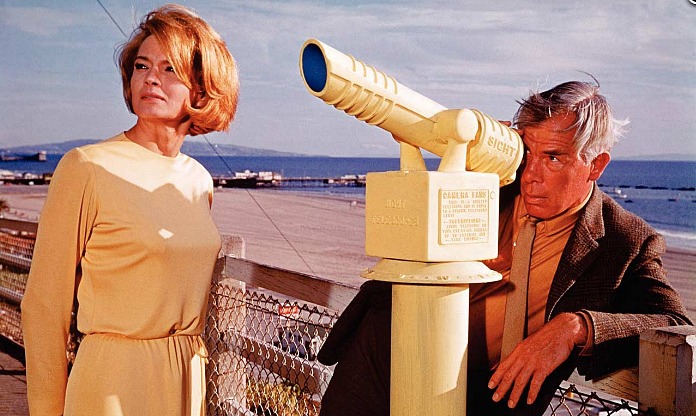
Two scenes dissipate John Frankenheimer‘s Seven Days in May (’64), an otherwise gripping thriller about an attempted military takeover of the U.S. One of them is fairly ludicrous in its action plotting, and both take your attention away from the story by suggesting that the film was made for a modest sum — something an audience should never be allowed to contemplate.


(l. to r.) George Macready, Edmond O’Brien and Fredric March in a second-act scene from John Frankenheimer’s Seven Days in May.

#1: President Jordan Lyman (Fredric March) and a team of anti-conspiracy allies are watching filmed footage of two Pentagon higher-ups (including John Larkin‘s Col. Broderick, a close confidante of Burt Lancaster‘s General James Mattoon Scott) spying on the President’s vacation home from a rowboat. Someone notes that the conspirators must be small in number or else why would Broderick, a Pentagon bigwig, be engaged in routine surveillance work? And it hits you that this whole menacing conspiracy is a small-scale affair. Just six or seven middle-aged men on either side, playing for opposing teams. The film needed a scene or two demonstrating the overwhelming military power that the bad guys had at the ready. Jets, tanks, warships, armed battalions.

#2: A nighttime scene at a secret New Mexico air base (“Site Y”) being used by the bad guys shows Colonel William Henderson (Andrew Duggan) escaping with Senator Ray Clark (Edmond O’Brien) in an open-top military tank. Henderson rifle-butts a soldier and guns the tank over a sand dune and into the night. And nobody chases after them? Site Y security chiefs presumably have all kinds of jeeps and helicopters at their disposal, and they can’t catch a tank driving through the desert at 35 or 40 mph? Broderick and O’Brien should’ve escaped in a chopper. That I would half-buy.

Read more

Passing of Powers Boothe

The ghost of Powers Boothe is reading Lawrence Yee’s Variety obit and quietly seething. For Yee’s opening sentence describes Boothe as “a character actor.” Not “the renowned, ruggedly handsome, Emmy Award-winning actor known for his gruff, steely machismo” but “a” character actor. What Yee means is that Boothe’s peak period in the early to mid ’80s doesn’t mean that much, at least to him. But it does, or did, to those who were around and alert during the early Reagan years.

When Tom Cruise dies do you think Variety will describe him as “an” actor? The indignity! For once upon a time Powers Boothe was a brand, a force and a presence that was valued by top-rank directors.

His performance as demonic cult leader Jim Jones in Guyana Tragedy: The Story of Jim Jones was easily the best thing Boothe ever did. Boothe won an Emmy for best lead actor in a limited series. The four-hour, two-part TV movie aired on CBS in April 1980. I haven’t rewatched it since but I would right now if it was streaming, but it’s only on DVD.

Boothe’s movie heyday boiled down to three films that followed Guyana TragedyWalter Hill‘s Southern Comfort (’81), John Milius‘s Red Dawn (’84) and John Boorman‘s The Emerald Forest (’85). For a while it seemed as if the Texas-born, conservative-leaning actor might become an Eastwood-like figure. Or at least a regular leading guy.

Read more

More Cannes Spitballing

Indiewire‘s Anne Thompson and Eric Kohn (who’s now in Paris, staying in some baroque Left Bank hotel that hangs animal portraits on the walls) discuss the 2017 Cannes Film Festival. Things start three days from now (i.e., Wednesday, 5.17). Almost every Paris-based journalist and layover will be on Tuesday’s 7:19 am train from Gare de Lyon. I’m terrified about sleeping through and missing it.

Thompson compares staying “with a bunch of guys” in Indiewire‘s Cannes crash pad to Snow White and the Seven Dwarfs. There’s a mention of Tuesday’s La Pizza gathering. They’re hot for Michael Haneke‘s Happy End and Todd HaynesWonderstruck, but who isn’t? They sound excited but, in my view, not excited enough about Andrey Zvyagintsev‘s Loveless. Thompson is hearing “good things” about Michel HazanaviciusThe Redoubtable, the ’60s-era Jean Luc Godard love story. They discuss the festival’s decision to turn a cold shoulder to Netflix movies starting next year. They mention the incessant partying, drinking and hobnobbing, but the only thing that matters during the Cannes Film Festival is the filing.

Things get interesting when Kohn trashes Naomi Kawase, noting that “the only time you ever hear about her” is during the festival, “which is a little peculiar.” And then Thompson, stepping out of her amiable safe zone, dismisses Taylor Sheridan‘s Wild River, which is playing under Un Certain Regard, in part because it’s “the only Weinstein film” and is “opening in August.”

Read more

Walk Like A Tourist

HE’s own Svetlana Cvetko and David Scott Smith invited me to join them early Saturday evening at the Louvre. A connected friend of Svet’s escorted us inside to a restricted-access tour of the Egyptian exhibit. I had never before wandered through this world-renowned museum as an invitation-only cool cat. No crowds or lines to cope with. The Egyptian statues, sarcophagi, relics and artifacts were nothing to sneeze at either. The highlight was the 4000 year-old chapel of the tomb (or “mastaba”) of Akhethotep, a bigwig in the Old Kingdom who was close to the king. (Egyptian rulers weren’t called pharaohs until the New Kingdom.)


Svetlana Cvetko, David Scott Smith at Louvre cafe — Saturday, 5.13, 7:50 pm.

Read more

Where’s The Rest Of Me?

Last week I settled in with Don Siegel‘s The Beguiled (’71), which I’d seen in portions but never all in one session. This was necessary homework prior to the Cannes Film Festival showing of Sofia Coppola’s remake, which Focus Features will open stateside on 6.23. I’m presuming every Cannes-bound critic has done (or is doing) the same.

Honestly? I didn’t like it all that much. I was mildly intrigued by the perverse tangle of it all (repressed libidos, subtle hostilities, shifting alliances) but I didn’t care about the story or the characters, least of all Clint Eastwood‘s somewhat creepy Union army corporal. He’s mostly focused on which of the seminary women he wants to fool around with, except he’s indecisive or even lackadaisical about it, and after a while I was wondering “what does he want to do, fuck all of them?” Not to mention thoughtless. These women are giving him care and comfort, and all he can think about is Mr. Happy.

The seminary students and their headmistress, played by Geraldine Page, are all eccentric in one way or another, beset by erotic curiosity or stifled longing, but they’re so constricted and corseted that it all turns demented before long, and certainly by the final act. I just didn’t care for their company. After a while I just wanted to get the hell out of there.

Then I began to fantasize about the Union cavalry brigade from John Ford‘s The Horse Soldiers dropping by and saving Eastwood from himself. I wanted to see muddy John Wayne stride into that Confederate mansion and tell Eastwood to snap to attention and report for duty, or at least put him under the care of William Holden‘s Maj. Henry Kendall.

Read more

Made In The Shade

HE’s temporary base is on the third floor at 40 rue de Saintonge. The lively Rue de Bretagne, a few meters to the south, is teeming with locals (tourists are apparently forbidden) and full of the usual bars, cafes, bikes, scooters, patisseries, boucheries, clothing shops and an apparently permanent encampment of outdoor stalls selling the usual bric a brac. I guess I could be mistaken for a tourist as I seemed to be the only one taking snaps. But I’m not a tourist and never have been. I’m a traveller, a nomad, a free soul on the prowl.


Read more

Going Pink

The new poster for Sofia Coppola‘s The Beguiled (Focus Features, 6.23) seems to convey a certain agenda. As you might expect, Don Siegel‘s 1971 version of the same Civil War-era tale regarded Clint Eastwood‘s Union soldier character (i.e., Corporal John McBurney) with a faint measure of allegiance, and depicted his fate at the hands of the Southern women (Geraldine Page, Elizabeth Hartman, Jo Ann Harris) as an unwarranted mutilation, however much Eastwood’s character may have tempted fate by being a scamp. Coppola’s version, which I won’t see until it plays at the Cannes Film Festival, is presumably more condemning of McBurney, played this time by Colin Farrell. The pink lettering pretty much says it all. The Beguiled is a movie for girls, and particularly those with no tolerance for caddish guys who fuck around at will.

Read more

Richly Rewarding “Trip” Is “Not For Dead Fans”

Yesterday I had a brief chat with Amir Bar-Lev, the highly respected director of My Kid Could Paint That, Trouble the Water, The Tillman Story, Happy Valley and, most triumphantly, Long Strange Trip (Amazon, 5.25). I’m a huge fan of this 241-minute doc, which more than justifies its length and winds up really bringing it during the second half. I went in as a marginal Grateful Dead fan and came out the other end as something of a devotee.

I’m sorry I won’t be in the States when Long Strange Trip has a one-night-only nationwide premiere on 5.25, but I’ll definitely be snagging the three-disc soundtrack CD. Amazon wil begin streaming the doc in 220 countries beginning on 6.2. Here, again, is the mp3. Here are some ABR excerpts from our discussion:


Long Strange Trip director Amir Bar-lev — Tuesday, 5.9, 12:35 pm.

Excerpt #1: “The film is not for fans…it’s for people who are not Dead fans. It’s meant to serve as a kind of marriage counselor between people who loved the band and people who never got them. Very few people are indifferent…this film is meant for people who never really understood the whole thing.”

Excerpt #2: “I’m not ready to start another film now. I’m tired. This one took a lot out of me. I remember being asked ‘if you could make any film, what would it be?’ And I said ‘I’ve just made it. This is the film I’m really the most proud of.'”

Excerpt #3: “The original idea was to make a 90-minute doc that would come out on the 50th anniversary of the start of the Grateful Dead‘s beginning, or two years ago. Everything doubled…the length, the budget, everything. It was meant to be a theatrical film, and then I couldn’t cut it down. I couldn’t cut it down. We fine-cut out way through it from the beginning, and [then] we had a working cut that was two hours long, which took the story up to 1974.”

HE review excerpt: “This is a first-rate chronicle of a great, historic American band. Don’t let the four-hour running time stop you because this time the length fits the scale of the tale. It’s one sprawling, Olympian, deeply-dug-into achievement, largely because it focuses on the story instead of the historical bullet points, and because it takes the time to explain the appeal of Grateful Dead music and the whole Deadhead ’80s culture thing, which I paid no attention to when it was happening.

“The first half is a good, comprehensive mid-to-late-’60s history lesson — efficient, amusing, well-honed and sometimes great. But Act Two (or the last two hours) really brings it home. This is where the heart is, what turned the light on — the thing that told me what Amir Bar-Lev is really up to.”

Sense of Direction, No Urgency

I wrote for two or three hours this morning (i.e., the Sgt. Pepper piece, half the action flick piece), did my interview with Long Strange Trip director Amir Bar Lev at the Smyth Hotel (Church and Chambers). I lunched with Jett in eastern Chinatown, and then roamed around a bit, looking for the right cafe or a Starbucks to settle into. I went to Will Leather Goods on Prince Street and asked them to repair my black leather computer bag. (They never charge for repairs — always stand by their stuff.) I eventually parked it at a Starbucks on Spring and Crosby. This evening I’ll be seeing Obit at the Film Forum.


Read more

What’s Changed Over Last Four Years?

Best Action Flicks of the 21st Century” was posted on 5.9.17. What if anything has changed in the action realm in the four years since?

To most people “action film” means violent, whoop-ass shit with lots of leaping around, automatic rifle fire, squealing tires and non-stop adrenalin. But when it comes to deciding on the best action films, most viewers aren’t that demanding. They love their jizz-whiz and don’t care about the shadings and subtleties. But I am demanding, you see. To really love an action film I have to believe that (a) what I’m watching bears at least some relation to human behavior as most of us have come to know it and is therefore delivering a semi-believable, well-motivated thing, and (b) what I’m watching could actually happen in the real-deal world of physics (i.e., no idiotic swan dives off 50-story office buildings).

I don’t care, by the way, if the action content in a film takes up the first 10 minutes or the last half-hour or the whole damn running time. All I care about is whether or not I believe what I’m seeing, or…you know, whether I’m distracted or dazzled enough so that I don’t pay attention to logic or realism factors. Whatever works. As long as action defines character and vice versa.

If I’m enjoying an action flick it’s because I fucking believe it, and I never believe anything that doesn’t respect some grown-up concept of reality. Fantasy flicks can blow me for the most part. I want an action movie that will plant its feet, look me in the eye and tell the fucking truth.

Very few 21st Century action films live up to HE’s rules and standards, or even give a damn about doing so. The Fast and Furious franchise is notorious for spitting in the face of reality. Almost all superhero comic-book movies revel in the fact that their realm allows them to ignore logic and believability. Once in a great while and in a very blue moon, a first-rate action flick will come along that defies HE rules but gets away with it. One of these was Ang Lee‘s Crouching Tiger, Hidden Dragon (’00), but that’s a very rare occurence. On the other hand Crouching Tiger led to the stars of Charlie’s Angels: Full Throttle flying around on wires, and that was an awful thing to behold.

Here are Hollywood Elsewhere’s choices for the 11 craftiest, best-made, most believable action films of the 21st Century, and in this order:

Read more

Don’t Ignore The Spiritual Awakening Aspect

A 50th anniversary edition of Sgt. Pepper’s Lonely Hearts Club Band will pop in early June — a six-disc, all-in, bells-and-whistles cash grab.

The selling point will be a a newly remastered stereo mix by Giles Martin and Sam Okell (a friend says it “sounds a bit more mono-ish” than previous editions). $117 and change. You can’t blame the keepers of the flame for trying to exploit the occasion, but no thanks. I’ve been all Pepper-ed out for longer than I’d care to acknowledge.


Expect a fresh torrent of looking-back assessments and tributes starting later this month. All will remind that Sgt. Pepper exerted a massive influence upon its time and realm, not just upon musicians and the music industry but the culture at large. I strongly suspect that a good portion and perhaps even a majority of these will ignore the psychedelic drug explosion that the album brought about. Those who do so will of course be ignoring the entire cultural earthquake that Sgt. Pepper incited, but that would be standard procedure for the corporate sector of 21st Century journalism.

Here’s an HE piece, posted in June ’07, about this very topic:

“Astonishingly and rather suddenly, beginning in June 1967 and continuing long after that, Sgt. Pepper’s Lonely Hearts Club Band persuaded a significant portion of America’s middle-class youths to throw out the basic rock ‘n’ roll rebel handbook and embark upon chemically-fortified, radiant-vision journeys of the mind and soul. This in turn led to a mass injection of satori/Godhead consciousness that literally upended liberal American society.

Read more