Little Did Hollywood Know

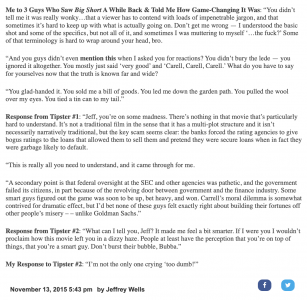
On the night that Unforgiven won the Best Picture Oscar, which happened on 3.29.93, none of us had the slightest inkling that roughly two decades into the 21st Century (or 30 years hence) corporate Hollywood would be operating under the adhere-or-die principles of China’s Great Cultural Revolution, and that films that reflected the creative vistas, mindsets and inclinations of the dudes who were pretty much running things back in the early Clinton era would be all but suffocated.

Which isn’t to say that the moral, administrative and attitudinal changes brought about by wokester commandants starting around five or six years ago (post-Moonlight and post George Floyd BLM-ers, LGBTQ-ers, #MeToo) didn’t transform the Hollywood industry into a much more fair, just and humane thing. They did.

These changes also ensured, however, that the kind of urgent, occasionally irreverent and sometimes super-bull’s-eye films that occasionally poked through between 1930 and 2015…those kind of films would, for the most part, never again be made for theatrical.

Because the Hollywood Maoist system (“Don’t offend Zoomers or Millennials!…don’t wink at or even acknowledge outmoded attitudes!…don’t allow any representations of the way life was on the planet earth before woke-ism came along…all casts must prominently feature women, actors of color and LGBTQs”) has largely outlawed this approach or aesthetic.

Read more

Vanity Fair’s Feinberg Headline is Dead Wrong

The wolves are circling and the hyenas are hee-hee-ing over yesterday’s Vanity Fair story, penned by Charlotte Klein, about THR columnist and executive awards editor Scott Feinberg allegedly asking for me-first screening access as far as hot film festival titles are concerned.

Let every Oscar pundit and chatterbox know, whether it wishes Feinberg well or ill, that the headline of Klein’s article is flat-out erroneous, and that the jackals looking to lick Feinberg’s blood are also dead wrong.

In an email to studios and strategists last week, Feinberg did not request “priority” access (as in “me before everyone else!”) to early-bird screenings. He asked for concurrent access along with the other swells. Not “me first!…me! me! me!” but “please allow me to see hot-buzz festival films at the same time as the elite trade critics and long-lead journos and editors.”

Feinberg didn’t say the following but he could have also put it this way: “Please don’t favor these guys and gals over me…the people who are routinely shown the hot-ticket films early and who have filed their reviews before the big premieres in Cannes or Telluride and Toronto…please let me into this elite fraternity…don’t give them preferential treatment over me as every second counts during film festivals, and it’s not fair to let a tiny handful of hotshot critics have the first crack while I have to scramble and hyperventilate and file reactions on the fly.”

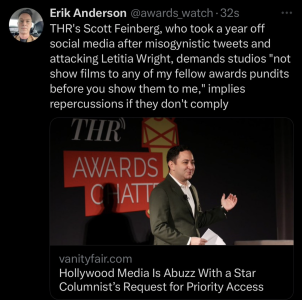
Again — the implication of Klein reporting that Feinberg “requested priority access to the hottest movies coming this year” is an obscuring of the truth. Asking for priority access doesn’t mean exclusive priority access. In some people’s minds the word suggests “me first” but that’s not what Feinberg wrote or meant.

Feinberg: “As you plan the rollout of your film(s), I would like to respectfully ask that you not show films to any of my fellow awards pundits before you show them to me, even if that person represents himself or herself to you as (a) a potential reviewer of it, (b) needing to see the film in order to be part of decisions about covers, or (c) really anything else.”

As for the portion of Feinberg’s email that implied a certain degree of THR pushback if publicists fail to consent to his request…well, that’s not what any experienced industry vet would call a capital crime. There isn’t a power player in Hollywood who hasn’t said at one time or another “do not fuck with me because if you do…well, actions have consequences.” I’m sorry but this falls under the heading of standard negotiating postures.

A publicity source confides that Feinberg has already sent a clarifying letter to the recipients of his original email, but if I were in his shoes I would plainly state that (a) the word “concurrent” was and is key to the original import, and (b) that he shouldn’t have implied any sort of quid pro quo retaliation if publicists failed to consent to his request.

We all make tactical or phrasing errors from time to time. Feinberg wasn’t wrong in the first place, but just to cover the bases I would apologize for the sabre-rattling and for temporarily overplaying his hand. Not a huge deal. This is merely a Twitter/X flurry.

I would also bicker with Erik Anderson’s claim about Feinberg having posted “misogynistic” tweets about Letitia Wright last November, which was more bullshit. Feinberg simply stated that Wright, who didn’t have a prayer of landing any kind of acting nomination for Wakanda Forever, had baggage due to allegedly promoting anti-vax messaging. Which she did.

Statement of values: There are few things more disgusting than Twitter/X predators ganging up on this or that person who has allegedly said or written or tweeted the wrong thing. You can hear the snarls and see the saliva-coated sabre teeth and feel the hot breath of pathetic pisshounds…”the genius of the crowd,” as Charles Bukowksi once wrote. I have never taken part in a mass pile-on, and if I have I’ve forgotten about it. Wokesters are great at this stuff, and I am completely proud to spit in their faces for this behavior.

Better Quality “Romper Stomper” Gang Fight Scene

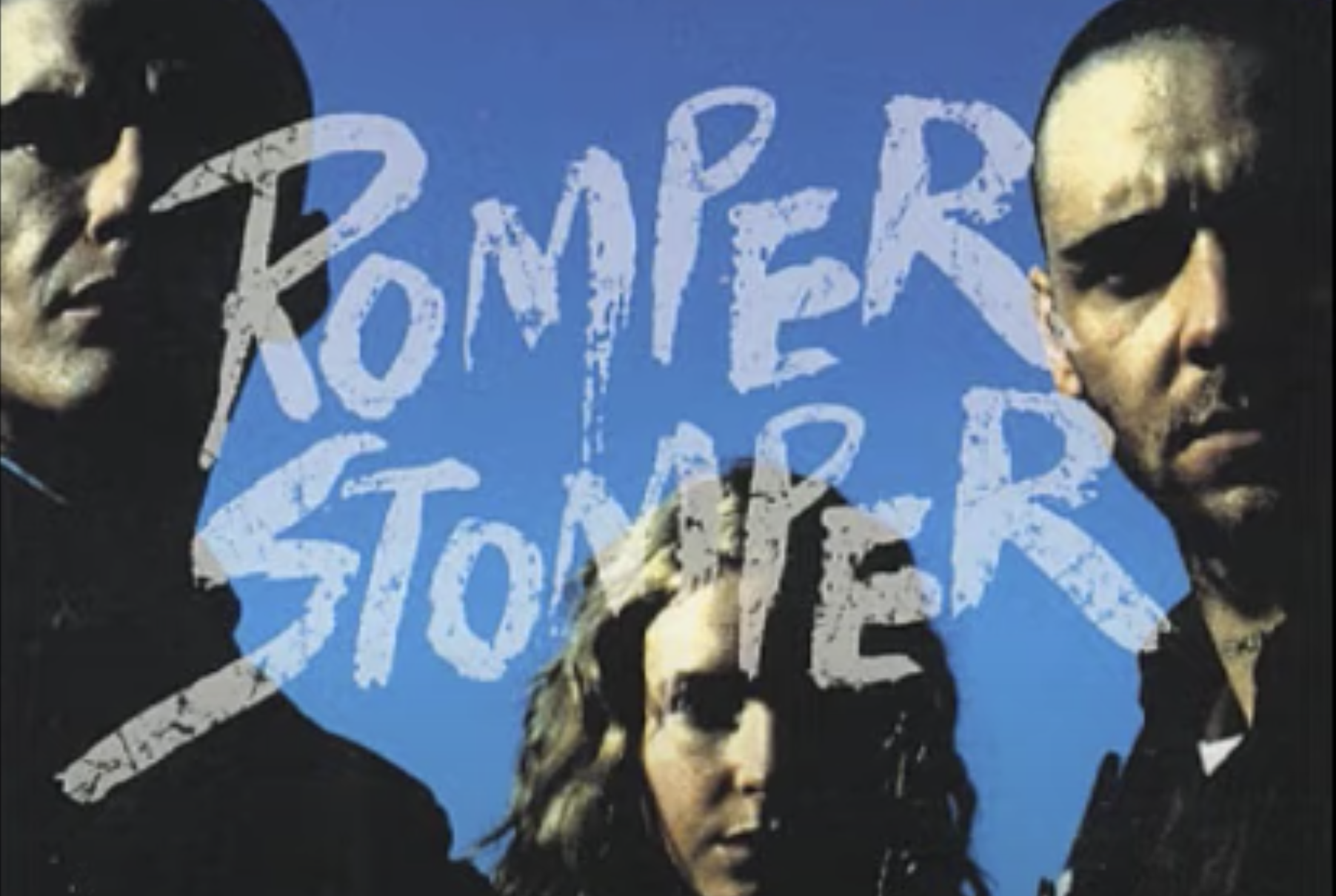
27 months ago I posted a six-and-a-half-minute version of the legendary gang fight sequence from Geoffrey Wright‘s Romper Stomper (’92), one of the most indelible, pared-to-the-bone, punch-kick-and-wallop flicks about hate groups ever made.

It starts with six or seven skinheads (led by an astonishingly young and slender Russell Crowe) beating up on three or four Vietnamese guys in a family-owned pub. But word gets out immediately, and a large mob of furious Vietnamese youths arrive and beat the living crap out of the skinheads. Hate in and hate out. Bad guys pay. Glorious!

Hashtags are well and good but, as Woody Allen said about Nazis in that MOMA-party scene in Manhattan, baseball bats really bring the point home.

I’ve just found a longer (15 minutes), much better looking version of the same sequence. It was posted 10 months ago by “Dunerat.”

Those who’ve never seen Romper Stomper are urged to do so.

Posted on 6.4.21:

One of the reasons Geoffrey Wright‘s Romper Stomper (’92) works as well as it does — an anti-racist, anti-skinhead film that isn’t afraid to dive right into the gang mind and pretend-revel in the fevered currents — is John Clifford White‘s score.

The main theme seems to simultaneously channel skinhead rage and, at the same time, deftly satirize it. I don’t know what kind of brass instruments White used on these tracks — tuba? trombone? — but the sound and mood are perfect. Just a clever instrumentation of a melodic hook and obviously less than complex, but once you’ve heard the theme you’ll never forget it.

No Remake Allowed

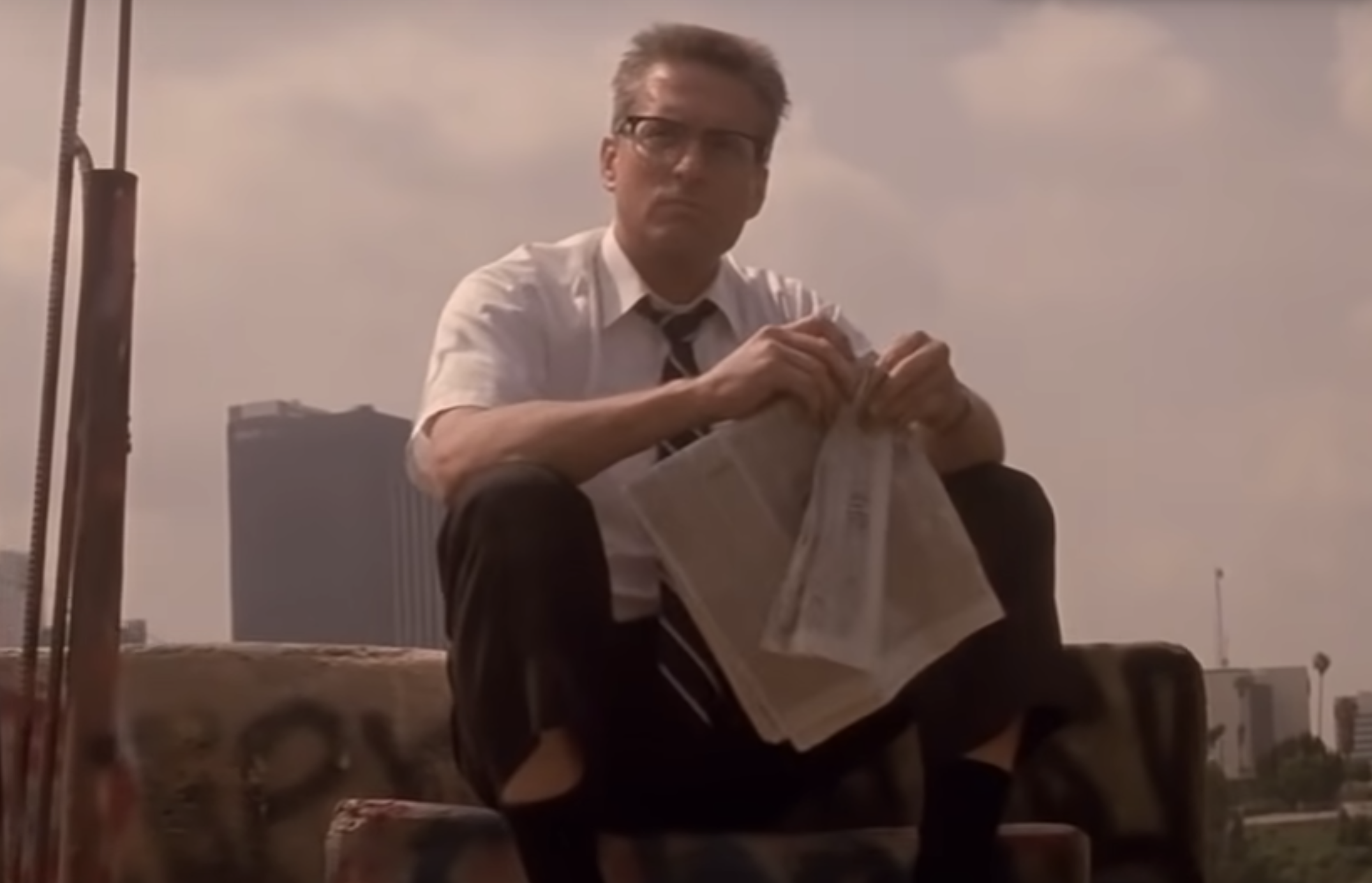
Joel Schumacher and Ebbe Roe Smith‘s Falling Down opened on 2.26.93 — 30 years and six months ago. No one would dare remake it today, but if someone did it would certainly be portrayed by the wokester congregation (all those who praised Women Talking and hated Empire of Llght) as a rightwing movie in the vein of Sound of Freedom.

Which means that apart from what the few truly independent-minded reviewers out there might say, no mainstream critics (i.e., the go-along-to-get-along types who represent the vast majority) wouldn’t be allowed to write anything praise-worthy. On top of which Clayton Davis would strongly disapprove.

Even if Son of Falling Down turned out to be good or half-decent or at least popcorn-worthy, it would nonetheless have trouble finding a distributor because the focus is too Joe Rogan or Daily Wire-ish…doesn’t follow the woke party lne. But if it found a distributor and managed to open theatrically, it would most likely become a word-of-mouth flick among MAGA types.

From Roger Ebert’s 2.26.93 review: “Some will even find it racist because the targets of the film’s hero are African American, Latino, and Korean…with a few Whites thrown in for balance. Both of these approaches represent a facile reading of the film, which is actually about a great sadness, which turns into madness, and which can afflict anyone who is told, after many years of hard work, that he is unnecessary and irrelevant.

“What is fascinating about the Michael Douglas character, as written and played, is the core of sadness in his soul. Yes, by the time we meet him, he has gone over the edge. But there is no exhilaration in his rampage, no release. He seems weary and confused, and in his actions he unconsciously follows scripts that he may have learned from the movies, or on the news, where other frustrated misfits vent their rage on innocent bystanders.”

I posted a shorter version of an HE Falling Down piece on 6.20.19.

Another crazy white guy movie that couldn’t be remade…forget it.

Hedren on Downslope

I was so disengaged during my one and only viewing of Charlie Chaplin’s A Countess From Hong Kong (‘67) that I can’t remember Tippi Hedren’s cameo performance as “Martha” — her first post-Hitchcock gig.

She had a more substantial role in The Harrad Experiment (‘73) as a married sex instructor, although her cool and somewhat icy manner in The Birds and especially Marnie made that kind of character a difficult sell. Her Harrad husband was played by James Whitmore…go figure.

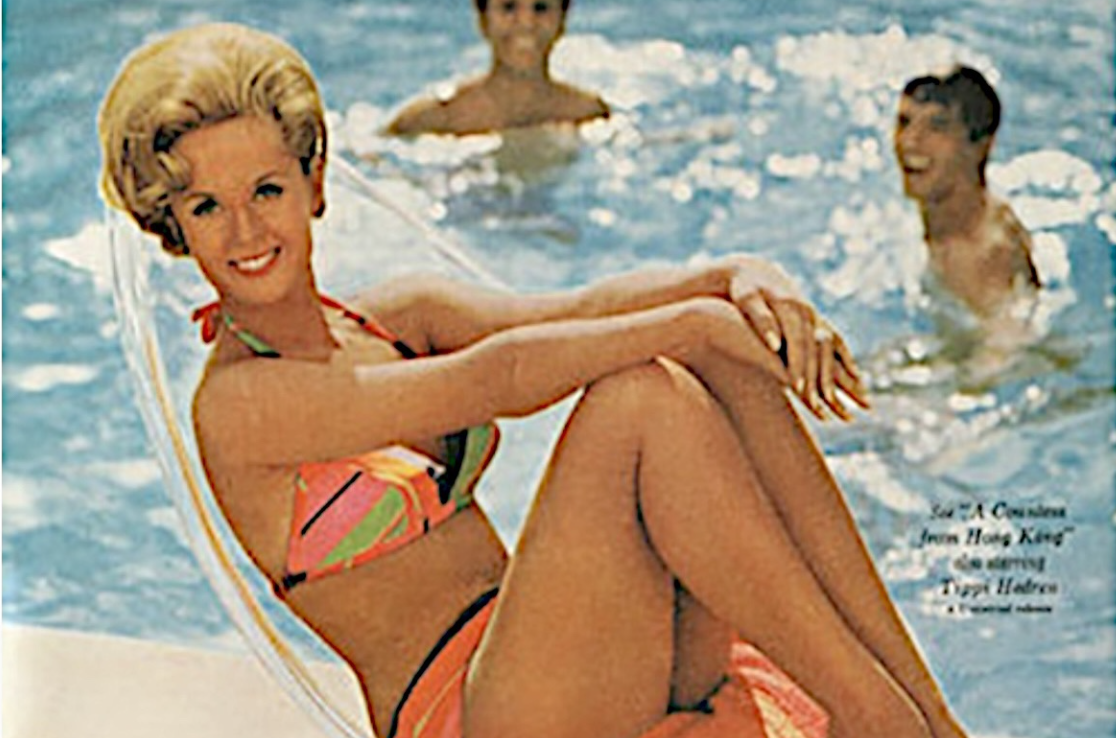
Speaking of icy I was surprised to come upon this Coppertone ad the other day. I honestly didn’t think the mid ‘60s Hedren, who began as a model, was capable of wearing a two-piece bathing suit, much less posing in one for a magazine ad. The frigid-chilly Marnie persona had really sunk in by that time.

I’m trying to think of another actress during that era who conveyed such anxiety or acute discomfort with any sort of erotic presence or expression. She was like a brittle nun of some kind, tense and guarded and buttoned up.

Helen Mirren vs. Ingrid Bergman

From Fionnuala Halligan‘s Screen Daily review of Golda (2.20.23):

“When an iconic actor portrays an iconic figure, the success or failure of the project tends to depend on the power of the performance blasting away the wigs and prosthetics. Helen Mirren achieves all that while playing Israeli politician Golda Meir. But, in Golda, director Guy Nattiv and writer Nicholas Martin haven’t quite kept up their end of the bargain.

“Dropping the audience into the start of the 1973 Yom Kippur war with the chain-smoking caretaker premier, the film is a tense story of a woman and her generals around a cabinet table over the course of the conflict. Endless cigarette smoke, overflowing ashtrays, maps, a fat suit, a wiry wig, hairy eyebrows, orthopaedic shoes — but who was Golda Meir? The film prefers to avoid her as a human being, swerving into her politics and replaying the war from the perspective of her military cabinet over 10 charged days.”

Back Door Passion of Oliver Barret, Jr.

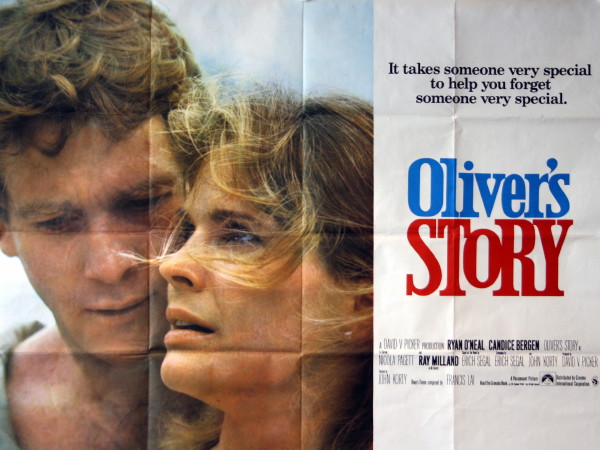
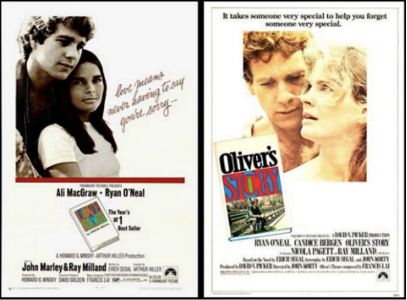
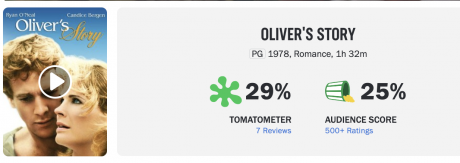
Posted on 2.29.16: “In a few days Quentin Tarantino‘s New Beverly Cinema will be screening a beware-of-Ryan O’Neal double bill — Love Story (’70) and Oliver’s Story (’78).

“A little more than 37 years ago I laughed at a defaced version of an Oliver’s Story one-sheet on a New York subway station wall. It won’t be very funny if I use the original graffiti so I’m going to use polite terminology. The dialogue balloons had O’Neal saying to costar Candice Bergen, “I’m sorry but may I have sex with you in a way that can’t get you pregnant?” Bergen answered, “If missionary is really and truly out I’d prefer oral.”

“I was poor and struggling and mostly miserable, but the graffiti made me laugh. It still makes me laugh today. I guess you had to be there.”

Read more

Respect for Bo Goldman

In the wake of Bo Goldman‘s passing I’m fully aware of what I’m supposed to say, which is that his screenplays were wonderful.

Well, I’m sorry but over the decades I never regarded Goldman as much more than a good, respected, dependable craftsman.

That’s not a putdown as very few screenwriters have made their way into that kind of pantheon, but I never thought of Goldman as one of the pip-pip-pips. I’ve understood for decades that everyone thought he was great, and I never offered an argument.

I’ve never mentioned that 34 or 35 years ago I was assigned to write coverage of Goldman’s screen adaptation of Susan Minot‘s “Monkeys“, and I honestly didn’t think it was all that rich or profound or even, to be perfectly frank, good.

Tonally Goldman’s Monkeys reminded me of the fractured and despairing family weltschmerz that Goldman’s Shoot The Moon was consumed by.

The best line in that 1982 Alan Parker film, which I never liked all that much, was when Albert Finney said that “San Francisco could die of quaint.” I also got a huge kick out of Finney destroying Peter Weller‘s backyard landscaping with his station wagon…crazy nuts.

But I loved Goldman’s script of Melvin and Howard, for the most part. And I admire his screenplays for Scent of a Woman and The Flamingo Kid (uncredited).

I never loved anything about Milos Forman‘s One Flew over The Cuckoo’s Nest (’75), Goldman’s adapted screenplay included, and I’m saying this as a guy who once played Dr. Spivey in a Stamford, Connecticut stage production of the 1962 play, written by Dale Wasserman and based on Ken Kesey’s 1962 novel.

Intimate “Salk” Perspective Is What Matters

Following a special screening of Salk at Manhattan’s Whitby Hotel last weekend, director Christopher Nolan explained why he chose not to show the human-scale benefits of the Salk polio vaccine, which began to be distributed in 1955 and eventually eliminated polio in the United States.

In the recent documentary To Eliminate Polio: Jonas Salk and his Miracle Vaccine, the impact of the innoculations is shown in abundant, upbeat detail. Although the documentary was released in part to drum up hype for Nolan’s three-hour biopic about Jonas Salk‘s heroic achievement, no such footage appears in Nolan’s Salk.

Nolan’s film doesn’t show thousands of children running around and enjoying their lives unhindered by polio, he explained, for a good reason. Salk is strictly a POV film that is centered around Salk’s immediate perspective, and since Dr. Salk didn’t innoculate any kids personally (except for his own three children) and didn’t go on a national goodwill tour to personally observe the vaccine’s beneficial effect upon families with children, it felt like “a reach”, Nolan said, to dramatize the effects of the Salk vaccine.

“We know so much more than Salk did at the time,” Nolan said. “He didn’t personally observe the mass innoculations and only saw them on TV, as he wasn’t exactly a ‘people person.’ He didn’t meet with any children or parents on a random basis, and he certainly didn’t administer the vaccine personally to children outside his own family, and so I decided to focus the film strictly on Salk’s research along with his dealings with scientific colleagues and a couple of government representatives.”

Truffaut or Bertolucci?

I happened upon these snaps (actually captures from a brief video) on Instagram…@alix_brown via keithmcnallynyc. Right away I was wondering if it’s from a ‘70s French film of some distinction. In and of itself the cigarette is unfortunate, but what the guy does with it is very Alain Delon in La Piscine or…I don’t know, Jean Pierre Leaud in Bed and Board. Back in the day I used to be that guy.

“The Big Short” As A Comfort Flick

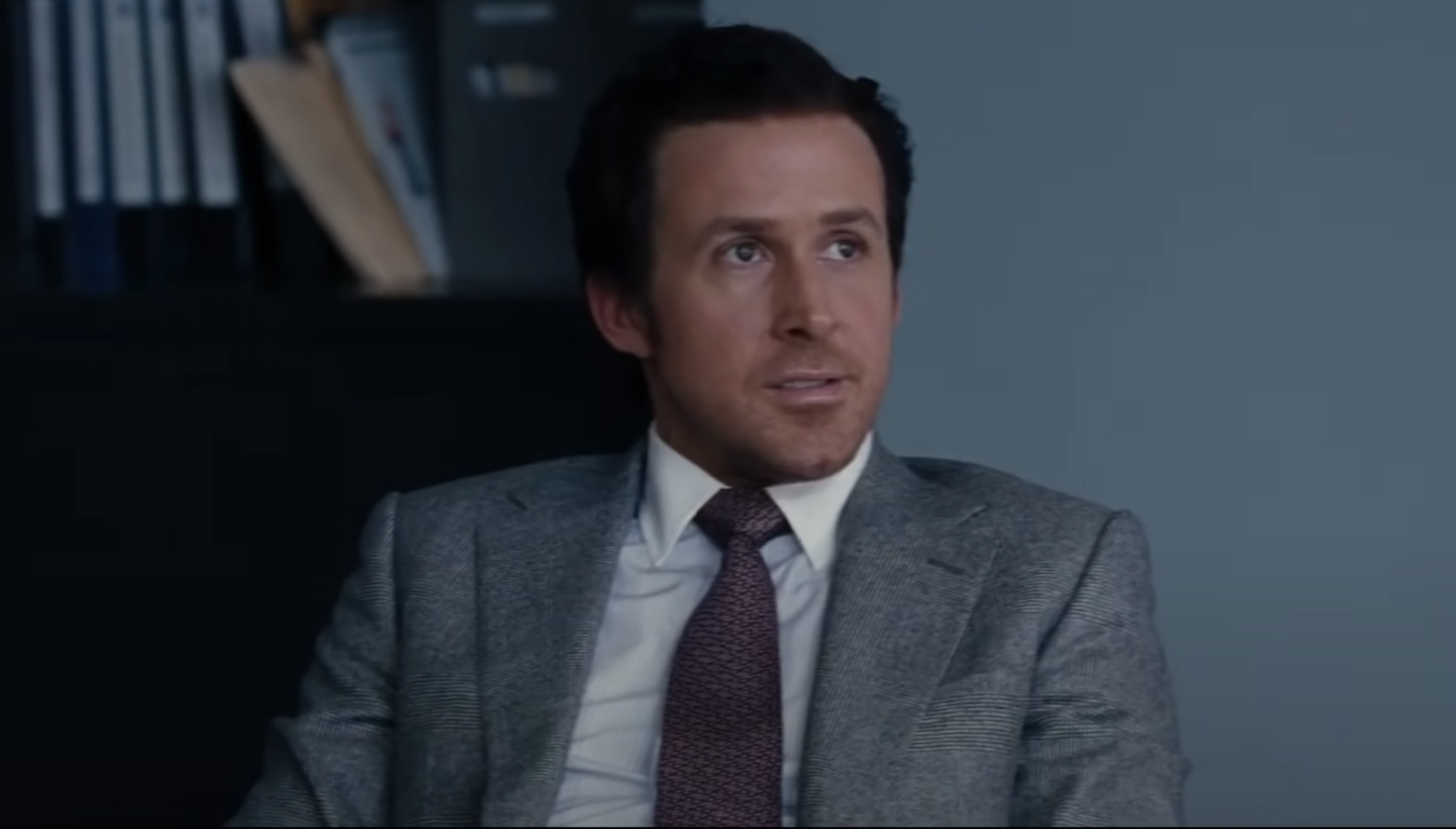
I was too dumb to really enjoy Adam McKay‘s The Big Short when it first came out in late ’15. It made me feel like an ignoramus…my head was concurrently spinning and stalling and slowing down from being covered in liquid chewing gum. But after several viewings I gradually came around, and now I love this fucking film.
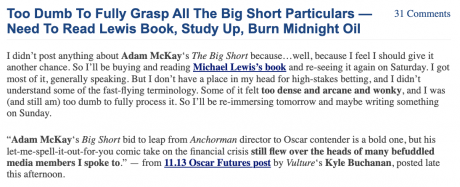
It took me three or four years to start watching portions late at night, and gradually enjoying them more and more as I went along. I now like it almost as much as Margin Call.

I still have problems with the opening 25 or 30 minutes (Christian Bale‘s Michael Burry, a barefooted genius analyst who looks stoned half the time, still drives me crazy), but once Ryan Gosling‘s Jared Vennett steps in and becomes a regular presence, it’s all good.