Some are still antsy or even fearful, but a N.Y. Times projection graph [below] indicates that things are looking up for the 2021 Telluride Film Festival, attendance-wise. Especially with the Johnson & Johnson one-shot vaccine about to kick in.




Some are still antsy or even fearful, but a N.Y. Times projection graph [below] indicates that things are looking up for the 2021 Telluride Film Festival, attendance-wise. Especially with the Johnson & Johnson one-shot vaccine about to kick in.
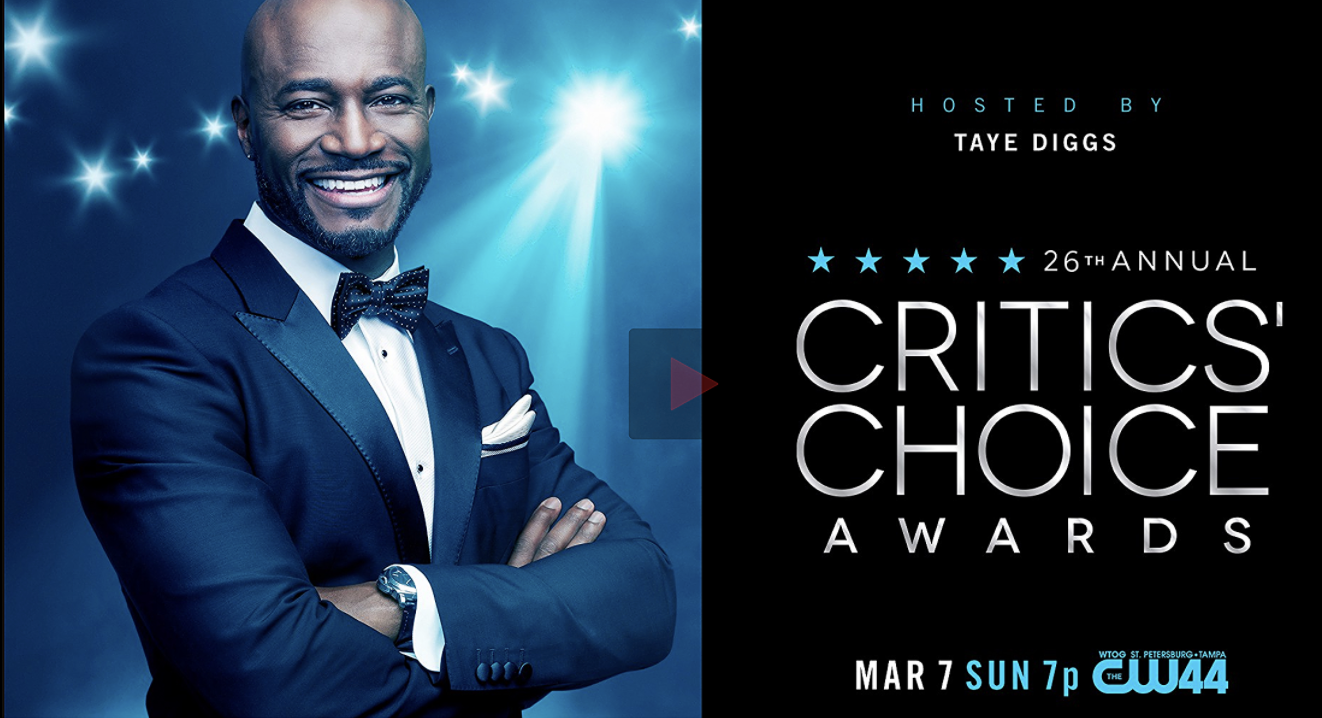
7:15 pm update: Congrats to all winners of the 2021 Critics Choice Awards, and particularly to Nomadland (Best Picture), Chloe Zhao (Best Director), Chadwick Boseman (Best Actor, Ma Rainey’s Black Bottom), Carey Mulligan (Best Actress, Promising Young Woman). Plus Best Original Screenplay — Promising Young Woman (Focus Features), Best Adapted Screenplay — Nomadland. Best Adapted Screenplay: Nomadland (Searchlight Pictures). Best Foreign Language Film — Minari (A24). Best Visual Effects — Tenet (Warner Bros). Best Visual Effects — Tenet (Warner Bros). Plus whatever & whomever I’ve overlooked.
5:20 pm update: Critics Choice members have handed their Best Comedy trophy to Max Barbakow‘s Palm Springs…God! I found more to like in The Prom than in Palm Springs, and that’s saying something. The finest feature comedy of 2021 was and always will be Judd Apatow‘s The King of Staten Island. followed in this order by Borat Subsequent Moviefilm and On The Rocks — those are the top three. What could have possibly been the motive among CC members in choosing Palm Springs? What is it, some generational thing? Has Scott Mantz been lobbying for it? If they didn’t care for Apatow’s film they could’ve at least gone for Borat 2.
Earlier: I’ve never played the awards-prediction game. I write about the good stuff, period, and couldn’t care less what the majority has gone for, particularly with the progressive woke virus permeating just about everyone and everything. You can always count on Critics Choice members to blow with the wind, and right now the prevailing winds are coming from Vichy.
That said, I voted for Sound of Metal’s Paul Raci in the Best Supporting Actor category — Judas and the Black Messiah‘s Daniel Kaluuya has won instead. For Best Supporting Actress I voted for The Father‘s Olivia Colman; in actuality Borat 2‘s Maria Bakalova has taken it. I voted for News of the World‘s Helena Zengel for Best Young Actor/Actress, but Minari‘s Alan Kim is the victor.
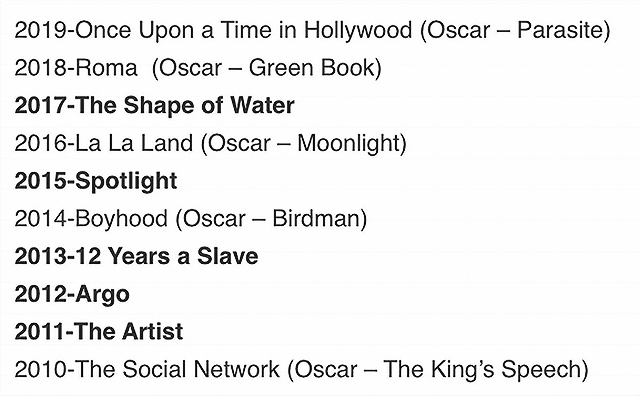
HE picks (posted a few days ago:
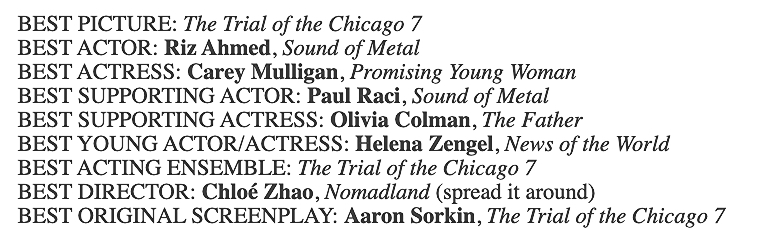
This color test footage for Rowland Lee‘s Son of Frankenstein (released on 1.13.39), was probably shot in the early fall of ’38. This clip has been on YouTube since 2011, but I saw it for the first time today. It’s actually the first color image I’d ever seen of Karloff in Frankenstein monster makeup, period.
The makeup genius was Jack Pierce (1889 — 1968). Yes, that’s Pierce getting strangled starting at the 45-second mark.
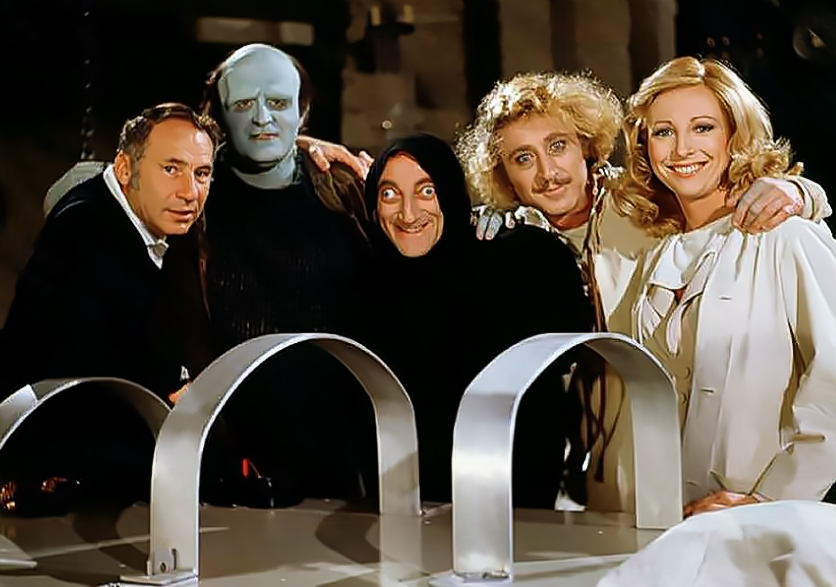
Karloff’s tongue improv (35-second mark) is good for a chuckle, but what genuinely surprised me was the mint-green skin. Widely circulated color snaps of Peter Boyle‘s Young Frankenstein monster (’74) also showed green skin, but I always thought that was a one-off. One presumes that the mint-green makeup was chosen by director Mel Brooks and Young Frankenstein dp Gerald Hirschfield because it delivers an extra-deathly pallor in monochrome.
Either way I’d never read or been told that Boris Karloff‘s monster had the same skin shade, at least as far as Son of Frankenstein was concerned. No clues if Karloff and Pierce went green for the previous two he starred in, Frankenstein (’31) and Bride of Frankenstein (’35).
I’d actually come to believe, based on a December 2012 visit to Guillermo del Toro’s “Bleak House,” that Karloff’s monster had mostly grayish skin with perhaps (at most) a faint hint of green. (The below photo, taken on 12.22.12, shows life-sized wax models of Pierce working on Karloff for James Whale‘s 1931 original.) Nobody is a more exacting historian or connoisseur of classic monsters than GDT, so I naturally presumed that the skin tone on Karloff’s wax model was accurate. I stand corrected.
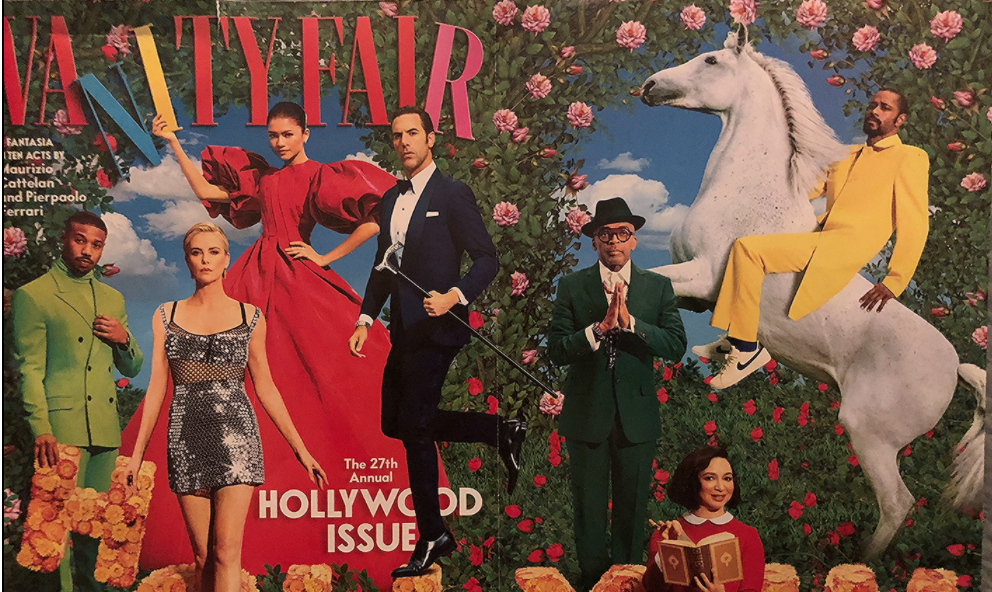
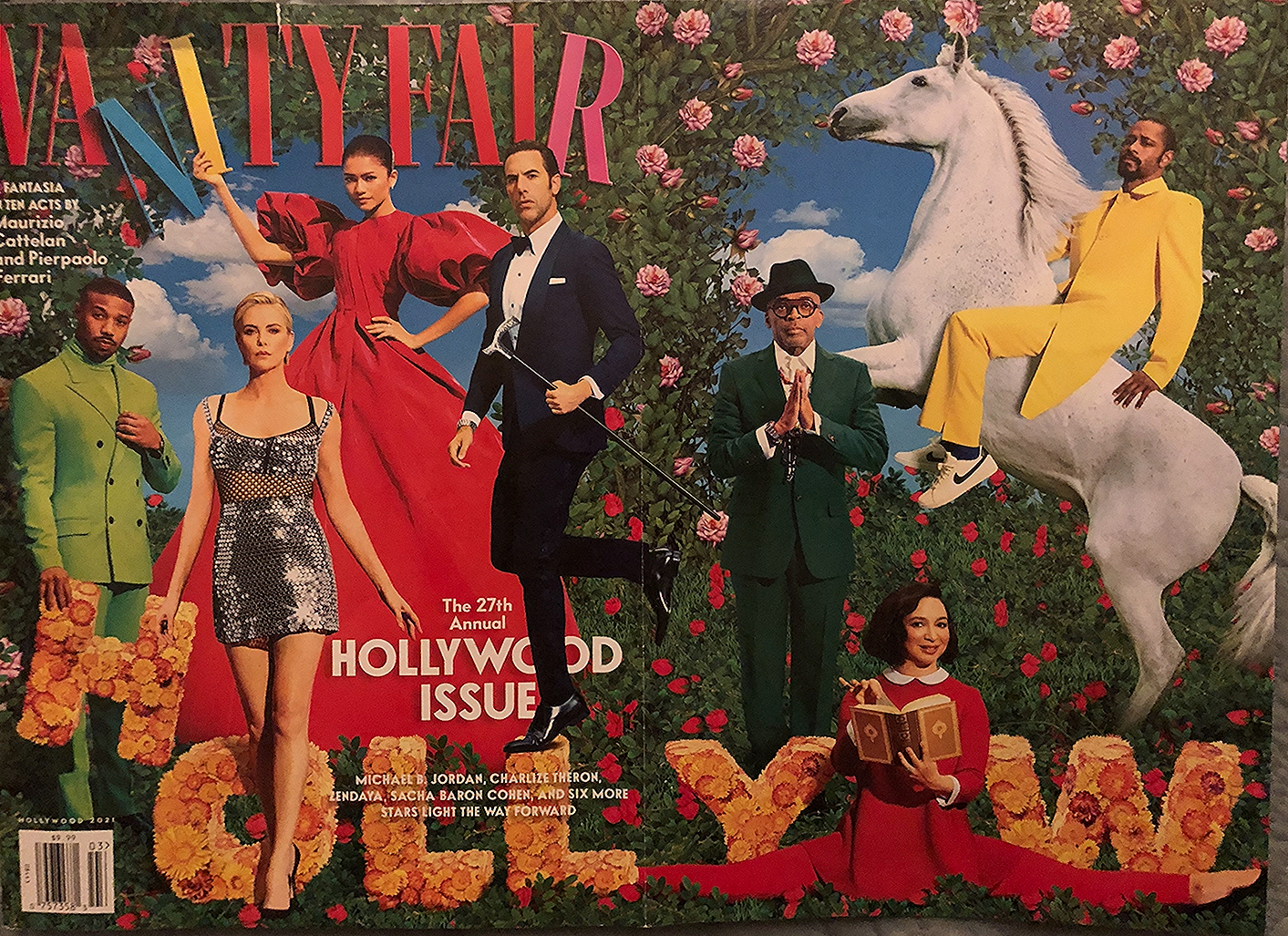
I used to derive serious pleasure from the annual Vanity Fair Hollywood issue, as I did from the generally knowledgable and delicious grade-A writing during the Graydon Carter era.
Carter left VF in 2017, Radhika Jones has been running the shop since, and nobody likes the magazine as much. You know what I mean. VF has “changed with the times.” It looks and feels like a lightweight hand-out — serving those who allow it to keep afloat. That special storied vibe from those Hollywood issues of the ’90s, aughts and early teens — a feeling that you were absorbing some kind of thought-through reconnaissance of where Hollywood culture was at that year and with one or two carefully sourced recollections of its own past — is totally out the window.
The only thing I like about the cover is the inclusion of Judas and the Black Messiah‘s Lakeith Stanfield.
It was during a discussion this morning about David Caruso that it hit me. For a minute or two in ’93, when the carrot-haired Caruso was riding high with NYPD Blue and after his bravura performance as Mike the Chicago detective in Mad Dog and Glory…for a while there it looked like Caruso might pole-vault onto the next level and become a superstar. Maybe. It seemed possible.
But of course it wasn’t. Because freckly, ginger-haired guys can’t be superstars. They can be admired or even worshipped for their acting chops (i.e., Phillip Seymour Hoffman) or respected or “popular” as far as it goes, but they can’t be “the alpha guy“…that charismatic, rock-solid, center-of-the-universe force field whom other guys want to be and women want to go out with…to be a real movie star you need to exude a certain extra-cosmic, triple-dimensional quality.
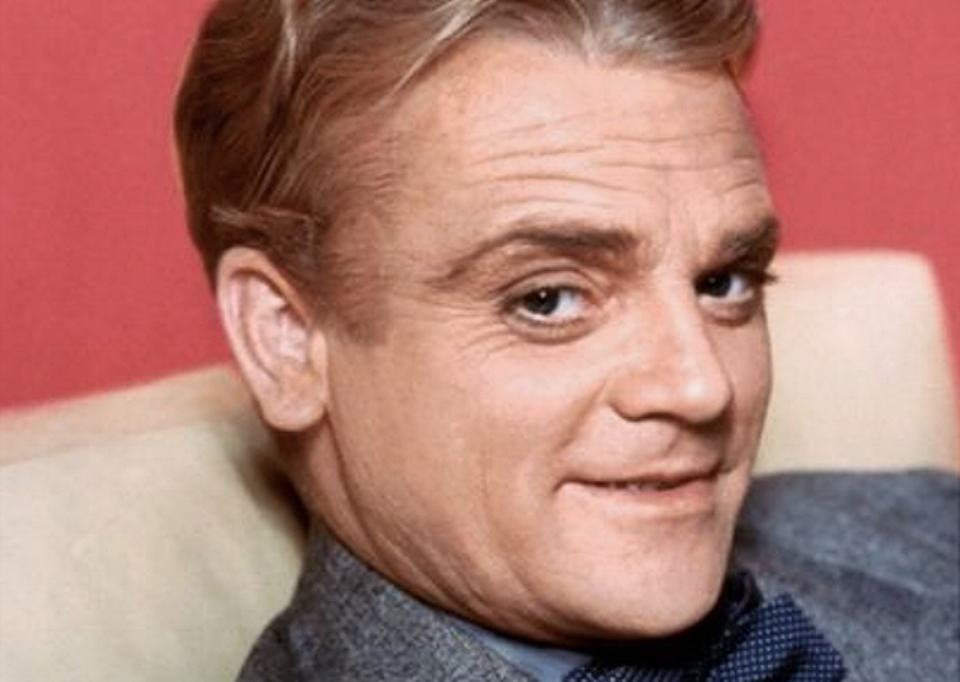
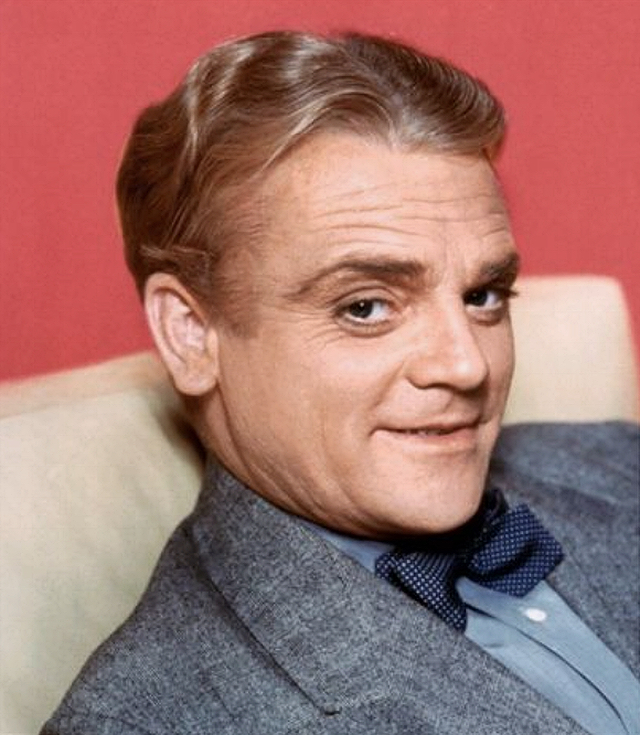
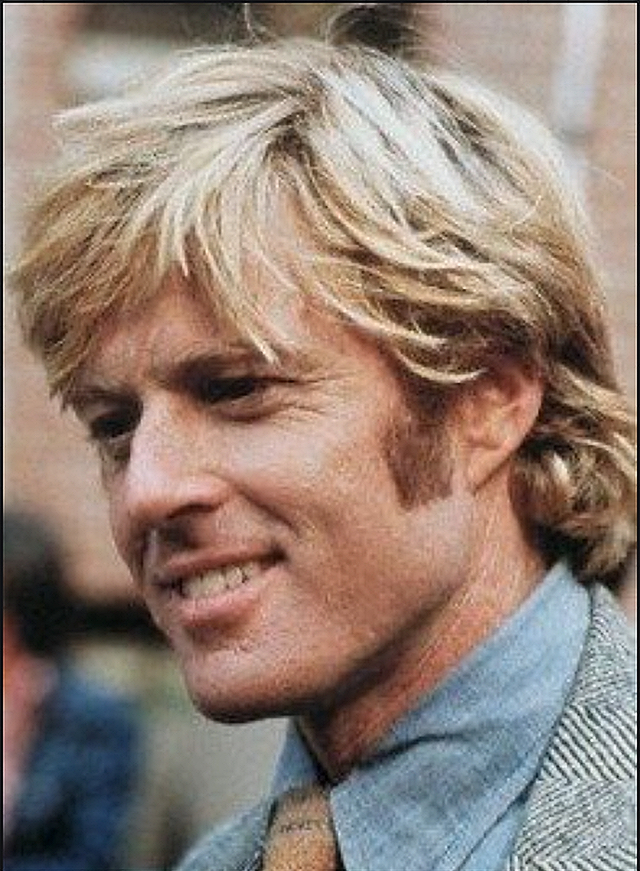
And the fact is that only two copper-haired actors in the entire history of Hollywood have become serious superstars — James Cagney and Robert Redford.
Except Cagney doesn’t really count because he ascended and enjoyed his big-star heyday in the mostly monochrome ’30s and ’40s, and so no one was obliged to contemplate his hair color or freckly complexion.
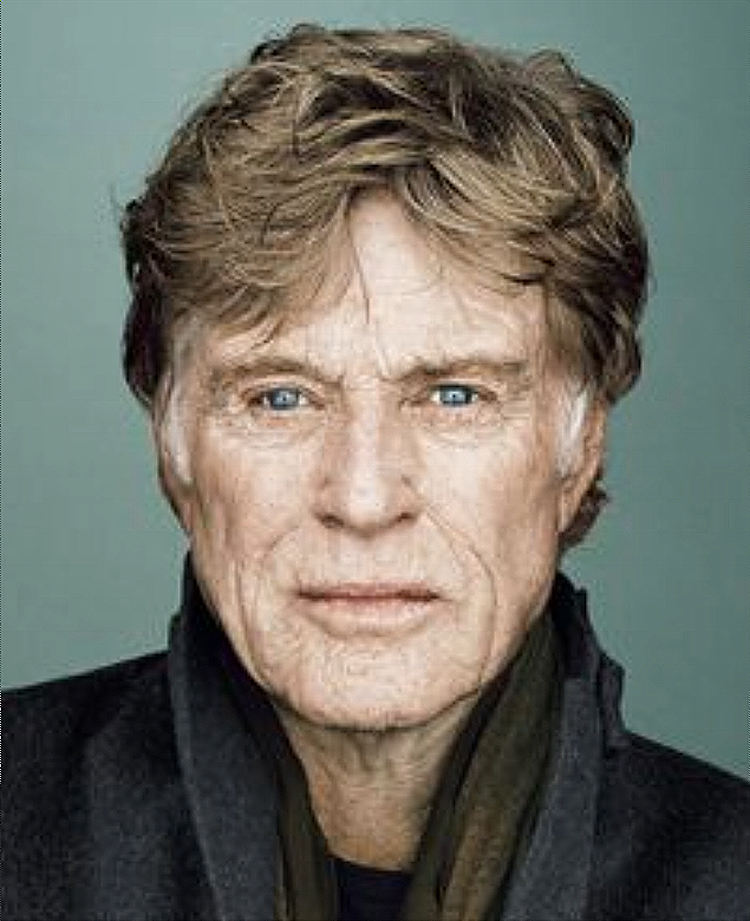
And Redford doesn’t really count because, as we all know, he became a blonde sometime in the early to mid ’60s and stayed that way until his downshift period began sometime in the late ’80s or early ’90s.
And why do you think he became a blonde? Ask yourself that. Okay, I’ll tell you why. He became a blonde because he wanted to be big, and he knew (or his agent or some good friend persuaded him) that it wouldn’t happen unless he did something about his hair. I recall talking to an old friend of Redford’s on the phone once, a guy he used to hang out with in Van Nuys, and this guy told me that Redford’s high-school nickname at the time was “Red.” But eventually he let the blonde thing go. I know that he walked around as a natural copperhead when he was hosting the Sundance Film Festival in the ’90s.
Ginger or copper-haired actresses have never had the slightest problem in Hollywood, of course. And a select few (as with anything else) have become major stars — Cate Blanchett, Amy Adams, Emma Stone, Jessica Chastain, Nicole Kidman, Julianne Moore, Bryce Dallas Howard, Isla Fisher, Lindsay Lohan, Christina Hendricks plus yesteryear’s Katharine Hepburn, Deborah Kerr, Myrna Loy, Tina Louise, Greer Garson, Rita Hayworth, Lucille Ball, Maureen O’Hara, Carol Burnett, Susan Hayward.
But ginger-haired guys have almost never made it to the penthouse level. Because there’s something about them that Americans just can’t quite settle in with or bow down to…not really. Michael Fassbender, Lucas Hedges, Paul Bettany, Jesse Plemons, Caruso, Ed Sheeran, Damian Lewis, Rupert Grint, Alan Tudyk, Brendan Gleeson, Danny Bonaduce, Eric Stoltz, Carrot Top Thompson, David Lewis, Domhnall Gleeson, Rupert Grint, Simon Pegg, Toby Stephens, the great Philip Seymour Hoffman, Chuck Norris, Jason Flemyng, Seth Green, David Wenham…none of them ever made it into the elite winner’s circle, not really. Because people glommed onto that red hair and went “okay, fine, good actor but nope.”
Yes, Leslie Howard was a fairly serious star in his 1930s heyday, but he wasn’t way up there. He wasn’t Clark Gable big.
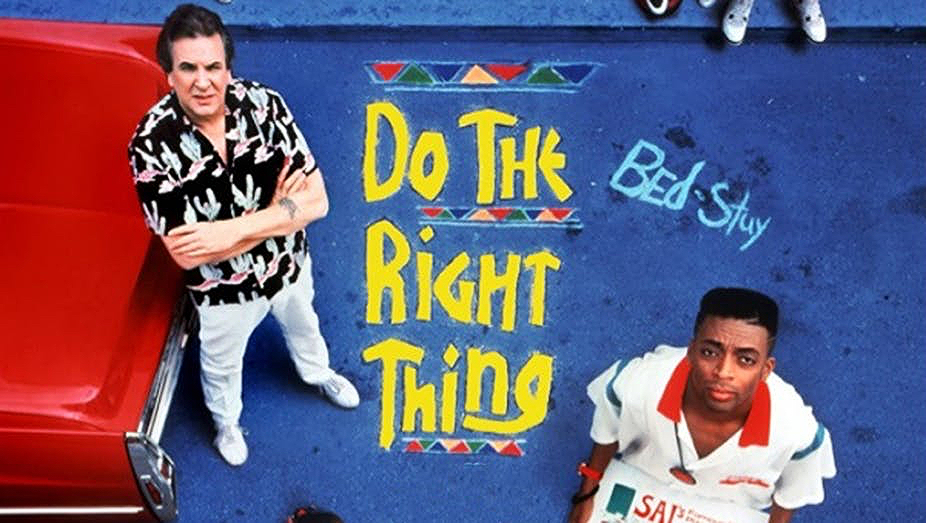
I am one of the many columnist-critics who regard Spike Lee‘s Do The Right Thing as one of the finest films of the ’80s. I have it ranked sixth on my current ’80s roster. I decided that the instant that Mookie threw that garbage can through Sal’s Bed-Stuy pizza parlor window. It therefore comes as no surprise to me or anyone else that World of Reel‘s Jordan Ruimy announced yesterday that Do The Right Thing was the #1 choice among over 200 critics.
If this or that critic insists that Lee’s film is the best of the Reagan decade, fine. Ditto others choosing Platoon or Local Hero or The King of Comedy or Prince of the City or Raging Bull. Or HE going with Risky Business. Whatever. But when you hear that Do The Right Thing topped “almost half the lists,” as Ruimy puts it, one can at least wonder why. Most of us agree that people (and especially critics) tend to judge films according to whatever cultural winds may be blowing at a given moment, and right now Spike’s 1989 film seems to fit right in.
Ruimy: “Lee’s film no doubt benefited from an abundance of relevance over the past year in a socially and politically tumultuous America dominated by racial issues.”
HE ’80s faves: Risky Business, The Hidden, Drugstore Cowboy, Raging Bull, Local Hero, Do The Right Thing, Crimes and Misdemeanors, Prince of the City, Blue Velvet, Platoon.
#11 through #16: Full Metal Jacket, Scarface, Thief, Lost in America, Die Hard and Aliens.
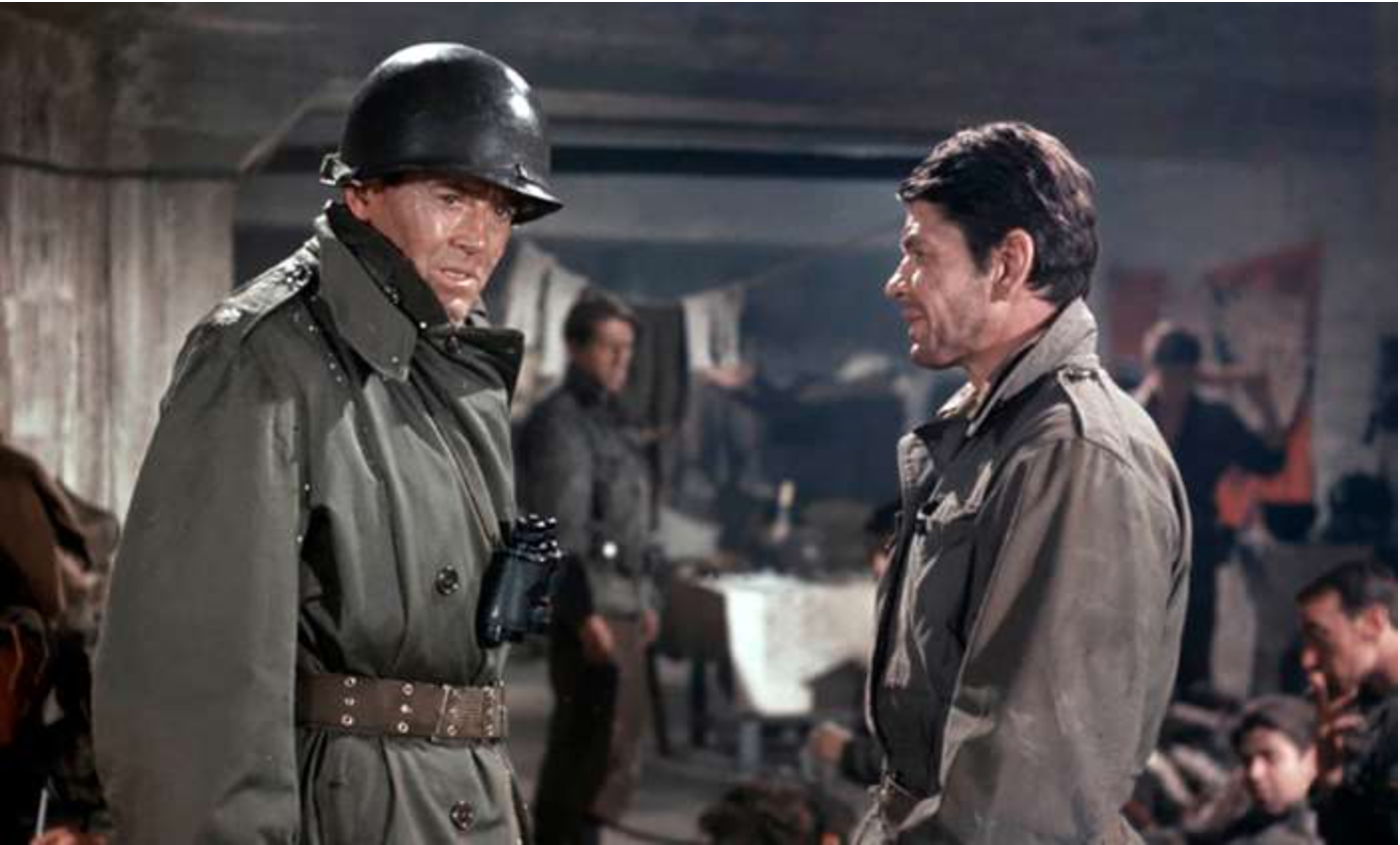
I have a certain affection for films shot in Ultra Panavision 70 and Camera 65, processes from the ’50s and ’60s that yielded aspect ratios of 2.76:1. (They were technically identical or damn near.) Actually, there were 11 such films in all, but I only have a fondness for three — Ben-Hur (Camera 65), Mutiny on the Bounty (UP70) and The Fall of the Roman Empire (ditto).
I never got around to seeing Raintree County, which also was shot in Camera 65.
Bounty and Empire were shot by the great Robert Surtees, and the framings and lighting are quite elegant. Empire was shot by Robert Krasker (Odd Man Out, Brief Encounter, The Third Man).
I have no affection at all for Quentin Tarantino‘s The Hateful Eight, which squandered the UP70 potential by mostly shooting inside the darkly lighted Minnie’s Haberdashery.
I’ve never seen Ken Annakin‘s The Battle of the Bulge (UP70, released on 12.16.65), and after watching this Smilebox trailer it’s possible I may never set the time aside.
The dialogue conveys stodginess, or what I would call an overdose of “officer-talk”. You can tell the whole thing smells. Any mid-’50s-and-after movie costarring Dana Andrews is something to be feared. German soldiers speaking German-accented English was outlawed after The Longest Day, but Annakin went there anyway. The Wikipedia page features a long list of historical inaccuracies. Dwight D. Eisenhower came out of retirement to denounce the film for gross inaccuracies. It was shot in Spain with little or no snow on the ground, and too many scenes feature the wrong kind of typography (I’ve been to the the Ardennes forest) and not enough pine trees.

Remember the “creepy handsy kissy Joe” problem, which began to be a thing about two years ago? The recent accusations of overly intimate flirtation and touching on the part of Gov. Andrew Cuomo sound vaguely similar, perhaps with a the dial turned up a bit. Or not. What do I know?
The descriptions and complaints make Cuomo sound (emphasis on the “s” word) like many male politicians of a certain age, like alpha lions who like to subtly (or not so subtly) sniff, sample and paw their way through a room.
I’m wondering if Cuomo drinks. If so that could be a factor. Guys who’ve had a couple tend to be less restrained, more impulsive.
Either way it appears as if Cuomo is about to be Al Franken-ed. With every new accuser the pressure intensifies all the more. We know how this goes.
>> @ChrisCuomo at the top of @CuomoPrimeTime tonight: “Obviously I am aware of what is going on with my brother. And obviously I cannot cover it because he is my brother. Now, of course CNN has to cover it. They have covered it extensively and they will continue to do so.” pic.twitter.com/G49mZYTG4D
— Brian Stelter (@brianstelter) March 2, 2021

Click here to jump past HE Sink-In
Most of us would call losing one of our five senses — sight, sound, smell, taste, touch — an unmitigated tragedy. This, at least, would be our first thought. Gutted by loss, driven to tears — our ability to savor the joy and wonder of life sharply reduced and never to return.
But of course, the body gradually compensates. And so does the spirit.
Darius Marder‘s Sound of Metal tells the story of a heavy metal drummer, Ruben (Riz Ahmed), suddenly confronted with all-but-total hearing loss. And of course, freaking out and desperate for a cure, he sinks into denial and despair, before ultimately learning how to live with his new identity.
Ruben’s power-chord-playing partner Lou (Olivia Cooke) takes him to a sober house for the deaf, a bucolic retreat for hearing-loss victims run by Joe (Paul Raci), a 60-something Vietnam veteran. Ruben settles in, learns to “sign,” and even becomes a member of the family. Joe eventually offers him a permanent job at the house, but Ruben is determined to get cochlear implant surgery. He sells his touring van and drums and has the surgery, but his subsequent “hearing” is tinny and agitating.
The long and short is that Ruben finally comes to understand that deafness is not a handicap, but, if accepted and engaged with, a doorway to a certain enhancement.
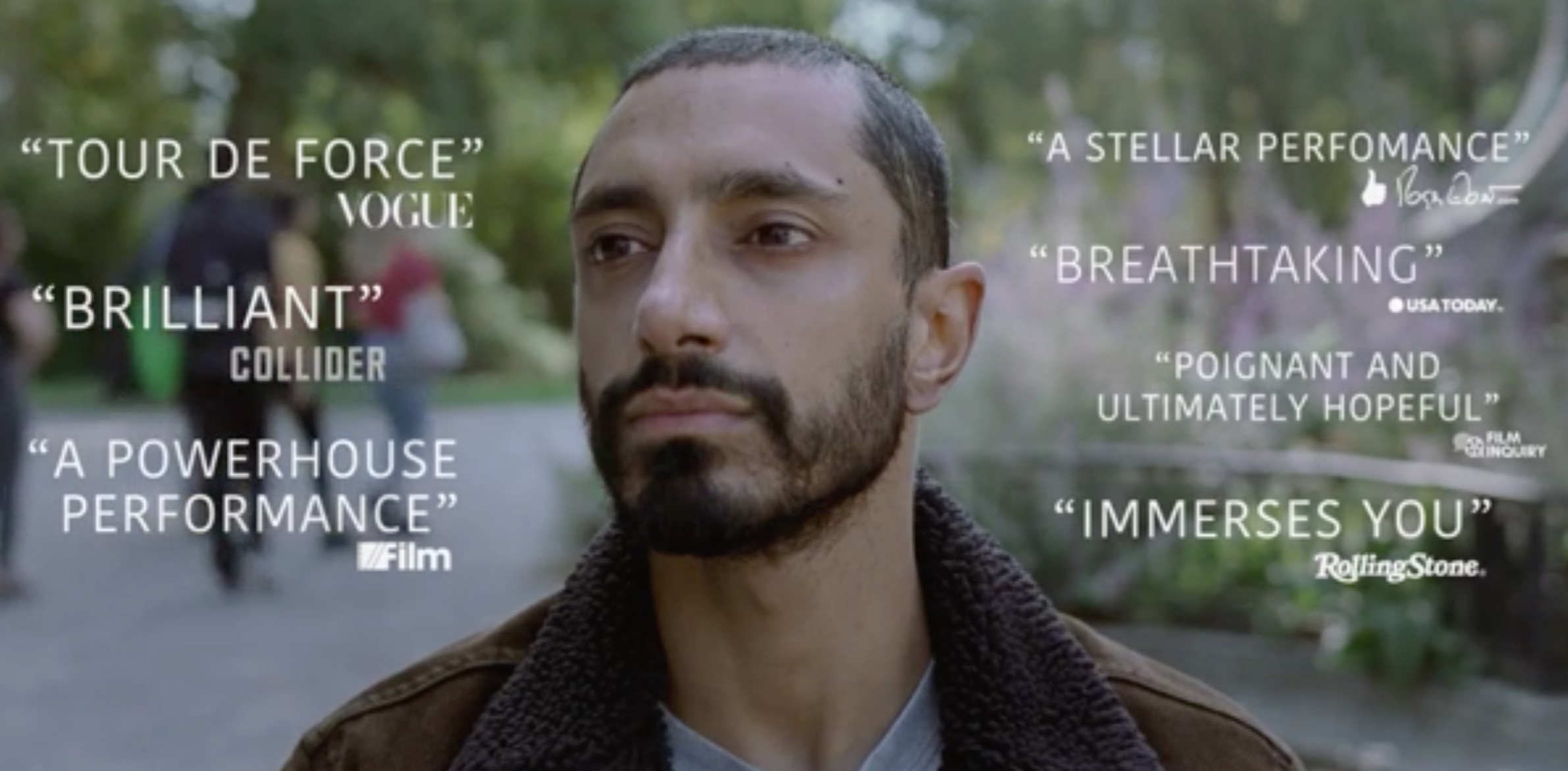
Sound of Metal is a home-run for Ahmed, a performance that says “wait…this is it…this is me.”
The first time I noticed Ahmed was at the Sundance Film Festival in January 2010, when I saw him play a homegrown British terrorist in Four Lions. The next standout was his performance as Jake Gyllenhaal‘s half-assistant, half-colleague in Dan Gilroy‘s Nightcrawler (’14). Then came Rogue One (’16), in which he played Bodhi Rook, an Imperial cargo pilot who defects to the rebels. Then a bizarrely named 19th Century character (Hermann Kermit Warm) in Jacques Audiard‘s nihilistic, negligible The Sisters Brothers. And then, finally, Marder’s Sound of Metal.
I also believe that Paul Raci, Ruben’s straight-shooting mentor at the sober house for the deaf, deserves a Best Supporting Actor nom. Raci, whose parents were deaf, intimately understands the deaf community, and is perfect in the part. Like Harold Russell was perfect in The Best Years of Our Lives, I mean. Raci is actually a blend of Russell and Lives costar Hoagy Carmichael.
Sound of Metal is an absorbing and quite delicate film about using tragedy to transition from one world to another, and one that offers a doorway into a spirit world — a realm of cosmic serenity and stillness…a place that expresses the age-old axiom “never speak unless you can improve upon the silence.” Radiance is everywhere.
The bottom line is that Sound of Metal is easily the most spiritual Best Picture contender. It’s the only contender that says “look beyond the noise…look within.” It contains arias, symphonies, multitudes.
Sound of Metal uses innovative sound design to mimic the experience of hearing loss. Marder and Supervising Sound Editor Nicolas Becker drew upon extensive research into how hearing loss actually sounds, and began work on it a year before any other crew members were brought onto the film. The sound design team — lead by Becker and production sound mixer Phillip Bladh — definitely deserve Oscar noms, and…oh, hell, the Oscars themselves.
Also excellent are Olivia Cooke as Lou, Ruben’s singing-bandmate girlfriend who insists that he go to the sober house for the deaf, and Mathieu Amalric as her wealthy French dad.
There’s a moment when Ruben and Lou realize that they can’t resume their relationship, and it’s performed without a single line of explanation or descriptive dialogue…it’s one of the saddest breakup scenes I’ve ever seen.

Back in ’51 a gifted artist in the employ of 20th Century Fox created an alternate version of The Day The Earth Stood Still. He/she added (a) a giant, dark gray mummy’s hand and (b) Gort carrying a screaming Las Vegas blonde dressed in a pink-champagne gown instead of Patricia Neal in a dark business suit. No one complained when the film opened on 9.18.51 and everyone realized that neither of these elements were in the film. Because artists were allowed to…wait for it…use their imaginations!
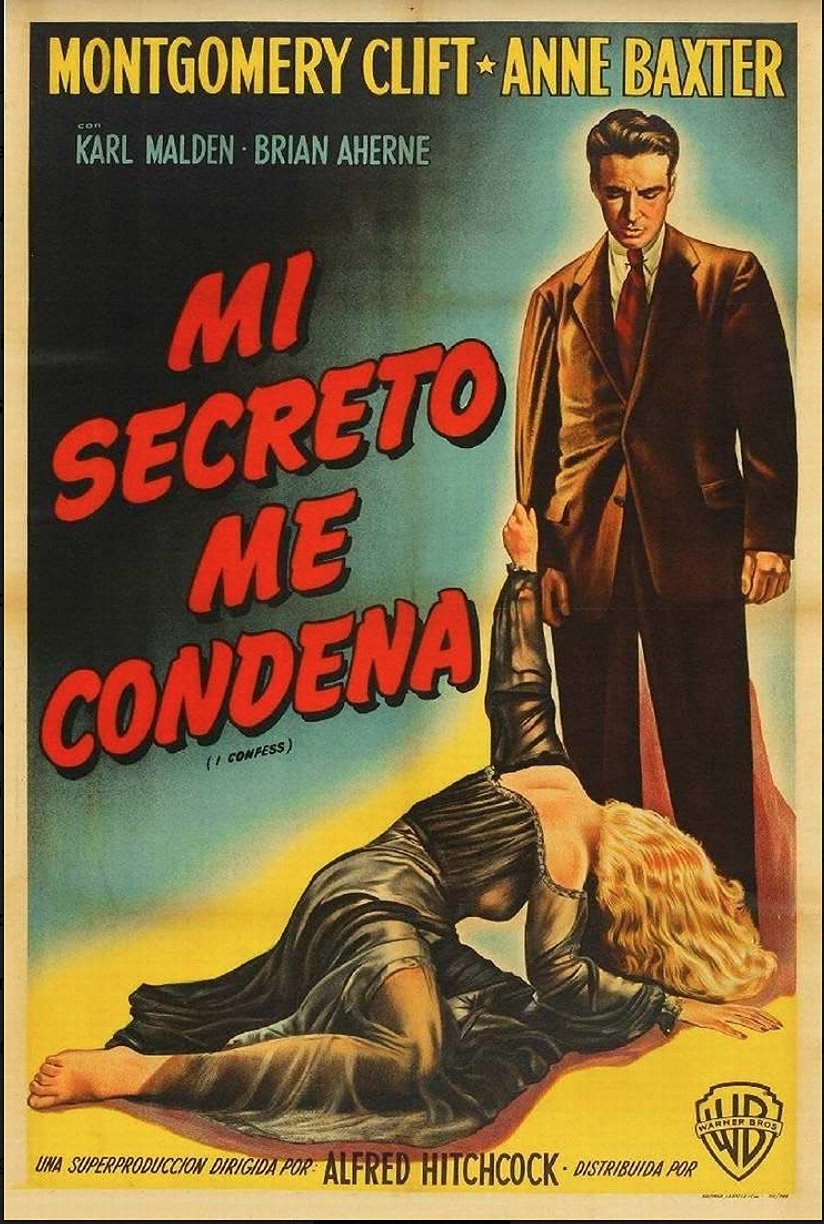
A few months later an Italian poster artist followed suit with similar art for Me Secreto Me Condena, which is what Alfred Hitchcock‘s I Confess was called in Roma, Siena, Venice, Genoa, San Remo, Montepulciano, Firenze, Milano and Brindisi. (Google Translation: “I Secretly Condemn Myself.”) Montgomery Clift was no longer a priest, and the same gown-wearing blonde from The Day The Earth Stood Still poster was back, only this time wearing a semi-transparent black outfit and lying before Clift in a posture of shame and degradation.

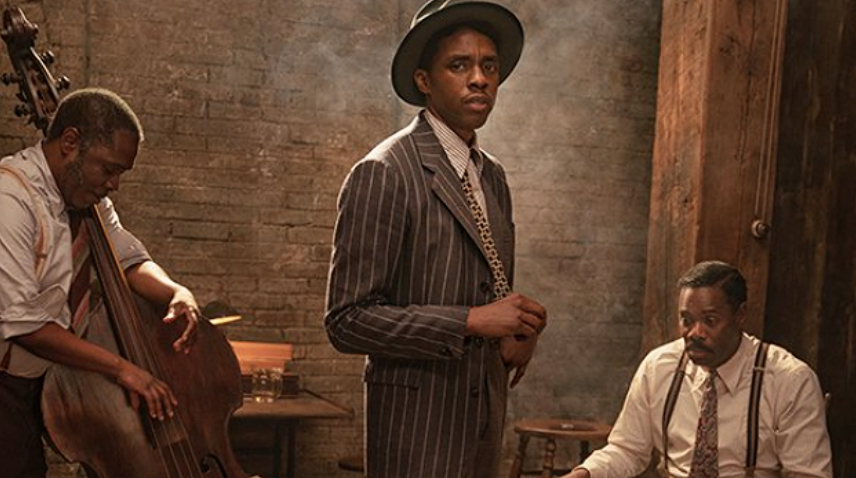
Tina Fey, Amy Poehler opening remarks (2:55): “The Golden Globes are given out by the Hollywood Foreign Press Association…made up of around 90 international, non-Black journalists who attend movie junkets each year in search of a better life.” (4:38) “Nomadland is about a lady played by Frances McDomand who travels across the desert in her van and poops in a bucket.” (5:46) “Soul is a beautiful Pixar animated movie in which a middle-aged black man accidentally get knocked out of his body and into a cat. The HFPA really responded to this movie because they do have five cat members.”
6:10 pm: HE is unable to invest any interest in animation, but respectfully believes that the HFPA giving a Golden Globe in this category to Pete Docter‘s Soul in an odd call. Posted on 11.29.20: “Despite an absolute avalanche of charm and energy and whimsical, wild-ass associations, Soul is just not good enough. Too fast and busy, too scattered, too all over the place, too hyper. And because it pushes a fundamentally false or at least conflicted concept of life. And because (this is minor but significant) it tries to normalize obesity with the casting of the fattest animated cat you’ve ever seen in your life.”
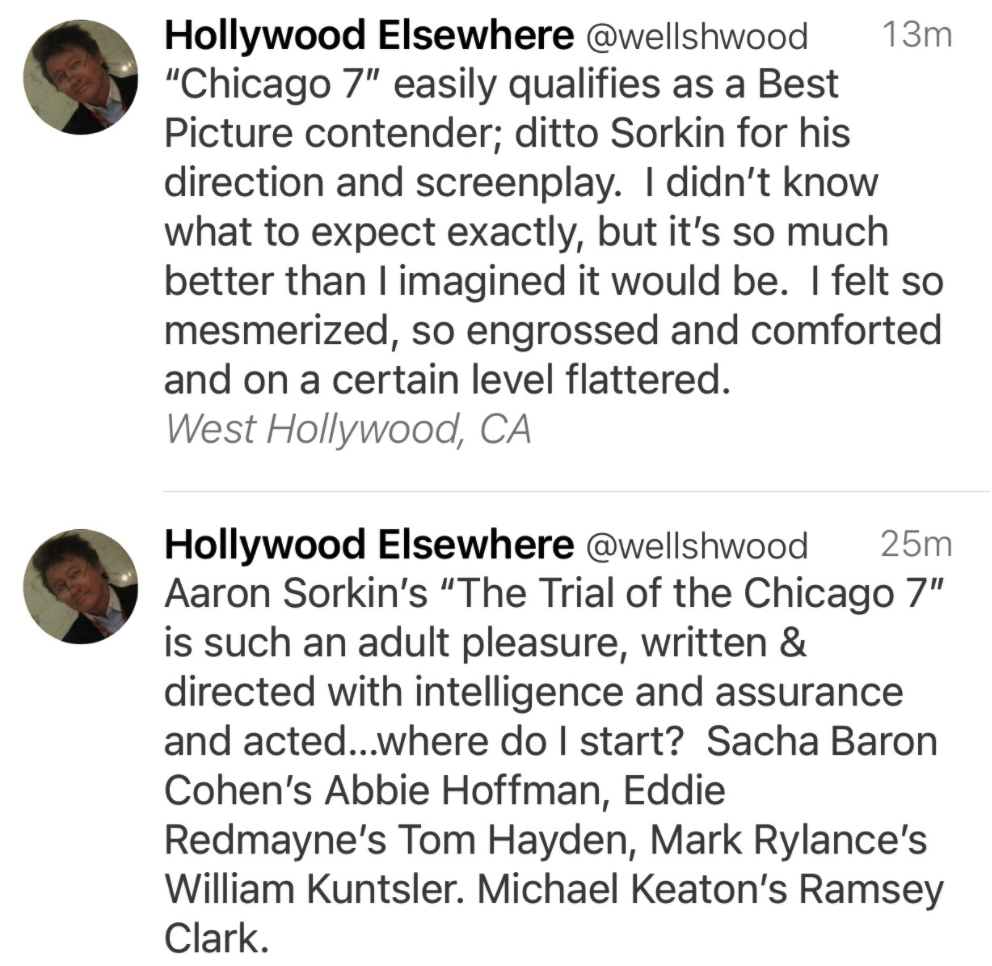
6:35 pm: Congrats to The Trial of the Chicago 7‘s Aaron Sorkin for winning the 2021 Golden Globe for Best Screenplay, Motion Picture. Posted on 9.22.20:
7:15 pm: Congrats to Minari for winning the Best Foreign Language Feature Golden Globe award. The only problem is that it’s not really a foreign-language feature. It’s a totally American film, set in the Midwestern heartland and featuring a scene in an American small-town church and costarring a Jesus freak (played by Will Patton). It happens to focus, yes, on characters who happen to speak Korean because that’s their native language. But it’s not a foreign-language film. Not in the usual sense.
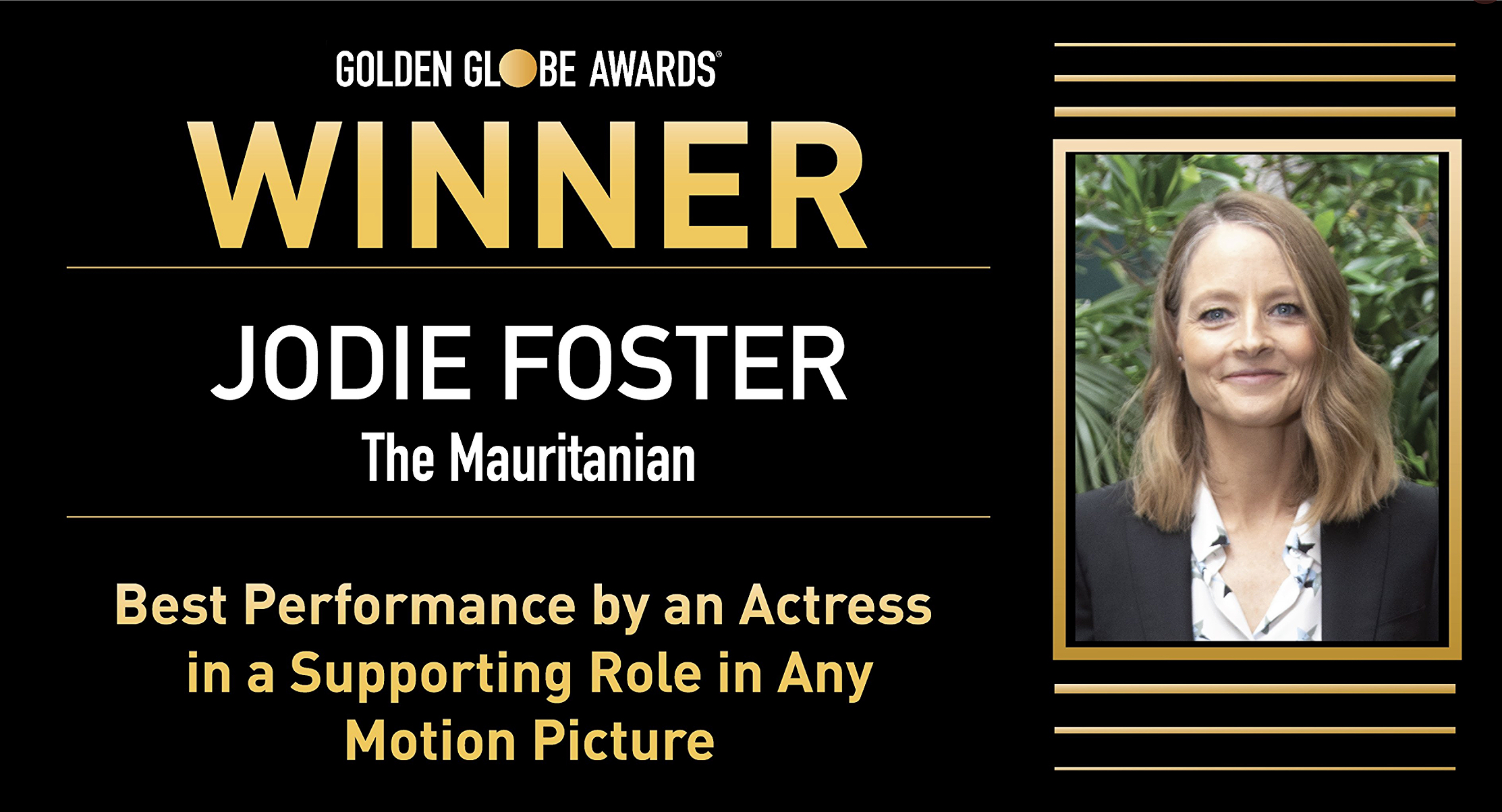
7:45 pm: Congrats to The Mauritanian‘s Jodie Foster winning a GG for Best Supporting Actress, but where did this come from? And why, again, was Mank‘s Amanda Seyfried shafted? The Father‘s Olivia Colman gave the most compelling performance in this category, but she didn’t win because she won the Best Actress Oscar two years ago for The Favorite…right? Zip for Hillbilly Elegy‘s Glenn Close. I just don’t get (and I don’t “mean” anything by this) where the Foster vote came from. What drove it? Where was the big rationale?
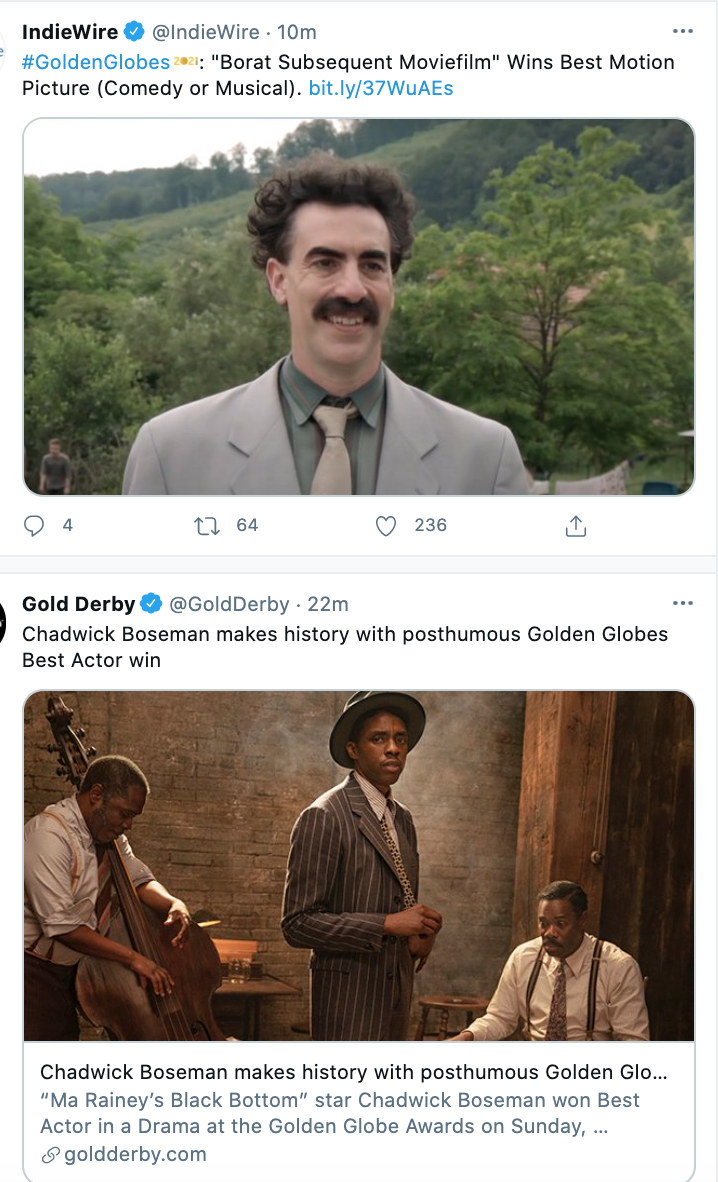
8:10 pm: Congrats to Nomadland for winning Best Motion Picture, Drama; ditto Chloé Zhao winning for Best Director. Congrats all around.
Andra Day delivered an excellent performance in The United States vs. Billie Holiday — no question about that. But what she brought was significantly better than the film itself. Usually the film has to be well-liked or at least well-respected for a major category acting win to happen — not this year. You have to admit that Day winning is a surprise.
The bottom line is that HFPA members are seemingly terrified about possibly getting canceled or blackballed by the woke crowd. Hence the Boseman win (pure sentimental tribute trophy) + Kaluuya (I honestly feel that Sacha Baron Cohen really nailed Sorkin’s enhanced version of Abbie Hoffman, and I could’ve accepted a win for Leslie Odom Jr. as Sam Cooke in One Night in Miami) + Minari.
HFPA to Hollywood community (per friendo): “Just because we are an all-white voting body does not mean we are not woke. We get it. Please understand this. Because we do.”
Friendo: “Oscar-wise it’s Nomadland vs The Trial of the Chicago 7 for Best Picture. I think Boseman will probably win the Oscar for that goofy performance.”
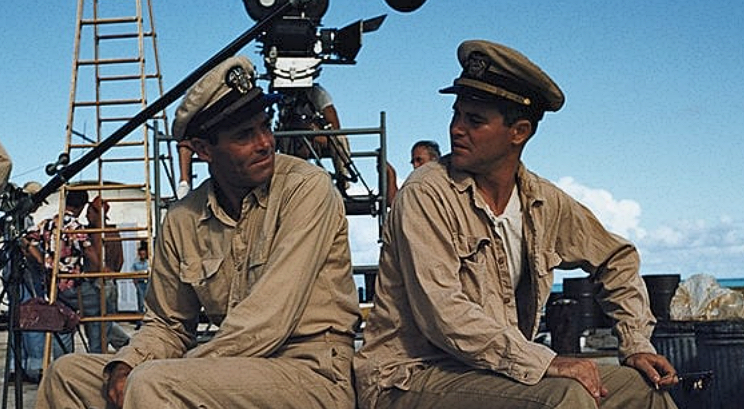
Nobody gives a damn about a 73 year-old Tony Award-winning play called Mr. Roberts. Well, a few boomers do, I suppose, but everyone hates boomers (polluted the planet, took all the money, condemned Millennials to a lifetime of economic anxiety) so fuck them and the play together. Whatever merits the play (co-written by Thomas Heggen and Joshua Logan) may have radiated during the Truman administration, they’ve long since seemed to matter.
But speaking as someone who long ago watched a degraded pan-and-scan version** of the 1955 Warner Bros. CinemaScope adaptation with Henry Fonda, James Cagney, William Powell and Jack Lemmon in the lead roles, I’ve always been mystified why anyone in the mid ’50s ever thought Mr. Roberts, regarded as some kind of ace-level heart comedy in its heyday, thought it was any good.
A WWII Naval chuckler set aboard a backwater cargo ship called “the bucket” (and based upon some short stories written by Heggen about his war experiences), it’s basically a serving of coarse service humor, sentimentality and painfully sodden slapstick.
And yet the stage version of Mr. Roberts, directed by Logan, won a Tony Award for Best Play. I’ve never read the Heggen-Logan original, but the film must have coarsened the material considerably. It just stands to reason. Broadway sophistos have rarely celebrated the above-described behaviors in any form.
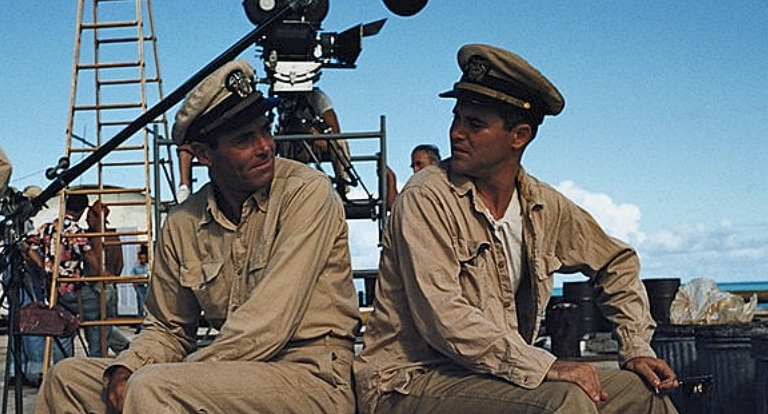
The central idea of the film version is that the enlisted men are eight-year-old children who love their kindly father (Fonda’s Mr. Roberts, a Lieutenant JG) and despise the petty, neurotic and tyrannical Captain Morton (Cagney). Over and over the film conveys what a rollicking pleasure it is to taunt or belittle Morton or better yet make him so furious that he throws up.
Oh, and what a hoot it was to watch nurses undress through binoculars from a distance of several hundred yards. And to make your own liquor with various rotgut ingredients…hilarious!
With the exception of one amusing scene in which the under-educated Morton rants about how much he hates snooty college boys like Roberts and how they treated him when he worked as a bus boy in the 1920s (“Oh, bus boy! It seems my friend here has thrown up all over the table…fetch a mop and clean up the mess, bus boy, will ya?”), there’s nothing the least bit funny in the entire film. You can see what was intended to be funny but none of it lands.
The lead performances are fine in and of themselves (Lemmon won a Best Supporting Actor Oscar), but the crew is just awful. The simpleton behavior and mentally-stunted emotions…God.
The principal reason for the failure of Mr. Roberts was John Ford, the genius-level, Oscar-winning director who was also a lifelong alcoholic and a surly old cuss who always brought the material down to his own unpretentious and irreverent level, especially when it came to films about men in uniform. Ford worshipped the idea of getting loaded and being insubordinate and snarly and generally sour-facing everyone.
Alleged Cagney quote: “I would have kicked his brains out. He was so goddamned mean to everybody. He was truly a nasty old man.”