Foundas considers the Landmark

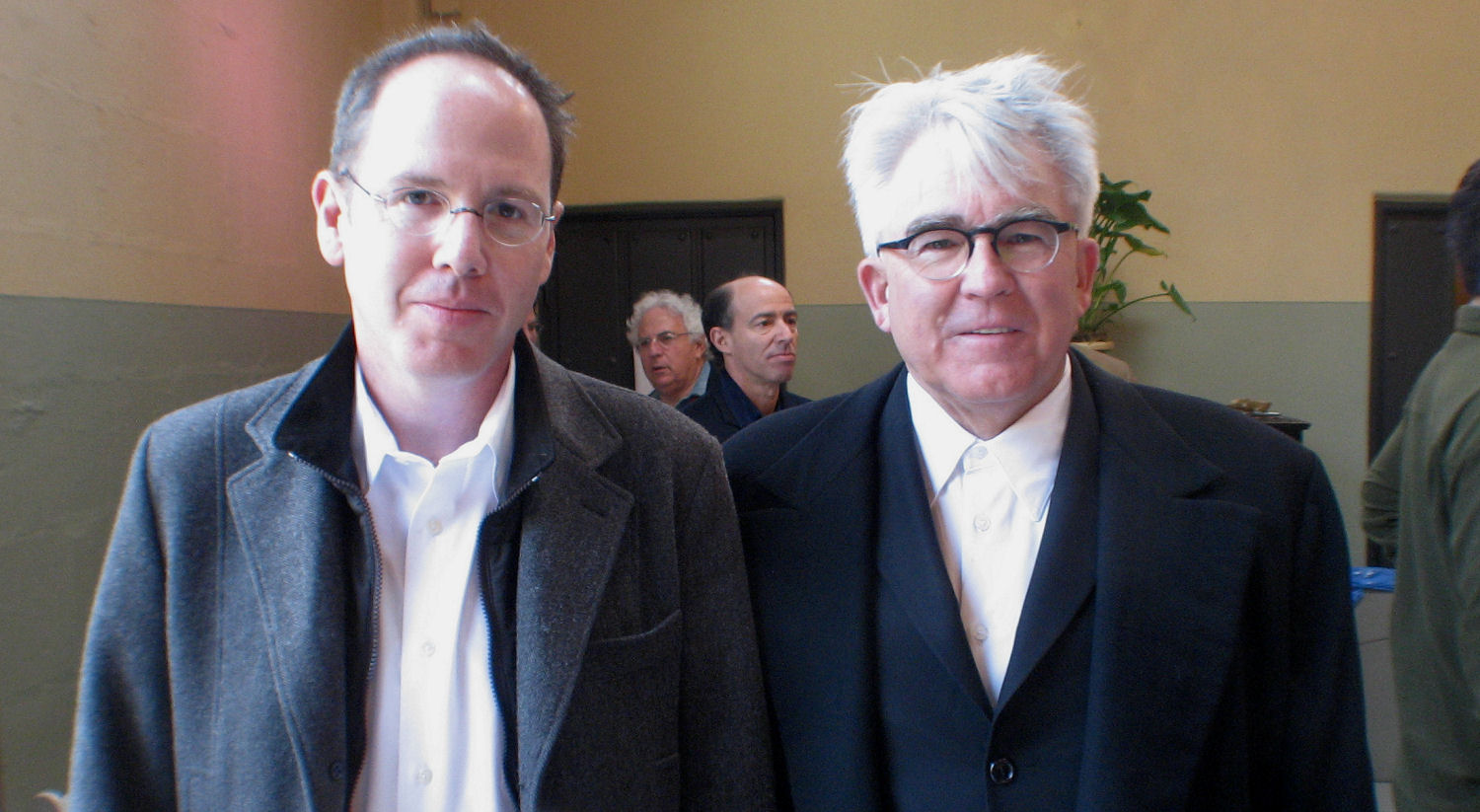
In an L.A. Weekly piece about the just-opened Landmark plex in West L.A., which is committed to showing mostly indie-level fare, critic Scott Foundas talks to San Francisco exhibitor and Telluride Film Festival co-director Gary Meyer about the future of upscale exhibition.

“It’s my feeling that within the next 10 years, the screen count in the U.S. will go from the current 37,000 to under 10,000 screens,” Meyer predicts. “Films will come out theatrically, on DVD and through on-demand cable simultaneously. There will be the occasional event film that may only be available in theaters, but for everyone else, the economics are going to dictate that things move in this direction.
“There will be centralized megaplexes; you won’t have one in your neighborhood anymore. It will be like back in the old days — you’ll be driving to the `event’ theater. Most of the small neighborhood art houses will go away, and you’ll have art complexes like the Landmark that will survive because they’ll be the only ones showing those films.”
Foundas also speaks to theatrical booker Dick Morris, who sounds a more pessimistic note. “You can’t play 12 screens of art — it’s out of the question,” he proclaims. “Most of the audience for these films is now at Forest Lawn or some other cemetery. For the under-50 crowd, it’s just not the thing to do.”
Wells note: what is Morris saying here? That art film lovers might want to think about throwing in the towel and putting a plastic bag over their heads because the game is basically over? What a fucking cynic!
And yet Landmark COO Ted Mundorff feels that the Landmark is the very theater that could bring a new generation of moviegoers to art films. “People go to a megaplex theater without necessarily having a particular film in mind,” he says. “As we play a wide array of product in the theater, I think it will introduce the theater and introduce the concept and make people want to explore films.
“If they really like going to the theater, they may take a chance on a movie they wouldn’t ordinarily go to see. There becomes a trust factor; I think people will trust what we play.
“Cheese” finally opening

16 or 17 months after the 2006 Tribeca Film festival debut of Jeff Garlin‘s I Want Someone to Eat Cheese With, a smart and emotionally poignant character comedy in the general vein of Paddy Chayefsky‘s Marty, it’s finally going to be put in front of paying audiences. Three and a half months from now, that is.


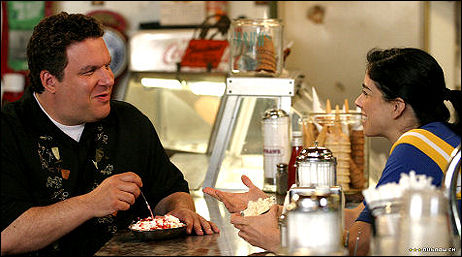
Jef Garlin, Sarah Silverman in I Want Someone to Eat Cheese With

IFC First Take and The Weinstein Company will be booking Cheese into theatres in “late September,” according to a just-received press invite to some early-bird screenings. My gut tells me that Harvey and IFC are sorta kinda looking to dump it in a super-supportive “we love you Jeff and we love your movie” type of way, but it deserves better than that.
I saw Cheese almost a year ago at the L.A. Film Festival, and thereafter described it as “a Big Fat Greek Wedding for witty fat guys, only without the wedding or the slobbery cattle-yard relatives.”
I also called it “the most entertaining and engaging audience-friendly film I’ve seen at [this festival] over the past eight days” and [that] it “definitely has the makings of a theatrical hit if it’s shaped up and sold right.”
Cheese is “a sharply written (here and there genius-level) comedy-drama about a witty, likably humble Chicago comedian named James (Garlin) who lives with his mom but badly wants a soulmate girlfriend. Vaguely fortyish, James is saddled with a yen for slurping down junk food late at night (which costs him in the romantic department), and he’s pretty good at getting shot down or turned down or fired.
“But as gloomy as James sometimes gets (and for good reason), he’s tenacious in a shuffling, good-natured, comme ci comme ca way, and you can’t help but feel for the guy and want him to succeed.
Cheese is “a small-scaled, funky-looking thing in a handheld 16mm vein (it could have been shot in the ’70s or ’80s…there’s nothing here-and-now digital in its technique or emotional approach), but it’s warm and engaging and pretty damn funny.
“Director-producer-writer Garlin — best known for his ongoing role as Larry David‘s manager in HBO’s Curb Your Enthusiasm — and his fellow performers (Bonnie Hunt, Sarah Silverman and a team of Chicago-based actor pals) are all top-notch. And in an unassuming little-movie way with the emphasis on spirit and tone and quirky-hip humor, Cheese works.
“I could feel the satisfaction levels in the house right away. The audience was totally grooving on it until the very last scene, but this is a fixable problem. The Weinstein Co. is in the process of acquiring, and if I know Harvey he’ll be pressing Garlin to re-cut or re-shoot the ending, which isn’t ‘bad’ as much as vague.
“If the finale is re-tooled in the right way, Cheese could catch on and then some. Garlin said last night he’s totally at peace with the ending and his heels are dug in, so maybe the film will go out as is. But even if it does critics and auds will still speak highly of it and it’ll do some decent business.
“Garlin’s model, obviously, is Marty. The Oscar-winning celluloid version of Chayefsky’s play, directed by Delbert Mann and released in 1955, is brought up several times, and Garlin uses a theatrical staging of the play in Chicago as a plot point.
Cheese isn’t as sad or tear-jerky as Marty, and of course, being a Garlin thing, is coming from a wittier, schtickier place. Marty was about urban lower-middle-class pathos and the loneliness of a homely Brooklyn butcher (Ernest Borgnine). Garlin’s world view (and his film’s) is that of a candid, very bright, vaguely self-loathing Jewish comic with gumption…big difference.”

Shapiro has been shilling

Former O.J. Simpson attorney Robert Shapiro has been defending and rationalizing the Paris Hilton side of the story during talk-show visits on MSNBC and CNN. Radar‘s Jeff Bercovici is reporting that he’s not only a paid shill, but that he hasn’t informed MSNBC producers of this fact. (A CNN spokesperson told Bercovici he/she “could not immediately say whether its producers had knowledge of the arrangement.”) Last Friday Shapiro was a guest on both MSNBC’s “Countdown” with Keith Olbermann and CNN’s “Anderson Cooper 360″ to discuss the case.

Morrison’s folly

I’m sorry for Tennessee-based projectionist Jesse Morrison (AICN’s “Memflix”) having been whacked for submitting a negative, embargo-breaking review of Fantastic Four: Rise of the Silver Surfer, but whatever happened to the practice of subterfuge?
Morrison had to know he might run afoul of his bosses (he worked for the Malco theatre chain) if it became common knowledge that he’s been reviewing the same films he’s shown to the occasional test audience, and reviewing for AICN to boot. Morrison can’t be so dumb not to have known that.
If he was willing to risk his job by reviewing Fantastic Four/Silver Surfer a few days early, why didn’t Morrison simply submit it through a friend with a freshly created moniker, so the source couldn’t be traced? (Better yet — an out-of-state or out-of-country friend.) I’ll tell you why. Because he’s a known AICN quantity — he’s the one and only Memflix, a guy with friends and followers who’s enjoyed certain levels of attention and respect — and he didn’t want to write without the glory and the ego-boost, and so he was found out and paid the price.
AICN’s Drew McWeeny got angry at Fox yesterday (or was it Tuesday?) for “tracking Morrison down and getting him fired, threatening to pull their business from the entire chain over that review. Think about that for a minute… this is one megacorporation threatening to blackball another corporation because one guy didn’t like their movie and had the stones to say so. So fuck you, Fox. You have proven over and over that you not only hate your audience, but you don’t want to know what they think. All you care about is the filthy lucre.”
I say again — if you want to be a truth-telling crusader, at least do so with the basic Jack-and-Jill knowledge that there are corporate types out there who get angry when they decide that a certain truth-teller has affected their interests and security, and, being corporate types, will take steps to get you. Why do I feel as if I’m addressing a class of second-graders here? It’s a wild world out there, and the forest is filled with lions, tigers and bears. So be smart, assholes, and learn how to hide under bushes and behind trees.

“The Heartbreak Kid” script

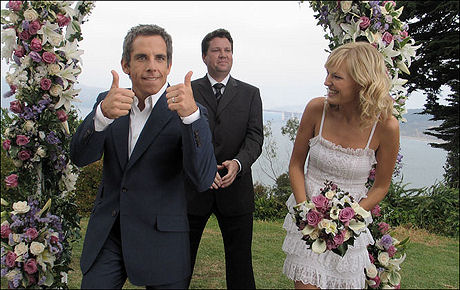
A guy sent me an October 2006 script for the Farrelly BrothersThe Heartbreak Kid (Dreamamount, 10.5.07), which stars the rapidly graying Ben Stiller.
The cover page says “Most Recent Revisions by John Hamburg and Peter Farrelly,” and then “Revisions by Peter Farrelly, Bobby Farrelly and Kevin Barnett,” and then “From a short story by Jay Friedman” and “Adapted from the original screenplay by Neil Simon,” and then “Previous revisions by Leslie Dixon & Scot Armstrong.”
“Leslie Dixon did the first draft,” the guy explains, “and it was pretty good before it became Farrelly-ized. Her draft attracted Jason Bateman for the lead part, but the Farrelly drafts attracted Stiller. Although the movie tested higher than There’s Something About Mary, they went back to re-shoot the ending a few times to make it just right.”

“No Country” trailer

The image is unnatural — squeezed into 1.37 to 1 when it should be 16 x 9 — but Variety columnist Anne Thompson has an exclusive on the new trailer for Joel and Ethan Coen‘s No Country For Old Men.

The Miramax marketing guys have made this marvelous film look like an action-horror flick about a stalking ogre with an early ’80s haircut (Javier Bardem‘s “Anton Chigurh”) out to kill and kill again like the most ungodly and merciless Jason/Freddy Krueger psychopath of all time. And he is that, yes, only much, much funnier. And the movie isn’t an action-horror film. It’s much deeper and darker than that.

Academy votes an exception

The Academy of Motion Picture Arts and Sciences has finally responded to storms of criticism that came down early this year when they declined to nominate Little Miss Sunshine producers Ron Yerxa and Albert Berger as recipients for the Best Picture Oscar because of a dumb-ass rule stating that only three producers can be eligible.


Little Miss Sunshine producers Albert Berger, Ron Yerxa at last January’s Santa Barbara Film Festival

Now the Academy will consider more than three producers if and when the situation involves “a rare and extraordinary circumstance.” The new decision was “adopted by the film academy√ɬ¢√¢‚Äö¬¨√¢‚Äû¬¢s 43-member board of governors on Tuesday night,” according to N.Y. Times reporter Michael Ciepley.

Haiti, Sex, Death

It’s been eleven months since I ran my first piece on Asger Leth‘s Ghosts of Cite Soleil, a jolting doc about sex, violence, death and politics in 2004 Haiti, and now ThinkFilm is finally putting it into theatres on June 27th.

“This excellent 88-minute film adds recognizable humanity to a culture that has seemed more lacking in hope and human decency than any other on earth,” I wrote early on.
“Everyone will say that Ghosts is City of God but in ‘real’ verite terms…and it is that, of course. But it’s less about violent street crime than stink-from-the-head Haitian politics, and it explores an unusual romantic triangle between a white French female relief worker named Lele and two gangster brothers, 2pac and Bily (not “Billy”), and it has a tragic ending that touches you as much as any well-crafted Hollywood tearjerker could…and yet it happened all on its own.”

Remaking “The Big Chill”?

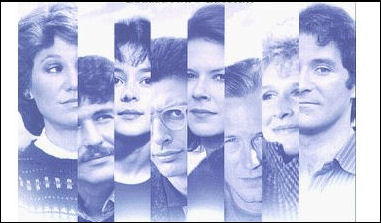
Somewhat older people (i.e., thirtysomethings) have always looked back on their early 20s with unequal blends of nostalgia and regret, and movies about same are of course permissible and expected, but you can’t just “remake” The Big Chill in a present-day context. If you want to remake a movie of this type, pick on Kenneth Branagh‘s Peter’s Friends.

Lawrence Kasdan‘s 1983 classic was about a bunch of middle-class people in the early ’80s who’d lived together and gotten high and enjoyed bacchan- alian sex in the late ’60s, and 15 years later were coming to terms with not just adult life, but adult life as influenced by a culture that had abandoned and moved on from the pseudo-rebellious atmosphere of the free-form ’60s. A Ronald Reagan culture that had become “chillier.” A society more invested in status and income levels and less about heart, spirit and discovery.
This changeover spirit hasn’t manifested between, say, the early ’90s and today, or the mid ’80s and today. There’s just no analogy that fits so forget it. Just make an old-friends-getting-together-ten-of-fifteen-years-later movie and make it your own.

Caro dissing Farrelly Bros. “Kid”

Pop Machine‘s Mark Caro rips into the Farrelly BrothersThe Heartbreak Kid (Dreamamount, 10.5.07) with Ben Stiller in the Charles Grodin role.

Going by the trailer, Caro suspects the feature may be a cowardly, slapstick-shallow, hopelessly dumbed-down non-echo of Elaine May‘s original The Heartbreak Kid (1972), which was funny but at the same time traumatic, angst-y and occasionally cruel. My favorite scene was the abrasive after-dinner confrontation between Grodin and Eddie Albert (i.e., playing Cybil Shepherd’s dad), in which Albert tried to buy Grodin off.
Caro understands, of course, that every remake of a film made in the ’60s, ’70s or ’80s has to be cruder and dumber than the original. He realizes that today’s under-35 moviegoer need things to be broader, louder, blunter, etc. “Hit me with it!…no, pour it over my head!” works much better than “nudge me in the ribs” or “whisper it in my ear.” Nonetheless, Caro is pissed.