Oh, Stop It…She’s Okay in “OBAA” But Only That
January 13, 2026
Timelessness of Divinity?
January 13, 2026
I Still Say Stacy Martin Is Too Hot To Portray A Sex-Averse Religious Zealot
January 13, 2026
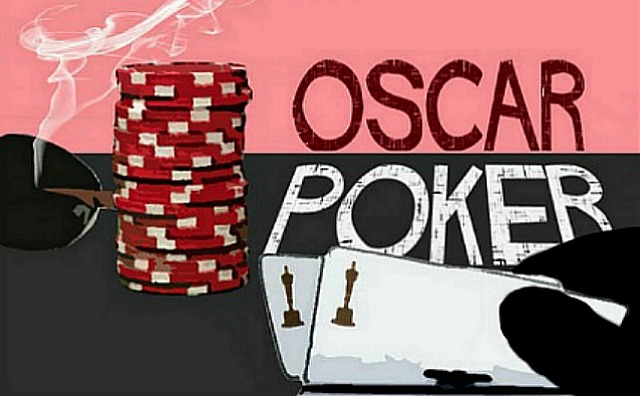
Well, it’s not really an “Oscar Poker” because it doesn’t have the music intro that Sasha Stone used to record and attach, but it’ll do.
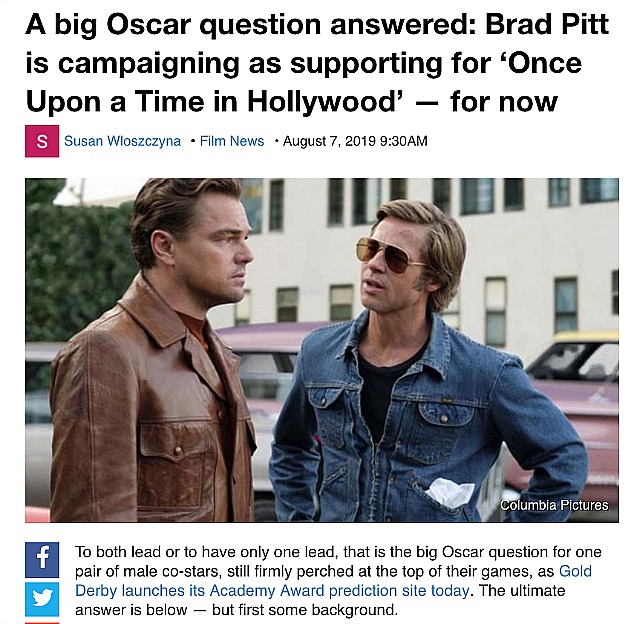
World of Reel‘s Jordan Ruimy and I decided to assess the current Best Picture spitballs, as listed on Gold Derby — The Irishman (“Made more by the guy who made Silence than the guy who made Goodfellas“), Marriage Story, 1917, Judy, Once Upon A Time Hollywood, Little Women, A Beautiful Day in the Neighborhood, The Farewell, The Lighthouse, JoJo Rabbit.
Footnote #1: The Irishman will run about three hours, I was told earlier today.
Footnote #2: Early in the discussion I mentioned that I wasn’t aware of any Les Miserables screenings at any of the big early-fall festivals. An hour or two later I learned that Ladj Ly‘s film will play at the Toronto Film Festival.
I’m told that Ladj Ly‘s Les Miserables, a gripping cops vs. street kids drama set in contempo Paris and easilly the most intense, high-throttle film shown during last May’s Cannes Film Festival, will screen during the forthcoming Toronto Film Festival.
But I wish this Amazon film would also screen at the Telluride and New York film festivals, which would allow Hollywood Elsewhere to catch it a second time without breaking stride.
I was a huge fan in Cannes along with everyone else. It’s certainly among the year’s best, and it ought to be the official French nominee for Best Foreign Language Feature.
“The first truly exciting film of the 2019 Cannes Film Festival screened this afternoon — Ladj Ly‘s Les Miserables. Set in the Parisian suburb of Montfermeil, a poor but tightly knit Muslim community, it offers a jolting contemporary echo of the cruelty, harassment and oppression that ignited Victor Hugo’s classic 1862 novel, this time rooted in police brutality and racial animus.
“Written by Giordano Gederlini and Alexis Manenti and brilliantly shot by Julien Poupard, LesMiserables feels like a rough-and-tumble Antoine Fuqua film, using the basic dynamic of Training Day (but with three cops instead of two) plus a Little Do The Right Thing plus a dash of the anxious energy of William Freidkin‘s The French Connection.
“But it’s about more than just urban action beats. It’s a racially charged tragedy, injected with sharp social detail and several strong (if somewhat sketchy) characters on both sides of the tale. It’s a bit splotchy and slapdash at times, but is quite the ride.
“Part policier and part social-canvas suspenser, Les Miserables is basically about conflicted cops (including one bad apple) under pressure vs. a crew of scrappy, rambunctious, vaguely criminal kids in the ‘hood.
“It takes the side of Montfermeil natives (Ly was raised there) but also portrays the cops in reasonably fair and humanistic terms.
“Closing motto: ‘There are no such things as bad plants or bad men. There are only bad cultivators.’
Originally posted on 1.11.08: “Does anyone remember that scene in At Close Range when Sean Penn and his gang are getting ready to rob a truck, and Penn tells Crispin Glover to stand watch and tell them when he sees it coming down the road? Glover eventually spots it from afar, but he can’t just spit out the words “here it comes.” Because he’s “Crispin Glover”, he gets all spazzy and tongue-tied as he says in that nerdy voice with one of his hands patting the back of his head, “Uhhmm…haaaeeeyyy?…here comes the truck!”
Steve McQueen‘s Chicago-based Widows was a sophisticated, femme-slanted heist thriller that was just as focused on racism, local politics and neighborhood culture as it was on the mechanics of a climactic robbery. It had elements of feminist fantasy but conveyed a semi-trustable feeling of 21st Century realism. Plus it had excellent performances. Plus that McQueeny art-film panache. It had enough reality echoes to pass muster.
Set in the late ’70s, Andrea Berloff‘s Manhattan-based The Kitchen uses the same premise as Widows (i.e., wives becoming criminals after their husbands are either killed or sent up the river). But it’s far less finessed than the MxQueen film, and is heavily invested in a kind of feminist-woke fantasy plot in which the three heroines — Melissa McCarthy, Tiffany Haddish, Elizabeth Moss — become better, tougher, more efficient criminals than their husbands while two of them become even more ruthless and brutal.
I didn’t believe a fucking word of it. A few scenes work (especially toward the end), but mostly it’s shallow, trite boilerplate stuff.
I didn’t hate The Kitchen. I actually liked Moss’s performance as a sadly abused, extra-angry wife whose ruthless side comes out when her brutish hubby is jailed, and I enjoyed Bill Canp‘s droll and avuncular Brooklyn mob boss. But I was shaking my head in disapproval less than five minutes in.
Almost every scene feels phony or hackneyed or second-tier in one way or another. There’s a Brooklyn hitman character named “Joe Goon”….c’mon! And there’s too much garbage on the streets. I know that Hell’s Kitchen (Manhattan’s West 40s) was a down-at-the-heels neighborhood in the ’70s, but almost every exterior scene looks like production assistants were told to throw garbage around for the sake of atmospheric realism. Too much, I tell you!
Moss’s Claire plus concerned mom Kathy (McCarthy) and their pal Ruby (Haddish) are the insufficiently respected wives of small-time thugs (Brian d’Arcy James, James Badge Dale, Jeremy Bobb) who get arrested and sentenced to three-year terms after holding up a liquor store.
The wives are told by the local Irish mob (aka the “Westies”) that they’ll be “taken care of” while their hubbies are in stir. Bullshit — the money they receive isn’t even enough to cover the rent. And so Kathy, Ruby and Claire start shaking down local merchants for protection money. Which in itself is obviously a hostile and oppressive thing to do, bui they do it with a smile and the ladelling of neighborly affection. The fuck?
Naturally the Westies aren’t happy that the wives are muscling in on the action, but guess what? The wives are tougher and more murderous than anyone expected. So fuck you, Mr. Irish mob boss — you’re not only a dead Mick but your head, legs and arms are being sawed off and your lungs are being removed in the bathroom before the whole package is dumped into the Hudson. Meanwhile the Italian Brooklyn bad guys (Camp, “Joe Goon” and the others) are anxious and wary but ready to talk turkey about slicing up the pie.
Yesterday Collider posted an interview with GuillermodelToro in which he elaborated (somewhat) about his vision of Nightmare Alley, which might have starred LeonardoDiCaprio but will, in fact, star BradleyCooper.
GDT: “The [William Lindsay Gresham] book was given to me in 1992 by RonPerlman, before I saw the TyronePower movie, and I loved the book. My adaptation that I’ve done with [co-writer] Kim Morgan is not necessarily…the entire book is impossible, it’s a saga. But there are elements that are darker in the book, and it’s the first chance I have…in my short films I wanted to do noir. It was horror and noir. And now is the first chance I have to do a real underbelly of society type of movie. [There are] no supernatural elements. Just a straight, really dark story.”
FBI and local Floridian law enforcement should be immediately advised. This radical fanatic is no different than any ISIS murderer. Hollywood Elsewhere lives fairly close to Silverman and hereby offers to do whatever I can do within reason to help protect her — this is horrendous.
This is Adam Fannin of the Stedfast Baptist Church in Florida and he is going to get me killed. pic.twitter.com/I6Us59o59v
And speaking of contrarian uglies, TheWrapreported this evening that the FBI has advised Rosanna Arquette to make her Twitter account private after online critics attacked her yesterday for tweeting that she was ashamed of being “white and privileged.”
Arquette to TheWrap‘s Sean Burch and Sharon Waxman: “Yes, I’m locked to protect myself…I was told by [the] FBI to lock it up. There are toxic and very vicious people on social media. Threatening and cruel. I said yesterday that I am ashamed of the color of my skin. I am privileged just because I’m white. I feel shame. Because of all the violence that is happening in America and other racist countries.”
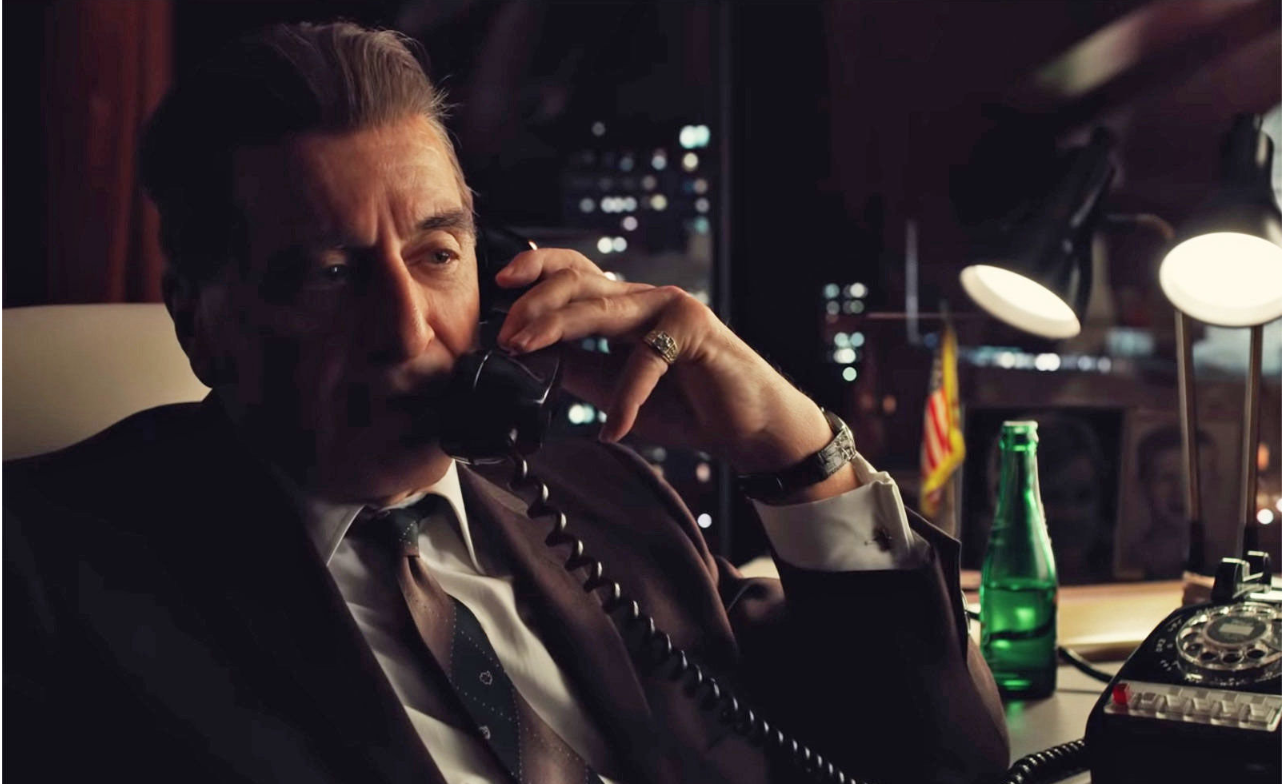
Updated Thursday evening: It’s hardly sticking my neck out to say that Martin Scorsese‘s The Irishman will definitely be Best Picture nominated, and that it’s looking like the odds-on favorite to win. Because apart from the story being about Robert De Niro‘s Frank Sheeran taking a long, hard look at his life, it’s also a Scorsese sum-upper — a kind of “who am I and what have I accomplished?” movie, the fifth and final Scorsese gangster flick that will assess the previous four (Goodfellas, The Departed, Mean Streets, Casino) along with itself, and issue a late-in-life assessment of the moral, ethical and aesthetic meat of the matter. Half street saga, half melancholy elegy. A cinematic equivalent. if you will, of Frank Sinatra‘s “It Was A Very Good Year.”
I wouldn’t call myself a devoted reader of popular fiction, but in the late ’70s I was heavily into all things Ira Levin (Rosemary’s Baby, The Stepford Wives, Sliver, A Kiss Before Dying, Deathtrap). Authors of his sort are sometimes under-appreciated, but Levin was a gifted craftsman. He really knew how to shape a sentence, a paragraph, a chapter, a story.
And then along came Levin’s heyday period — the novel of The Boys From Brazil in ’76, and then his most successful play, Deathtrap, in early ’78.
I loved The Boys From Brazil — so deliciously written, so crafty and hooky. All through ’77 and most of ’78 I was highly cranked about Franklin Schaffner’s film version, which I anticipated would be the equal of Roman Polanski‘s Rosemary’s Baby (’68). How could it not be?
I also felt a certain personal investment due to Jeremy Black, the younger, blue-eyed brother of ex-girlfriend Sophie Black, having been cast as a clone of the young Adolf Hitler.
Then I attended a press screening of The Boys From Brazil in September of ’78, and was startled — the word is actually “stunned” — by how disappointing it seemed.
Gregory Peck was too mannered and actorish as the evil Josef Mengele, but Laurence Olivier‘s performance as Nazi-hunter Ezra Liberman was steady and invested. The film wasn’t inept or clumsy, exactly, but somehow it never took flight. “How could this have happened?” I wondered, shaking my head. But it became a mediocre film for the most part.
And on top of everything else Schaffner hadn’t given poor Jeremy the right kind of direction in a couple of scenes. What a bummer.
It just goes to show that any adaptation of a catchy, fine-tuned novel can be messed up if there’s a will to do so, and especially if the wrong director is in charge.
Can anyone name similar cases? A novel they were in love with, and then the film came along and the reaction was “what happened?”