Continued Mothballing of Rhett and Scarlett

The reputation of Gone With The Wind began its decline a little more than three years ago. The campaign began with former N.Y Post critic Lou Lumenick calling its “undeniably racist” attitudes no longer tolerable in our current socio-political climate. This was reiterated last August when the Orpheum theatre in Memphis said it would no longer show Gone With The Wind after receiving complaints about the 1939 film being “insensitive”, etc.

Now a Reddit piece offers further proof of how yellowed and moth-eaten Gone With The Wind is by the current calendar. With Margaret Mitchell‘s story spanning the years 1861 to 1873, David O. Selznick‘s film is now slightly closer to the Civil War era it portrays than to the present day. The film opened 78 and 1/2 years ago (i.e., December 1939) while the timeline of the film (which begins in April 1861) began just shy of 79 years before that event.

The author of the eight-day-old Reddit piece, “u/RespectMyAuthoriteh,” goes on to explain in detail how phenomenal the popularity of Gone With The Wind was, considering the intense competition from other films. Example #1: “From the ’20s to mid ’50s seven major Hollywood studios were grinding out 25 to 40 movies per annum,” etc. Example #2: “Gone With The Wind finally left theaters in late 1941. But it was such a huge hit, it was already resurrected for a revival run in March 1942, just three or four months later. It ran on Broadway for two years straight. That’s why GWTW‘s run is so impressive. There has never been anything like it before or since, with the possible exception of Star Wars.”
Read more

Mid-Clinton Era

I was in a negative-attitude place with Robin Williams at the time of Joe Johnston’s Jumanji. I’d loved Williams’ genie in Aladdin but half-hated his overly precious acting in The Fisher King, and I really despised him in Hook, Toys and Mrs. Doubtfire. But man, I sure do miss that mid ’90s Williams now. He was around 43 when he made Jumanji, and had another seven years of good career traction ahead of him. Things started to go downhill after his performance in Chris Nolan‘s Insomnia (’02)

Last December’s Jumanji: Welcome to the Jungle was a huge hit, of course — $404 million domestic, $962 million worldwide. I avoided it like the plague, mostly due to the presence of Dwayne Johnson. So I’m in no position to compare it to Johnston’s 1995 original, which brought in $100 million domestic and $262 million with overseas revenue. I can report, however, that Detroit News critic Adam Graham wrote last December that Jumanji: Welcome to the Jungle “makes the original Jumanji look like a towering cinematic achievement.”

The general consensus was that Johnston’s film was (a) far from classic but (b) not too bad. I remember loving David Alan Grier‘s performance as an easily flustered local cop.

Not Again

Upmarket screenwriter Erin Cressida Wilson (The Girl on the Train, Men, Women & Children, Secretary) will pen a Paramount remake of Adrien Lyne‘s Indecent Proposal. Collider‘s Jeff Sneider reported it first.

The 1993 drama, adapted by Amy Holden Jones and costarring Robert Redford, Demi Moore and Woody Harrelson, was basically a chick flick that flirted with the double-edged fantasy of a woman being paid a million smackeroos for a single night of sex with a suave, good-looking billionaire. Lyne’s film won three Razzies (Worst Picture, Worst Supporting Actor, Worst Screenplay) but earned $266 million.

I saw Indecent Proposal once a quarter-century ago, and have never even flirted with a re-watch. I recall flinching in my theatre seat when Moore used the term “dream house” in a voice-over narration. But this clip is pleasing. The 81-year-old Redford was 55 during shooting, and seemed a good five years younger. Harrelson had hair back then, and looked around 24 or 25 — he was actually 31. The 30 year-old Moore was peaking (A Few Good Men, Disclosure), but her fortunes plummeted after Striptease (’96) and G.I. Jane (’97).

Clinical Weirdness

Cary Fukanaga‘s Maniac costars Emma Stone and Jonah Hill as two strangers participating in a clinical trial for a new mind-altering drug. The “darkly comic” miniseries is based on a Norwegian show of the same name. Producer/writer Patrick Somerville (The Leftovers, The Bridge) wrote and created this, a Netflix version of the series. Premiering on 9.21. Sally Field and Justin Theroux costar.

Read more

Moonves Skates

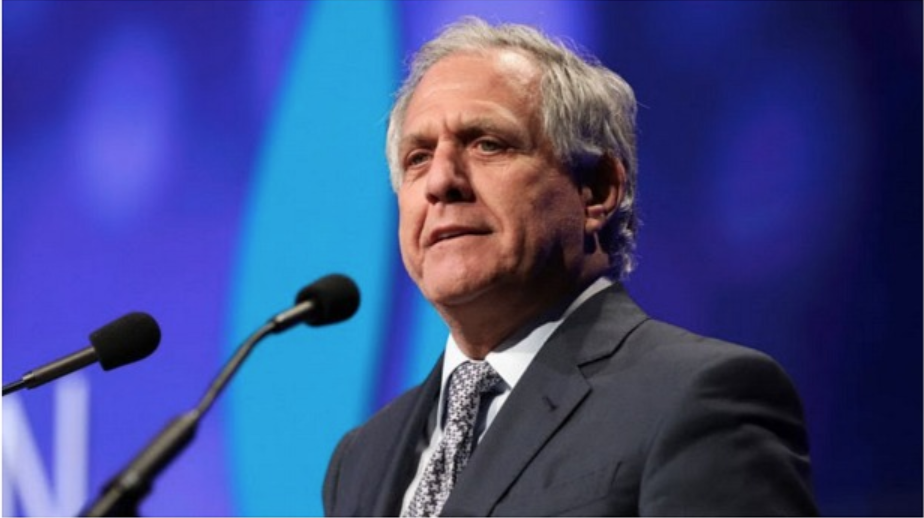
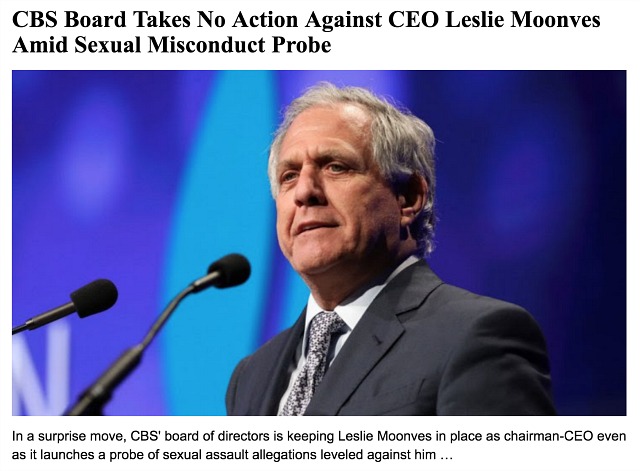
I’m recalling a David Poland tweet from two or three days ago, one that predicted that the CBS board of directors wouldn’t oust chairman, president and CEO Les Moonves over the sexual harassment complaints contained in a recently published article by The New Yorker‘s Ronan Farrow. Or suggest a leave of absence or anything.

The thinking was that the alleged incidents (Ileana Douglas, et. al.) all happened in the ’90s and ’80s. Not to mention that Moonves, married since 2004 to Julie Chen, has been contrite, apologetic and diplomatic. There is irony in the fact that Moonves is a founding member of the Commission on Sexual Harassment and Advancing Equality in the Workplace, formed in late 2017 to “tackle the broad culture of abuse and power disparity” but whatever.

The feeling among the board of directors, apparently, is that what happened in the ’80s and ’90s is distant water under the bridge.

Down Elvis Road Again

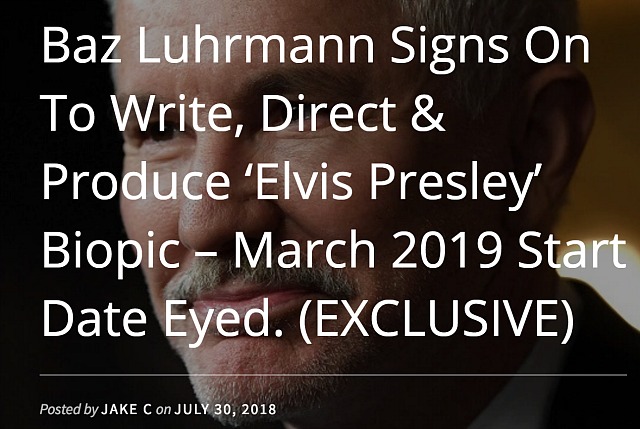
I don’t know who “Jake C.” is and I’ve never visited discussingfilm, but he’s posted an “exclusive” about Baz Luhrmann having “officially signed” to direct an Elvis Presley biopic, and to revise a script that Kelly Marcel and Jeremy Donner have previously worked on.

Production is expected to begin in March 2019, according to this report. Collider‘s Jeff Sneider first reported about a possible Luhrmann/Presley biopic four years ago, and apparently the story is half-legit “Jake C.” reports Luhrmann will also produce with Catherine Martin, Lloyd Braun and Gail Berman.

He adds that casting director Kristy Carlson is “looking for two guys to play Presley, one between 18-22 and another around the age of 35.” ATROCIOUS IDEA! Hire one cool dude to play young Elvis and then age him up slightly, which is beyond easy to do. Remember that Elvis didn’t really get fat until he was 40 or thereabouts (i.e., ’75), and that he was reasonably slender and undessicated before that. Elvis turned 35 in 1970, during the peak of his Las Vegas white-jeweled-jumpsuit era. An 18 year-old actor could easily be made to look 17 years older without anyone blinking or doing a double-take.

What’s the point of making a movie about Elvis in his late teens to early 20s (’53 to ’57), or from his Sun/Memphis years to his peak period as the king of RCA Victor ’50s sideburned bop-rock, and then fast-forwarding to the beginning-of-the-end period when he first started to perform in Las Vegas but before he became fat and drugged out and wound up dead on a bathroom floor in Graceland? Who cares?

What is there to say about Presley, really, that hasn’t been said over and over for decades? The man died nearly 41 years ago. Fame comes early to a conspicuously gifted fellow, too early for such a sensitive soul. The pressure warps the frail creative vessel, resulting in seclusion, addiction and early death, blah blah.

Eugene Jarecki‘s The King says it all, knows it all.

Read more

If Gunn Goes, We Go With Him

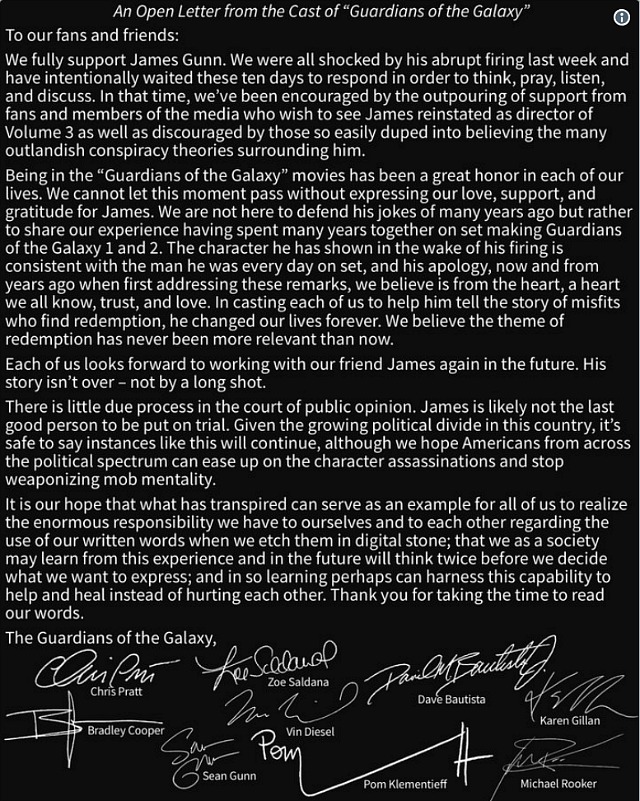
11 days after Disney fired James Gunn off the third Guardians of the Galaxy installment for having posted vulgar tweets a decade ago, the cast — Chris Pratt, Zoe Saldana, Bradley Cooper, Dave Bautista, Vin Diesel, Sean Gunn, Pom Klementiff, Michael Rooker and Karen Gillan — has issued a statement that basically says they have Gunn’s back.

As I understand it, the cast is telling Disney they might not be willing to appear in Guardians of the Galaxy 3 unless Disney reconsiders and hires Gunn back. They’re not saying this in so many words, of course, but what’s the point of standing by Gunn unless they’re prepared to back this up with deeds?

“We fully support James Gunn,” the statement says. “We were all shocked by his abrupt firing last week and have intentionally waited these ten days to respond in order to think, pray, listen, and discuss. In that time, we’ve been encouraged by the outpouring of support from fans and members of the media who wish to see James reinstated as director of Volume 3 as well as discouraged by those so easily duped into believing the many outlandish conspiracy theories surrounding him.”

“His story isn’t over, not by a long shot,” the statement declares. If I’d had a hand in the writing of the statement, I would have said “not by a damn sight.” That sounds more Ving Rhames.

A Little Woody Reminder

Five and one-third years ago Woody Allen saved George StevensShane from an aspect-ratio slicing that would have rocked the classic cinema universe and resulted in a great hue and cry from the Movie Godz. When all is said and done and the Chalamets of the world have all been put to bed, this is one of the events that will burnish and solidify Allen’s legacy.

On 3.16.13 I revealed that George Stevens, Jr. and Warner Home Entertaiment restoration guy Ned Price were intending to release a Bluray of the classic 1953 western using a 1.66:1 aspect ratio, which would have cleavered the tops and bottoms of the original 1.37 photography by dp Loyal Griggs. I howled and screamed in my usual way, but nothing seemed to change until Allen, the only top-dog, world-class director to step into this fray, shared his opinion on 4.4.13.

On 3.29 I appealed for help from Martin Scorsese in an open letter. On 4.4 I posted the Allen letter. 13 days later Joseph McBride’s letter to Stevens, Jr., deploring WHE’s intention to present the film within a 1.66 a.r., was posted. Later that day Price threw in the towel and announced that WHE’s Shane Bluray would be released in the original 1.37 aspect ratio. I’ve long believed that Allen’s opinion was the crucial factor in rectifying this situation.

Three versions of Shane were included in a 2015 Masters of Cinema Bluray (Griggs’ original 1.37:1 capturing on disc one + 1.66:1 theatrical presentation + an alternate 1.66:1 framing optimized for this ratio, supervised by George Stevens, Jr., on disc two).

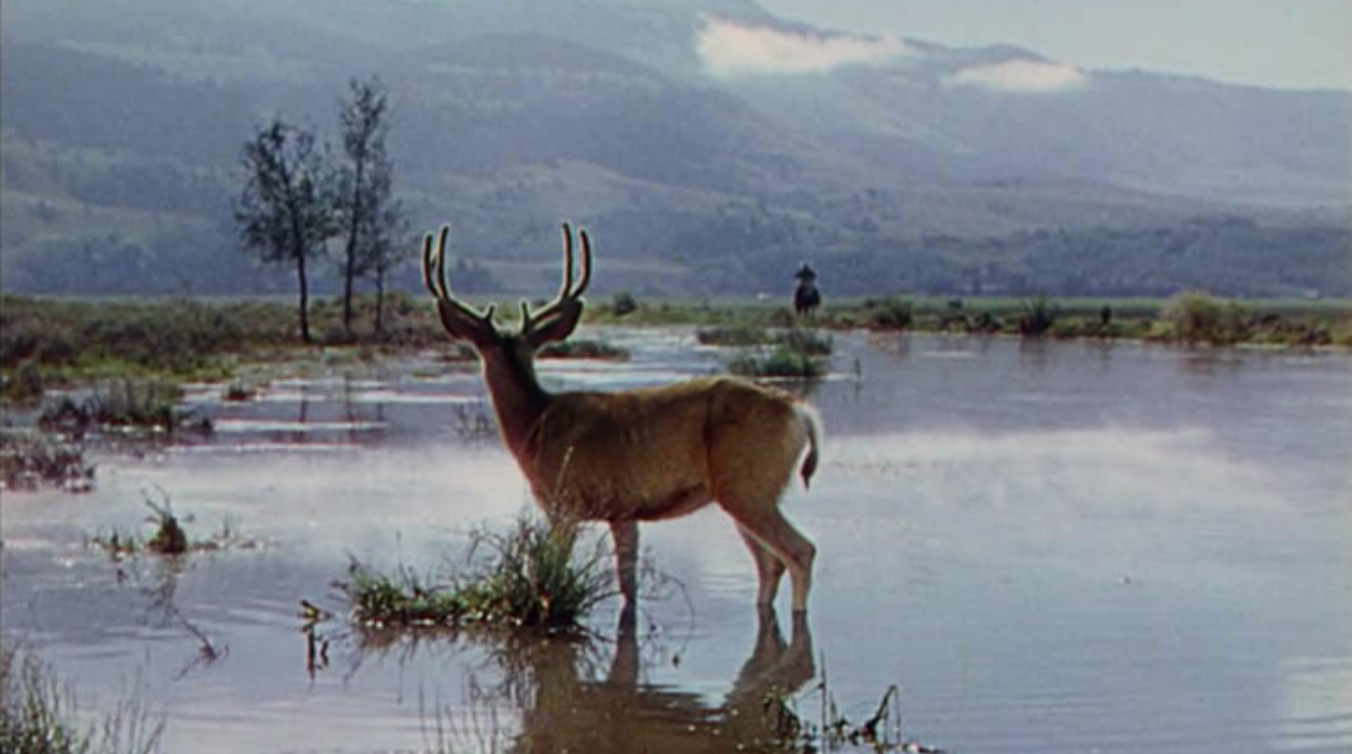
Below is Shane‘s bar fight scene in the original 1.37 a.r.; further below is the same scene sliced down to 1.66.

Ace In The Hole

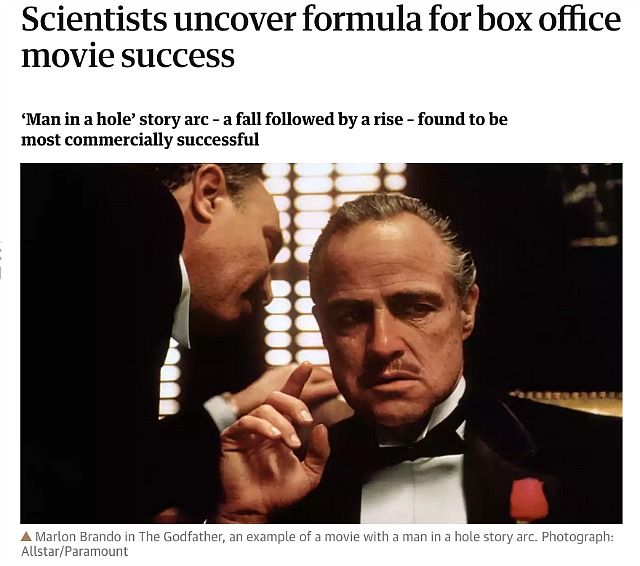
This morning I read a week-old Guardian piece about the most successful movie formula — i.e., “man in a hole.” Part of the article reads like an Onion satire, but the author, Mark Brown, is dealing straight cards.

Ignore the lede and consider the second sentence: “After analyzing data from 6,147 movie scripts and filtering it through a series of algorithms, a team of UK scientists has identified the emotional arc that makes the most money, called the ‘man in a hole’ arc.”

This sounds reasonable and most likely accurate. Stories about characters gradually pulling themselves out of a bad situation (Tender Mercies, 12 Years A Slave, Birdman, Gladiator, Places in the Heart, Ordinary People, Warren Beatty and Buck Henry‘s Heaven Can Wait, Slumdog Millionaire, The Verdict, Zero Dark Thirty) always deliver a measure of comfort if not a balm to the soul.

The howler arrives in the third sentence: “[This discovery] could be game-changing for both film producers and audiences, said Ganna Pogrebna, a professor of behavioral economics and data science at the University of Birmingham, who led the research team. ‘We know that when we talk about movie production it is a small group of people that make decisions for the viewers. We were essentially trying to listen to the viewer, to see what they actually want.”

Brown explains that the Birmingham scientists have “categorized movies according to six emotional profiles or clusters, which were previously applied to novels.

“These are (1) rags to riches — an ongoing emotional rise as seen in films such as The Shawshank Redemption; (2) riches to rags — an ongoing emotional fall; (3) Man in a hole; (4) Icarus – a rise followed by a fall (On the Waterfront); (5) Cinderella — a rise followed by a fall followed by a rise (Babe); and (6) Oedipus, a fall followed by a rise followed by a fall (All About My Mother).”

Pogbrena believes that “riches to rags movies could be financially successful if they’re epic and made with a huge budget, such as Christopher Nolan’s Batman movies.” He’s also concluded that “Icarus films are most successful with a low budget, and that Oedipus films do not do well at awards ceremonies.”

The research data claims that The Godfather is a “man in a hole” movie, or one in which the lead character (i.e., Michael Corleone) starts out more or less happy or at least content, falls into a pit of danger and misfortune and then gradually climbs out of it. In fact Francis Coppola‘s 1972 film has two lead characters — Marlon Brando‘s Vito Corleone + Al Pacino‘s heir apparent — who experience this fate.

Read more

Comfort Food

“The normal rules of politics do apply to Donald Trump, after all.

“Four years ago, he became the fifth man to win the presidency while losing the popular vote. Now he becomes the fourth of those five — along with John Quincy Adams, Rutherford Hayes and Benjamin Harrison — to serve only a single term, and to be unpopular during most of it. The exception is George W. Bush, who benefited from being a wartime president.

“In hindsight, the extraordinary nature of the circumstances that propelled Trump in 2016 have become obvious: the unpopularity of his opponent, Hillary Clinton; the help from Russia; the late involvement of James Comey, the then-F.B.I. director who now hosts an ABC talk show; and Trump’s razor-thin victories in several states.

“Without that good fortune this year, Trump still won roughly 90 percent of self-identified Republicans and Republican-leaning voters. Yet it was not nearly enough.

“’Trump said he was going to fix things, and he didn’t,’ said Kevin O’Reilly, 54, of Manchester, N.H., who voted for Barack Obama in 2012, Trump in 2016 and Elizabeth Warren this year. ‘I don’t think he really cares about the middle class. He cares about himself.'” — from David Leonhardt‘s “How Trump Lost Re-election in 2020,” posted in N.Y. Times on 7.29.