Contained in the just-received 6.7.18 edition of Richard Rushfield‘s The Ankler:
Seven months ago Quentin Tarantino told Indiewire‘s Anne Thompson that Once Upon A Time in Hollywood, which may start shooting in Los Angeles sometime this month, would be more about hippy-dippy 1969 Los Angeles than the Tate/LaBianca murders by the Manson family. Exact quote: “It’s not Manson, it’s 1969.”
Maybe so, but the latest announcement of casting and characters for Once Upon A Time in Hollywood sure as hell overlaps with the August 8th murders at Roman Polanski and Sharon Tate’s home at 10050 Cielo Drive.
Damian Lewis is playing Steve McQueen, who was invited to drop by the Polanski/Tate home that evening but at the last minute decided to hang with a girl he’d just met.
Emile Hirsch is playing hairstylist Jay Sebring, who was one of the Cielo Drive victims along with coffee heiress Abigail Folger, Folger’s boyfriend Voytek Frykowski and an 18 year-old named Steven Parent.
Dakota Fanning is playing Lynette “Squeaky” Fromme, a Manson family member who wasn’t at the Polanski/Tate home that evening but attempted to murder President Gerald Ford on 9.5.75.
Tate will be played by Margot Robbie, and Burt Reynolds will reportedly play George Spahn, the weathered owner of the Spahn Movie Ranch who allowed the Manson family to live on the ranch in the weeks and months before the August ’69 killings.
I’m posting this out of boredom. My tank feels empty now. That review of Ocean’s 8 took it out of me. Plus I have stuff to do this afternoon.
Earlier this week Indiewire‘s David Ehrlich posted a survey piece titled “The Best Movie Plot Twists of All Time.” Various critics had passed along their favorites, etc.
Allow me to start my own conversation about same, and to begin by noting that far too many screenwriters are convinced that third-act twists are essential components for a strong commercial script. What they’ve become, in fact, is a kind of pestilence. The third-act switcheroos on the parts of Woody Harrelson and Emilia Clarke‘s characters in Solo (i.e., “You thought I was an ally but I’m not”) are but one example. That bullshit twist in Adrift is another.
People also need to understand the difference between a twist and a striking third-act plot development. Revealing that the young Charles Foster Kane‘s sled was called “Rosebud” is not a twist — it’s simply a revelation. Ditto Kevin Spacey telling Brad Pitt and Morgan Freeman that he visited Pitt’s wife, Tracy, and cut off her head and then sent it special delivery in a box. That’s not a twist — that’s a stunning macabre occurence.
The coolest, most satisfying, top-ten twists in own moviegoing experience, and in this order: 1. M. Night Shyamalan‘s The Sixth Sense; 2. George Roy Hill‘s The Sting; 3. Bryan Singer‘s The Usual Suspects; 4. Gregory Hoblit‘s Primal Fear; 5. Irvin Kershner‘s The Empire Strikes Back. 5. Franklin Schaffner‘s Planet of the Apes; 6. Alfred Hitchcock‘s Psycho; 7. Alejandro Amenabar‘s The Others; 8. Alan Parker‘s Angel Heart; 9. John Ford‘s The Man Who Shot Liberty Valance. 10. Neil Jordan‘s The Crying Game.
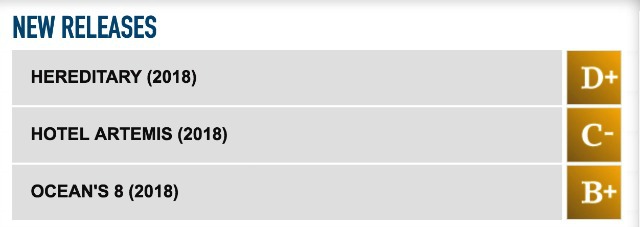
I purposely didn’t read a slew of Ocean’s 8 (Warner Bros., 6.8) reviews before seeing it Wednesday night. (All the way out in Burbank, by the way.) I wanted to just go in clean and ready for whatever. And honestly? It doesn’t deliver much but it’s not that bad.
This being a chick flick of sorts, I was afraid (and I know how sexist this sounds) that it might lean too much on emotional content. Hugging, crying, hurting…that line of country. But to my profound surprise it doesn’t get into emotional stuff at all. It’s like “emotion who?” It deals almost nothing but dry, droll, mid-tempo cards. And I kind of liked that. Was I knocked out? No, but I felt oddly placated.
The strongest emotional current in Ocean’s 8 is one of revenge on the part of Sandra Bullock‘s Debbie Ocean, a great-looking, zero-drama 40something with an almost icy composure. The revenge is directed at a former male colleague who did an uncool thing, resulting in considerable discomfort for Debbie, and so he must be paid back. But beyond this issue, Ocean’s 8 is almost purely a technical or logistical exercise film.
It’s about Bullock commanding a team of six ultra-confident, super-poised women with no hangups or behavioral issues of any kind (Cate Blanchett‘s Lou, Rihanna‘s Nine Ball, Sarah Paulson‘s Tammy, Mindy Kaling‘s Amita, Awkwafina‘s Constance, Helena Bonham Carter‘s Daphne). The goal is to steal a $150 million, six-pound Toussaint diamond necklace. The job will happen during the annual Met Gala, and the mark will be Anne Hathaway‘s Daphne Kruger, a flush, big-time celebrity.
Ocean’s 8 is also about wallowing in wealth and fashion porn in midtown Manhattan, and about the importance of always keeping your cool and being one or two steps ahead of the other guy. I half-enjoyed the fact that the team looks great, and that their makeup and hair are perfect in every scene. Hell, everyone looks good. Even the late-arriving James Corden, playing an insurance investigator, has been buffed to the max.
That wasn’t a typo about Bullock having six partners for a total of seven. They only become a crew of eight in the third act, and that’s after the job has already been pulled.
Director and co-writer Gary Ross, co-scenarist Olivia Milch and producer Steven Soderbergh knew exactly what they wanted to do, which was to stay on a mellow and even keel. And so Ocean’s 8 just glides along in second or third gear for the most part. Nothing crazy happens, and certainly nothing dark or startling (like, for example, a 2018 equivalent of Richard Conte dying of a heart attack on the Las Vegas strip in the original 1960 Ocean’s 11) or ominous or even a bit sad. It doesn’t get into drama at all. Start to finish, the whole thing is cool, calm and collected. It’s not even that complex or tangled. You can actually follow what’s going on.
Marlon Brando‘s Emiliano Zapata is suddenly seized with self-doubt. He’s become the very thing he once fought against. He’d begun to circle the name of Henry Silva‘s Fernandez, whom only a few seconds ago he’d regarded as an irritant or an enemy. Then the feeling spreads. Joseph MacDonald‘s camera dollies in as a key light hits Brando’s eyes and cheekbones and for 32 seconds — 2:08 to 2:40 — the realization sinks in. Joseph Wiseman places his hand on Brando’s shoulder, conveying a shade of concern but not much comfort, and the score by the great Alex North underlines and obliterates.
Matthew Cullen‘s London Fields “was selected to be screened in the Special Presentations section of the 2015 Toronto Film Festival, but it was later pulled from the festival roster after Cullen sued the film’s producers, accusing them of fraud and using his name to promote a cut of the film he does not support.”
From Kaleem Adtab’s 9.17.15 review, published by The Independent: “Images of a world in chaos flash throughout the film, which is told from the perspective of an American writer who has come to London to seek inspiration for a new novel.
“Billy Bob Thornton plays Samson Young, trying to overcome writer’s block by sampling the underbelly of London life. He is a quiet, lonely figure who complains that he has a bad imagination. Given that much of what happens on screen comes from his imagination, this is a big problem. Most scenes lack pace, are performed badly and are accompanied by a running commentary of action we can see for ourselves. It’s car-crash film-making.
“Young has two suspects in mind: a cockney hooligan who dreams of being a darts champion (Jim Sturgess) and a city slicker (Theo James) who is bored with his seemingly idyllic life. All three parts of this love triangle give dire performances and when the action settles on their shenanigans the film falls apart, and the early promise of an inquiry into the writing process, à la Adaptation, goes by the wayside. Of the characters it’s only the uncredited Johnny Depp, the coolest guy in the room with his dapper dress sense and long sideburns, who comes away with any credit.
The reason I visit Starbucks is partly the coffee, of course, but mainly the wifi. And yet I never just squat — I always order something. Because it’s rude to just stroll in and plop down and suck up their wifi like a hobo. They’re trying to run a business and they only have so much space for customers. I figure the least I can do in exchange for the good wifi is order a black coffee and perhaps even a large cappuccino with an extra shot.
If I’d arranged to meet someone at Starbucks I would definitely order a tea or a coffee before sitting down. It’s just good manners, and who can’t spare a couple of bucks?
Those Philadelphia dudes who got escorted out of a Starbucks six or seven weeks ago were probably targeted because of their skin shade, but they would’ve been free and un-hassled if they’d simply ordered something. Starbucks isn’t a public library or park or airport lounge — it’s a business.
I’m totally down with the idea of Starbucks exec chairman Howard Schultz, an actual billionaire, running for president against fake billionaire Donald Trump in 2020. Yesterday Schultz resigned as exec chairman, effective 6.26, with his eye on new challenges. He’s obviously pondering a White House run. Schultz has the Starbucks brand recognition. He’s obviously innovative, practical minded and not insane, and he could pull away from the pack. And the rural dumbshits would’t feel threatened because he’s white, albeit half-Jewish.
Nobody really believes that Bernie Sanders can beat Trump. Everyone likes Joe Biden but he has a certain yesterday’s-news aura (not to mention that horrible neck wattle). And Oprah Winfrey has made it clear that she lacks the character and cojones to run. Somebody has to step up and start making noise about replacing Trump. If not Schultz, who?
When it came to mastering The Big Country for Bluray, MGM technicians were both the bad guys and the good guys. They incorrectly mastered the 1958 William Wyler film eight years ago so that their 2011 Bluray appeared to have the mumps, but they also fixed the problem when Kino Lorber bought the video rights last year.
KL told MGM they would pay to fix the mumps problem, but MGM did it on their own dime, I’m told, while at the same time removing dirt, enhancing the color, deepening the black levels, etc. So the just-released KL Bluray looks a lot better.
Plus the extras are either new or new-to-Bluray (audio commentary by Sir Christopher Frayling, “Directed by William Wyler”, a 60-minute documentary; Wyler doc outtakes with Gregory Peck, Charlton Heston and Billy Wilder; interviews with Catherine Wyler, Cecilia Peck, Carey Peck, Tony Peck and Fraser Heston; “Fun in the Country” featurette; and Larry Cohen on Chuck Connors.
Whoever cut this Star Is Born teaser is highly skilled. The timing, the touch, the vibe, the glancing moments…it feels just right. It also indicates that there might be something to the heated buzz about the film itself, even if it came from the likes of Sean Penn, Barbra Streisand, Robert De Niro and Jennifer Lawrence. (Never listen to actors’ opinions about anything.) The performing feels assured, confident, real. Director-star Bradley Cooper seems to know a thing or two.
Remember hearing last year about how Lady Gaga wanted to be billed by her actual name, Stefania Germanotta? Obviously that’s out the window.
Lady Gaga: “Everyone tells me they like the way I sing but not the way I look.” Bradley Cooper: “You mean because of your nose?” Gaga: “Yeah, partly.” Cooper: “Don’t worry about it. You’re beautiful. You think I worry about having a ruddy, sunburnt face, which kinda makes me look like a wasted, gone-to-shit alcoholic? I don’t. I just get out my guitar and sing the song.”
Jurassic World: Fallen Kingdom (Universal, 6.22) is just another serving of idiot-brand dino sausage. Same software, same template, aimed at popcorn rabble. Did I hate it? No and yes. But we all know what the shot is. Universal continues to push the same dino buttons because millions of easy-lay types have paid good money to see the sequels. The Jurassic franchise is downswirling, and Chris Pratt is devalue-ing himself. No good can come of this except to the benefit of Universal stockholders.
There’s a single, stand-alone moment that gets you — i.e., the sight of a long-necked, cow-like dinosaur moaning in despair, all alone as volcanic lava bombs rain down upon Isla Nublar as the last ship departs. The island is being consumed by the Mount Sibo volcano and this poor sad dinosaur is stuck on the pier, awaiting a fiery death. It’s the only formula-free bit in the whole film.
It’s very dispiriting to see director Juan Antonio Bayona, whose sublime crafting of The Orphanage (’07) made it one of the finest horror films of the 21st Century…it’s very dispiriting to see such a gifted director succumb to by-the-numbers, corporate-format, hack-level filmmaking.
I regret that Bayona felt obliged to begin Jurassic Park: Fallen Kingdom with an action-teaser sequence — the exact same strategy (i.e., a promise of gorey thrills) that so many other films in this realm have gone for.
I’m annoyed that Jeff Goldblum accepted a fat paycheck to shoot a windy Congressional testimony scene — one that boils down to an editorial warning about disturbing the natural order of things.
I hate that the first time we see Pratt’s Owen Grady, he’s building his own home — singlehandedly! — in some remote wilderness location, and I hate that he’s singing to himself when Bryce Dallas Howard‘s Claire Dearing first approaches with the expected proposition — i.e., returning to Isla Nublar to transport the dinos to a new island. And I hate the fact that no one mentions financial compensation for either Dearing or Grady as part of the deal, etc.
I was annoyed by the predictable p.c. flavor in the screenwriting and casting realms — Daniella Pineda playing Dr. Zia Rodriguez, “an ex-Marine who’s now the Dinosaur Protection Group’s paleoveterinarian”, as a blunt-spoken, tough-as-nails type, while Justice Elio Smith squeals and cries and all but weeps with panic as Franklin Webb, the Dinosaur Protection Group’s systems analyst and hacker.