Chilly Type-A Hardballer

I know next to nothing about John Madden‘s Miss Sloane (EuropaCorp, 12.9). Written by Jonathan Perera, it feels like a smart, flinty Aaron Sorkin-like piece about tough Congressional hombres in conflict. Apparently the plot has to do with Jessica Chastain‘s titular character trying to push through gun-control legislation. Strong, classy costars (Mark Strong, Gugu Mbatha-Raw, Alison Pill, Michael Stuhlbarg, Sam Waterston, John Lithgow) but Madden’s previous liking for emotionally soothing material (Shakespeare in Love + two Best Exotic Marigold Hotel flicks) scares me a bit.

Friend #1 who’s seen it: “I liked it a lot. NRA will hate it. Chastain great.” Friend #2: “Miss Sloane is indeed very good: Michael Clayton by way of Aaron Sorkin. A super-smart Black List script written by a British-born lawyer who lives in Singapore. Chastain is phenomenal, but so is the whole supporting cast. And it’s probably the best directing of John Madden’s career. I was like…wait, John Madden directed this?”

Foods That Give Pause

What kind of mouth-breathing, mandal-wearing, three-toed sloth would even think of buying a bag of ketchup-flavored chips? Until yesterday I’d never heard of them. They were being offered free in the third-floor press room at the Bell Lightbox. Apparently Canadian Lay’s ketchup chips aren’t well known in the States. Buzzfeed ran a story about them 20 months ago — one of the quotes was that the ketchup chips “taste like a mistake.”

Yesterday afternoon I ordered a bowl of cream of broccoli soup at a sports bar on John Street. I don’t like sports bars, partly because they attract jowly conservative types who are living in the ’70s or ’80s and partly because Sports Bar food is always old-fashioned — too fatty, too meaty, lotsa fries — or otherwise doesn’t taste right. The below photos show what a standard bowl of the stuff looks like — little bits or chunks of broccoli floating inside a white creamy broth. The soup they served me yesterday was light brown and tasted like mushrooms.

HE to waiter: “No offense, dude, but what is this stuff? It’s okay but it sure isn’t cream of broccoli soup, I can tell you that.”

The guy offered to take it back & asked if I wanted to exchange it for something else. I politely declined. If you’ve ever worked in a restaurant you know it’s not unheard of for chefs to spit into dishes that people have asked to be reheated or exchanged. I’ve worked as a waiter and busboy in restaurants and charcoal grills, and I know what goes. If you don’t like the taste of something, just send it back and pay the bill and leave it at that.

Elderly Jews Rattled By Late ’60s Social Convulsions

I’ve never in my wildest dreams detected any reason to associate the cinematic realm of Woody Allen with Jefferson Airplane‘s “Volunteers,” a street-revolution song that was one of the standout tracks on their Volunteers album, which popped in late ’69. But rules are made to be broken. New York-area Jews are naturally liberal-minded, but like most Americans they didn’t know what to do with the radical mentality that permeated urban-left culture between early to mid ’68 (LBJ’s resignation, MLK and RFK’s assassination) and late ’74 (the resignation of Richard Nixon). Allen’s Crisis in Six Scenes, a half-hour Amazon-produced series, will debut on 9.30.

Note: That’s Elaine May and not her daughter Jeannie Berlin (The Night Of) in the role of Allen’s wife. They sound alike, look alike and are only 18 years apart in age.

Read more

Woody’s LBJ Doesn’t Sound Right — Same Folksy Drawl He Used In No Country For Old Men

I won’t be seeing Rob Reiner‘s LBJ until this evening, but it apparently covers Lyndon Johnson‘s transitions from ’60 to late ’64 — Senate Majority Leader to JFK’s Vice-President to the Oval Office after Dallas to the passage of the Civil Rights Bill. This is more or less what HBO’s Emmy-nominated All The Way covered, and that Bryan Cranston-starrer premiered only four months ago. If Reiner had focused on LBJ’s Vietnam War-related downfall (’66 to ’68), it would at least have a fresher feeling. But you can tell right off the bat that Woody Harrelson‘s accent ain’t right. He doesn’t have that Texas hill country drawl, which had a specific Huckleberry Hound-like tonality. On top of which Woody sounds awfully similar to Carson Wells, the bounty hunter he played in No Country For Old Men. (You know who came close to nailing Johnson’s accent? Randy Quaid in LBJ: The Early Years.) So right off the top, pre-viewing, there’s a certain amount of trouble.

Read more

Reasonably Decent Kablooey Flick

I caught Peter Berg‘s Deepwater Horizon (Lionsgate/Summit, 9.30) a few hours ago. It’s not subtle but not too difficult to sit through, and at least it’s over in 107 minutes. It’s an FX-driven fireball thing, mostly predictable in terms of story beats and cloying emotion. Call it a blend of Godzilla, Backdraft and The Towering Inferno. And based, of course, on a true story many of us know backwards and forwards — the April 2010 Deepwater Horizon explosion. Yes, just the explosion and how all those oil-rig workers in red jumpsuits managed to escape the resulting inferno, and then a little postscript info over the closing credits.

The film isn’t interested in the massive oil spill and the environmental catastrophe that followed. Sorry, that’s for your earth-friendly lefties. Deepwater Horizon is a megaplex movie for pizza-eating Americans.

The reason Berg has directed this film and not J.C. Chandor (who was canned off the project in early ’15) is because the Lionsgate/Summit guys wanted it kept simple and popcorny. Who cares about that boring ecological stuff? All the popcorn-munchers and Coke-slurpers want are those oil-rig inferno effects (crash-bam-BOOM!) plus a few hero-saves-the-day moves by Mark Wahlberg as real-life survivor and truth-teller Mike Williams…right? And that’s what this is — one of those event films that leave your head and become vapor 90 seconds after you leave the theatre.

But like many Hollywood films about complex subjects, Deepwater Horizon requires two immersions — one, the watching of the film and two, researching the facts online. Because the film is mainly for the grunts (morons, lazybrains, teenagers, under-educated 20 somethings, viewers from the People’s Republic of China) who want their boilerplate elements — explosions, fireballs, mud, grease, good-guy workers, asinine BP execs, guys screaming and groaning, etc.

Read more

Food Revolt

Two nights ago I visited the La La Land party at the ultra-swanky Lavelle, an open-air rooftop club with a pool and great views of the city. I didn’t see Damian Chazelle but costars Ryan Gosling (currently filming Denis Villeneuve‘s Blade Runner sequel) and Emma Stone were sitting wihin their own private banquettes, surrounded by the usual array of friends, sycophants and lookie-lous.

Before venturing into the elite area I was standing outside near the pool. I noticed right away there were almost no waitresses offering the usual hor d’oeuvres. Without something to nibble on people who haven’t had dinner get hungry around 9:30 or 10 pm. Lavelle management knew that, of course, but they were almost solely focused on taking care of the swells.

Twice I asked a waitress near the pool “are you guys serving any food?” and I was twice told “it’s coming right out.” Translation: “We’ll get around to serving hors d’oeuvres for pool-hangers like yourself only after the specials have been given their fill.”

I eventually gave up and wandered into the swell space, and of course there were trays upon trays of luscious sushi and whatnot being placed on top of various reserved-banquette tables. Other starved guests had the same idea as myself and were hovering like starved urchins in Calcutta. All at once we pounced on those trays like locusts. One waitress looked concerned as a tray of food meant for some producer or La La Land costar was devoured in a matter of seconds.

HE to Lavelle management: If you don’t want your invited celebrities getting upset because the serfs are eating their food, try giving the serfs some food at the same time. Don’t over-cater to the lah-lahs. The battle between Average Joes and the 1% rages on.

Scabs, Sunburn, Touchy Tempers

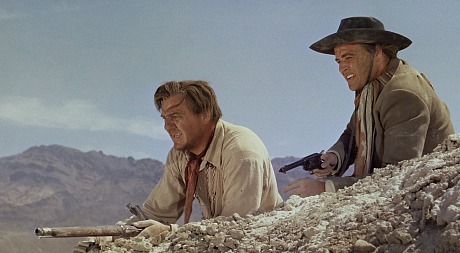
On 5.22 I posted an opinion that Joseph Biroc‘s cinematography in Robert Aldrich‘s The Flight of the Phoenix (’65), while professionally handled as far as it went, never seemed distinctive enough to warrant any special excitement, and certainly didn’t seem to be prime Bluray material. Quote: “I’ve seen it two or three times on the tube, and as best I can recall it just looks sufficient…it’s nothing more than a professionally shot, decently framed desert-locale thing…I certainly don’t remember any mesmerizing visuals.”

And yet DVD Beaver’s Gary W. Tooze writes that Eureka Entertainment’s Region 2 Bluray (which popped two days ago) looks “amazing” and “magnificent,” certainly compared to the unexceptional DVD from 13 years ago. “This 1080p looks fabulous — richer colors, far superior contrast and some impressive detail on the film’s many close-ups…our highest recommendation!”

Read more

Best Westworld Trailer Yet

A legendary Roy Orbison tune plopped onto a soundtrack always adds an agreeable vibe, some kind of haunted yesteryear feeling, as this trailer makes clear. The buildup to HBO’s Westworld has gone on forever, but the 10.2 debut is nigh. Side issue: I’m a bit confused about the romance between James Marsden‘s Teddy Flood and Evan Rachel Wood‘s Dolores Abernathy. Robots aren’t supposed to fall for each other — they’ve been built strictly and entirely for tourist diversion, and have surely been programmed not to fraternize in any way, shape or form. Okay, I’m not 100% certain that the gunslinging Flood is a robot, but what else could he be? He’s clearly no tourist visitor or Westworld administrator. Imagine if Yul Brynner had begun an affair with one of the hotel prostitutes in Michael Crichton‘s 1973 version. James Brolin and Richard Benjamin would’ve looked at each other and gone “what the fuck is going on here?”

Divorced From Reality

I just came out of Mick Jackson‘s Denial (Bleecker Street, 9.30). A reasonably well-honed courtroom drama buttressed by crisp writing and performances that serve the film rather than vice versa, Denial does a decent job of making an absurd, real-life libel suit seem almost interesting.

It focuses on a real non-jury trial that examined the legitimacy of a claim made by Hitler biographer and apologist David Irving (Timothy Spall) that professor and Holocaust historian Deborah Lipstadt (Rachel Weisz) libelled his reputation by writing that he, Irving, was a Holocaust denier. 

This may have been a compelling case for certain parties within the British legal system 16 years ago, but a legal argument about whether or not Irving’s published opinions about the Holocaust being more or less an overblown myth and that Adolf Hitler was a misunderstood visionary whom history has maligned and more particularly whether Lipstadt erred in calling him a fantasist…well, the mind reels.

It’s just not a compelling story, this thing. In what realm are Holocaust deniers even listened to, much less taken half seriously outside of neo-Nazi circles? Exactly, and yet Denial tries to make audiences care about a legal dispute that has no realistic bearing on reality as millions know and accept it, based on indisputable fact. 

The Holocaust happened. Anne Frank and her family really died. Schindler’s List was not an exaggeration. In 2012 my sons and I visited Dachau, the infamous concentration camp outside Munich, and stood just outside the one-story brick building where prisoners were given “showers.” 

 Denial is a well-made, well-acted film but give me a break.

“Are You Okay?”

I don’t like it when someone asks “are you okay?” They’re showing concern and compassion, of course, but I don’t like the invasiveness of those words. What they mean, of course, is that they’re noticing or sensing that I’m not okay and that they’d like to lend a hand in some way. I don’t mind if people say “are you okay?” if I’ve fallen onto the pavement or been hit by a fastball or shot by a gang-banger, but I don’t like people to ask if I’m emotionally okay. Thank you but that’s my business, my concern. If I want to share I will but until that happens, please hang back. A friendly hug or pat on the back is cool, but don’t say those words. I never do. If I’m sensing someone is upset, I’ll show respect by giving them a back-pat and hanging close and talking to them as if nothing’s wrong. I’m not their doctor or counselor — I’m their friend. When I’m about to bid farewell I might say “you’re good?” but that’s as far as I’ll go.

Billy Lynn’s Day of Reckoning Approaches

Yesterday an anonymous guy from Definition magazine, a high-tech camera site, tweeted an observation about Ang Lee‘s Billy Lynn’s Long Halftime Walk, a high-frame-rate groundbreaker that will have its big hoo-hah premiere at the New York Film Festival on Friday, 10.14.

Definition: “Just watched 12 minutes of Ang Lee’s new 120 fps movie. It’s the new reality, like live theatre, you are there, like stepping into the scene.”

This prompted a tweeter named Henrik Cednert to ask, “Is that a good thing or a bad thing? For sure different, but good or bad…? Gives me a bad flashback from The Hobbit.” Definition dude replied that 120 frames per second “gets rid of judder and strobing. Film has no makeup, actors had to bring A game. Intense experience. Much better than Hobbit.”

Some guy named Tweets of Rage, reflecting the concerns of untold millions, rejected Definition’s enthusiasm out of hand. “Doesn’t it still feel hyper real?,” he asked. “Like watching a play uncomfortably close up?” Definition: “I think less so than Hobbit‘s 48fps. [This] might be a case of using 120 as an effect to start with. Ang will only shoot 120.”

Ben Schwartz then mocked Definition by re-tweeting something Schwartz alleges he said in 2015: “All 3D films gave to us was a headache and an increased determination that we didn’t want to see another one.” Definition: “Correct. Now they’ve got an answer. Do the math.”

I can only repeat an observation I heard during a demonstration of high-frame-rate cinematography at a tech conference in Los Angeles three or four years ago, which is that to most viewers the differences between 48, 60 and 120 fps photography are barely noticable. I myself was having trouble detecting a big difference between the three formats, and I know my shit.

I’m presuming that the conservatives will be less dismissive of Billy Lynn than they were of Jackson’s The Hobbit as it operates in real-world milieus, which on some level will, I suspect, seem less jarring or challenging.

I myself am a total whore for HFR photography. Bring it on, please. And make 30 fps (i.e., the frame rate of Todd AO back in the mid ’50s) the industry norm. The more fluid the movement, the better the film seems. I’ve been saying for years that HFR has the potential of making banal FX-driven films feel at least diverting. If Antoine Fuqua‘s dreadful The Magnificent Seven had been shot at 48 or 60 of 120 fps, I would have said “shitty film but very cool to watch.”