

“Life is a bombed-out, soulless cabaret in Christian Petzold’s Phoenix (IFC Films/Sundance Selects, 7.24), a haunting portrait of identity, loss and the search for answers in post-WWII Berlin. The sixth teaming of Petzold and his leading-lady muse, the extraordinary Nina Hoss, finds the duo once again refracting the social and political complexities of 20th-century Germany through the prism of American genre films — here, specifically, the rich strain of doppelganger psychodramas (A Woman’s Face, Vertigo, Seconds) that hinged on the immutable power of the human face. Like those movies, Phoenix demands a certain generous suspension of disbelief that may be more than some audiences are willing to muster.” — from a 1.12.15 review by Variety‘s Scott Foundas.
Turnaround
Five days ago I conveyed enthusiasm about episode #2 (airing tonight) of the second season of HBO’s True Detective, or more particularly about something that happens toward the end. (“Okay, now things have kicked into gear.”) Well, hold up on that. I’ve since seen episode #3 and what I thought…best not to say any more.
Stuck In Craw
Brokeback Mountain isn’t quite ten years old. It popped at the 2005 Telluride Film Festival (i.e., on or about Labor Day) and opened commercially on 12.23.05. But that isn’t stopping Variety from revisiting the film for its Marriage Equality issue. I think it goes without saying that in the wake of the Supreme Court’s marriage equality decision and the alpha vibes that have followed that if the whole Brokeback Mountain-vs.-Crash competition had never happened a decade ago and that if both films were set to open this fall…I don’t think there’d be any question that Brokeback Mountain would be the decisive industry favorite.
It might still lose the Best Picture Oscar because…well, because The Revenant or Steve Jobs or The Danish Girl might win. But if 2015 was to somehow shake down into the same kind of face-off, Brokeback would be on top. The geezers who either voted against it or even refused to see it ten years ago would be far less influential, in part because a lot of them (including Tony Curtis, who once declared that “Howard Hughes and John Wayne wouldn’t like it”) have passed on. You have to let this stuff go, of course. Major cultural events happen in their own time and for their own reasons and you can’t reconstitute those circumstances, but I’ll never get over the Best Picture loss of Brokeback Mountain…not entirely.
Return of Pink Ladykillers…Beware!
Don’t be suckered into buying Studiocanal’s 60th anniversary Bluray of Alexander McKendrick‘s The Ladykillers, which as far as I know is a re-issue of the same Bluray that popped in February 2010. The cover of the newbie claims to be “digitally restored” but that could mean anything. Trust me — this is one of the ugliest and most repellent Blurays ever released in the history of the format, right up there with Criterion’s Stagecoach and the original grainstorm pressing of The Third Man. In my original review I called it “a strawberries-and-whipped-cream nightmare — perhaps the most visually unappealing manipulation of a classic film ever issued. It’s saturated with the brightest and bleachiest white light seen anywhere since the aliens stepped out of the mother ship at the end of Close Encounters. It’s like someone turned down the color key and then poured milk and cherry sauce over the master negative. The effect is one of rosey anemia — a sickly dilution like nothing I’ve ever seen from a 1950s color film.”

Brent Lang Is A Cyborg
There are two forehead-slapping statements in a 6.28 boxoffice analysis piece by Variety‘s Brent Lang. Titled “Ted 2 Fumbles: Are R-Rated Comedies in a Funk?,” the piece seeks to understand or at least ask why Seth MacFarlane‘s decidedly unfunny, splooge-soaked sequel opened with a lousy $32.9 million…horrors! Lang’s basic takeaway is that “raunch isn’t selling like it once did.”
Forehead slapper #1: “The difficulty is that unlike other genres, novelty is a key selling point for comedies. That makes them unusually execution dependent.”
Wells reaction: May God protect Hollywood executives and their shitty mainstream movie slates from the dreaded, fang-toothed beast known as “execution dependent.” In Lang’s realm, execution is a mosquito that occasionally flies into your ear. Swat it and forget about it. Because in Lang’s realm audiences regard the concept of quality in the same light. They never evaluate comedies by way of the aggregate sites or trailers or even by sniffing the wind…right? Lang and his sources in production and box-office analysis (including the legendary Phil Dergarabedian!) apparently believe that if you put a raunchy comedy on their plate, they’ll eat it up like a starving dog. Or they used to, at least. If there’s one thing that’s absolutely verboten in Lang’s world, it’s the idea that people might not want to see a movie that reputedly sucks.
A Significant Wounding
Every nine months or so New Yorker film columnist Richard Brody will tap out something marvelous, which is to say an opinion I agree with. The topic this time is Inside Out, which drove Brody crazy for reasons that are much more specifically explained and dissected than I cared to get into in my little piffle reviews. I didn’t care that much; I just can’t stand the oppresively peppy energy of mainstream animated features. But Brody, man…Brody goes into the mouth of the leviathan with a scalpel and slides down the gullet and eventually finds the giant Pixar heart and stabs, slices and severs with precision…covering himself in whale blood.
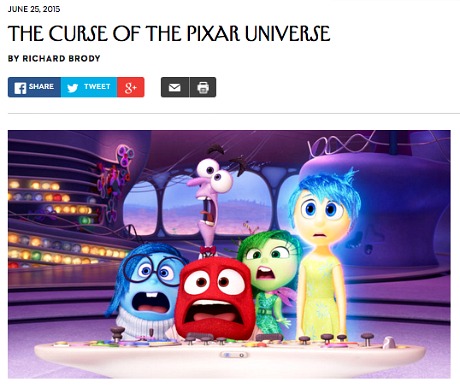
Excerpt #1: “Since the subject of Inside Out is life lived in the grip of emotions, let me admit to mine: I emerged from the theatre feeling like W. C. Fields, hating children, all children, even my children, because of what those who purport to make movies for them have been doing, both to movies and to children.
Excerpt #2: “For all the cleverness of Inside Out I was jolted from the start by its deformation of children and of mental life. I saw a feature-length sales pitch — or, worse, an indoctrination — to mold kids into beings as artificial and uniform as those created, by computer graphics, in the movie. In effect, Inside Out is a feature-length training manual for seeing life like a Pixar movie, an imprint machine for creating its own consumers.
Sneakers
One of the most quietly thrilling episodes of my teenaged life…okay, stop right there. Let me assure before continuing that this story won’t get icky. Okay? I was in eighth or ninth grade, about 14 or 15, and I hadn’t done a damn thing with a girl. No flirtations to speak of, no dates…nothing. Nudie magazines were the extent of it. It was 9:30 pm on a Friday night (or so I recall — it might have been a Thursday), and a friend and I had walked a couple of miles to the home of a cheerleader who was going out with a jock-type dude we were friendly with. The names of my friend, the jock and the cheerleader were Jack, Chip and Pam.
It was a surreptitious arrangement so Jack and I didn’t knock on the front door but waited for Chip outside of a basement den room on the side of the home. I remember we were playing around with Pam’s dog for a bit. It was a coolish evening. We were wearing sweaters or fall jackets…something like that. As as the hour began to approach 10 pm, we began to wonder what was up. Chip had told Jack he’d meet us at Pam’s home around 9:30 or 9:45.
Bickle’s Fate
I’ve always believed that Travis Bickle died on the couch after that East Village shoot-out. Everything that happens in the aftermath — the newspaper articles praising him for having murdered a couple of pimps, Iris’s parents writing to thank him for saving their daughter, Cybil Shephard looking at him dreamily after he drops her off at her Grammercy Park apartment — is Travis’s dying fantasy. And then in the last shot he’s driving along and looks into the rearview mirror with a slight look of alarm, apparently sensing that something’s wrong and then…zhhhoop! Bickle disappears. It seems obvious as hell, but no one has ever agreed with me.

Devin Slams A Homer
I’ve been talking for a long, long time about how the bottom has fallen out of badness in movies. Basic levels of scriptwriting have been dropping, certainly when it comes to CG-driven tentpolers, for a good 10 or 15 years. Six or seven years ago I wrote that relatively few big-studio whammers are as well-ordered and “professionally” assembled as Abbott & Costello Meet The Mummy, as silly and inconsequential as that 1955 film was. Two days ago the great Devin Faraci chimed in along similar lines, and with excellent drillbit phrasing.
“I think every movie should be ‘good.’ Especially really big, expensive ones that were worked on by thousands of people. And I don’t mean great, or perfect or transcendent or Oscar-worthy. When I say ‘good’ what I really mean is ‘competent.’
“Yet this bar, low as it is, is seen as excessive by some. Demanding basic competence — that a movie be adequately made on a fundamental level — is a sign of elitism. This bums me out [because] this tyranny of low expectations is why big movies can be, and often have been, so terrible. Why get the story right when the audience simply does not give a shit about it?
Please Come Later
Last night a producer friend invited me to a birthday party being thrown in her honor. A two-stage affair, she explained. It’ll begin with a sit-down dinner around 8 pm and then a second wave of friends will arrive for a stand-around-and-drink party at 9:30 pm. A filmmaker friend is hosting, she said, but his home is not a McMansion so the dinner invitees will have to be restricted to ten or twelve. (There’s a concern about seating plus his ex-wife is coming.). She asked me to please drop by at 9:30 and bring my party hat. “So I’m a second-waver?,” I said. “On one level I don’t care but on another level it’s a wee bit insulting. Not horribly insulting — I’m an adult and it’s really not that big of a deal — but you are ranking me…you’re telling me that I rank below others and that casting-wise I’m a supporting player.” She said that’s the wrong way to take it, that she’s just going along with what the host told her, etc. “Can I make a suggestion?,” I said. “Invite the ten or twelve you had in mind for the dinner and leave it at that. Don’t invite the second wave. Because they’ll all feel vaguely, slightly insulted…trust me. It’s better not to invite them than to graciously label them as coach-class.” Thoughts?
Better Than What Crosby Described
Update: On 6.28 Joni Mitchell’s conservator, Leslie Morris, posted the following about Mitchell’s condition following a HuffPost quote from David Crosby that said (a) Mitchell had suffered an aneurysm and (b) was not able to speak. To my knowledge Morris never used the word “anuerysm” before Crosby mentioned it, and you could bet she wouldn’t have mentioned it otherwise.
“Joni did in fact suffer an aneurysm,” Morris’s statement says. “However, details that have emerged in the past few days are mostly speculative. The truth is that Joni is speaking, and she’s speaking well. She is not walking yet, but she will be in the near future as she is undergoing daily therapies. She is resting comfortably in her own home and she’s getting better each day. A full recovery is expected.”