

Don't Dweeb On Me
The remaining winners of Los Angeles Film Critics Association 2010 awards have been announced, and there’s another head-scratcher to ponder — Kim Hye-ja, star of the Brian De Palma-like South Korean potboiler Mother, has been handed their Best Actress award.

Mother star Kim Hye-ja, winner of LAFCA’s Best Actress award.
This is “interesting” and outside the safety zone in a cool way, I suppose. But it also seems like a deliberate provocation to the status quo for the sake of deliberately provoking the status quo. I saw Mother at Cannes ’09 — neither it nor Kim Hey-Ja’s performance were anything to have major kittens over. She’s fine in a broadly theatrical, suffering-drama-queen way, but c’mon.
LAFCA has a oddballish reputation to uphold, I realize, but you just know they were saying to themselves “why do we have to fall in line for Natalie Portman?…let’s go with somebody fringe!”
Winters Bone‘s Jennifer Lawrence was the Best Actress runner-up.
LAFCA also went with the Prophet guy, Niels Astrup, for Best Supporting Actor.
The Social Network won Best Picture, of course, but Carlos was the runner-up. And sincere cheers to LAFCA for splitting their Best Director award between The Social Network‘s David Fincher and Carlos‘ Olivier Assayas. Colin Firth won the org’s Best Actor award for The King’s Speech. Carlos won also for Best Foreign Language Film. And Tiny Furniture‘s Lena Dunham won the New Generation award.
Network Tops NYFCO Awards
“I surrender to Social Network inevitability,” a critic friend just wrote in an email. “A juggernaut, apparently.” One of the indicators he was referring to were the awards announced today by the New York Film Critics Online (which should of course be called the New York Online Film Critics, or NYOFC). They went with Network for three top awards — Best Picture, Best Director to David Fincher and Best Screenplay to Aaron Sorkin.
James Franco won Best Actor for his performance in 127 Hours , and Natalie Portman, of course, won Best Actress for her performance in Black Swan. Christian Bale won Best Supporting Actor for The Fighter, and his costar Melissa Leo won for Best Supporting Actress.
Noomi Repace‘s one-facial-expression performance (i.e., glaring rage) in The Girl With The Dragon Tattoo won a Breakthrough Performer award? Really? Company Man director John Wells won the org’s Hotshot New Director award, or whatever they call it. The Kids Are All Right, totally shut out so far by other critics groups, was given an Ensemble Cast award.
The NYFCO’s Best Documentary award went to Banksy’s Exit Through The Gift Shop. Their Best Foreign Language Film trophy went to I Am Love. Toy Story 3 won for Best Animated Feature. “Matty” Labatique‘s cinematography won for Black Swan. Darren Aronofsky‘s film also won for Best Film Music or Score.
Commentary from an NYFCO memer: “Best Picture was a first-round slamdunk, as was screenplay and director (Aronofsky was a close second). Natalie Portman also won by a substantial margin but Breakthrough Performer Noomi Rapace fared well in the actress category.
“The closest races were foreign language, doc and animated where I Am Love won in the third round by one point over The Girl with a Dragon Tattoo. Toy Story 3 beat The Illusionist by just two points in the first round. Exit through the Gift Shop just beat Waiting for Superman for doc in a third round.
“Bale and Leo were both first-round wins but supporting were the only categories where The Fighter had significant showing. Neither True Grit nor The Fighter made NYFCO’s top 10…. and the oddly absent actor that no one nominated, not one person? Robert Duvall. Might want to reassess the actor and move Jesse Eisenberg into that position.”
Niels Who?
Two somewhat curious acting awards have happened today. First the Boston Society of Film Critics give their Best Supporting Actress award to Juliette Lewis, and now the Los Angeles Film Critics Association has given its Best Supporting Actor to Niels Arestrup, the scowling, white-haired, chain-smoking prison boss in Jacques Audiard‘s A Prophet.

Niels Arestrup, winner of LAFCA’s Best Supporting Actor award for his work in A Prophet, is the snarly old buzzard on the right; A Prophet costar Tahar Rahim is on the left.
Again — nobody in my realm pre-approved this in any way, shape or form. Secondly, Arestrup is quite effective in the film, but his performance is not what anyone would call “oh, wow!” stupendous. He plays a French criminal-class guy in typical French-criminal-class fashion. He’s gruff and blustery — an aging barking dog who’s trying to hide the fact that he’s terrified of losing his hold on power. And always with the cigarettes, the cigarettes, the fucking cigarettes. It’s a very oddball call.
What happened to Christian Bale in The Fighter? What happened to one of the Social Network guys, Andrew Garfield or Justin Timberlake? What happened to Bill Murray in Get Low? The King’s Speech costar Geoffrey Rush was the runner-up.
Niels Arestrup?
HE approves of Animal Kingdom‘s Jacki Weaver winning for Best Supporting Actress, and would have also high-fived the runner-up, Ghost Writer costar Olivia Williams, if she had prevailed. LAFCA’s Best Screenplay award went to Aaron Sorkin for “The Social Network. The Best Documentary Award went to Last Train Home, which I never even saw. The Best Doc runner-up, Exit Through the Gift Shop, should have taken it.
The Best Cinematography award went to Black Swan‘s Matthew (i.e., “Matty” if you’re talking to HitFix‘s Drew McWeeny) Libatique, with True Grit‘s Roger Deakins coming in second.
The Best Music Score award was split between Ghost Writer‘s Alexandre Desplat and The Social Network‘s Trent Reznor and Atticus Ross. The Best Production Design award went to Inception‘s Guy Hendrix Dyas with Eve Stewart coming in second for her work on The King’s Speech.
Say Again
Typepad log-in problems have blocked would-be commenters over the last two or three days, but I think things are okay now. It had something to do (idiotically) with the server clock being off due to the time change. In any case, Film Society of Lincoln Center associate program director Scott Foundas tried to respond two days ago to blogger reactions to the LAFCA voting, but was blocked by the malfunction. Here’s what he wrote:
“[LAFCA Best Supporting Actor winner] Niels Arestrup did not ‘exhaust’ his Oscar eligibility last year. In fact, he was never — and never will be — eligible for an Oscar because of the current Academy rule (much revised over the years) stating that any film nominated for Best Foreign Language Film can not be nominated in a subsequent year in any other categories, regardless of when it actually opens in the U.S. Had A Prophet been released for a qualifying run in 2009, then Arestrup would have been eligible at the 2010 Oscars. Had the film not been nominated for Foreign Film at the 2010 Oscars, then Arestrup would have a shot in the spring.
“This is the sort of thing one would assume would be common knowledge amongst such an august group of awards-season ‘experts,’ but then we all know the old adage about making assumptions…
“As for the suggestion that neither Arestrup nor Kim Hye-Ja will surface again during the remaining awards season, ‘just as it was the first and last we heard of LAFCA’s 2009 best actress Yolande Moreau,’ I suppose that was true of Moreau if one discounts Moreau’s similar wins at the National Society of Film Critics, the Cesar Awards [French Oscars], and even that hotbed of obscurantist cinephilia, the Newport Beach Film Festival.
“At the very least, you can expect to see Arestrup (who also already won a Cesar for his performance) and Kim’s names in the mix in the annual nationwide polls of film critics conducted by The Village Voice, Film Comment and Indiewire. Look back to the reviews these films received at the time of their release, and you will find that the performances in question — and the movies that contain them — were among the best received of the year.
“Sorry that the companies responsible for releasing the films in question didn’t paper the pages of Variety with ‘For Your Consideration’ ads or organize any cocktail soirees to parade their talent before the Oscar-blogging cognoscenti, thereby instantly ruling them out as contenders in the minds of some. (Hey, they’re no Frankie and Alice.) The job of film critics, however, remains to review movies, and not just the hype surrounding them.”
Juliette Lewis?
What’s the meaning of the Boston Society of Film Critics giving their Best Supporting Actress trophy to Conviction‘s Juliette Lewis? Seriously — what’s this about? Lewis’s performance is quite good but surely the BSFC members understood they needed to award one of the pre-approved, award-blogger favorites — The Fighter‘s Amy Adams or Melissa Leo, Animal Kingdom‘s Jacki Weaver, Black Swan‘s Barbara Hershey, etc. Instead they went all wildcat.
Otherwise they honored David Fincher‘s The Social Network as 2010’s Best Picture. Fincher won for Best Director, TSN‘s Jesse Eisenberg for Best Actor, and TSN author Aaron Sorkin for Best Screenplay. The Beantown guys also honored TSN composers Trent Reznor and Atticus Ross for Best Use of Music. The Fighter‘s Christian Bale won for Best Supporting Actor.
What does it mean, if anything, that King’s Speech star Colin Firth didn’t win for Best Actor?
Say Again
Typepad log-in problems have blocked would-be commenters over the last two or three days, but I think things are okay now. It had something to do (idiotically) with the server clock being off due to the time change. In any case, Film Society of Lincoln Center associate program director Scott Foundas tried to respond two days ago to blogger reactions to the LAFCA voting, but was blocked by the malfunction. Here’s what he wrote:
“[LAFCA Best Supporting Actor winner] Niels Arestrup did not ‘exhaust’ his Oscar eligibility last year. In fact, he was never — and never will be — eligible for an Oscar because of the current Academy rule (much revised over the years) stating that any film nominated for Best Foreign Language Film can not be nominated in a subsequent year in any other categories, regardless of when it actually opens in the U.S. Had A Prophet been released for a qualifying run in 2009, then Arestrup would have been eligible at the 2010 Oscars. Had the film not been nominated for Foreign Film at the 2010 Oscars, then Arestrup would have a shot in the spring.
“This is the sort of thing one would assume would be common knowledge amongst such an august group of awards-season ‘experts,’ but then we all know the old adage about making assumptions…
“As for the suggestion that neither Arestrup nor Kim Hye-Ja will surface again during the remaining awards season, ‘just as it was the first and last we heard of LAFCA’s 2009 best actress Yolande Moreau,’ I suppose that was true of Moreau if one discounts Moreau’s similar wins at the National Society of Film Critics, the Cesar Awards [French Oscars], and even that hotbed of obscurantist cinephilia, the Newport Beach Film Festival.
“At the very least, you can expect to see Arestrup (who also already won a Cesar for his performance) and Kim’s names in the mix in the annual nationwide polls of film critics conducted by The Village Voice, Film Comment and Indiewire. Look back to the reviews these films received at the time of their release, and you will find that the performances in question — and the movies that contain them — were among the best received of the year.
“Sorry that the companies responsible for releasing the films in question didn’t paper the pages of Variety with ‘For Your Consideration’ ads or organize any cocktail soirees to parade their talent before the Oscar-blogging cognoscenti, thereby instantly ruling them out as contenders in the minds of some. (Hey, they’re no Frankie and Alice.) The job of film critics, however, remains to review movies, and not just the hype surrounding them.”
Say Again
Typepad log-in problems have blocked would-be commenters over the last two or three days, but I think things are okay now. It had something to do (idiotically) with the server clock being off due to the time change. In any case, Film Society of Lincoln Center associate program director Scott Foundas tried to respond two days ago to blogger reactions to the LAFCA voting, but was blocked by the malfunction. Here’s what he wrote:
“[LAFCA Best Supporting Actor winner] Niels Arestrup did not ‘exhaust’ his Oscar eligibility last year. In fact, he was never — and never will be — eligible for an Oscar because of the current Academy rule (much revised over the years) stating that any film nominated for Best Foreign Language Film can not be nominated in a subsequent year in any other categories, regardless of when it actually opens in the U.S. Had A Prophet been released for a qualifying run in 2009, then Arestrup would have been eligible at the 2010 Oscars. Had the film not been nominated for Foreign Film at the 2010 Oscars, then Arestrup would have a shot in the spring.
“This is the sort of thing one would assume would be common knowledge amongst such an august group of awards-season ‘experts,’ but then we all know the old adage about making assumptions…
“As for the suggestion that neither Arestrup nor Kim Hye-Ja will surface again during the remaining awards season, ‘just as it was the first and last we heard of LAFCA’s 2009 best actress Yolande Moreau,’ I suppose that was true of Moreau if one discounts Moreau’s similar wins at the National Society of Film Critics, the Cesar Awards [French Oscars], and even that hotbed of obscurantist cinephilia, the Newport Beach Film Festival.
“At the very least, you can expect to see Arestrup (who also already won a Cesar for his performance) and Kim’s names in the mix in the annual nationwide polls of film critics conducted by The Village Voice, Film Comment and Indiewire. Look back to the reviews these films received at the time of their release, and you will find that the performances in question — and the movies that contain them — were among the best received of the year.
“Sorry that the companies responsible for releasing the films in question didn’t paper the pages of Variety with ‘For Your Consideration’ ads or organize any cocktail soirees to parade their talent before the Oscar-blogging cognoscenti, thereby instantly ruling them out as contenders in the minds of some. (Hey, they’re no Frankie and Alice.) The job of film critics, however, remains to review movies, and not just the hype surrounding them.”
Say Again
Typepad log-in problems have blocked would-be commenters over the last two or three days, but I think things are okay now. It had something to do (idiotically) with the server clock being off due to the time change. In any case, Film Society of Lincoln Center associate program director Scott Foundas tried to respond two days ago to blogger reactions to the LAFCA voting, but was blocked by the malfunction. Here’s what he wrote:
“[LAFCA Best Supporting Actor winner] Niels Arestrup did not ‘exhaust’ his Oscar eligibility last year. In fact, he was never — and never will be — eligible for an Oscar because of the current Academy rule (much revised over the years) stating that any film nominated for Best Foreign Language Film can not be nominated in a subsequent year in any other categories, regardless of when it actually opens in the U.S. Had A Prophet been released for a qualifying run in 2009, then Arestrup would have been eligible at the 2010 Oscars. Had the film not been nominated for Foreign Film at the 2010 Oscars, then Arestrup would have a shot in the spring.
“This is the sort of thing one would assume would be common knowledge amongst such an august group of awards-season ‘experts,’ but then we all know the old adage about making assumptions…
“As for the suggestion that neither Arestrup nor Kim Hye-Ja will surface again during the remaining awards season, ‘just as it was the first and last we heard of LAFCA’s 2009 best actress Yolande Moreau,’ I suppose that was true of Moreau if one discounts Moreau’s similar wins at the National Society of Film Critics, the Cesar Awards [French Oscars], and even that hotbed of obscurantist cinephilia, the Newport Beach Film Festival.
“At the very least, you can expect to see Arestrup (who also already won a Cesar for his performance) and Kim’s names in the mix in the annual nationwide polls of film critics conducted by The Village Voice, Film Comment and Indiewire. Look back to the reviews these films received at the time of their release, and you will find that the performances in question — and the movies that contain them — were among the best received of the year.
“Sorry that the companies responsible for releasing the films in question didn’t paper the pages of Variety with ‘For Your Consideration’ ads or organize any cocktail soirees to parade their talent before the Oscar-blogging cognoscenti, thereby instantly ruling them out as contenders in the minds of some. (Hey, they’re no Frankie and Alice.) The job of film critics, however, remains to review movies, and not just the hype surrounding them.”
Mediocre Poets
I’ll post my review of Tron: Legacy (Disney, 12.17) in a day or two, but let’s say for now it’s somewhere between an “okay, shrug, whatever” and not very good. If you’re an easy-lay geekboy you might tell your pallies it’s a stimulating fantasy by way of above-average eye candy. The first thing I said to Jett when it ended was “it was okay…meh.” But the more we talked about it the worse it seemed. Other guys were griping about it out in the lobby and on the sidewalk.
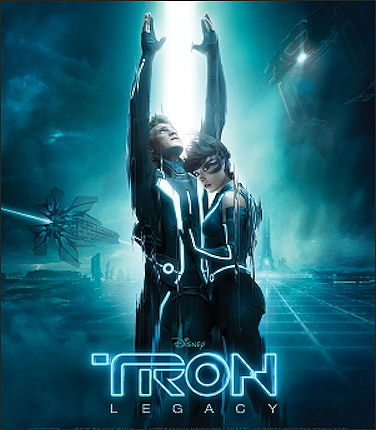
The script by Adam Horowitz and Edward Kitsis (i.e., the principle bad guys) is second-tier. The dialogue is somewhere between passable and lumpy, and some plot elements don’t hold up when you give them cursory think-throughs. Garret Hedlund‘s son-of-Jeff Bridges character (i.e., Sam Flynn) lacks the necessary panache — they’ve got him saying the same blah machismo lines that Bruce Willis used to mutter 15 or 20 years ago. To me, director Joseph Kosinki looks more like the new Peter Hyams than the new Jimbo.
Here’s one specific example of how it doesn’t work. Explaining involves revealing a minor spoiler. Ready…?
I’m speaking of a bit in which Bridges’ Kevin Flynn, the video-game maestro who disappeared into his own self-created realm (i.e., the “grid”) in 1989, overpowers a droid robot who’s telling him he can’t do something. So he bashes the top of the robot’s helmet with his fist and bingo — the robot reverses and retreats. This, of course, is a mixture of two bits from the original Star Wars. One, Alec Guiness‘s Obi-Wan using the Force to hoodwink two guard-droids into allowing his group to pass (“These aren’t the droids you’re looking for”) and two, Harrison Ford‘s Han Solo slamming the wall of the Millenium Falcon in order to get it to start. Both are classics, but the Bridges helmet-bash falls flat. This is what not-very-good movies do — they imitate good stuff but they can’t quite make their own versions “work.”
Tourist Bites It
Florian von Henckel Donnersmarck‘s The Tourist earned a piddly $17 million domestic this weekend. To project a semi-healthy appearance it would have had to bring in at least $20 if not $25 million. But that was impossible, I guess, given what most ticket buyers were smelling. If it manages to triple that figure by the end of the run…but why even consider this as a hypothetical? It’s not going to happen. The guess is that most HE readers took a pass, but if there are any reactions (to the content, I mean), please share.
Truman-Eisenhower Factor
I was discussing The Social Network this morning with a very bright, plugged-in, boomer-aged lady. Good job, motivated, sharp, no simpleton. And until I pointed it out, she didn’t get what Jesse Eisenberg‘s Mark Zuckerberg was doing at the very end of the film — i.e., refreshing Erica Albright’s Facebook page in hopes of discovering that she’d accepted his friend request. TSN‘s finale is merely one component, of course, but it follows that if my smart friend didn’t quite get it (i.e., she’s new to Facebook) there are probably dozens if not hundreds of Academy and guild members who also didn’t understand at first. These guys may even resent TSN on some level, ironically, for having made them feel a little bit out of it. People are funny that way.