Festive Bones


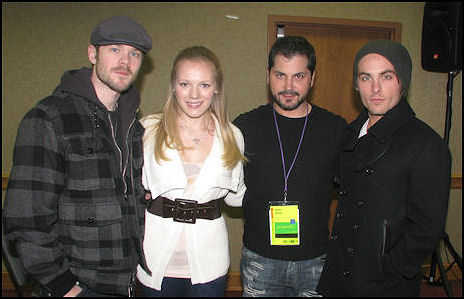
During last night’s discussion of The Lovely Bones between Time‘s Richard Corliss (l.) and director Peter Jackson (r.) at the DGA screening room on W. 57th. Corliss said at one point that the film could almost be Psycho as told by Janet Leigh’s Marion Crane from death, especially given (a) the nerdy-normal creepy killer, (b) Crane’s sister Lila (Vera Miles) rummaging around the killer’s home for evidence in the third act and finding something big, and (c) the killer arriving home before she’s finished, forcing her to try and hide/escape.

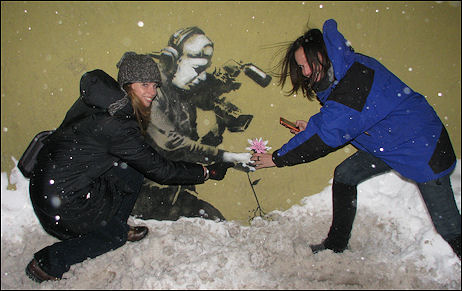
The Oak Bar’s famous mural is titled “Old Vanderbilt House,” painted by Everett Shinn — snapped last night during Lovely Bones premiere party.

As glimpsed in early scene in Alfred Hitchcock’s North by Northwest.

McIver, Ronan — Wednesday, 12.2, 11:10 pm.

Better Bones Than Expected

Last night’s viewing of Peter Jackson‘s The Lovely Bones was a fresh experience, as I’ve never read Alice Sebold‘s book, and a guarded one given the conflicted (i.e., leaning negative) advance word plus my own resistance to Jackson’s tendency to over-saturate and over-flourish his films with visual imagery that always seems to say “look at what I’m doing!” But I have to say that I wasn’t all that unhappy with The Lovely Bones, and that it even got me at times.


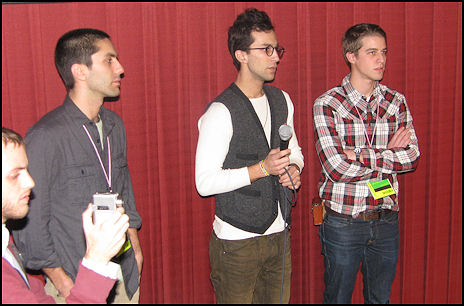
Lovely Bones costars Rose McIver, Saoirse Ronan at last night’s after-party at the Plaza’s Oak Room.

Was I jumping up and down after it ended? No, but I wasn’t feeling too badly about it either. As Jackson films go it’s a fairly decent sit, at least for the novelty of it. I felt at the very least diverted by much of it, and it has some passages that are very affecting (especially the way it conveys the poignancy of Saoirse Ronan‘s Susie Salmon being simultaneously involved with and forever cut off from the lives of her mortal family and friends) and even brilliant at times. I was reasonably impressed for the most part, which is a significant admission for a longtime Jackson disser like myself.

The Lovely Bones is not restrained — far from it. It would have been better, I feel, if Jackson had dialed himself and the film back about 20% or 30%. Art isn’t easy, but the final canvas always seems grabbier if you’ve stepped back at the last minute and not gone whole-blitzkreig. And yet Bones does enforce a certain discipline at times. (“At times,” I say.) It seems in fact like the most intimate and exacting and emotionally expressive Jackson film since Heavenly Creatures, even with the full-spigot digital effects that overwhelm the delicacy and etherealness of the story and themes.

Jackson will always be Jackson, but this time the visual flamboyance makes sense as it conjures Susie’s afterlife experience after being murdered by a neighborhood creep. The otherwordly compositions tie in with certain bits and real-time echoes and memory fragments from the real world so at least there are underlying connections that lend a certain cohesiveness.

And Ronan’s performance is vivid and bold and open-hearted — she’s really quite the natural presence, and not incidentally a natural and well-chosen component in a world of Jackson’s feverish composing. And it all sort of comes together in a way that feels fairly novel and provocative — it’s like nothing I’ve seen in a long while, and a good deal more transporting than What Dreams May Come, for what that’s worth. It’s also very Jacksony in 40 or 50 different ways, of course. But that’s okay. It’s not a hate film — it’s “hmm, yeah, not bad” thing.

I loved that Jackson chose not to show Ronan’s murder — I really, really didn’t want to go there, even glancingly — and particularly his decision to show her escaping from her own death, running away from something that has happened but is so horrible that she instantly imagines or wills herself into a fantasy-escape mode. I got that right away and quite liked Jackson’s way of showing this sudden transformation.

Stanley Tucci‘s fungusy life form is interesting in a kind of nerdy and peculiar way that feels mostly right. It’s a contained performance that he doesn’t have a big “this is why I am who I am” moment — thank the Lord. The underserved are the adult actors and performances — Rachel Weisz‘s mom, Mark Wahlberg‘s dad, Susan Sarandon‘s alcoholic chain-smoking grandmother, Michael Imperioli’s investigating detective. I don’t know why Jackson bailed on Seebold’s subplot in which Weisz would have had an affair with Imperioli, but I guess there wasn’t time. Rose McIver stands out as Susie’s willful younger sister. I know I didn’t have the slightest problem with Wahlberg’s ’70s hair wig. The period flavorings (’70s cars, haircuts, home furnishings, wardrobes) are completely authentic.

There’s a moment near the end when a certain party doesn’t reveal that she’s gotten hold of an incriminating piece of evidence, and I must say this quickly drove me insane. “Why is she hesitating?” I screamed to myself. Very irritating, a serious misstep.

Will I find myself doing a down-the-road turnaround like I did with King Kong ? I doubt it. The Lovely Bones doesn’t feel overly long, although my ass was telling me it should have been more like 115 or 120 minutes rather than 136 minutes. I know I’d like to see it again, and that in itself is another significant admission.


Ronan, Jackson during filming.

It is an unusual film, and obviously a disturbing one with all kinds of different tone shifts and movements and burrowings and whatnot. I went in presuming there would be a show-offy quality to the after-life compositions, and it is a bit overbaked and over-cranked, but I was able to roll with it. I know what it is to be moaning and coughing and slapping my leg through a Peter Jackson film, and I didn’t do this last night.

It may be that The Lovely Bones will slip into the Best Picture running after all, especially given the general view that Invictus is a shortfaller.

Keller Plugs Freeman

It seemed curious — certainly unusual — to see this morning a N.Y. Times front-page story (i.e., the front page of the web version) by executive editor Bill Keller that heartily endorses Morgan Freeman‘s performance as Nelson Mandela in Clint Eastwood‘s Invictus.

Keller knows Mandela quite well personally, having been the TimesJohannesburg bureau chief from ’93 to ’95, so his opinion obviously carries some weight and authority. What he’s done, in effect, is to heartily endorse Freeman as a Best Actor contender in this year’s Oscar race. I’ve heard some arguments against Freeman over the last two or three days — his Mandela is appealing but “thin,” the film gives him nothing to play, etc. — but Keller’s article could turn things around. Maybe.

“Morgan Freeman has been cast as God — twice — so he evidently has no trouble projecting moral authority,” Keller writes. “The challenge of portraying Nelson Mandela, then, was not the size of the halo, but knowing the performance would be measured against the real, familiar Mandela, and his myth. ‘If we can say any part of acting is hard, then playing someone who is living and everybody knows would be the hardest,’ Mr. Freeman said in a phone interview.

“The role has defeated actors as varied as Danny Glover (the 1987 TV film Mandela), Sidney Poitier (Mandela and de Klerk, 1997, also for TV) and Dennis Haysbert (Goodbye Bafana, 2007), in vehicles that were reverential and mostly forgettable.

“But as someone who studied Mr. Mandela over the course of three years while he replaced an apartheid regime with a genuine democracy, I found Mr. Freeman’s performance in the film Invictus, directed by Clint Eastwood, uncanny — less an impersonation than an incarnation.”

Keller’s story is dated 12.6, so it’ll be in this Sunday’s print edition.

More Than “Mecha”

I want to hear Michael Bay dissing Avatar composer James Horner right back on his website within 24 hours. Actually, make it twelve hours. The cycles on these things are getting faster and faster. You can’t sit around and drink tea and read Faulkner on your patio for fear of missing the latest who-whatta?

Here’s the excerpt:

LA TimesGeoff Boucher: “It’s interesting, too, that small moments become so key when a movie gets as big as this one. The machinery of the movie is so big that without successful small moments and human emotion, it could turn into a video game.

Horner: “Absolutely. Yes, that’s right. And, not to mention names, but if it was Michael Bay making this movie we wouldn’t be having this conversation. These things, [heart, story, soul], wouldn’t matter or they certainly wouldn’t matter as much. Jim Cameron knows the importance of it not just becoming mecha. Jim knows that a movie can become swamped in just unbelievable imagery and that it becomes hollow. Jim won’t allow that and my job is to make sure it doesn’t happen.”

Okay, But What Was It…Really?

“You won’t find a more devoted supporter of the Bourne franchise than me,” says departed Bourne director Paul Greengrass in a prepared statement. “I will always be grateful to have been the caretaker to Jason Bourne over the course of The Bourne Supremacy and The Bourne Ultimatum. I’m very proud of those films and feel they express everything I most passionately believe about the possibility of making quality movies in the mainstream.

“My decision to not return a third time as director is simply about feeling the call for a different challenge. There’s been no disagreement with Universal Pictures. The opportunity to work with the Bourne family again is a difficult thing to pass up, but we have discussed this together and they have been incredibly understanding and supportive. I’ve been lucky enough to have made four films for Universal, and our relationship continues. Jason Bourne existed before me and will continue, and I hope to remain involved in some capacity as the series moves on.”

Sundance 2010 Competish Paintball

Every time the Sundance Film Festival announces their competition slate, I respond with one of those blah-blah, gee-this-seems-interesting, well-maybe-not-because-most-of-the-descriptions-seem-boring, blah-dee-blah, I-don’t-actually-have-anything-to-say pieces. This time, however, I forgot the power cord and I’m in a Starbucks on Eighth Avenue and there’s only about 20 minutes left so I can’t really go to town. But some of the stand-outs are as follows:

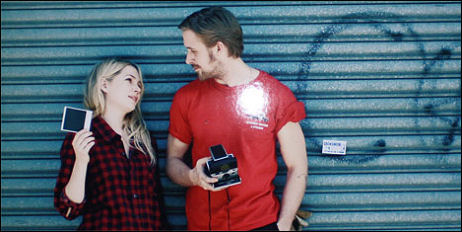
(1) Blue Valentine, directed and co-written by Derek Cianfrance, with Ryan Gosling, Michelle Williams, Mike Vogel and John Doman costarring. Relationship drama of some mild interest because of Gosling and Williams, but I’m not holding my breath. I don’t know why I just said that.

(2) Douchebag, directed by Drake Doremus, written by Doremus, Lindsay Stidham, Doremus, Jonathan Schwartz and Andrew Dickler. Great title! Where’s the poster?

(3) Happythankyoumoreplease, directed and written by Josh Radnor. “Six New Yorkers negotiating love, friendship and gratitude when they’re too old to be precocious and not yet fully adults.” I smell a mumblecore movie. Is that what it is? If it is a mumblecore film why don’t they just say that and stop plotzing around? And if you can’t say “mumblecore” any more, what term is everyone supposed to use as a substitute?

(4) Holy Rollers, directed by Kevin Tyler Asch. Young Hasidic guy becomes an international Ecstasy smuggler. With Jesse Eisenberg!

(5) Howl, directed and written by Rob Epstein and Jeffrey Friedman. Allen Ginsberg, 1950s obscenity trial, horn-rimmed glasses, the horror of the Eisenhower era. James Franco, David Strathairn, Jon Hamm, Mary-Louise Parker, Jeff Daniels.

That’s it…the battery is going. I’ll be dead in 90 seconds.

Try Again

Universal had it right with the Emily Blunt Wolfman poster, going the suggestive/subtle route. And then, I’m guessing, some marketing guy said, “Uhhm, I hate to mention this but surveys are showing this Blunt poster isn’t doing well with the dumbasses…we need to punch things up.” And so they did. Just a guess. I do know that I didn’t see the right-side poster until recently.

“Keep in mind something I was recently told,” a friend writes, “which is that Universal doesn’t officially have a marketing department now as no one really and truly replaced Adam Fogelson in the job. So the marketing executive is now head of the studio calling all the shots about this stuff. That poster not only represents his direct personal taste, but how they’ll sell the movie which they’re now shaping as something for the Saw audience as opposed to ‘classic gothic horror.'”

Waking Sleeping Beauty

Last night HE reader Aaron Lindquist saw Don Hahn and Peter Schneider‘s Waking Sleeping Beauty, a doc about the re-emergence of Disney animation from the time of ’84’s The Black Cauldron to ’94’s The Lion King, at the Art Center College of Design.

Despite an ’09 Toronto Film Festival pan by Variety‘s Rob Nelson, Lindquist calls it “amazing film” that “seems to bring closure to much of the animosity between Michael Eisner, Jeffrey Katzenberg and Roy Disney.

“Their interviews were incredibly candid and filled with dimension, and about such an important period of their lives.” he writes. “It seemed a very honest account of Disney Animation from 1984 to 1994 and the work that went into those films and the struggles that went on behind-the-scenes.

“Hahn and Schneider were there for a q & a afterward and mentioned it would be playing at MOMA soon. I highly recommend it if you get the chance.

“The title alludes to Disney animation going from its nadir (like Sleeping Beauty falling under the spell) with the release of The Black Cauldron to its pinnacle with The Lion King. The doc covers the transition of Disney from the failing Ron Miller days to the Eisner-Wells-Katzenberg era and the challenges and triumphs of the animation department throughout that time.

“They literally went from almost being excised from Disney to being the reason the brand endures. All of the footage was shot by Disney employees (John Lasseter among them) over the years, in defiance of strict corporate policy. Not always high quality images, but incredibly candid stuff.

“From what they said at the q & a it seems like Disney is giving it a small release (five theaters) and will then quietly release it on video, which I think is a shame because it’s a really good film. I think there are a lot of people who would be interested to see Eisner, Katzenberg, and Disney in a human light because all they’ve seen is the media spectacle. Here’s the film’s Facebook page.”

On The Clock

Runaround day, stand-around day, friendly-meeting day, UPS day, FedEx day, Starbucks day, forgot-the-power-cord day, wait-in-line-at-six-or-seven-different-locations day. There’s a Lovely Bones screening early this evening, folllowed by a q & a and then an after-event.

Wily Pathan

President Barack Obama‘s West Point Afghanistan speech last night reminded us once again that the right runs this country. It sure as hell knows how to crack the whip and prompt Commanders in Chief, young or old and of whatever party, to get out the old sheet music and sing the old hymns. And the Bush Jail guards are delighted because they know they’ll never be out of a job.

As we all know the tragedy of 9/11 wasn’t a single ghastly occurence, but a match that lit a fuse that still burns and looms large. It triggered a mandate and a rationale for a never-ending war with Islamic yahoos who may want to one day attack this country with more domestic terrorism. For as long as the 9/11 fire alarm continues to clamor in our heads, we will be inmates in Bush Jail. Because guys like Barack Obama can’t finally think of anything to say or do except “kill the Islamic wackos and keep killing them until further notice.”

As long as we believe, in short, that the proverbial “Wily Pathan” (as Richard Lester‘s How I Won The War describes him at 5:40 in this clip) is constantly plotting to bring more terror to our shores, there can be no end to it.

The only way to win the war against Middle Eastern terrorism is to kill every U.S.-hating Islamic wacko and every last one of his sons and cousins, and then bury them all in a huge mass grave in the desert. And even then we wouldn’t be safe. Because there is no such condition. So we’re in jail for life. No one is leaving.

The 28th Amendment, the still-unmade thriller about a young U.S. president who discovers the existence of a secret cabal that runs (and has always run) the foreign policy of the government, is not fiction.

“Hell Rode With Him”

I’m perfectly fine with the pace of the subtitled narrative in Matt Zoller Seitz‘s video essay about Clint Eastwood‘s career-long theme of revenge, called “Kingdom of The Blind.” Some have said it moves along too fast but not for me. MZS has nonethless said he’ll be launching a version later today (possibly by noon) that will be friendlier to readers who prefer a slower pace..

The Hand

I was half taken and half irked with Brian DePalma‘s Carrie when I first saw it in ’76. But the bit that happens at 6:33 made me jump out of my seat, and I was thereafter sold on the idea of DePalma being a kind of mad genius. I was gradually divested of this view in subsequent years, sad to say. Actually by The Fury, which was only two years later.

To me DePalma was at his craftiest and most diabolical in Greetings, Hi, Mom, Sisters, Phantom of the Paradise and Carrie. Bit by bit and more and more, everything post-Carrie was one kind of problem or another (except for Scarface).