Suffer No Fools

The formidable Tommy Lee Jones lets go with three choice comments during an interview with 02138‘s Richard Bradley — about Iraq and the draft, righties pushing for the building a border fence between the U.S. and Mexico, and the meaning of the ending of No Country for Old Men.
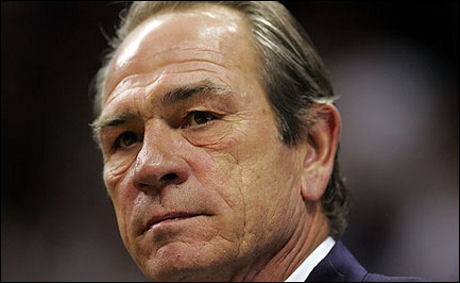
(1) Draft/Iraq: “About eight months ago, [New York Democratic congressman] Charlie Rangel came out advocating the reinstitution of the draft, and people were shocked. ‘Congressman Rangel,’ they said, ‘why would you argue for the reinstitution of the draft?’ He said, ‘It’s very simple. We have a volunteer army. We’re sending ’em back tour after tour after tour. We’re running our military into the ground, and if we would just reinstitute the draft so that it had some impact on American people — those who don’t do a lot of thinking — this war would be over in six months.’
“[And] think that’s right. We had the draft in ’68, we had a bullshit war, and it ultimately ended. And there were terrific repercussions throughout the government. The Bush administration has escaped those repercussions because the American people have a way to turn their head and say, “It doesn’t really affect my family. My daughter is in no threat of having her legs blown off. My son is in no threat of coming back with no face, no ears, no nose — because he didn’t volunteer.”
“If somebody were making them incur those risks, the votership might change radically.”
(2) Border Fence: “The idea of a fence between El Paso and Brownsville bears all the credibility and seriousness of flying saucers from Mars or leprechauns. Or any manner of malicious, paranoid superstition. In other words, it’s bullshit.
“[You hear the talk] and the talk is worth headlines, the talk is worth attention, and that might lead to votes. It’s a predatory approach to democracy by those who would instill fear and then propose themselves as a solution. It’s very destructive. Very, very destructive. And it’s the perfectly wrong thing to do.
“First of all, it won’t work. You can’t build a fence that I cannot get over, through, or under if I want to go to Mexico. In that [border] country, you cannot do it. It’s a complete folly. Ecologically, it’s a complete disaster, and sociologically, it’s a complete disaster. It’s an act of fascist madness.
“And the people who are being appealed to, the voterships that are removed from that country, are being spoken to as if it’s time to fence their backyard so the stray dog doesn’t get in. ‘Okay, let’s just build a fence.’ That’s as far removed from reality as can be, and entirely cynical by those who would manipulate these people. It’s a sad day for the democratic process to see people manipulated through fear and insecurity.”
(2) About No Country: “So there’s a lot of different ways of thinking about morality, is what we were saying last, and the conventional way is not always the right way. Morality might be bigger than you are. And I think the human being needs — I don’t know if he deserves, but needs — frequent reminders that the world ain’t flat and he’s not living in the center of the universe. I think that’s an important part about the last few moments in the movie.
“You’re asking me now about the last scene, which is essentially a speech by Ed Tom Bell recounting dreams about his father. And you have the feeling that Ed Tom is thinking about hope, about the future, and that no matter what evil might have transpired, or no matter what opportunities were lost for communication between father and son, or between brother and brother, sister and brother, that somewhere off ahead through the darkness and cold there’s a father who carried fire to create a warm place to welcome you. And that keeps you going, because you know he’ll be there.
“And after describing that beautiful picture, Ed Tom says, ‘And then I woke up.’ So, as always with Cormac, the question becomes more important than the answer. Was that dream an illusion or not?”

Denver Showdown

Democratic political consultant and former West Wing writer Lawrence O’Donnell has tapped out a short play about how things could go at the Democratic Party convention in August could go if there’s still a close contest going on between Hillary and Barack. Which won’t be the case, of course. It’ll be over sometime in early to mid June. But it’s good writing. It reminds me of the tone of Gore Vidal‘s The Best Man. The only it doesn’t have are lines like “there are no ends — only means.”

Barack: Hillary, I care about two things exactly as much as you do: the party and getting the nomination.
Hillary: You mean you don’t give a shit about the party and you’d kill to get the nomination?
Barack (smiles): You wearing a wire? (beat) You know, all that ugly ink you√ɬ¢√¢‚Äö¬¨√¢‚Äû¬¢ve been getting all summer about destroying the party, handing the election to McCain — there√ɬ¢√¢‚Äö¬¨√¢‚Äû¬¢s only one person who can make that go away. Me. That brilliant acceptance speech you√ɬ¢√¢‚Äö¬¨√¢‚Äû¬¢re expecting me to give can put you back where you belong√ɬ¢√¢‚Äö¬¨√¢‚Ǩ¬ùhero of the Democratic Party — can put your husband back where he belongs — respected statesman. Nothing else can.
Hillary: Winning can.
Barack: If you got the nomination, you’d lose to McCain and the Clintons become the official destroyers of the Democratic Party. End of story. Have fun in the Senate after that.
Hillary: C√ɬ¢√¢‚Äö¬¨√¢‚Äû¬¢mon, I can beat McCain. I can…
Barack: Hillary, your negative is at 49 percent. You have the highest negative of anyone who’s ever run. You cannot possibly win in November.
The best line comes at the very end when Bill comforts Hillary at the very end: “Don√ɬ¢√¢‚Äö¬¨√¢‚Äû¬¢t worry. McCain√ɬ¢√¢‚Äö¬¨√¢‚Äû¬¢ll kick his ass.”

Iraq War Needs Vittorio

“While researching an upcoming piece on the films of 1968, Variety‘s Todd McCarthy “noticed that The Green Berets was the 10th highest grossing picture of the year, and it struck me that this was very likely the last film about a contemporaneous war that actually made money. So no wonder all those Iraq movies are bombs.”

Which suggests…what, that a Green Berets-styled Iraq War film might succeed where others have failed? That if some director were to invent an optimistic fiction that had U.S. forces winning with someone like the Duke leading the charge, it might do some business? I wonder. I don’t think there’s a place for John Wayne in Iraq today any more than there’s a place for George S. Patton or Sgt. York or General Robert E. Lee. The only old-school guy who might fit into Iraq would be Steve McQueen‘s hard-assed loner character in Hell Is For Heroes.
There was no place for the Duke in Vietnam, really. Not in any straightforward heroic way. Oliver Stone, who was there, certainly didn’t think so. If anything, the Duke’s descendant in Platoon was the Tom Berenger character — the surly scarface who drank and looked down on the pot-smokers and wound up fragging Willem Dafoe‘s Jesus-like Sgt. Elias.
People seem determined to blow off any movie that has anything to do with Iraq. In my dreams I like to think that Average Joes might respond to (a) an old-fashioned 70mm Iraq War film — one that strictly prohibits cell-phone or handheld video footage, and goes instead for a 21st Century Apocalypse Now effect with Vittorio Storaro-level cinematography; and (b) one that delivers the excitement and intensity without the liberal finger-pointing about how we’re poisoning our souls over there. (Which is absolutely the case.) Something as good and jolting as the last third of Full Metal Jacket, say.
I only know that shitty-looking pixellated videos are over as far as Iraq War depictions are concerned. The cliche has been ground into the dust, and the only way to go now is to make that war look totally blue-chip, which is to say horribly and grotesquely “pretty.” Kathryn Bigelow and Paul Greengrass, take note!

Fighting Spirit

I was thinking last night about all the rancor that goes on at this site. At least it’s proof that HE readers aren’t ones to nod off and say “tutto bene.” This led me for some reason to re-read Richard Brody‘s “Auteur Wars” in the 4.7 New Yorker this morning, and the following passage from a December 2007 Die Zeit interview (translated by GreenCine) with Jean Luc Godard:
“Arguing about cinema [is] something that’s stayed with me from the days of the nouvelle vague, even though it no longer exists in this form,” he says early on. “Because the beautiful thing about cinema is that it still always allows us to argue. Fundamentally. You can get far more upset about an opinion about a film than one about a painting or a piece of music.
“For example, when I say to someone, ‘It doesn’t surprise me at all that you like the new film by Robert Redford because I always knew you were daft.’ That sets things off immediately: ‘Who do you think you are! How dare you!’ And if I want to get to know someone, let’s say, for example, you, then I wouldn’t ask for your opinion about Iraq or Yugoslavia or the train strike, but instead ask you to name a film you like.”

Meet My Monster

To hear it from Oscar-winning filmmaker Errol Morris, his new documentary about the Abu Ghraib prison scandal, Standard Operating Procedure (Sony Classics, 4.25 NYC, 5.2 in L.A.), basically says that U.S. soldiers based in Iraq who tortured and humiliated local terrorist suspects weren’t that bad. If you grade them on a curve, that is. Because we’re all that bad if given half a chance. We’re all about as decent and humane as the next guy until circumstances and dark guidance bring out our inner monster

“I made a movie about people like yourself or myself trapped in the middle of this — people we never would have seen or would have forgotten about, who we just would have assumed are really monsters,” Morris told Defamer‘s Stu VanAirsdale. “And I’ve brought them back across the line back into humanity. And I think it’s an interesting story, and a human story.”
And a movie that is almost certainly going to die because Joe Average doesn’t want to know about this stuff. Who does? Boiled down, isn’t this aspect of Standard Operating Procedure repeating the same message as Rod Serling‘s famous Twilight Zone episode, “The Monsters Are Due on Maple Street“? Our willingness to turn on our neighbor when sufficiently motivated (i.e., scared)? Our capacity for malice and violence and savagery?
It’ll make for an interesting topic during my Errol sitdown tomorrow (4.10) at the Four Seasons hotel.

Note of Concern

HE to that self-amused New York “Vulture” writer who tapped out yesterday’s item about how Stanley Weiser‘s script of W, the basis of Oliver Stone soon-to-shoot George Bush biopic, sounds like the comedy hit of ’09 that perhaps should costar Will Ferrell and Seth Rogen, etc.
Have you read Weiser’s script or merely Stephen Galloway and Matthew Belloni‘s 4.7.08 Hollywood Reporter story about the reaction of four Bush biographers to it, and perhaps also that link to the first four pages of an October draft of the W/Bush script?
If you’ve read Weiser’s script then I don’t know what to say to you. Your reaction suggests an incredibly thick head and an oafish sensibility. If you haven’t read it but would like to, send me an e-mail and I’ll fire it off to you. Keep in mind, naturally, that the draft is about six months old and has since undergone the usual revisions and refinements.
I ran my reactions to the script on 4.2.08. I didn’t see any comic aspects except for the darkly comedic, bordering-on-demonic ones that go with the territory of the Bush presidency. It is, as I said, “tightly written and clear of mind — everything is very choice and precise, and it never wavers from its focus of delivering a well-honed portrait of who this guy is, what’s driven him, what he’s always wanted, how he’s gotten to where he is, and what the central themes of his life seem to be (i.e., the drag-downs and the uplift).
“It seems,” I wrote, “to have its ducks in a row and is carefully shaped and ordered, because the dialogue is very tight and pruned down, because Weiser seems to have captured Bush’s speech style perfectly. Not once did I sense the presence of Hollywood far-left liberals getting off on skewering Bush because it’s in their blood. I sensed a real submission to documented or reliably sourced fact.
“Boiled down, W is a cogent dramatic summary of the significant chapters and stages in the life of an aw-shucks, smart-but-dumb, silver-spoon fratboy who, like all of us, has had his issues and limitations and hang-ups and challenges to deal with, but nonetheless managed to grow into a donkey demagogue of the first order.”

Loose Guru

A guy who hears things and is usually on (or close to) the money says that Mike Myers‘ conduct on The Love Guru “has once again raised the bar for nutty behavior and he’s driven everyone at Paramount over the edge. Crazy, crazy, crazy.” In short, the usual-usual. Eccentricity and exactitude sometimes go with the territory. If you want to deal only with moderate people and moderate behavior, work for the insurance industry. No surprise if what I’m hearing is even half true. I did some Entertainment Weekly reporting about Myers back in the Wayne’s World (and Wayne’s World sequel) heyday, and I heard plenty so don’t tell me.

Masters on Valkyrie

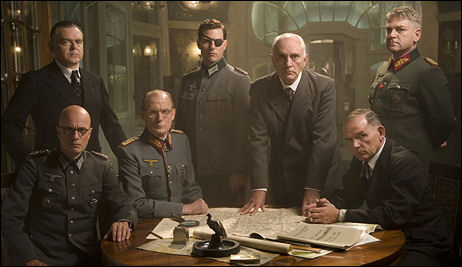
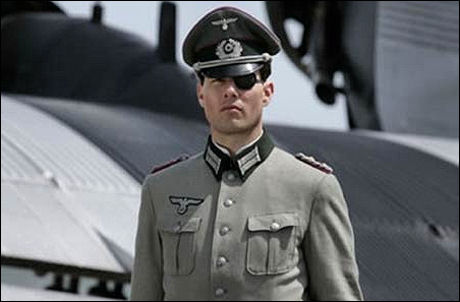
Slate‘s Kim Masters has taken a poke at the Valkyrie postponement, reporting the United Artists position that the bump to the Presidents’ Day weekend “represented an opportunity to cash in, [although] many see the move as a very bad sign, and, indeed, the buzz on the film is not good.
“What’s not in dispute is that filming remains unfinished, which is remarkable for a movie that started shooting in September 2007. One piece not yet shot is a battle sequence that begins the movie. An insider says director Bryan Singer will film a scaled-back version of what was originally conceived as a Saving Private Ryan-type opening.
“According to this source, the sequence was abandoned at one time as a cost-saving measure — and this movie is racking up the bucks — but when it became clear that the film was too talky, the battle was reinstated.”

Who Knows or Cares?

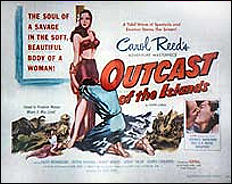
Nobody cares about Carol Reed‘s Outcast of the Islands, a 1952 adaptation of Joseph Conrad‘s novel with Trevor Howard in the lead role of Willem, a man who surrenders his dignity and civility for the love of a native woman. It’s a forgotten film and nobody cares at all. Except, I’m thinking, possibly those obsessive weirdos at the Criterion Collection. Those guys are just whacked enough to put out a remastered version of this British-produced film on DVD.

I saw it on the tube eons ago, and I’ve never forgotten a scene in which Robert Morley has been tied up inside a hammock with the hammock having been hung by a rope from a tall tree, and Morley, poor fellow, is shown swinging back and forth while being taunted by Howard and some local natives with sticks and spears.
The story mostly takes place in Malaysia. I don’t remember the particulars. I’ve never read the Conrad book, but I’ve been told it’s a bit grim. Ralph Richardson and Wendy Hiller costar in the film. The striking black-and-white cinematography is by Ted Scaife and John Wilcox.

Crawford’s Hoover…10-4!

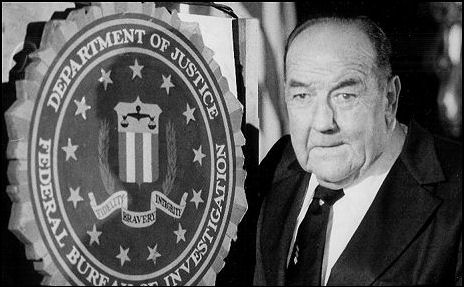
The fact that you can’t rent or buy Larry Cohen‘s The Private Files of J. Edgar Hoover on DVD, and that it hasn’t been shown in a Los Angeles theatre since ’83 or thereabouts makes the three-day booking at the New Beverly Cinema (4.13 to 4.15 at 9:25 pm) something of an event.

Mark Felt as “Deep Throat” over 25 years before the press broke the story. (Or so the press release claims.) Cohen will discuss this and other Hoover matters at a q & a following each screening.
Broderick Crawford plays Hoover, but isn’t shown engaging in curious intimacies with FBI agent Dan Dailey‘s Clyde Tolson. (Revelations about Hoover’s personal life hadn’t surfaced when the film was made.) The film costars Jose Ferrer, Dan Dailey, Michael Parks, Celeste Holm, Lloyd Nolan and Rip Torn. It features a classic musical score by Miklos Rozsa.
The film was shot at FBI headquarters, at the FBI Training Camp at Quantico and at Hoover’s own home — but without Bureau censorship.
The New Beverly Cinema (323.938.4038) is located at 7165 Beverly Blvd., LA 90036.

Drop by Drop

Yet another take on the slow eclipse of elite film criticism has been filed by L.A. Times columnist Patrick Goldstein (“The Death of the Critic”).

The piece is partly based on his having interviewed students from an entertainment reporting class at the USC School of Journalism, whom Goldstein and L.A. Times reporter John Horn visited last week at the invitation of instructor Charles Fleming.
“The internet has played a big role in [this process],” Goldstein writes. “It has promoted a democratization of opinion in which solo bloggers — most famously Matt Drudge — can outstrip mammoth news organizations. Whenever I spend time with young students, I see an even more intriguing concept at work. Although they are heavily influenced by peer group reaction to films or music, they do listen to critics, but largely as a group, not as individual brands.”
Key quote: “The age of the singular critical voice is ending — people prefer the wisdom of a community.”
Goldstein reports that “nearly [all the students] said that when they want to read up on a film, they often go to metacritic.com or rottentomatoes.com, websites that offer a healthy sample of critical consensus. As student Victor Farfan put it: “They put all the reviews in one easy, convenient, conglomerated source that gives you a breadth of opinions from trusted sources and some less familiar ones.”
“Other students acknowledge that they put little stock in critical opinion, lumping it in with the cascade of hype that accompanies today’s entertainment. ‘We tend to be wary of anything that seems over-hyped, whether it’s by critics or over-advertising,’ said Courtney Lear. ‘Personally, I trust certain actors, artists or directors from previous experiences. The Arcade Fire is playing in Hollywood? Their last album rocked my socks off. When do tickets go on sale? They’ve already gained my trust.’
“For a generation that lives on the web, even the most eloquent critics are distant thunder, rarely promoted well on newspaper websites and often reluctant to use blogs as a platform to spread their gospel. Even among savvy journalism students, it’s hard to find anyone who knows any critics by name.”

Valkyrie Bump Revisited

As I understand it, the MGM/UA rationale for bumping Bryan Singer‘s Valkyrie from October 3rd to February 13th (i.e., President’s Day weekend) is simple — they believe it will make more money on that date than it will in early October.

Conventional wisdom says that a twice-bumped movie that ends up opening in February of the following year has a problem. On the other hand we’re all on a moving train, and it’s necessary each and every day to hit refresh and ask, “Okay, what’s changed? What’s evolving? What is the reality of the situation right now?” Here are some thoughts and comments I’ve been processing since posting a brief item about this matter yesterday afternoon:
(1) United Artists publicity/marketing chief Dennis Rice says the reason for the switch was “real simple. The last three years of the first weekend in October produced roughly $85 million for top twelve pictures. For the last three years for President’s weekend, the top twelve have produced $150 million. We’re a small start-up company and we’re looking at the bottom line, and with the February opening we’re looking at a bigger opening, a holiday weekend and a longer playing time.”
(2) I recognize that the President’s Day weekend has delivered bonanza box-office for films like Jumper, The Spiderwick Chronicles, Ghost Rider, Bridge to Terabithia, The Pink Panther, Hitch, Constantine and so on. But all these movies were crap-level “audience” movies, and Valkyrie is a big-budget, class-A World War II thriller with a superstar lead (Tom Cruise), a blue-chip supporting cast (Kenneth Branagh, Terrence Stamp, Bill Nighy), a top-drawer director (Bryan Singer), an Oscar-winning screenwriter (Chris McQuarrie), etc.
(3) So yes, the money-making opportunity is obviously there, but it’s nonetheless unusual for an ostensibly classy, first-rate film of this sort to be bumped out of two release dates in a given year and then shifted over to February. How many films that have been twice bumped have turned into formidable critical and commercial hits?

(4) When I read an early version of McQuarrie’s Valkyrie script, it didn’t seem like an Oscar contender — I was thinking “smart thriller and leave well enough alone.” It could score in the acting categories, however, and certain films — Silence of the Lambs, Gladiator, Crash – have opened outside of the Oscar season fall-holiday weekend and gone on to get recognized. “If recognition comes, so be it,” says Rice.
(5) The February 23rd date was deemed especially attractive after Joe Johnston‘s The Wolf Man dropped out of that slot — fine. But what was Valkyrie facing on October 3rd? The Express, a football movie directed by Gary Fleder, plus Nick and Norah’s Infinite Playlist, Nights in Rodanthe and Possession. Obviously not much competition. The big competition the following week (Oct. 10th) would have been Ridley Scott‘s Body of Lies with Leonardo DiCaprio and Russell Crowe.
(6) “Actually, I heard the push-back of Valkyrie isn’t necessarily just to [postpone] the film,” a director-writer wrote this morning. “The motive is to give Cruise a chance to court other studios and get a commercial film on the boards, such as The Hardy Men with Ben Stiller or even another Mission: Impossible, before the Singer flick opens and possibly colors perceptions [on this or that level].”
(7) There’s a belief among this and that producer that October is “the new Dead Zone,” as one industry-watcher explained this morning. This is based on the disappointing or underwhelming box-office that several prestige-level dramas and dramadies encountered last October — among them Rendition, Reservation Road, Gone Baby Gone, Sleuth, Before the Devil Knows You’re Dead, Things We Lost in the Fire, Elizabeth: The Golden Age, Michael Clayton, Lars and the Real Girl, Dan in Real Life, Control, etc.
(8) “I heard that Singer was trying to shape [Valkyrie] into something like [Alfred Hitchcock‘s] Rope…a kind of intense suspenseful parlor drama,” the director-writer said this morning. “But it was apparently one of those things that was one thing on the page, something that read well, but it became something else when the actors starting saying the lines on the set and people started looking at it as something to watch and sink into. I’ve been told it plays like an HBO movie.” Is that a put-down? Not in my book.
(9) A small group has seen a cut of Valkyrie. A journalist friend says he knows two people who’ve seen it and have said that it’s ‘really good‘ and have said that UA pushed it back because they still have to shoot the big desert sequence.” (I answered that the movie may be fine, but this is early April — almost six months before the 10.3 opening, which is plenty of time to shoot a desert sequence and pop it into the front section.) Another guy I know was told a while back by a person not with MGM or UA that he might be invited to a screening of it, but then it didn’t happen. The vibe he got from this person was a kind of a “hmmm, what do we have here?”