

Letterman: “A hard-boiled egg and an orange? Gee, you can’t go wrong there.” Hilton: “Yeah, but [the jail experience] is over and I don’t want to talk about it any more.” Letterman: “Uh-huh…well, this, this is where you and I differ because this is all I want to talk about.” You might think you’re sick of this but watch this…happened last night. The way she turns on the sniffles when Letterman won’t let up is exactly how this empty vessel got out of jail the first time…before they sent her back.
Bottle Rocket on Criterion
Two days ago director Wes Anderson told MTV.com’s Josh Horowitz that work has begun on a bells-and-whistles Criterion DVD of the great Bottle Rocket. The only way to see this seminal ’90s film now is on a bare-bones Sony Home Video DVD that’ came out in December ’98 — no extras, voice-overs, deleted scenes, nothing.
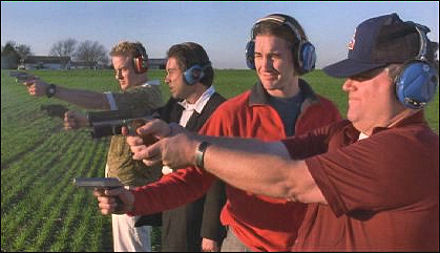
“We’ve just begun work with the Criterion Collection [people] to do Bottle Rocket on a new DVD that’s going to have all kinds of stuff,” Anderson told Horowtiz. “There’s a lot of Bottle Rocket that was on the cutting room floor, so we have a lot to work with on that one.”
Of course, one reason why this seems like such good news is that it provides escape from the present. A shaft of sunlight in an otherwise dark atmosphere.
Ignore the Academy
The whole idea of MCN’s Gurus of Gold and The Envelope prognosticators (who will be assembled in good time) trying to predict which films and filmmakers will be honored by Academy nominations next January is a waste of breath, space and influence. Or at least, it is at this stage of the game.
October and November should be set aside as ignore-the-Academy months. Or at least about downplaying suspected Academy beliefs, prejudices, allegiances and tea leaves. There’s plenty of time for that drool in December, January and February. And the repetition from stirring that drool over and over becomes sickening after the New Year. The nausea sets in every year around that time. Going to Sundance and getting away from the awards-prediction game is a huge relief in mid-January. Why? Because Oscar handicapping has been going on for three, three and a half months by this point.
I say delay the clock and inject a little nobility into the process. The next eight weeks should be about giving a little spotlight action to those films and filmmakers who truly and fully deserve to be honored (the Sam Riley‘s, the Once‘s, the Zodiac‘s) without considering the sentiments of a sometimes ignoble body that — no disputes, please — often gets things wrong, in part because of small, selfish, territorial factors.
Keep the Academy/industry predictions if you must, but at the very least they should be given minor attention until at least the passing of Thanksgiving. The Gurus and the Envelopers should spend the next seven or eight weeks primarily championing the right movies and the right stuff, and not in some elitist, off-in-their-own-realm Village Voice sense of that term. The Gurus and the Envelopers are fairly conscientious and grounded and not, as a rule, on the anal-obsessive side. (You know what I mean.)
I know the Gurus and the Envelopers, and I know they’re more particular, more impassioned and far less provincial than the Academy and the guilds about the best of the best. No brag, just fact. And it’s a sin –a dereliction of duty — to waste an opportunity to possibly influence the shape of things in favor of trying to predict or second-guess what the industry pack mentality (which each and every industry person feels and responds to, and sometimes goes along with) will be down the road.
This all started last night when one of MCN’s Gurus of Gold responded to my having written two days ago that the Gurus “should be ashamed of themselves” for blowing off Control‘s Sam Riley as a potential Best Actor candidate.
I suggested that “each and every Guru needs to go outside, light a cigarette (even if they don’t smoke), take a 20-minute walk and ask themselves why they failed to even mention one of the absolute finest performances of the year by an actor of either gender. For this oversight alone, this team needs to be regarded as the Gurus of Shame.”
The guy’s response was perfunctory. “Surely you can’t have forgotten, having been a Guru once yourself, that we’re not voting for who or what we personally think should get Oscar noms,” he said. “We’re trying to think the way an Oscar voter thinks and make our choices accordingly, and I suspect very few Oscar voters have heard of Joy Division or Ian Curtis or Sam Riley. [Predicting] is the whole purpose of the exercise. What critics think and what Academy members think are often two very different things, as you well know.”
“I strongly disagree,” I wrote back. “To hell with the Academy and the guilds at this stage. The Gurus and the Envelopers have a golden opportunity to put certain titles and names into the hat. You can play that dull, dispiriting ‘how the Academy dullards will vote’ game starting December 1st, or maybe after Thanksgiving. But October and November should be about history, callings and visions, and not industry politics.
“People have said time and again that Academy voting choices are sometimes a joke, and sometimes embarassing in hindsight. Let’s be honest — they sometimes have been. That’s because of persuasions, attitudes and prejudices that come out of a kind of laissez-faire corruption. Well, I believe the Gurus of Gold and The Envelopers are just as corrupt if they devote their time and energy entirely to predicting how these chowderheads will think, feel and vote.
“It’s banal and boring — the word is actually ‘destructive’ — to focus on this crap for four and a half months. Please, please — the basic format and the attitudes need to change.”
I realize that my “ignore the Academy and the guilds” will be laughed off by some. (Milquetoast mentalities always laugh off anything new or different.) So the compromise would be for the Gurus and the Envelopers to at least run two charts in each category — call one “pure” and the other one “political.” Go ahead — explain to me how this is a bad or unworkable idea. Because it’s not.
Amy Adams in “Enchanted”
A producer with no connection to Enchanted, Kevin Lima‘s part-animated, part live-action fantasy drama that opens on 11.21, saw it last night at the Landmark and believes that Amy Adams, who plays a fairytale princess named Giselle who’s thrust into the harsh present and needs to adjust her perspective as a result, will receive an Oscar nomination.
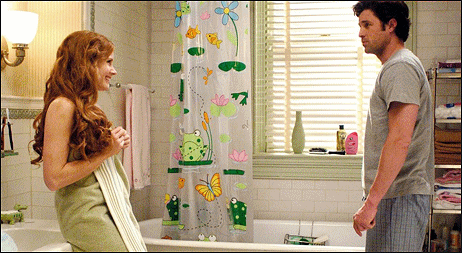
“The movie is a very well-conceived, well-made product straddling the po-mo Pixar style and the throwback Walt-era tropes,” the producer says. “But Adams gives an incredibly complex, detailed performance that it makes the movie seem almost literary — there is a scene when her character first feels anger that brings to mind John Milton. The movie will be gigantic and will make Adams a worldwide household name.”
Enchanted costars Patrick Dempsey, James Marsden, Susan Sarndon, Timothy Spall and Rachel Covey


“Enemies” reborn under Redford?
I thought with all the apparent lack of interest in Iraq/ Aghanistan/9.11-type movies that Against All Enemies, a film based on former terrorism czar Richard Clarke‘s novel about the failures of the Clinton and Bush administrations to stop the terrorist plotters who eventually brought about the 9.11 attacks, was dead. Indeed, Variety‘s Michael Fleming has reported that Columbia Pictures, “[which] had been developing the project, put it into turnaround last month.”
But the guys who run Capitol Films (i.e., the owners of ThinkFilm) have picked up the project and and are raising financing, and if and it all comes together Robert Redford (whose troubled Lions for Lambs opens on 11.9) has agreed to direct.
I ran a piece in April 2006 about James Vanderbilt‘s adaptation of Clark’s novel — a “gripping, pared-to-the-bone screenplay, which Paul Haggis was going to direct with Sean Penn as Clarke.
It has a 24-page opening sequence that kills in terms of tension and psychological suspense, showing the White House staffers in turmoil on the morning of 9/11. Then it rewinds back to start of Clarke’s government career in the late ’70s (when he was in his late 20s) and takes us on a journey of gradual discovery as Clarke learns more and more about the Mujahdeen, Islamic fundamentalists, offensive Jihad, “Usama” bin Laden and so on.
Then it’s back to 9/11 and Clarke’s confusion when the Bushies decide to use the attacks as an excuse to go to war with Iraq, and then his leaving the White House and writing his book and delivering his rant before a Congressional 9/11 committee, and finally his apology…even though he’s arguably the least guilty guy in the Washington establishment as far as 9/11 negligence is concerned.
Hickenlooper, Anderson, Spacek
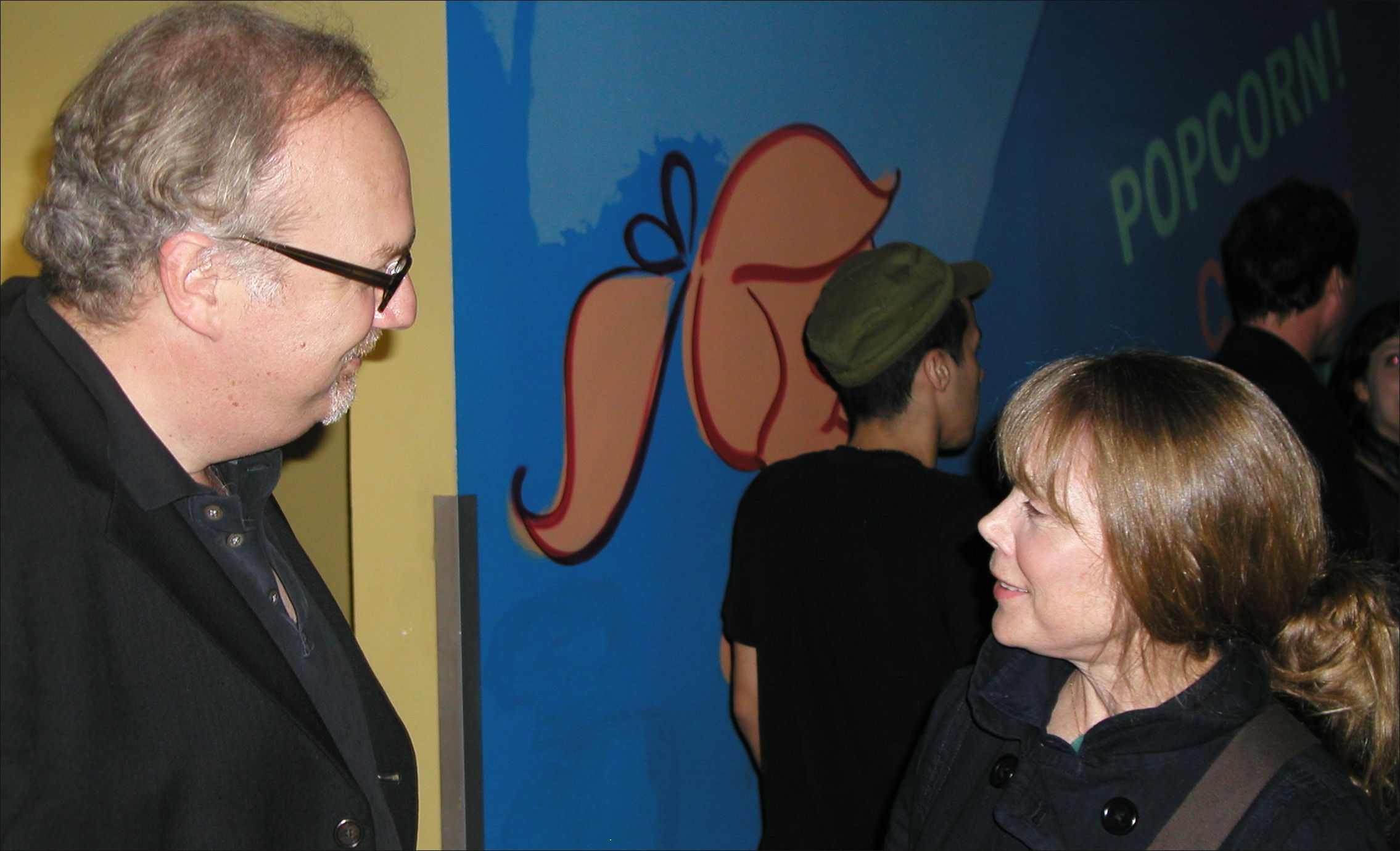
George Hickenlooper (r.) and Paul Thomas Anderson (l.) at the Alamo Draft House in Austin last Thursday night after that already-fabled screening of There Will Be Blood. Hickenlooper had just come from an adjacent-theater screening of Mayor of the Sunset Strip. Sissy Spacek joined them soon after and, says Hickenlooper, “kept telling me how it was one of the most extraordinary films she had ever seen…she seemed completely blown away by it.” Spacek has been married to Blood‘s production designer Jack Fisk since 1974.

“Kingdom” loses to “Game Plan”
Universal gave The Kingdom a nationwide sneak a weekend or two ago and vigorously plugged it besides, and yet Dwayne Johnson‘s The Game Plan will ace it out this weekend. One estimate has the Sunday-night tallies for The Game Plan at $21,458,000 and $18,029,000 for The Kingdom.
More people simply liked the idea of a comedy over a Riyadh shoot-em-up, I guess, but it’s also hard to dismiss the implications of yet another Middle-East drama underperforming. I thought The Kingdom was going to be the exception to the rule. It’s also time to ask whether Kingdom star Jamie Foxx is an actual movie star who sells tickets. Another factor: The Game Plan snuck last weekend also.
Schoeller at ACE

Two Martin Schoeller prints at Ace Gallery, 9430 Wilshire, Beverly Hills, during a benefit gathering — Thursday, 9.27.07, 10:05 pm
“Body of Lies” shot
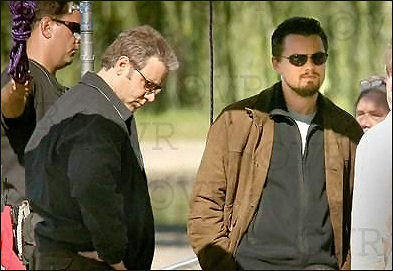
Leonardo DiCaprio as “Roger Ferris” and an obviously chunky Russell Crowe as “Ed Hoffman” during filming of Ridley Scott‘s Body of Lies (Warner Bros.), a Middle East drama that’s been scripted by The Departed‘s William Monahan. It’s about Ferris being after Suleiman, a Muslim terrorist behind a series of car bombings. The title refers to a complex scheme instigated by Ferris in which false information is fed to the bad guys via a dead body of a decoy agent.
Somebody sent me a cpy of the script last spring and now I can’t find it. Anyone have a digital copy?
Whitty on “The Orphanage”
Juan Antonio Bayona‘s The Orphanage (Picturehouse) “won’t be released until the end of December, and there will be plenty of [similar-type] films before then — including the very big budget I Am Legend,” writes Newark Star-Ledger critic/columnist Stephen Whitty. “But I’m willing to already call this little Spanish film the best horror movie of the year.
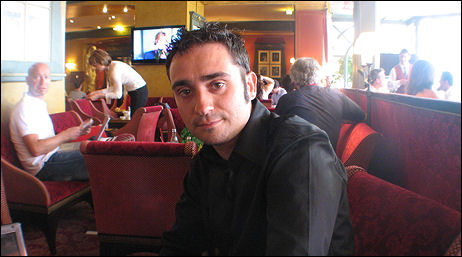
The Orphanage director Juan Antonio Bayona following our chat in the Majestic Hotel lounge in Cannes — Wednesday, 5.23.07, 12:25 pm
“Admittedly, it’s not going to be a big hit with the blood-and-guts crowd (although there is one gory shock midway through that left even a Fangoria writer shaken). And its scares have more to do with suggestion than special effects. Then again, that’s exactly why I liked it.
“Watching it at the New York Film Festival, I kept thinking of classics like The Innocents and The Haunting, as well as the Spanish masterpiece The Spirit of the Beehive.”
Damn straight. I said exactly the same thing four a half months ago. I expect many others to join in as the release date approaches.
After seeing it twice at last May’s Cannes Film Festival, I wrote that The Orphanage is “hands down the creepiest sophisticated ghost story/thriller to come along since Alejandro Amenabar‘s The Others.
“If you ask me (or anyone else who’s seen it here) it absolutely deserves a ranking alongside other haunted-by-small-children classics as Jack Clayton‘s The Innocents and Nicolas Roeg‘s Don’t Look Now. It also recalls Robert Wise‘s The Haunting, although the ghosts in that 1961 film were all over 21.”
“Outsourced” Seitz review
On the same day that a certain film about three American brothers in India is getting half-trashed, a smaller, possibly less affected film about a single American guy visiting India under professionally strained circumstances — John Jeffcoat‘s Outsourced — has also opened in Manhattan, Austin, San Francisco and various northwestern cities.

It opens in L.A. (and other northern California towns) next week and, of course, no one has told me about any screenings. N.Y. Times critic Matt Zoller Seitz has called it “a wonderful surprise.” I’ve decided to see it entirely because of this photo of Outsourced star Josh Hamilton in the feces-filled Ganges.