Low-rent audiences

“In 2007, the divide between critics and the moviegoing habits of mainstream American [audiences] seems further apart than ever,” writes Variety‘s Ian Mohr. Which has led some to conclude (or “crow,” as Mohr describes the tone of one Disney exec) that “critics are out of touch with their readership.”

Just because people pay to see something doesn’t mean they love it, or even like it. Many people will pay to see second-tier movies and sit there and seethe, or do the opposite and surrender. Some will sit for almost anything that raises an occa- sional smile or a chuckle. They’ll watch something fairly bland or tedious and go “hey, that’s familiar…kinda funny, in a way…heh!” They’re not looking for any kind of transcendence or deliverance, like most critics; they’re looking for a familiar- feeling massage…a visit with old friends…a cat in their lap.

Does the situation needs to be solved? Should editors think about hiring dumber, less seasoned, more oafish critics?

By the age-old Planet of the Apes caste system (and I realize I’ve used these terms too often in the past), critics are almost all orangutans and chimps while general audiences are always going to include a high percentage of gorillas. Frankin J. Schaffner, the director of Planet of the Apes, knew from gorillas — he knew who they were, what they were like deep down, how they thought, etc. And we’re supposed to contour our moviegoing tastes to the vistas and appetites of those with the least refinement and curiosity and brain cells?

General audiences always prefer crap and rarely show any real taste in anything. Audiences generally have the same low-rent taste in movies, art and music that they have in food. Look at the movies and filmmakers that win the People’s Choice Awards each year — they’re almost always on the level of Carl’s, Jr. and Bob’s Big Boy.

A site called “Super Seventies,” which goes by reader vote tallies, says the following tunes were voted the top songs of 1970: (a)”Bridge Over Troubled Water,” Simon And Garfunkel (tolerable..barely); (2) “American Woman”, The Guess Who; (3) “Get Ready”, Rare Earth; (4) “Band Of Gold”, Freda Payne; (5) “Raindrops Keep Fallin’ On My Head”, B.J. Thomas; (6) “ABC” — The Jackson 5; (7)”Let It Be”, The Beatles — THESE ARE ALMOST ALL TERRIBLE SONGS! — (8) “(They Long To Be) Close To You”, Carpenters; (9) “Mama Told Me Not To Come”, Three Dog Night; and (10) “War”, Edwin Starr. What does that tell you? That people know good music when they hear it?

Most critics admired Zodiac (and some creamed over it), and yet audiences gave it a $13.1 million shrug while gifting Wild Hogs, which earned itself an El Crappo 7% Rotten Tomatoes rating, with $38 million in ticket sales. Just about every last critic chortled at Ghost Rider; audiences went for it big-time. Critics said Norbit was dogshit; Eddie Murphy fans made it a hit anyway.

Reader question: you are absolute King of the Land and you have two choices that will remedy this situation: (a) wave your scepter and make editors hire dumber critics or (b) round up the worst gorillas (i.e, the ones who saw Norbit or Wild Hogs two or three times) and put them in Army trucks and send them off to benevolent artistic re-education camps out in Idaho and Montana where they’ll have to do exercises at 6:30 a.m. and eat vegetables and learn to understand and appreciate the works of Michelangelo Antonioni, Sergei Eisenstein, Budd Boetticher, early Fellini, Nicholas Ray, Jonathan Kaplan and Gus Van Sant.

I realize that the latter solution sounds like a Stalinist nightmare on one level, but if there are only these two choices would you really choose to deliberately dumb the culture down? Honest answers, please.

My arguments with David Poland have gone on and on, but the idea he threw out this afternoon to save The Hollywood Reporter from a really tough competition with Variety down the road, a fight that might eventually prove harmful or even fatal, isn’t half-bad and actually sounds sensible. Poland’s idea is that VNU, parent of THR, would buy Movie City News in order to recreate the Hollywood Reporter.

The Reporter probably does have to do something radical and revitalizing in order “to become a √ɬ¢√¢‚Äö¬¨√Ö‚Äúmust read√ɬ¢√¢‚Äö¬¨√Ǭù again,” says Poland. “And the only way to do that is to add young, smart talent and to let them have their heads more than a little.

“The [Reporter] website needs to do everything MCN does and more,” he goes on. “The print magazine needs to be a thrill to open every single morning. News is news. Variety will win that fight on points. For a Traditional Media paper like The Hollywood Reporter to truly embrace the crossover to a web-based culture is the paradigm of survival and success.”

“And they don√ɬ¢√¢‚Äö¬¨√¢‚Äû¬¢t have to piss all over the industry to make that work. (This is a lesson that the reconsidered Los Angeles Times will learn in about six more months.) But they can√ɬ¢√¢‚Äö¬¨√¢‚Äû¬¢t be sycophantic suck-ups either.

“In short, they need to be what MCN would be if MCN got venture capital, hired a dozen hungry reporters, a few very smart and funny columnists, and launched a print magazine to boot. But THR has a huge head start in that it already has a strong base of 40,000 subscriptions. It goes to every office in Hollywood, read closely or not.”

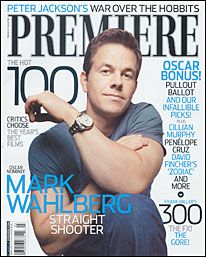
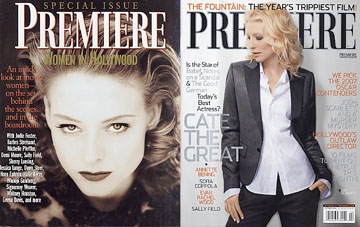
Premiere is dead

Not long after Elvis Presley died of a drug overdose in August 1977, the blunt- spoken John Lennon told a reporter that Presley “died in 1958, when he went into the Army.” An honest response to the death of the print version of Premiere magazine, which was revealed today, would be along the same lines: Premiere — the once-ballsy Hollywood magazine that was about nervy, sharp reporting and not upscale fan-mag aesthetics — died in May 1996 when much of the upper-level staff quit over editorial interference.

“You could feel the life forces leaving at that point,” recalls L.A. Times staffer Corie Brown, a former Premiere columnist (“California Suite”) and West Coast editor.

Brown was quick to praise Susan Lyne, now CEO of Martha Stewart Omni, for having launched Premiere in 1987 and running it for eight years, until 1995. “She was the guiding force,” says Brown. “And Chris Connelly was her deputy until she left, and then he took over. They were the two best editors I ever worked for.”

Premiere maintained high writing and editing standards after May ’96, but things were never quite the same. It gradually became a smart, respectably configured fan magazine — above-average writing and reporting (by L.A. Times staffers John Horn and Patrick Goldstein, Christine Spines, Fred Schruers, et. al.) and good film criticism by Glenn Kenny — and yet, in the view of most, a shadow of its former self.

Print publications are getting killed left and right by the internet these days, and that’s what got Premiere in the end. Ad Age‘s Nat ives wrote earlier today that Premiere‘s “paid circulation has declined slowly over the years, from an average of 616,089 in 1995 to 492,498 in the second half of last year, according to Harrington Associates and the Audit Bureau of Circulations.

“Even more ominous,” wrote Ives, “Premiere sold 24.7% fewer ad pages in 2006 than it did the year before, according to the Publishers Information Bureau. Titles and websites focused on celebrity gossip, meanwhile, have continued to gain circulation, making it difficult for older entertainment brands.”

“I do believe that the world has turned to get information online,” said newly- installed Variety columnist Anne Thompson, who was Premiere‘s West Coast editor from July 1996 to June 2002. “And running a monthly film magazine…a costly monthly operation at a time when everything is getting faster and faster….that’s a tough order.”

The online version of Premiere will continue. The print version’s editor, Peter Herbst, is out the door. The April issue will be the final one. A friend of a friend had been working on Premiere‘s “power” issue due in June…forget it. A source in Premiere‘s New York office said “the mood here is pretty frustrated, but this wasn’t completely unexpected.”

Premiere‘s 1996 editorial revolt happened when Hachette Filipacchi CEO David Pecker accepted “the resignation of two top editors, Chris Connelly and Nancy Griffin, and a near rebellion by the staff” (according to a Time magazine report) over the spiking of a “California Suite” column by Corie Brown about “business deals involving Sylvester Stallone and the Planet Hollywood restaurant chain”, which had venture plans at the time with Premiere‘s owner Ron Perelman.

One of the stars of the glory-days Premiere was Slate columnist Kim Masters. The top players in Masters’ era (she worked there from ’87 to ’90, give or take) were Lyne, Connelly, Peter Biskind, Griffin, Brown and John Richardson. (A star-in- the-making was E! columnist Bruce Bibby, who worked as a fact checker during Masters’ time.).

“My first piece was about Ovitz making a big scene at the Palm when some agents had defected from CAA, and Ovitz made a big flap about it, he didn’t want them eating there,” Masters says, “and I remember an editor read it to [then-publisher] Rupert Murdoch, and he laughed at the piece and said it was fantastic.

“That was the golden age of Premiere,” she recalls. “That was when the Power list was created. That was when we coined the term ‘Young Turks’, which I had gotten from doing legal reporting and hearing that term used in law firms. Things were so different in those days….a very different internet-free world.


founder and former Premiere editor Susan Lyne

“I did a big investigation of a Delta Force helicopter crash, in which several people were killed,” she recalls. “An interview piece about Sam Kinison. A great Roger Rabbit piece….I remember sniffing around about the film early on and getting this call from Jeffrey Katzenberg, saying what are you doing to my movie? Premiere was ballsy enough back then to fly me to London [where Roger Rabbit was shooting] when we had no access…they just sent me there and waited for the studio to cave.

“I remember when John Richardson and I were working on a power list [in ’92 or thereabouts], and we were sitting with Mark Canton in his office at Sony and he was saying, “I make the decisions! I run the show!…and Peter Guber stuck his head in and said, ‘I need you now‘ and Canton got right up and followed him out. And of course, Nancy [Griffin] and I Nancy and I wrote the story that was the origin of Hit and Run,” the 1997 best-seller about how Guber and Jon Peters “took Sony for a ride in Hollywood.”

“It was a good magazine, but that was such a long time ago,” says Masters. “It just went off the radar.”

“Reign” boo-boo at L.A. Times

Tens of thousands of L.A. Times “Calendar” readers were informed yesterday in the “Guide” section (page E20) that Mike Binder‘ s Reign Over Me will open on Friday, March 9th. Informed not just by the film’s inclusion in the list of bullet graphs identifying the title, makers and synopses of the films opening five days from now, but also with a big, can’t-miss-it photo of Reign costars Don Cheadle and Adam Sandler .

The unfortunate fact, however, is that Reign won’t be opening until March 23rd. Sony had it down as a 3.9 release about a month and a half ago, but then changed it to 3.23. The Calendar “Guide” listings are compiled by staffer Frank Torrez, who didn’t return two calls. That implies a wrongo on his part and not Sony’s. No biggie, mistakes happen. But if I were Torrez I’d have come in late, taken a very long lunch and caught up on my reading in a toilet stall for the rest of the afternoon.

Thompson off to Variety

Hollywood Reporter columnist and Riskybiz blogger Anne Thompson is now officially a Variety person. Her new title is Deputy Editor of Variety.com, working with/under Variety.com editor Dana Harris. Her daily/hourly blog will now be called www.riskybusinessblog.com (to differentiate from the riskybizblog she has/had at the Reporter). Her weekly “Risky Business” column will continue in the Variety print edition (most likely debuting Sundays in the weekly edition) .

Nikki Finke reported this about an hour and a half ago. Variety delayed all morning on the official announcement and finally got it up at 1:51 pm. You have to move fast these days…hubba-hubba. (Cynthia Littleton has reportedly also left THR for Variety.)

Restoring New DVDs

Variety‘s Diane Garrett has answered a question I put forward on 2.17 about the prospects of a restored African Queen DVD. The answer is, don’t hold your breath. The video rights are now held by Paramount Home Video (Fox Home Video having allowed its license to lapse) and the film is “awaiting restoration” — i.e., no funding has been approved/finalized to pay for a restoration of this 1951 classic John Huston film — “and has no set release date” — i.e., no restoration in sight, no release plans.

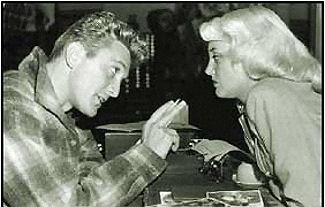
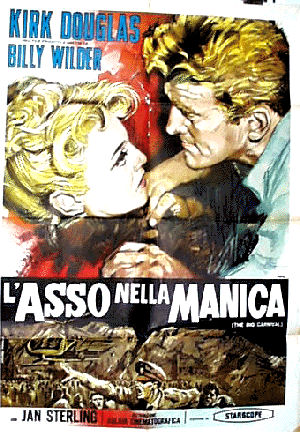
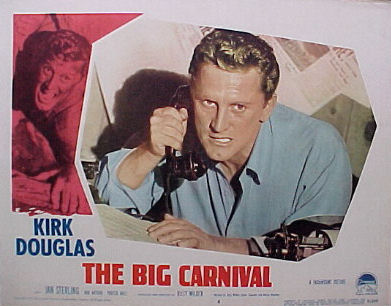
Garrett also reveals that the Criterion Collection is “devoting exacting care to [releasing] Billy Wilder‘s Ace in the Hole — good news! (Keep in mind that a restored print of Ace in the Hole was shown at Manhattan’s Film Forum from 1.12.07 through 1.18.07.) Criterion president Peter Becker acknowledges that “it often takes years to prepare special editions,” and says “we realize we are, in effect, suppressing these films while we are waiting to give them special edition treatment,.”

Warner Home Video’s George Feltenstein also reveals that “only right now are we able to release The Magnificent Ambersons,” Orson Welles‘ studio-mangled 1942 classic, which “will come out on disc next year.” (Not a big deal in my book — the Holy Amberson’s Grail is to find the footage that RKO and editor Robert Wise chopped out and reconstruct Welles’ original cut.)

Richard Armstrong‘s “Sense of Cinema” appreciation of Ace in the Hole is worth reading. The last graph is especially interesting:

“While Ace in the Hole won an award at the Venice Film Festival, it flopped so badly at the American box office that a chastened Wilder went on to mainly adapt hit Broadway plays until 1960.” In other words, the reception to Ace in the Hole is the reason Wilder did director-for-hire movies like The Seven Year Itch, The Spirit of St. Louis, Love in the Afternoon and Witness for the Prosecution all through the mid to late ’50s.

“Most Americans either hated the film or stayed away,” Armstrong continues. “Reviewers savaged it in turn. In 1997, the film was remade as Mad City (Costa- Gavras). If the title Mad City carries a hint that this city is exceptional, it also reminds us that Ace in the Hole‘s title was changed to The Big Carnival, according to the industry convention that ‘Big’ suggested exceptionally immoral doings.

“Oddly, the studios are still dependent upon yet scared of an unpredictable crowd. And with good reason, perhaps. As Wilder once said, people are people, after all. Fifty years on, some still pause at highway pile-ups.”

I’m also thinking back to that great Kirk Douglas speech in Ace in the Hole in which he speaks of his love for the rich culture and character of New York City compared to the primeval benefits of living in a hick town with its access to nature’s splendor, and Douglas saying that “the four spindly trees outside of Rockefeller Center” are all the nature that he needs in that department.

Flying Ninja Persians

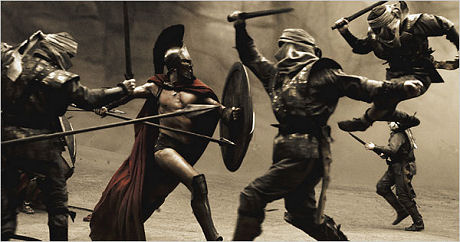
Zack Snyder‘s Battle of Thermopylae epic 300 is being read by certain brainy journo types as a modern-day political metaphor, according to this tongue-in-cheek Michael Cieply piece in the N.Y. Times.

I won’t be catching it until tomorrow night’s IMAX screening at The Bridge, but somehow a question reportedly asked of Snyder by a press-junket smarty-pants — “Is George Bush Leonidas or Xerxes?” — seems beside the point, given the heavily visual graphic-novel origins (i.e., shorthand for a primitive-mythical storyline geared to 15 year-olds) plus the repeated observation about the film’s homoerotic, gay-porn tone with all the buffed bods straight out of Gold’s Gym in Venice.

The funniest thing in the Cieply story is the 300 still [above] used by Times editors. A scene from the movie? It looks like a bunch of plastic action figures sitting on a table top in some photographer’s studio. Who are those guys with the tunics and the wrap-around, head-covering turbans….flying ninja Persians? (The Zodiac killer wore an outfit just like these when he knifed the couple by the lake.) The shot isn’t complete without a large thumb and forefinger of a nine year-old placing one of the action figures on the table.

If 300‘s mise en scene is in any way indicated by this shot, it’s going to be a joke.

Lager louts

Responding to yesterday’s remark that “the consistency in supporting and back-slapping low-brow entertainments straight out of the gate is what sets Americans proudly apart from other cultures….is there another big-time industrial western society as blue-collar oafish as ours?,” hotshot Manhattan entertainment journalist Lewis Beale writes the following:

“I would submit that if you’ve ever been in a European resort when it has been descended upon by lager louts from Britain, Germany, Holland or wherever, you will know that the ratio of idiots in these Western industrial powers is as high as in the U.S. I once spent a couple of days in Fuengirola,Spain, on the Costa del Sol, when it was overrun by tour groups from Britain and the Netherlands. The men started drinking at 10 a.m., and spent the entire time watching soccer games, fighting and vomiting. Quite an eye-opener.”

WordTheatre in London

Hollywood Elsewhere has a certain awareness/readership in London, so here’s a shout-out for a WordTheatre event I’ll be attending at Cafe de Paris (4 Coventry Street, London W1D 6BL) on Monday, 3.12.07.

WordTheatre is a literary salon with branches (communities?) in New York, Los Angeles and London,. It’s about actors and writers performing short stories (or portions of larger works), and a classy, pro-level thing all the way. Monday’s event will be the first of four in London this year. Proceeds for the first show will benefit The Parkinson’s Appeal. Richard Schiff, Ian Hart and Ray Panthaki will be reading. For the full program and to purchase tickets (20 pounds), please visit http://www.wordtheatre.com,

“Hurdy Gurdy” change

No question that Donovan‘s “Hurdy Gurdy Man” has been permanently reconfigured (or will be soon) in the public consciousness by its having been used in David Fincher‘s Zodiac, in much the same way that Gene Kelly‘s recording of “Singin’ in the Rain” never had quite the same cheer after Stanley Kubrick used it as a kind of perverse theme song n A Clockwork Orange.

Monument Valley & John Ford

L.A. Times film critic Kenneth Turan has written an agreeable travel piece about a recent pilgrimage he made to Monument Valley, largely in tribute to his memories of seven John Ford films that were shot there — Stagecoach, My Darling Clementine, Fort Apache She Wore a Yellow Ribbon, The Searchers, Sergeant Rutledge and Cheyenne Autumn.

And of course, Turan follows the herd by describing or discussing Monument Valley only in terms of the staggering beauty of the place and not once about the whopping absurdity of any 19th Century settlers living in Monument Valley because it has (a) no grass for cattle to graze on, (b) no rich soil to grow crops with (it’s all sandy, desert-type moon dust with rugged cactus and sage brush-type plants), (c) no big river running through it, and (d) no forest to invade and cut down trees to build log cabins and make lumber with with…no nothin’ in the way of life-sustaining, community-building elements of any kind.

Or at least, none that I’ve been able to notice in watching all these Ford films. Not a damn thing except worthless scenic beauty. And none of the Ford worshippers have ever complained about this…not once. Or have I missed something?

New time change

Daylight savings time begins a week from today, or Sunday, March 11th — three weeks earlier than usual. Get ready to manually reset your Treos, Blackberrys and computers because many devices, apparently, haven’t been programmed to synch with the new time change arrangement.

A 3.5.07 N.Y. Times story by Steve Lohr says that “the daylight-time shift, according to technology executives and analysts, amounts to a ‘mini-Y2K.’ That is a reference to the rush in the late 1990s to change old software, which was unable to recognize dates in the new millennium, 2000 and beyond.

“The fear was that computers would go haywire, and there were warnings of planes falling from the skies and electronic commerce grinding to a halt. Billions of dollars were invested to fix the so-called millennium bug, and there was no wave of computer-related disasters.

“This time, with extended daylight saving time, the problem is subtler. The potential pitfall is a disruption of business, if the clocks inside all kinds of hardware and software systems do not sync up as they are programmed to do. In a business world that is increasingly computerized and networked, there could be effects on everything from programmed stock trading to just-in-time manufacturing to meeting schedules.”