Transformer

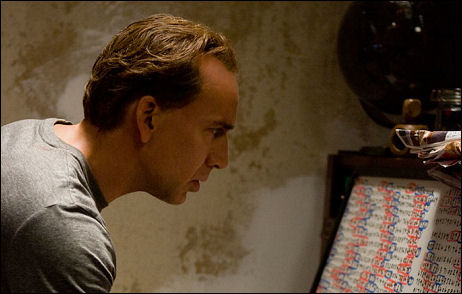
A bizarre metamorphosis has settled in with Nic Cage over the last three years. There is less and less about his onscreen manner or behavior which one would call “sane” if one were to encounter it in real life. His rigid, feet-in-cement, lunatic-asylum personality in Knowing confirms this, I’m afraid. Cage’s characters have become so loco-weed that he seems to have crossed into cuckoo-land in his actual life.

Which makes him seem not quite of this earth. I’m not trying to insult or degrade the guy. I’m saying there’s a beyond-Klaatu qualty to the men Cage has portrayed in The Wicker Man, Ghost Rider, the National Treasure movies, Bangkok Dangerous and Knowing. It’s like some virus has gotten into his system, like a pod was placed next to his bed in ’05 or ’06 and another life form took over.

Cage, of course, has always played guys who were eccentric or vaguely wackazoid in some way. It’s what I’ve always loved about him. Leaving Las Vegas, Matchstick Men, Vampire’s Kiss, Adaptation, Gone in Sixty Seconds, Con Air, Bringing Out The Dead, 8MM, Snake Eyes, Face/Off — these were films in which Cage played curious nutters but conveyed at the same time that he had a passing acquaintance with off-screen sanity, or at least the manner and behavior of a relatively “normal” guy. As committed as Cage has always been to the reality of the character, you believed he was performing a part.

No longer. Now a Nic Cage movie means you’re in for less of what narrative movies tend to do (a mixture of acting, story, pacing and atrmosphere) and more of an alternate-reality trip in the form of a behavioral study of a guy who’s become a kind of stone-faced alien zombie trying to pretend like he’s human and doing a half-decent job of it, but with the zombie part getting more and more determined to run the show. That’s what’s been happening since The Wicker Man. Tell me I’m wrong.

Hoop Shot

“There’s a moral and an ethical aspect to this, as well. And I think that’s what has gotten everybody so fired up. But I think the most important thing that we can do is make sure that we put in a bunch of financial regulatory mechanisms to prevent companies like an AIG holding the rest of us hostage. Because that’s… that’s the real problem.

“The problem is not just what’s happened over the last six months. The problem is what was happening for years, where people were able to take huge, excessive risks with other people’s money, putting the entire financial system at risk — and there were no checks, there were no balances, there was nobody overseeing the process.

“And so what we’re going to be moving very aggressively on — even as we try to fix the current mess — is make sure that before somebody makes a bad bet you say, hold on, you can’t do that.”

Here’s a complete transcript of the Obama-Leno conversation.

Adrenaline Spikes

The Hurt Locker “is the best overall film Kathryn Bigelow has ever made,” says HitFlix’s Drew McWeeny, “and it manages to fit neatly into the voice she’s already established as a filmmaker while hopefully also opening new doors for her as well. It’s basically about three volatile personalities put into some very tight quarters, and [then sent] into life-or-death situations over and over and over. And that’s pretty much it

“And I’m not being dismissive or reductive, either. I think the film works really well precisely because they don’t try to build up some phony narrative arc to hang the whole thing on. The film is very slice-of-life, very observational. And that’s precisely why it plays into Bigelow’s strengths. When you look at Point Break or, more directly, Strange Days, she’s very good at dropping the viewer right into the middle of an action sequence. Experiential action is hard to pull off, and I’m convinced that most of the shaky-cam stuff that gets released is someone’s attempt to do the same thing.

But The Hurt Locker delivers on a level that’s “about more than just handheld camerawork,” he says. “Instead, it’s about hooking the viewer in a way that synchs their pulse to the pulse of the scene, that causes real adrenaline spikes in the audience. Bigelow’s a strong enough filmmaker at this point that she exerts absolute control in sequence after sequence. And she never falls back on the standard devices of tension like a bomb counter-ticking down to zero or the red wire/green wire nonsense.

“These characters are professionals, great at what they do, and the tension comes from the fact that the bomb-makers are also pretty damn good at what they do. Each fresh challenge is a puzzle to be solved, and Jeremy Renner‘s Sgt. James thrives on the idea that he is the one person suited to do the work. And like any junkie, he has to push himself further and further to get the same high as the film progresses, to the point where he’s putting everyone else in harm’s way, and that escalation is what drives the film’s forward momentum.”

Good News

“It’s the perfect marriage between Bourne and United 93. Political as can be, but built like an action thriller.” — a comment from a smart, seasoned guy from the trenches who happened to catch Paul Greengrass‘s Green Zone (Universal) about a month ago. He’s obviously more receptive to it than that AICN guy who caught it in New Jersey the other night, and was haltingly positive — i.e., “a good film but drink a lot of coffee first!”

I hate the fact that the original title of Rajiv Chandrasekaran’s book, Imperial Life in the Emerald City, has been discarded because…let me guess, some dumb-asses were focus-grouped and they said it’s too weird or precious-sounding? Nonetheless, it has a beautiful ring.

Hard Road North

As directed by Cary Fukunaga, Sin Nombre “is more than just an immigration drama. Think City of God on the road and you’ve got the idea. In some ways [it] examines a society as corrupt and destructive as the one in Matteo Garrone‘s Gomorrah. But Fukunaga does it in a way that manages to be real and dramatically intense at the same time.” — from Marshall Fine‘s review, posted today.

The video was shot and cut by Jamie Stuart.

Diseased Delectation

Knowing (Summit, 3.20) has been selling itself as a spooky mind-bender about forecasting the spooky future, and about horrible pre-ordained catastrophes waiting to happen. It holds to this pattern for the first 40 minutes or so, but it gradually devolves into another worldwide destruction orgy on a doofusy Roland Emmerich level. On top of being an idiotic alien-visitation movie with kids being on the alien wavelength and adults being too consumed by their conventional blah blah. Don’t get me started. Well, I’ve already started, haven’t I?

Knowing is complete exploitation crap. Simplistically written, lurching from one tingly shock moment to the next, operating in total defiance of any semblance of rational human behavior. It will burn your soul and leave you poisoned. It will give you hives between your ass cheeks. And it will make you laugh at the end. Derisively, of course. That’s what the crowd at the 42nd Street Regal plex was doing the other night as the credits began to roll. Waves of giddy “what a piece of shit!” laughter rolling across the aisles. An hour earlier the world had just learned about the passing of Natasha Richardson. What a contrast. Good God.

Knowing‘s strongest characteristic is that it’s clearly in love (or in lust, I should say) with the idea of flaming mass destruction, or certainly its CG equivalent. It pants and salivates and attains a state of horndog tumescence over burning flesh and decimating cities and people shrieking and hugging each other before the end comes. That’s why I called it Doomsday Porn.

This is due to director Alex Proyas, of course — a quarter-of-an-inch-deep, visual-for-visual’s-sake CG whore who…I don’t know what precisely happened so I shouldn’t speculate. But Knowing feels as if Proyas and the producers said to themselves, “You know what? To hell with the precognition numerology stuff. Let’s just blow shit up and burn people alive and throw in some spooky aliens and…you know, go to town on that level. We’re making this film for people who read supermarket tabloids so what does it matter if it’s more or less nonsensical?”

.

The screenplay is by Ryne Douglas Pearson, Juliet Snowden, Stiles White and Stuart Hazeldine. If I were these guys I’d put on a pair of dark glasses and a fishing hat with the brim pulled down. Better yet, I’d fly down to Belize and stay there for two or three weeks until the smoke clears.

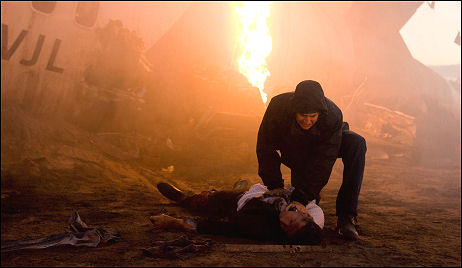
But I have to admit that Proyas does a bang-up job with the rainy plane-crash scene. Awesome choreography and hand-held photography, directed and coordinated in a first-rate fashion. it’s almost worth paying to see Knowing for this scene alone. But it also convinced me that Proyas has a bone-on for depicting people screaming for dear life as their flesh is roasting and they stagger around before flopping down dead in the gasoline-soaked mud. Kew-wuhl!

This is the end of Proyas. He’s crossed over into hell with this movie. When you think of him henceforth, think of him running through a raging forest fire as he carries his digital camera, his clothes and flesh consumed in ghastly orange agony as the animals of the forest — squirrels and rabbits and antlered deer — suffer the same fate. Proyas screams and bellows and begs God to forgive him, but God, having seen I, Robot, refuses.

I have a reaction to Cage’s performance, of course, but I’d rather run it as a stand-alone.

Duplicity for Dummies

For most viewers, I suspect, Tony Gilroy‘s Duplicity will be talked about as a corporate mindgame confection — not a “thriller” per se (there’s only one sequence in which the tension is seriously cranked up) but a movie that is truly expert at delivering a series of dry little fake-outs and doing quick little leap-frogs over your expectations. I had a seriously pleasurable time watching it — don’t get me wrong. It’s an amazingly sharp and sophisticated and well-honed thing. As far this sort of adult international chess-game tends to play, it’s quite delicious.

The issue, for me and for potential viewers who have similar tastes and attention spans, is that the serious pleasure happened the second time I saw it. The first time? Not as much.

The problem, I confess, was more mine than Gilroy’s. I’m just not smart enough, you see, to get or enjoy all the twists and curve balls and keep the whole equation proportionately focused and sussed. Slow guy that I am, it was just too much work. Not all the time or even for much of the running time. I’m not a complete moron. But every so often I felt a bit burdened and blurry of mind. I felt overly fucked with, to put a point on it. “Wait a minute, is this…wait, is that what’s going on? I guess so, okay. But then why….?”

Unlike, I should add, my brilliant ex-wife Maggie, who had no trouble keeping up, and unlike the Einstein-level N.Y. Times critic A.O. Scott, who had the audacity to write in his review this morning that Duplicity “ends more or less as you always suspected it would.” (What?). A good mystery flick (or more precisely a good what-the-fuck-is-going-on? movie) is supposed to work on a dog-race principle. The audience is the dog pack and the stuff you’re trying to figure out is the artificial rabbit. The rabbit is always supposed to be just ahead of the dogs, but never so far ahead so that they lose hope and start to give up.

Put simply, my first Duplicity experience made me feel like the dumb dog sitting in the back row in math class in seventh grade. I haven’t felt that way in a long time. Because I was, in fact, that dumb kid, and it took me years to get past that image of myself as a guy who would never get good grades or go to a good college, who would never be very good at sports, who would never drive a slick car or get to disrobe those wonderfully busty blonde girls who always hung out with the jocks.
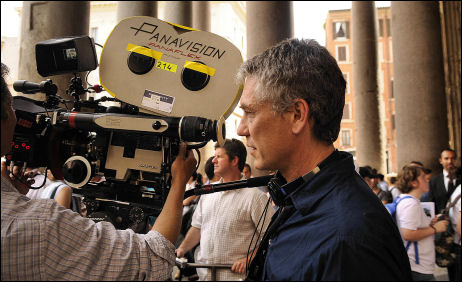

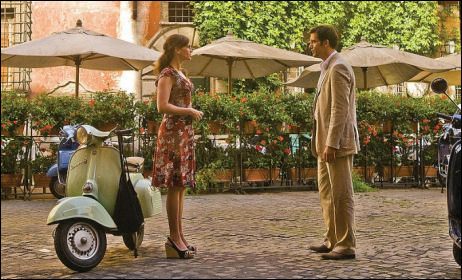
Duplicity director-write Tony Gilroy shooting next to Rome’s Pantheon

I was always good in high-school English and history and art class and gym (and smoking in the parking lot with my friends), but I despised math and chemistry. Most of the time I wanted to draw or look out the window. It was a miserable time in my life. So thank you, Tony Gilroy, for helping me to re-experience that sense of isolation and rage, that feeling of hell and futility.

I’ve since learned to be constructive with my comprehension problems. After my first encounter with Duplicity, I went back and read the script (which I had been too lazy to read all the way through when I was sent a copy last year) and talked it over with five or six critic friends, and all but one element (i.e., the scripted discussion between Clive Owen and Julia Roberts) began to come into focus. So the second time was cool. I liked it, I mean.

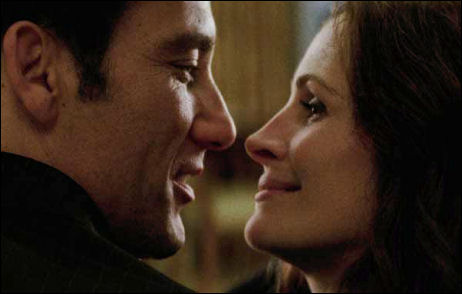
The undercurrent of Duplicity is about the difficulty of establishing genuine trust between lovers, and it was on this level that I connected with it the most fully. This can be a real-deal challenge in life, offering up one’s emotional underbelly, and it’s particularly well suited to a kind of love story (or lust story) in which a man and a woman who are very much alike and get what each other is about can’t quite let their guard down. Because each time they do, they run into an awful put-of-the-stomach feeling based on a suspicion that they’ve been played.

The tension in the Roberts-Owen relationship (if you want to read about the plot, read Scott’s review) is that the dialogue is magnificent, nimble and quick, and yet relaxed and convivial. But the basic vibe is cynical and guarded and defined by anxiety. The offshoot is that you, the movie-watcher, don’t really trust these two either, even when it appears that they’ve resolved matters. They’re a good-looking pair, but a long way from establishing that Trevor Howard and Wendy Hiller vibe in Brief Encounter.
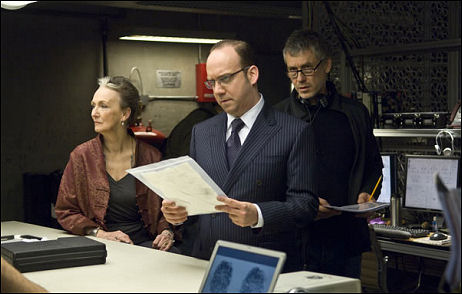

Paul Giamatti, Tony Gilroy

And with Roberts, as I’ve said before, I just don’t believe there’s a chance of any kind of peace with her. She’s not an actress as much as a presence and a personality who gets hired to be in movies. And deep down, I suspect, she’s only into herself, her security, her portfolio, her kids, her vacation hideaway, her private perimeter. She’s a fighter, a pistolero, an alley cat, a bullshit-buster, a Roger Friedman disser. She’s magnetic and fascinating, but I don’t think you want to ever fall in love with a woman like this. I’m not sure you’d even want to sleep with her. Even that might involve too much risk and melodrama.

You know what? Here comes a quasi-spoiler, which I feel is necessary to help the dummies out there.

The thing that everyone will talk about after seeing it is that Roberts-Owen have a particular conversation four times, each line repeated just so, line for line. There’s the original time plus three other times (including a rehearsal scene). because, this being a film about corporate espionage, they’re certain they’re being taped. What they say is immaterial; the repetition is all. Except it’s a pain in the ass.

Here comes the quasi-spoiler, which is based, I’ll admit, on a possibly flawed recollection. Ready?

The first time we see “the conversation,” in midtown Manhattan, they’re acting it because they know they’re being taped. The second time, in Rome, is the real thing: the two of them actually having this conversation for the first time after they reconnect for the first time since Dubai. The third time is when Duke (Dennis O’Hare) and another guy plays a recording of that Manhattan conversation that we saw in the beginning of the film. And the fourth time we hear it is in the wrapup, when they’re rehearsing the chat in Roberts’ New York apartment, unaware they’re being taped, rehearsing for the encounter that we first see near the beginning of the film. There — I’ve said enough.

More than anything else, I loved Paul Giamatti‘s feisty, highly-cranked CEO with an ego the size of a super-cruiser. When he’s on and in a half-decent film, the man is pure pleasure. So the price of your Duplicity ticket price is more than worth it for him alone.

But Gilroy, I think, got too caught up in his three-card monte game and keeping ahead of the people in the audience who are always trying to guess what will happen or where the plot will ultimately go . I’m not saying he outsmarted himself exactly, but he uncertainly outsmarted me. At least to the extent that Duplicity sometimes makes your brain feel like it’s being pulled in two or three directions, like turkish taffy. On top of which it’s…how to say it? Duplicity is not emotionally untrustworthy as it doesn’t really try for emotional trust in the first place by the act of casting Roberts, who, I believe, is first, last and always a misery-dispensing harridan.

I suspect it’s going to do well with the Maggie Wells and Tony Scotts of the world, but most of the public out there is, I suspect, on my intelligence level, which means that Duplicity may run into trouble starting with the second weekend. But I’m delighted that there are guys like Gilroy who write delightfully smart movies. It’s just that this time I loved the effort more than the execution.

Sin Nombre Guys

Cary Joji Fukunaga‘s Sin Nombre, which opens tomorrow (and which I finally saw this evening after missing it at Sundance) is the second near-great, sterling-silver, belongs-to-the-ages movie I’ve seen this year. (The first one that qualifies is The Hurt Locker.) It’s a tough, fully-believable story about survival, love, family and fate. (Or luck, as it were.) Every frame in Sin Nombre is solid, lean, gristly and true. There’s no question about it — Fukunaga is a major new director.


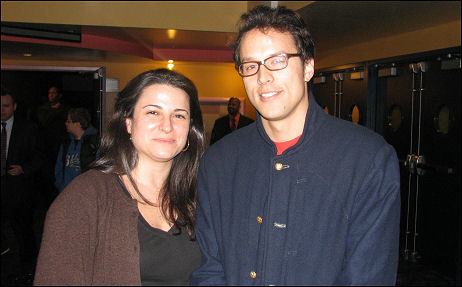
Sin Nombre producer Amy Kaufman (l.), director-writer Cary Joji Fukunaga (r.) at the Regal Cinema plex on Broadway and 13th Street — Thursday, 3.20, 9:15 pm.

The focus is on Central American immigrants trying to hike and train it through Mexico in order to slip into the U.S., and also about the ghastly Dante-esque existence of being a hardcore gang member (like the Mara Salvatrucha gang from Tapachula, Chiapas). Nothing in this film is out of proportion. Nothing is forced, fake, “acted” or levitated. Please catch it soon. You’ll be telling your friends what I’m saying here.

Doomsday Porn

All day I put off writing my review of Knowing, and now I’m on a bus, heading for Union Square and a 7:30 pm screening of Sin Nombre. l’ll have to do it later this evening. But the title of this item is a good indicator of where I’m coming from.

Russian Pistol

A cuffed and dusty Evelyn Salt (Angelina Jolie) being roughly escorted to a police van on Park Avenue following some violent chaos inside St. Bart’s. This scene from Phillip Noyce‘s Salt was shot yesterday afternoon around 4:30 or so. A huge crowd assembled in the vicinity of Park and 50th to watch, wave, snap photos, etc. At one point Angie gave a slight wave to some female fans standing across the street, which provoked squeals of delight. Costars Liev Schreiber and Chiwetel Ejiofor , both dressed in dark conservative suits, were also working it.

Bloody Wonka

This Funny or Die fake trailer for a movie called Gobstopper premiered at SXSW earlier this week without anyone being told it was a joke. Essentially a cross between Charlie and the Chocolate Factory and Saw, it features a demented Willy Wonka (Christopher Lloyd) terrorizing a group of teens that come to visit his Chocolate Factory. Here’s the website for the fake film.

Is it as funny and/or outrageous as the “giving head” scene in Reanimator (which is what it reminds you of right away)? Uhhm, no. The stand-out visual element is Lloyd’s yellow teeth. Were they yellowed for the trailer, or are they naturally that way? A tiny bit icky either way.

The four leads are played by Zach Gilford (Friday Night Lights), Paul Rust (I Love You, Beth Cooper), Martha Maclsaac (Superbad), and Nicky Whelan. Paul Sheer (Human Giant) and Wee Man (Jackass) also appear.

“Rollicking Struggle”

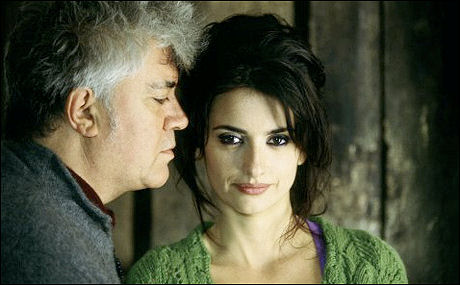
Screen International‘s Barry Byrne, filing from Madrid, has given Pedro Almodovar‘s Broken Embraces a mixed-positive (or a positive-mixed) review. “A lavish, noirish melodrama sparkling with Almodovar’s trademark humor, the film will thrill his loyal fanbase but perhaps leave a more general public dazed rather than dazzled,” he says.

“Ravishing in its artifice and outfitted with all of Almodovar’s stylistic tricks, this tale of desire, power, duplicity and fate is self-consciously steeped in noir conventions and provides Penelope Cruz with a sleek post-Oscar vehicle.

“[And yet] the director can’t quite bring himself to treat his characters with the Olympian detachment noir usually demands. Characters in the Almodovar universe can’t do deadpan delivery, and perhaps throwing in the towel, Almodovar deliciously parodies the typical Veronica Lake-Alan Ladd repartee when he has the lip reader interpret what they’re saying in a marvellous monotone monologue.

“Yet ultimately, Almodovar doesn’t seem comfortable in the cramped noir world of the Madrid film studio and mansion he has built for his pawns, and the second half of the film sees the characters flee to the wide open spaces of the island of Lanzarote. There, the film slips into lush, romantic melodrama against a bleak volcanic landscape.

“With the action moving ponderously towards a baffling denouement, we enter the terrain of high melodrama – sensational revelations and narrative twists. In the midst of all this, there’s an over-long clip from the quirky comedy film-within-a-film.

“It’s symptomatic of the strain in Broken Embraces, which sees the clashing genres of noir, melodrama and comedy vie for supremacy, but it’s a rollicking struggle that, in the hands of consummate ringmaster Almodovar, is a joy to watch.”