Banshee vs. Rabbi

Last night around midnight MCN’s David Poland tweeted that Deadline‘s Nikki Finke had written him the following message: “YOU ARE BEING SUED (INCLUDING FOR YOUR DEFAMATORY TWITTERS) NO MORE DELAYS. THAT’S IT.” More bluster and brimstone, or does she really mean it this time?

We all know about harsh judgments from Rabbi Dave, but if legal action results he’s clearly the Good Guy and Finke is not. The matter will never go to court, but it would be delightful if it did. It would be like the O.J. trial — the whole town would be watching. If I was the right kind of attorney I’d be calling Poland right now and insisting that he allow me to represent him pro bono.

On 6.17 Poland wrote that “it’s only been a couple of weeks since Nikki [Finke] last threatened to sue me, using the full might of Jay Penske‘s attorneys. Unfortunately, what I tweeted about her was factually accurate (as every factual statement that I have ever written about her has been), so her claim was limited to the notion that she is not a public person and therefore I was…well, I don’t even know what legal leg she was pretending to stand on.”

One of his stronger anti-Finke rants ran on 3.23. I wrote a day later that Poland “makes some good points; the writing is very clean and straight because he’s not hemming and hawing in the least. He’s not afraid of being Finke’s enemy, and I admire the ballsiness in that.”

Wolf in Sheep’s Clothing

Two nights ago at Houston’s Angelika Film Center, one of the stars of Restrepo — Sgt. Misha Pemble-Belkin — dropped by for a q & a. The following day Culturemap‘s Joe Leydon (who may or may not have conducted the interview with Pemble-Belkin) posted an admiring account of his visit.

Restrepo is a narrowly focused, bravely captured documentary about U.S. troops fighting in Afghanistan’s Korangal Valley from ’07 to ’08. Pemble-Belkin, now stationed at Louisiana’s Fort Polk, was one of those interviewed and befriended by co-directors Sebastian Junger and Tim Hetherington during their year-long stay.

For my money Leydon’s article seems a little too obliging, primarily because it mentions but doesn’t begin to explore an idea that’s been seeping through here and there, which is that Restrepo is a pro-war, support-the-troops, emotional-propaganda piece wrapped in allegedly neutralist observational verite clothing.

The apparent bottom line is that Junger and Hetherington, like many embedded war journalists before them, “fell in love” with their subjects, and in so doing evolved into supporters of the U.S. Afghanistan campaign. It seems as if they were unable to separate their feelings for the troops and the war that has taken the lives of over 1000 Americans. It’s been reported that Junger has recently been pushing a stay-the-course policy on news talk shows.

Pemble-Belkin obviously knows whereof he speaks and has an absolute right to say what he’s learned and believes about the war in Afghanistan. But reading that he wants to stay in the Army “until we win the war…I don’t want it to go on until my children are old enough to have to go over there” made me furious.

“Win” in Afghanistan? We’re not even stalemating over there. The effort is doomed and we’re on a timetable to evacuate. On top of which the movie doesn’t even explain that U.S. military command pulled out of the Korangal Valley last fall because they could see it was a losing effort.

It is bothersome that Leydon, the good host and gentle inquisitor, doesn’t even tip-toe into this, much less address Pemble-Belkin’s delusion that we might “win” over there. And yet he lets him get away with “politely but firmly” declining to answer “what he calls ‘political questions.'”

Let me explain something. Everything involved in the fighting of a war is political, and all questions about any aspect of that war, including a friendly documentary that presents a highly selective, grunt’s-eye view, are political. And anyone who stands up for the honest but restricted reporting in Restrepo is standing up for its roundabout pro-war stance. So Pemble-Belkin driving from Ft. Polk to Houston on a motorcycle to take part in the Angelika interview, was, in every sense of the term, a political act. Because in so doing he’s taking part in the Restrepo smokescreen, which is the filmmakers trying to pretend that it’s not political by focusing solely on the day-to-day lives of soldiers and saying, “Isn’t it fascinating and touching the way these guys just hang in there and do their job and survive and shit?”

Never trust anyone who says he’d rather not get into political questions. That’s a total chickenshit dodge.

Here’s how I put it in an HE piece called “Afghanistan Bananistan“:

“The kind of frankness that Restrepo is offering is, to put it mildly, selective. For realism’s sake Restrepo chooses to isolate its audience inside the insular operational mentality of the grunts — ‘get it done,’ ‘fill up more sandbags,’ ‘ours not to reason why’ and so on. In so doing it misleads and distorts in a way that any fair-minded person would and should find infuriating. Is there any other way to describe a decision to keep viewers ignorant about any broader considerations — anything factual or looming in a political/tactical/situational sense — that might impact the fate of the subjects, or their mission?

“Imagine a documentary about the day-to-day life of Steve Schmidt, John McCain‘s ’08 presidential campaign manager, that ignores how the campaign is going and instead focuses on Schmidt’s relationship with his family and his dentist and his kids’ homework and his visits to a local cafe and his dealings with the guy who mows the lawn once a week. What would you call that approach? Thorough? Honest?”

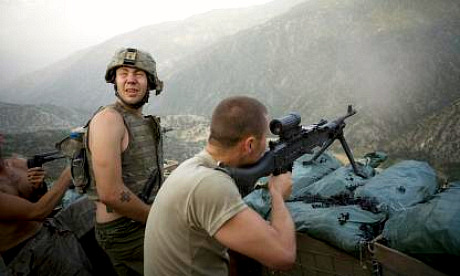
I thought it was odd, by the way, that neither Leydon nor his Culturemap editor[s] felt it inecessary to include a photo of Pemble-Belkin. They couldn’t snap a picture and post it? Here’s a link to a photo of Pemble-Belkin as captured in the film.


A Hatful of Rain

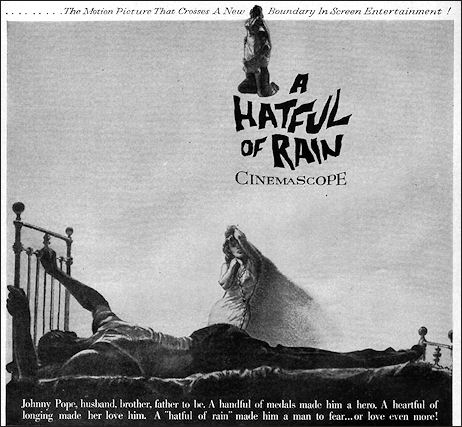
Last night a friend attended a special American Cinematheque/Aero theatre presentation of two Don Murray films — The Hoodlum Priest (’61) and Bus Stop (’56). Murray, 81, sat for an interview between showings. This reminded me of Fred Zinneman‘s A Hatful of Rain (’57), a black-and-white CinemaScope drama in which Murray plays a heroin addict whose effort to hide this fact from his wife (Eva Marie Saint) convinces her he’s having an affair.

I’ve been a fool for monochrome 2.35 to 1 all my life, and would eventually love to see at least a handsome DVD of this. I love the intensity of the one-sheet — the writhing bodies and the implications of frustration and imprisonment.

If I’m not mistaken, A Hatful of Rain has a reputation of being a little too issue-driven — a little too taken with itself for having the courage to deal with drug addiction, and maybe a bit too emphatic in a straight-arrow, Playhouse 90-ish way.

I don’t know about that. I caught it once on TV in my teens, and recall a jolting, hard-knocks drama with tough, sharply written dialogue (taken from the play by Michael V. Gazzo, who later played Frankie Pantangelli in The Godfather, Part II, and adapted by Gazzo, Alfred Hayes and Carl Foreman) and ace-level acting. Anthony Franciosa, Lloyd Nolan and Henry Silva costarred.

Knowing this about Gazzo gives emphasis to his big scene in The Godather, Part II when he complains to Al Pacino about the Rossotto brothers, his New York crime rivals, being low-lifes who push whores and “junk…dope!” At this instant Gazzo yanks up his sleeve to emphasize disgust.

Foreman’s name didn’t appear on the credits due to his being blacklisted at the time; the WGA restored his name in 1998, 14 years after his death.

It would also be interesting to hear Bernard Herrmann‘s score.

Free The Beaver!

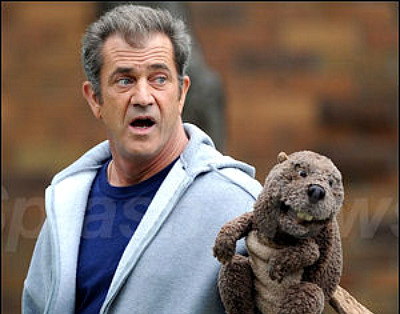
I’m presuming that Summit Entertainment chief Rob Friedman is currently in uh-oh mode about what to do with Jodie Foster‘s The Beaver, the oddball Mel Gibson dramedy that Summit was going to release in the fall. Gibson’s latest public-relations disaster, I suspect, has led Friedman to think about bumping Foster’s film into spring or fall 2011 on the assumption that the blowback to Gibson’s racial rhetoric will be less damaging if they let everything simmer down, etc.

That would be very unwise. Because they’ve got a hot iron in Gibson playing a nutbag, and they should strike while it’s hot. Instead of turning tail, Summit should open The Beaver as soon as possible. In September and October, I’m thinking. Wait any longer and they might “lose the momentum,” as Faye Dunaway explained to Robert Duvall in Network.

Here’s the thinking:

(a) Most people have understood for years that Gibson is one of the craziest and most hyper actors around (a trait that first surfaced in ’87’s Lethal Weapon) and that if anyone was born to play a middle-aged guy who walks around speaking through a beaver hand-puppet, it’s him. He may make the Grand Wizard of the KKK sound like the late James Farmer, but Gibson is the truest living embodiment of Three Stooges insanity living today.

(b) Kyle Killen‘s script of The Beaver was named the hottest Black List script of ’08. And Foster may have translated it into something special. What a waste if this film gets all but dumped by Summit! All that hard work, all that buzz, and that admiration and potential and the whole thing goes south because Gibson was recorded saying horrid things to his ex-girlfriend? That’s ridiculous.

(c) Surely no one at Summit is deluded enough to think that press won’t bring up Gibson’s racist remarks any less persistently if The Beaver opens in April 2011 or August 2011 or September 2012? The wisest thing would be to open it as soon as possible and just blow through that shitstorm and say “fine, whatever, Mel is an actor who acts in the movie, his personal issues are not our concern” and so on. Just man up and do it and no pussyfooting.

(d) Jodie Foster will put the Gibson bugaboos to bed when she does interviews for The Beaver. She’ll keep emphasizing over and over what a natural comedian he is, and how much she respects him as a performer, and how badly she feels about anyone suffering from a temper problem and retrograde attitudes but we all say ugly stuff that we don’t mean in our worst moments, and that a lot of Hollywood types say things to each other in private that they wouldn’t want to hear on the internet, and that perhaps we shouldn’t point fingers too strongly, etc.

(e) Gibson is a repellent figure now, but playing a nutter would be seen as a form of self-portraiture, and that would make The Beaver a hot ticket. As Bill Maher recently said, there’s an audience for what Gibson (or his image) has become — a repellent ayehole who’s articulating the last dying remnants of ugly racial thinking. “Dying” in the big-city regions, I mean, because racial resentments are more alive in flyover states than most Hollywood liberals appear to realize. There are millions of closet racists (right-wing and lefty) who probably relate to Gibson on some buried level and are probably cutting him another break in their heads. Among those who still care, I mean.

(f) There is also a slight sympathetic belief that while Gibson was stupid enough to not only lose his temper with but allow himself to be recorded by a woman he’s in a custody battle with, he was nonetheless sandbagged and sold out. Many feel that even ugly people saying ugly things should be afforded a certain privacy.

If you were Leonardo DiCaprio‘s manager and agent, would you be advising Leo to do that Vikings movie with Gibson or would you advise him to back off for the time being?

McWeeny Zone

I’ve made a recent decision to visit Los Angeles from 7.18 to 7.25, and so I figured I’d drop in for a day or so at ComicCon 2010 as long l’m as I’m in the neighborhood. I can stand about two days’ worth, at most. Make it 36 hours. I wrote and got the usual “forget it”/too late”/”registration is closed” crap, but that’s to be expected. If I can wangle it, fine. And if I can’t, fine. ComicCon is usually hell to deal with, but I wouldn’t mind a quickie.

Amarcord

“I saw the lamest minds of my generation driven mad by overdeveloped, freeway-clogged hills and valleys, filthy with condos and malls and fast-food joints and corporate chain stores and looking for an angry cappuccino. Everyone cruising around in their late-model cars and talking/texting on their smart phones and driving in a sort of mad-impulse way, accelerating and then hitting the brakes whenever and doing sudden U-turns between slurps and sips and bip-bip-bips on their iPhones. It’s psychotic — tens of thousands of Louis the Sixteenths driving over/under/sideways/down through grandiose remnants of the over-leveraged Clinton-Bush economic boom. It’s all less than zero.” — posted during my visit to last year’s ComicCon, and particularly while driving through a condo-nightmare area just north of San Diego, alongside Route 8.

No More Hiding

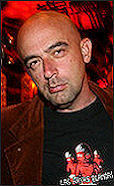
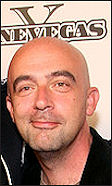
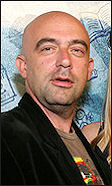
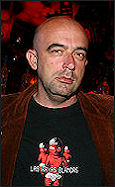
Yesterday I briefly posted a pic of the “other” Matthew Wilder (i.e., the “Break My Stride” singer) in my riff about Matthew Zoller Seitz‘s Salon interview with the presumed director of Lindsay Lohan‘s next film, a Linda Lovelace biopic. Here are photos of the actual guy, taken two years ago at Cinevegas.


Matthew Wilder, director of the possibly upcoming Inferno, during an appearance at Cinevegas ’08 to promote Your Name Here.

HE reader Circumvrent reported that E!’s The Soup “has a clip in their rotation of this bald-headed douche talking about the Lovelace biopic and saying, ‘There’s nudity in the movie, but I like to tell people that it’s not Porky’s nudity — it’s Schindler’s List nudity.'” (I’ve searched through the Soup site and can’t find it.) Wilder may sound like an enabling Iago in the Seitz interview, but I admire the “Schindler’s List nudity” quote. It has a ring. It sticks.

Real Machete

Machete (20th Century Fox, 9.3.10) looks pretty good — funny, cheesy, retro — but it’s been half-directed and half-written by Robert Rodriguez, and that’s bad. And good for Danny Trejo — an excellent fellow — but I wonder how many under-30 Eloi will flock to the movie because of his powerfully built, bulging-neck-muscles Hispanic machismo thing.

And speaking of that, there’s the sardonic Latino flavor in this trailer? The last one had a little more smirk humor. And where’s the scene where Machete beats the shit out of the big-mouthed white-cracker journalist when the latter complains about Machete talking too loudly in a cafe?

And why doesn’t the trailer take more notice of Lindsay Lohan‘s costarring role? And why doesn’t it make a little more hoopla out of Cheech Marin? I love that Michelle Rodriguez, Jessica Alba, Robert De Niro, Jeff Fahey, Steven Seagal and Don Johnson are also in this.

Interlude

I used to think I was some kind of half-Libertarian, half-lefty hybrid, but I’m not. I’m basically a tax-and-spend, Polanski-coddling, hunt-down-the-rightwing-nutters-and-put-them-in-green-reducation-camps Rooseveltian elitist liberal, but I respect Libertarians, and I like listening to Penn Jillette explain the basic Libertarian drill. I don’t agree with him (how could he be for a weak and ineffective government in the wake of the BP Gulf spill?), but I admire his phrasings.

Perfect Finish

Sixtyish Rich Guy: “Nice shootin’, son. What’s your name?” Young Cop: “Murphy.”

The greatest thing about this finale is that when this moment unspooled during my first viewing of Robocop, in July of ’87 at Grauman’s Chinese, a guy right next to me knew what Peter Weller‘s final line was going to be before he said it. As soon as the Old Man asked, he said “Murphy.” Everyone knew that line! That‘s when a movie is really working.

Outta There

Congratulations to Rose Kuo on being named the new executive director of the Film Society of Lincoln Center. She’s replacing Mara Manus, who stepped into the job only two years ago. So what happened with Manus? I”m not one to voice unwarranted suspicions, but people generally don’t give up prestigious high-paying gigs with the Film Society of Lincoln Center unless formidable forces have allied against them.

“[Manus] has been persona non grata over there for a long while,” a New York distribution source says. “She tried to relationship things in a positive way over the last six months, but I think it was too little, too late. It’s a little shocking that she left so soon, after only two years, but it’s not surprising that she’s left.”

“Mara Manus stewarded us through significant organizational changes during a difficult period for all non-profit organizations and we are grateful for her contributions,” said Ann Tenenbaum, chair of the FSLC’s board of directors, in a statement. That’s an allusion to Manus having discharged several long-time FSLC stalwarts when she first arrived in ’08, earning a rep as a tough hatchet lady.

But then the FSLC board wanted these firings to happen, so it’s not like Manus did this on her own. It’s suspected that some kind of blowback from Manus’s management style was a factor in her departure.

“The board hated her,” a well-placed source says. “Rose Kuo was the one [FSLC chief programmer] Richard Pena wanted when they hired Mara.”