The first American Hustle journalist screenings will happen a few days before Thanksgiving. As I won’t be back from Vietnam until late Sunday, 11.24, I may as well resign myself to everyone else seeing it (and perhaps posting reactions) before me. It won’t be tragic if this happens — just irritating.
Year: 2013
All Hail Omar
Less than a week after catching Yuval Adler‘s Bethlehem I saw another ace-level melodrama about the Palestinian-Iraeli conflict last night — Hany Abu-Assad‘s Omar. It tells a roughly similar story about a Palestinian youth informing for the Israelis and being suspected by his own. In fact, my description of Bethlehem — “a lucid, tightly wound thriller that regards the Israeli-Palestinian conflict through a filter of double-agenting, family matters, betrayal and anxiety” — pretty much applies to Omar. I’m not sure which film is better, but they’re both expert grippers. So we’ve got two superb films about similar subjects — Bethlehem the official Israeli entry and Omar submitted by the Palestinian territories. How can the Academy’s foreign-language committee select one and not the other?
Mistress, So To Speak
This presumably provocative Neil LaBute film premiered at last April’s Tribeca Film Festival. I was wondering when it would reappear. HE correspondent HE Clayton Loulan, who attended, wrote that “the question on everyone’s mind was will this film erase or mitigate the sins of LaBute’s Lakeview Terrace and The Wicker Man? The short answer is yes, but the longer answer likely has to do with how the ending hits you.”
Giant Bluray is Fuzzy, Indistinct, Awful
Three and a half years ago I described Criterion’s Stagecoach Bluray as “the worst-looking, worst-sounding Bluray of a classic black-and-white film in history.” Last night I looked at sections of Warner Home Video’s new Bluray of George Stevens‘ Giant, and I can say without reservation that it’s the worst-looking Bluray of a classic color film in history.” Forget the gravel-sized chunks of grain blanketing most of the outdoor footage. It’s the fuzziness of the damn thing that drives you nuts. Every now and then a shot looks sharply focused and well-balanced and generally attractive, but 80% of the time Giant looks soft and imprecise and hazy as a dust storm. It’s so bad that the word “blurry”can actually be applied. Why did Stevens and his dp, William C. Mellor, care so little about sharpness? Why would anyone want to look at a movie that looks this bad? For what purpose, to what end? I’m presuming that Stevens and Mellor wanted it to look soft-focus-y, but why the hell should I or anyone with any kind of taste in high-end cinematography want to watch it? This Bluray is a stain on the reputation of a great filmmaker. Don’t buy it. Don’t even think about it.

Dreaming My Life Away
This is a publicity shot of Tarnished Angels director Douglas Sirk conferring with costars Dorothy Malone and Rock Hudson. Is Hudson’s bored, ‘I’m somewhere else, man” expression affecting or what? Call me eccentric but I think this is one of the most honest and penetrating capturings of Hudson I’ve ever seen. He lived in his own realm, after all, and so much of what he performed on-screen was very much of an “act,” at least in terms of his deep-down personality and sexuality. This is Hudson all by himself, “all alone” in a sense, surrendering to whatever was running through his not-very-deep head. One of the things I dislike about Sirk films (and in fact almost all dramas and melodramas of the ’50s and earlier) is that no one is ever shown spacing out. Each and every character is always engaged in the moment, paying attention, saying something necessary or asserting themselves or reacting full-on. Everybody spaces out, especially creative types. Some of my best thoughts and insights come from my zone-out vacations.

Don’t Mention It
It’s a bit gauche to mention (much less talk about) anatomical fetishes but I don’t think I’m pushing the bounds to note that most men have special areas of intrigue, film critics included. Most average guys have run-of-the-mill likings for anything cantaloupe-y. Andrew Sarris used to say he was a “leg man”, or so I recall. Billy Wilder was into legs and particularly ankles, if Double Indemnity is any indication. Francois Truffaut was…now I’ve forgotten. Quentin Tarantino is understood to be a foot fetishist. Some guys like women with boyish bods (narrow hips, flat chests). I once knew a guy who said he liked wide-hipped women with big-mama arms. All to say that feet can make a difference on this end. If a woman has large feet and particularly if her big toes are German-sized (if you’ve been to Germany you know what I mean), that’s a problem. And if her feet are exquisitely proportioned that’s a huge plus. I’m mentioning this because there’s a shot in Tarnished Angels that resulted in my pulling back a bit from Dorothy Malone. Very few directors allow foot shots (even quick ones) into their films. There’s a reason for that. Some people take feet very personally. Not judging, just saying.
“You Look Quite Rough…What’s The Trouble?”
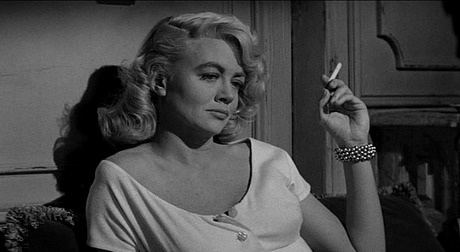
Nearly 31 years ago David Jones‘ Betrayal opened theatrically in the U.S. (On 2.18.83, to be precise.) And you still can’t stream it or buy it on DVD or Bluray. I would kill for a Bluray of this film, but the rights-owner (the family of the late producer Sam Spiegel, I was told some years ago) won’t deliver the elements or some shit. But I just found a full-length version on YouTube. It looks like a third- or fourth-generation VHS tape but at least it’s watchable.
Marty’s Process
During Saturday night’s Out Of The Furnace after-party I asked Martin Scorsese‘s rep Leslee Dart when Wolf of Wall Street might screen. Late November screenings (11.28, 11.29, 11.30) would be necessary for Wolf to be voted upon by the National Board of Review and the New York Film Critics Circle. Dart said the schedule was being looked at daily but that it’s possible that the film might not screen for these groups in time. Scorsese will be serving as president of the jury for the Marrakech Film Festival, which starts on 11.29. You’d have to figure the film will be completely finalized at least a couple of days earlier, no? If not sooner?
Anarchy In the U.K.
Director Stephen Frears started out as a street-level social realist, and in that vein Bloody Kids (’79) was the first serious “Frears film” I saw. (I caught it at the old Magno screening room on Sixth Avenue near 55th Street, and I recall that afterwards Frears stood up and took questions.) For the next 10 years Frears was on a roll — The Hit (’84), My Beautiful Laundrette (’85), Prick Up Your Ears (’87), Sammy and Rosie Get Laid (’87), Dangerous Liaisons (’88), The Grifters (’90). The ’90s wasn’t the greatest decade for Frears, but he came back big-time with High Fidelity (’00). Anyway, I bought Bloody Kids on Amazon and watched it two or three days ago. I was surprised to discover that while it’s a reasonably interesting portrait of unruly British youths galavanting around, it’s not quite the knockout that I’d built up in my head. Memory does that sometimes.

A Best Picture Surprise?
My older son Jett says Dallas Buyers Club is at the top of his list so far, and he’s seen Gravity, 12 Years A Slave, All is Lost, etc. Will Jean Marc Vallee‘s film become the little Best Picture contender that could? What seems clear, I regret to say, is that a lot of older viewers I’ve spoken to are sneering and grumbling about Slave‘s brutality. Steve McQueen‘s film is a grand-slam stone classic in my book, but I keep hearing pushback sentiments. That leaves Gravity as the consensus fallback, but shouldn’t a Best Picture contender be about more than just wowser “ride” movie visuals, however brilliantly rendered by the great Alfonso Cuaron? This is where Dallas Buyers Club comes in. It tells an inspirational, true-life, indomitable-human-spirit story, and it’s got the craft, the performances (McConaughey, Leto, Garner), the brass balls, the social conscience, the eff-the-FDA attitude. What’s not to vote for?




What Is a Norbit?
Every award season some columnist-blogger will point to a tawdry downmarket film starring an Oscar contender and ask, “Is this [fill in the blank]’s Norbit?” The term — a proper, non-italicized noun — refers to a belief that Eddie Murphy didn’t win a Best Supporting Actor Oscar for his Dreamgirls performance because Norbit, one of his coarse, low-rent comedies, was released on 2.7.07 — right smack in the middle of Oscar voting — and in so doing reminded Academy members that Murphy had never been especially committed to serious, quality-aspiring films or roles, and so a majority turned against him. But an exploitation film selling at the AFM can’t be a Norbit — it has to be a general theatrical release. And it has to open in January or February when the voting is actually happening. And it can’t be a one-off. A Norbit points not to a single paycheck role but to an actor’s continued downmarket inclinations. It reminds everyone that he/she has often wallowed in crap and that the current Oscar-calibre performance in question is an exception to the rule.