“You’re Tearing Me Apart, Lisa!”

Last night I finally saw James Franco‘s The Disaster Artist (A24, 12.1), which has generated pseudo-hip excitement since debuting at last March’s South by Southwest. It’s basically an amusing-but-never-hilarious thing — it never bored me but it never quite lifts off the ground either. But it’s worth catching, I’d say. It falls under the heading of “necessary viewing.”

On the other hand a lot of cognoscenti who should know better have gone apeshit over The Disaster Artist (what award-season handicapper suggested it might even be worthy of inclusion on a best-of-2017 list?), and I’m telling you right now that it’s time to calm down. It’s fine for what it is, but take it easy.

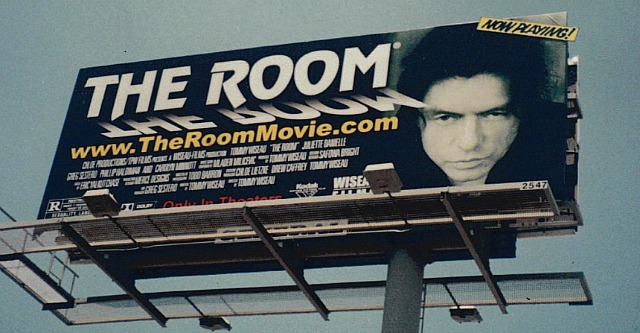
It’s basically a flat but unaffected true-life saga of the making of a notoriously awful indie-level film called The Room, which, after opening in ’03, gradually acquired a rep of being so bad it’s hilarious and perhaps even brilliant in a twisted-pretzel, ice-cream-cone-slammed-into-the-forehead kind of way.

Based on Greg Sistero‘s same-titled memoir about the making of The Room and his bromance with the film’s vampirish director-writer-star, Tommy Wiseau, The Disaster Artist is basically a curio, a diversion. It generates a kind of chuckly vibe on a scene-by-scene basis, but that’s all.

Why? Because watching a clueless asshole behave like a clueless asshole isn’t all that funny if you’re watching what that’s like on a line-by-line, incident-by-incident, humiliation-by-humiliation basis from a comfy seat in a screening room.

It might seem a bit funnier if you’re watching it ripped or better yet ripped with your friends during a midnight show somewhere. Or if you’re watching it ripped with producer-costar Seth Rogen and producer Evan Goldberg in a private screening room. I wouldn’t know. I haven’t been high in a long time, but I bet it would help. All I can tell you is that the Academy fuddy-duds I saw it with last night at the London Hotel screening room were chortling from time to time, but no one was howling with laughter or rolling in the aisles.

The Disaster Artist is basically a one-joke thing that says over and over that having no talent and being a total moron is no hindrance to making an attention-getting film if — a really big “if” here — you’ve got a few million to throw around and you’re willing to spend it freely on production and marketing and so on. It also says that if you’re a profoundly stupid actor and generally beyond redemption in terms of knowing how to produce, direct and write it can be “funny” for people to watch you struggle and fail in your attempt to make a shitty little indie drama that no one will pay to see, etc.

But if your film turns out to be “so awful it’s astounding,” the film says, you might have a shot at a certain kind of notoriety.

Read more

Dirty Old Man

In the old days the notion of an old man in a wheelchair pawing a young nurse was regarded as a comic cliche. This behavior is actually glimpsed during a scene in a Mar Vista retirement home in Roman Polanski‘s Chinatown…oh, wait! But in today’s environment, such behavior falls under the heading of sexual assault, and is therefore regarded with gravity and alarm, especially when the dirty old man in question is former President George H.W. Bush, who’s now 93.

Yesterday Heather Lind, a 34 year-old actress, reported that Bush, 90 at the time, “touched” her twice during a 2014 photo op. “He didn’t shake my hand,” Lind wrote in an now-deleted Instagram post. “He touched me from behind from his wheelchair with his wife Barbara Bush by his side. He told me a dirty joke. And then, all the while being photographed, touched me again. Barbara rolled her eyes as if to say ‘not again.’ His security guard told me I shouldn’t have stood next to him for the photo.”

A Bush spokesperson apologized for the former Commander in Chief while adding that Bush “would never, under any circumstance, intentionally cause anyone distress.” The word “intentionally” was apparently used because Bush 41 allegedly suffers from Vascular Parkinsonism, a condition which “often necessitates use of Levadopa/carbidopa, a drug with side-effects that include gambling addiction, sexual misconduct, and other impulse control issues.” I don’t know how reliable this information is, but it appears on Lind’s Wikipedia page.

Read more

Eastwood Calculation

Deadline‘s Anthony D’Allesandro is reporting that the wide commercial release of Clint Eastwood’s The 15:17 to Paris will happen on 2.9.18. This apparently doesn’t mean it won’t open in some limited way in December, and thereby become eligible for award consideration. A late ’17 platform release (or one at the forthcoming AFI Fest) is “yet to be determined.” It would certainly be unusual for an Eastwood film to bypass award-season qualification.

In a statement, Warner Bros. worldwide marketing chief Sue Kroll called The 15:17 to Paris “both a touching story of three lifelong friends and a compelling tale of patriotism and heroism, and we felt this” — the early February release — “would be a great window for audiences everywhere to experience this uplifting true story.” I guess, but not giving it a limited award-season debut will send a dispiriting message, given that Eastwood films are rarely positioned as straight commercial releases. The award potential is almost always a marketing factor.

Read more

Miles Teller Is Waiting

I think it’s fair to say that Miles Teller needs a break. I don’t honestly like the guy, but he’s a gifted actor who could be Robert De Niro in the ’70s. Alas, something’s not working for him. People respect Teller, I think, for being a grade-A talent who chooses well and always pushes himself to the limit or beyond, but in the four years since Whiplash none of Teller’s films have combusted critically or commercially. He was happening in the immediate wake of The Spectacular Now and Whiplash, but not lately.

The reviews of Teller’s latest film, Thank You For Your Service, are mixed so far, but Variety‘s Owen Glieberman is a fan, and so is The Village Voice‘s Alan Scherstuhl.

Teller to HE on Hollywood-Highland escalator: “Don’t be a pervert, man.” That alienating April ’15 Esquire interview. Not getting the La La Land lead role that went to Ryan Gosling, allegedly for being “too demanding.” Hiring “no” publicist Susan Patricola to represent him. (Patricola isn’t exactly a crisis publicist but she seems to be popular with clients who want the press kept away.)

2013’s The Spectacular Now (alcoholic teen) plus Whiplash (great drumming, his best performance yet) started things off well, but then came a trio of paycheck fantasy films that weren’t so hot — Divergent, Divergent: Insurgent, Fantastic Four. Then a trio of respectable, hard-driving performances in films that made the grade in my book but which didn’t connect with reviewers or at the box-office — War Dogs, Bleed For This and Only The Brave. Thank You For Your Service, which I won’t see until Thursday evening, probably isn’t going to make any money either.

Review-wise Teller has done himself proud in the last four, as noted, but that’s still seven tanks in a row if you count TYFYS.

Critic friend: “He was not only in one bomb after another, but seemed like one of those flaky young-fuck narcissists on a star trip who was destined to flame out. But the dude is fucking talented. I don’t have much commercial expectation for Thank You For Your Service, because no one — no one! — wants to see a movie about Iraq War vets. It just sounds like medicine. But I think his very strong and heartfelt performance (the opposite of flaky/narcissistic, etc.) will help bend the curve back his way.”

No Best Picture Frontrunners? There Are Four.

In a 10.24 column, Variety‘s award-season columnist Kris Tapley notes that nearly 1500 new members have been invited to join the Motion Picture Academy over the last two years. The current membership is somewhere close to 8000, according to Tapley. (A 2.13.17 Gold Derby piece said the tally was 6687). Accordingly, Tapley reasons, the classic definition of a Best Picture Oscar winner is probably undergoing a sea change.

Moonlight beat La La Land, of course, because a significant number of Academy members wanted to refute the “Oscars So White” pejorative that had taken hold a year before. (This, at least, was what happened according to director Spike Lee.) This year, Tapley allows, a pair of films that would normally be relegated to film critic trophies and the Gotham/Spirit Awards — Luca Guadagnino‘s Call Me By Your Name and Jordan Peele‘s “bold sociological satire” Get Out — are definitely in the Best Picture Oscar mix.

And yet, Tapley observes, right now “there is no frontrunner to speak of.” In fact there are four.

There’s Chris Nolan‘s strikingly arty (no lead characters, no conventional story arcs, a sprawling God’s-eye view of warfare) but chilly Dunkirk, which has been at the top of most handicappers’ Best Picture lists since last July.

There’s Call Me By Your Name, which is the only serious “see me, feel me” movie in the Best Picture pack — a palpably emotional dream trip that really washes over and sinks in, and at the same time feels like a sun-kissed Rohmer flick.

There’s Steven Spielberg‘s The Post, which has the earmarks of being the only traditional, “important”-sounding drama aimed at the 50-plus crowd — two big boomer-aged stars (Meryl Streep, Tom Hanks), a political film with an obvious echo that applies to the press-disparaging Trump administration, a serving of journalistic realism in the tradition of Spotlight and All The President’s Men.

And there’s also Greta Gerwig‘s Lady Bird. It was the toast of Telluride, Toronto and the New York Film Festival, and it definitely works on its own personal-recollection terms — an autobiographical tale set in 2002, from a female director-writer in her mid ’30s, about a high-school senior going through trying times with her family (especially her mom) and peers. There’s no question that Lady Bird hits the bull’s-eye with excellent, heartfelt writing and acting, and it’s been shot, cut and designed to near perfection. What more can a relationship film possibly deliver?

The other contenders aren’t happening. It’s only these four, and given my previously stated concerns about two-thirds of Liz Hannah‘s screenplay for The Post being about the reluctance of Washington Post publisher Katharine Graham (Streep) to stand up against the Nixon administration and fight for the publication of the Pentagon Papers, it might only be three. Who knows?

Surgical Adjustment

I’ve received some private emails over the last couple of weeks about the Harvey Weinstein endorsement (“Jeff is sometimes full of passion for the uncommercial stuff”) that flashes on and off inside the HE logo. It’s been there since ’06 or thereabouts. This morning another such note arrived, this time from a guy named Steve. “I’ve been a constant reader of yours for over 15 years,” it read. “Just wondering whether it’s time for you to remove the Harvey quote from your rolling masthead.”

My reply: “Yeah, I should probably eliminate Harvey, all things considered. On a certain level I feel like a fair-weather rat leaving a sinking ship, but I’d feel like a worse rat — an inhuman one, I mean — if I kept it there. Who are we if we don’t embrace kindness, compassion and respect for each other? Thanks for nudging me about this.”

I asked HE tech guy Dominic Eardley to deep-six the Weinstein thing, and five minutes later it was done.

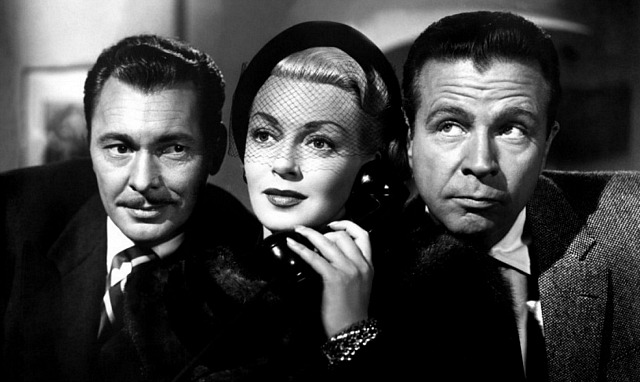
Sidenote: At the very end of Vincent Minnelli‘s The Bad and the Beautiful (’52) Lana Turner, Barry Sullivan and Dick Powell are listening with heightened interest to a producer they deeply despise, Kirk Douglas‘s Jonathan Shields, talk about his latest movie idea. The message rings true — sometimes vital filmmaking passion doesn’t necessarily emanate from the nicest people.

In the same light I wonder how indie cinema will fare without the “good” Harvey around to champion and aggressively sell the more artistically daring, less commercial projects. As Walter Pidgeon‘s Harry Pebbel said at the end of The Bad and the Beautiful, “You have to give the devil his due.” For all his abominable attitudes about women HW injected a shot of energy into the indie filmmaking scene that a lot of people admired and in many instances benefitted from. He’s history now and may even wind up in jail before this is over, but…well, I’ve said it.

Iconic Image

Every now and then a one-sheet for an upcoming film captures the essence just so. A distinctive right profile of Saoirse Ronan instead of the usual straight-on mug shot. The flaming red hair dye. An expression that seems lost in thought, pondering the calculus of existence. Maybe a touch of confusion or even anger thrown into the mix. A signature image, in short, that locks in on the mood of a film by way of a fascinating lead character, and which isn’t afraid of exuding a slightly contrary vibe.

HE Chat: The Square‘s Ruben Ostlund

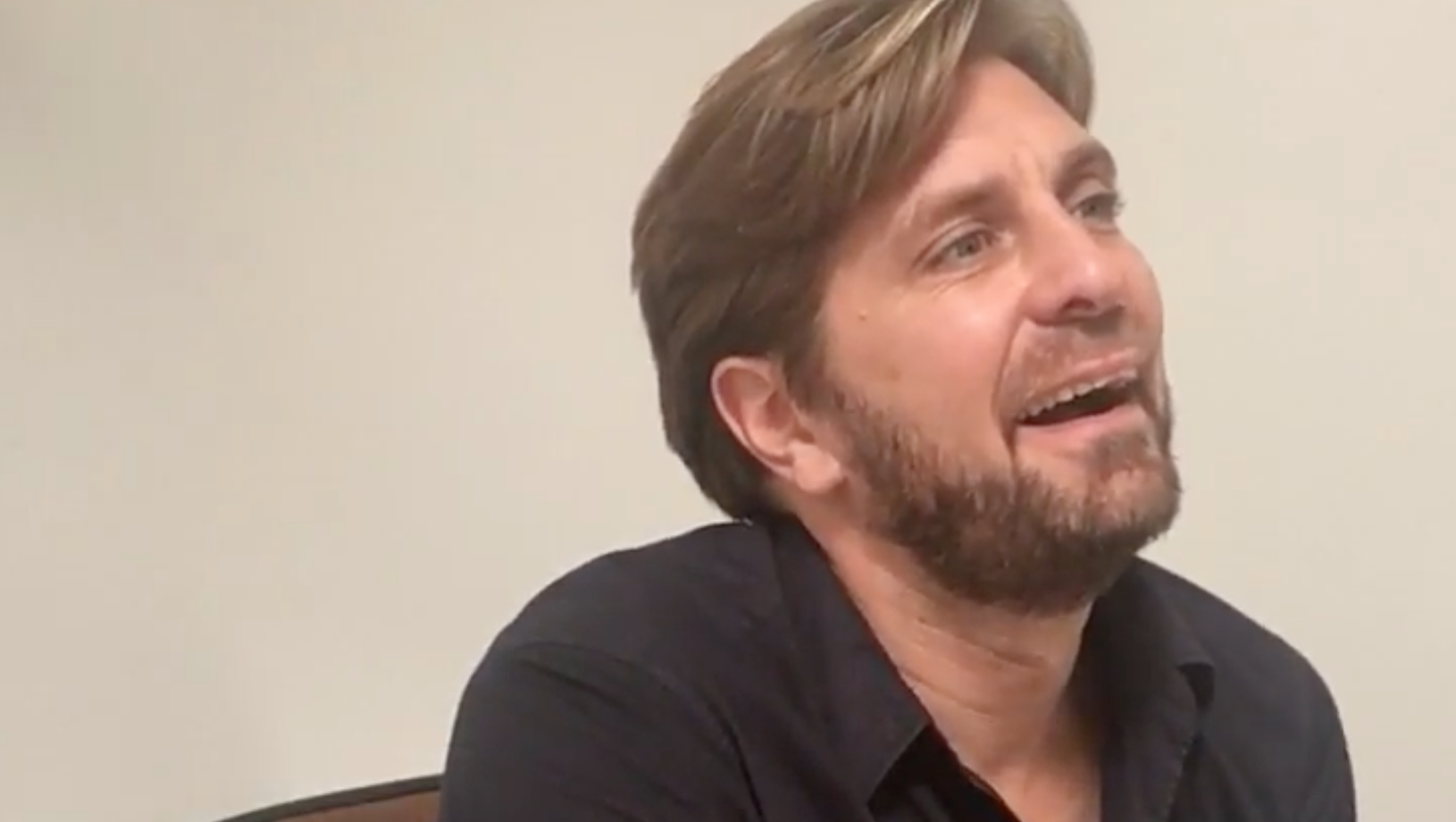
Earlier this afternoon I sat down with Ruben Ostlund, the Swedish director of The Square (Magnolia, 10.27), a brilliant art-world satire that won the Palme d’Or at the finale of last May’s Cannes Film Festival. 

I captured our 27-minute chat on iPhone and uploaded it in three sections.

If you’ve seen The Square the questions I asked Ostlund will make sense, but perhaps not if you haven’t. In my book it’s easily among 2017’s finest foreign-language films. I’m trusting that Academy members will agree and nominate it for Best Foreign Language Feature, but you can never tell with that crew.

Suffice that Ostlund’s film makes fun of the insular, politically correct museum culture that can be found worldwide, although The Square‘s focus is on a cutting-edge Stockholm art museum. 

As I wrote last May,” Ostlund’s precise and meticulous handling of The Square is exactly the kind of tonal delivery that I want from comedies. There isn’t a low moment (i.e., aimed at the animals) in all of it, whereas many if not most American comedies are almost all low moments.”

The Square is a longish (142 minutes) but exquisitely dry Swedish satire, mostly set among the wealthy, museum-supporting class in Stockholm. It’s basically a serving of deft, just-right comic absurdity (the high points being two scenes in which refined p.c. swells are confronted with unruly social behaviors) that works because of unforced, low-key performances and restrained, well-honed dialogue.

“There are four stand-out moments: a post-coital confrontation moment between Danish actor Claes Bang and Elizabeth Moss, an interview with a visiting artist (Dominic West) interrupted by a guy with Tourette’s syndrome, the already notorious black-tie museum dinner “ape man” scene with simian-channeller Terry Notary, and a hilariously over-provocative YouTube ad showing a little girl and a kitten being blown to bits. The Square is worth the price for these four scenes alone.

Read more

High-Concept Bullshit

Anyone over the age of five would instantly smell trouble if a stranger on a train were to offer them $75K to do anything at all. And then they’d excuse themselves and stay as far away from Vera Farmiga as possible. There are realistic, semi-believable ways of seducing innocent parties into doing bad things for money, but the scenario in this trailer is bullshit. “Strange woman offers man $75K if he’ll do a risky thing” — one of those cheap high-concept plot hooks that young screenwriters (i.e., guys who know they have to get down to the high-voltage stuff right away) pitch all the time. Directed by Jaume Collet-Serra, who directed The Shallows. You know what told me this movie is crap? When I saw that look of wifely devotion that Elizabeth McGovern offers to husband Liam Neeson as he’s about to get on the train. That settled it — game over. Lionsgate will open The Commuter on 1.12.18.

“La La” Land

Not to cut President Donald Trump the slightest bit of slack, but we can probably assume that when he stumbled with the pronounciation of La David Johnson‘s name (as Johnson’s widow has recently claimed), it was over the first name. He probably said “David” and then checked himself with “uhhm, I mean La David” or something in that realm. I don’t know that this happened, but what are the odds that Trump stumbled with the pronunciation of “Johnson”?

Well, I experienced the same kind of stumble when I attended a party for Crown Heights last July. I was talking to a publicist about Lakeith Stanfield, and I said “Keith” only to stop mid-sentence and say “I mean LaKeith”.   I mentioned right away that the “La” (an African-American culture thing) was a relatively recent add-on as Stanfield’s Wikipage was still referring to him as “Keith.” (Not now — the spelling has since been updated.) And keep in mind that Lakeith has no space between “La” and “Keith” while Johnson’s first name is spelled “La David.” Given the recent “La” prefix add-ons and general spelling flexibility, it seems as if a little stumbling might be forgivable.