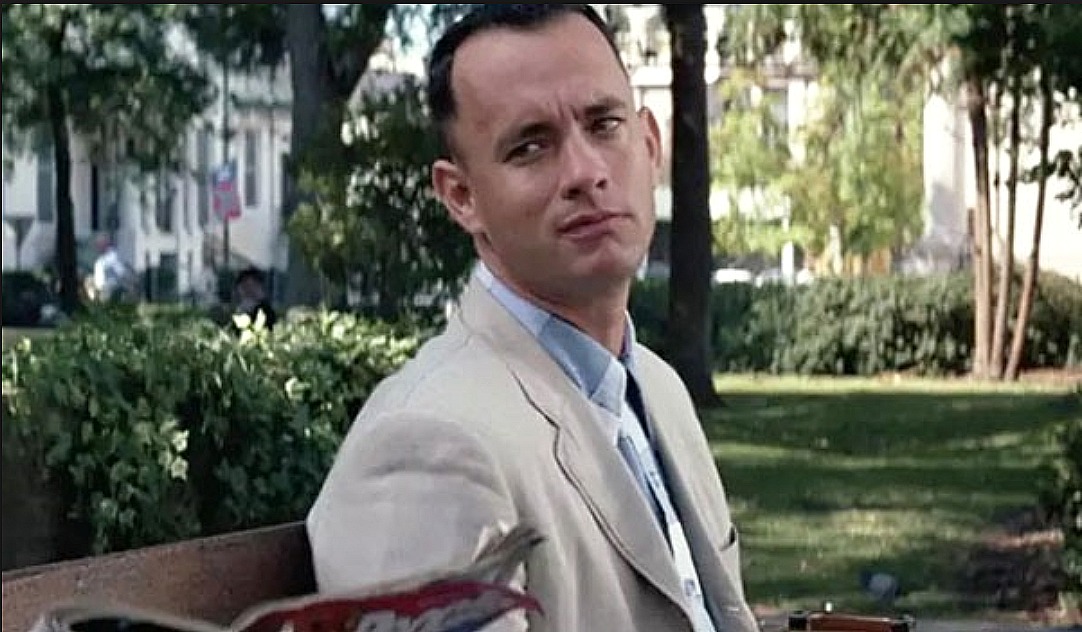
Embraced By Regressives

Eric Kohn doesn’t have to try and convince me that Forrest Gump blows — I’ve been pissing on the legacy of this Robert Zemeckis-Tom Hanks film from the get-go.

Best passage: “There’s a reason Forrest Gump became a beacon to an antiquated Republican Party when it came out in the run-up to the 1994 midterm elections: it preaches conservatism in its bones, whether its creators intended it that way or not.

“Through the lens of Hanks’ lovable naif, who somehow stumbles through every monumental moment in American history and emerges unscathed, Forrest Gump reads as a repudiation to any nuanced assessment of the country. It celebrates family values and obedience to the system over anyone who clashes with it. Every whiff of rebellion is suspect.

“This no-nothing white man becomes a war hero and a wealthy man simply by chugging along, participating in a country that dictates his every move. He never comprehends racism or the complexities of Vietnam; the movie portrays political activism and hippy culture as a giant cartoon beyond Forrest’s understanding, while presenting his apolitical stance as the height of all virtue.

“Viewed in retrospect, Forrest Gump whitewashes and dumbs down American history at every turn.”

From “How Do Those Chocolates Taste Now?“, posted on 7.10.14:

Yesterday afternoon N.Y. Post film critic Lou Lumenick posted a tribute piece about Robert Zemeckis‘s Forrest Gump, which opened 20 years and four days ago (i.e., 7.6.94). Millions of moviegoers fell in love with this delusional film about a kindly, aw-shucks simpleton who leads a charmed life. We all know it wound up with six Oscars and made a mountain of money, etc.

But in my mind Gump‘s most noteworthy achievement is that it showed how myopic Americans (particularly American males) were about themselves. They really love (or loved) the idea of half-sweethearting and half-dipshitting their way through life. Gump is also one of the most lying, full-of-shit films ever made when it came to portraying the tempests of the 1960s.

Here’s how I put it way back in October 2008, although I was drawing at the time from an L.A. Times Syndicate piece about the Gump backlash that I wrote just after it opened:

“I have a still-lingering resentment of Forrest Gump which I and many others disliked from the get-go for the way it kept saying ‘keep your head down’, for its celebration of clueless serendipity and simpleton-ism, and particularly for the propagandistic way it portrayed ’60s-era counter-culture types and in fact that whole convulsive period.

Read more

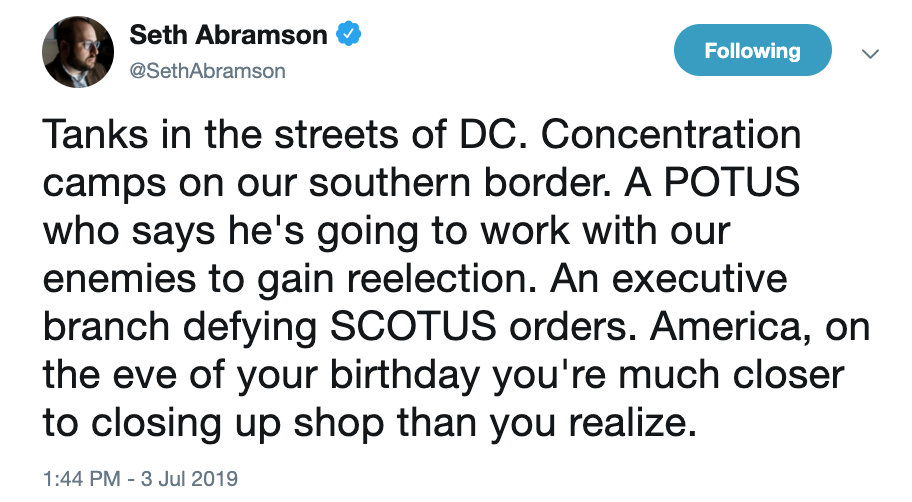
Imagine Participating in Trump’s July 4th Blowout

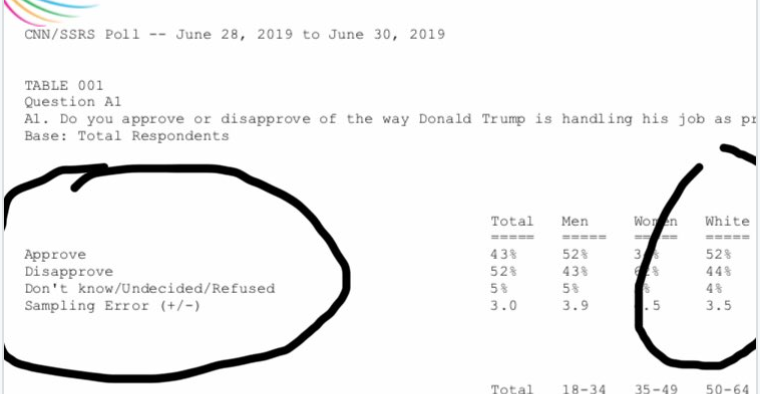
What is there to celebrate? We’re in the middle of a national authoritarian, verging-on-fascism nightmare — the lowest ebb that U.S. Democracy has known since 1776. Trump has turned an occasion for traditional patriotism into celebration of rightism and, of course, his own Mussolini-ness. Carole King has stated that she’s not participating in a Trump celebration, but if I were her I wouldn’t go anywhere near the nation’s capital today. I mean, good God.

What aspects of this once-great nation really deserve celebration? Presently speaking, I mean. The good would-be leaders (Buttigieg, Warren, Harris, O’Rourke), the native music (rock, jazz), the great movies and plays, the humor, kindness and neighborliness from everyday folks, the natural scenic beauty, etc. Not the military might (although that’s obviously essential for a world power), not the tanks and jets, not the drums and rifles. Everyone enjoys the comfort and privilege that comes with American citizenship, but who’s actually proud of being the Romans of our time — a rogue state that strikes when and where we please? I feel warm surges of patriotism whenever I watch The American Experience on PBS, but not so much when I look around today, and especially when I think of the the redhats standing behind Trump.

I love the culture of the great American cities, of course (including the one I live in), and I love the great natural wonders of this country. And pretty much every small rural town I’ve ever visited. But I’ve always felt happier in Paris, Rome, Prague, Bern, Munich, Lauterbrunnen, Berlin, Hanoi, Belize, the Pyrenees, the Italian Alps, southeastern Spain…anywhere across the pond. Especially these days. As far as I’m concerned this is a National Day of Mourning. Our Democratic traditions are being dismantled, and 40% or more of the populace thinks that’s just fine.

Another Rape of 1:37

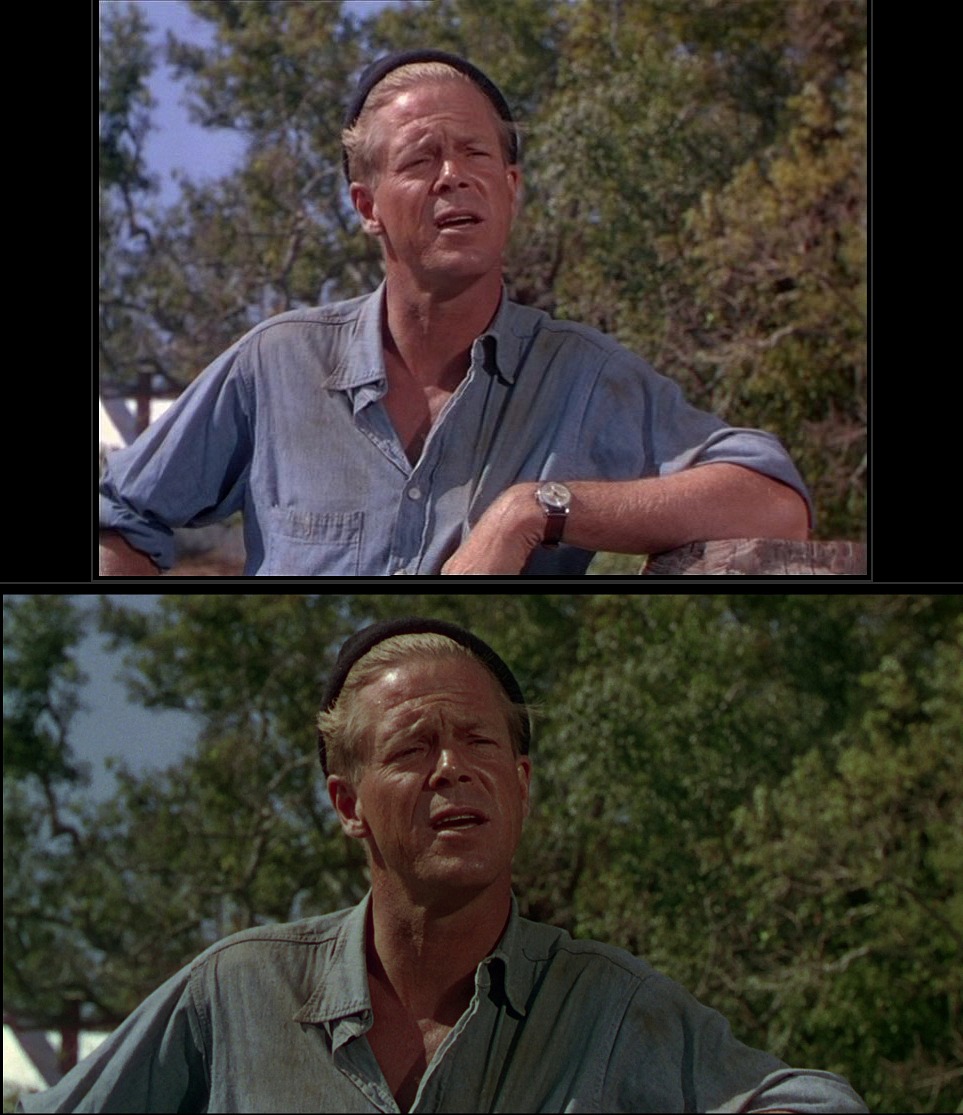
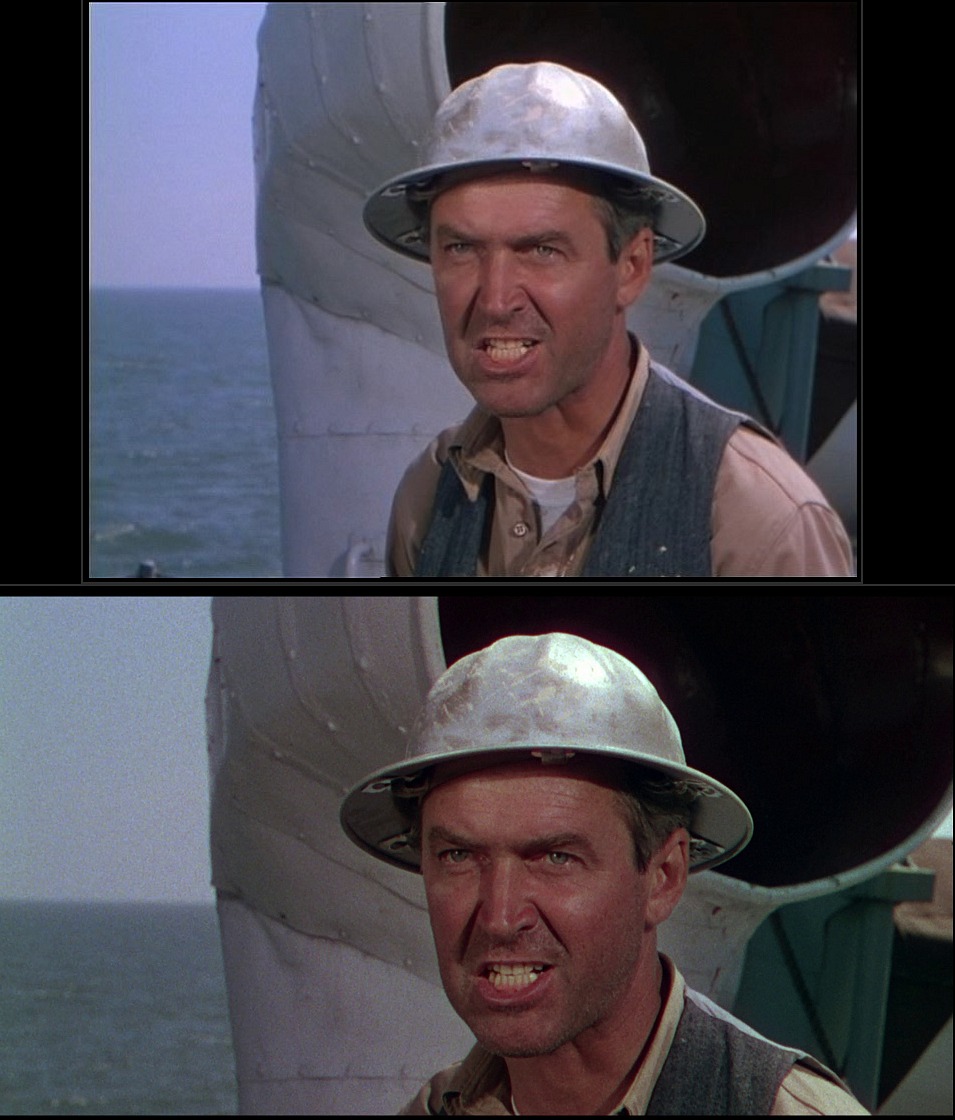
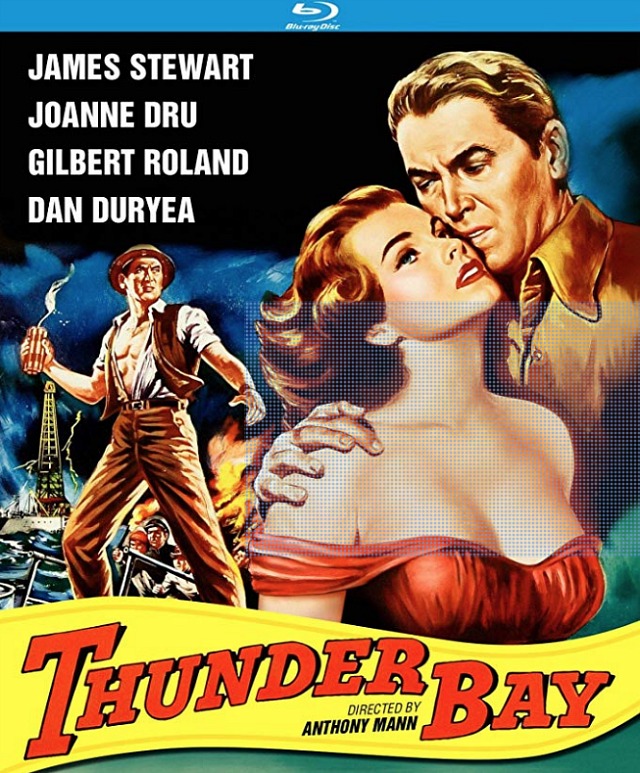
Anthony Mann‘s Thunder Bay was shot sometime in mid to late ’52, and released on 5.21.53. This was just as a general industry-wide mandate about projecting all non-Scope, full-frame (1.37:1) features at 1.85 was starting to kick in. There was a DVD version out in 2010 that presented the full-frame version, but look at the forthcoming Kino Bluray version (7.9) that slashes the fullness and balance of those original framings all to hell.

We don’t need to see Dan Duryea‘s arm or the watch he’s wearing — slash it off! And that shirt he’s wearing is too blue — let’s green it up some. And who needs to see Jimmy Stewart‘s white T-shirt just below his neck? Get rid of it.

Not Good Enough

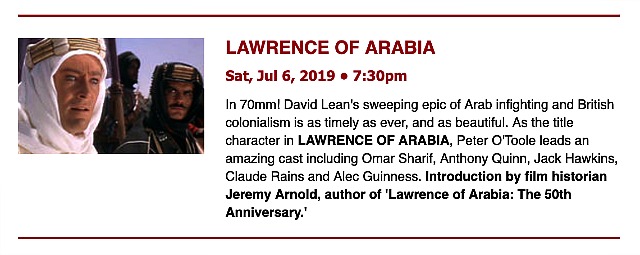
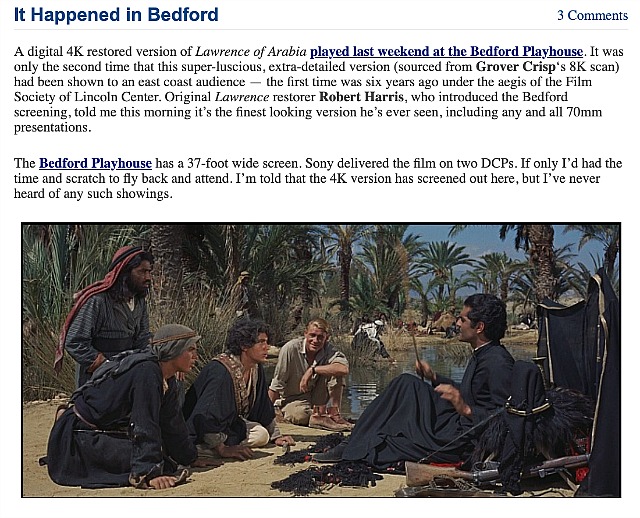
When are the American Cinematheque guys going to stop shovelling the same old Lawrence of Arabia 70mm ghoulash? The super-luscious, extra-detailed 4K digital version, which is sourced from Grover Crisp‘s 8K scan, is the only way to go. After the 4K Lawrence DCP played last April at the Bedford Playhouse, original Lawrence restorer Robert Harris told me it’s “the finest looking version I’ve ever seen, including any and all 70mm presentations.” For decades 70mm was the cat’s meow of theatrical presentation, but no longer.

“Farewell” Is Among Year’s Best

Last night I finally saw Lulu Wang‘s The Farewell, which A24 will open on 7.12. It’s brilliant — the most emotionally affecting, most skillfully assembled family drama I’ve seen in many years, and never in an overbearing way. At times Wang’s touch is light and darting, and other times matter of fact. But each and every scene hits the mark, and the ending nails it perfectly (and at the same time delivers an unlikely, last-minute surprise).

Billi (Awkwafina), a Chinese-American 20something, flies to northeastern China after her grandmother Nai Nai (Zhao Shuzhen) has been diagnosed with stage-four lung cancer. The tension stems from a family decision not to tell Nai Nai of her condition, as they’re afraid that knowing will hasten her demise. I still don’t understand how an 80something cancer victim wouldn’t be acutely aware that something dark and dangerous is growing within, but this was the only roadblock…call it a speedbump.

I was deeply impressed by Anna Franquesa Solano‘s widescreen (2.39:1) lensing, which is unusual for a film that’s almost entirely about MCU and CU interiors. And the editing (by Michael Taylor and Matthew Friedman) is fleet and to the point.

I was a touch suspicious of those Sundance raves and that 100% Rotten Tomatoes rating, but now I understand. I really think The Farewell belongs in the family-drama pantheon along with Little Miss Sunshine, It’s A Wonderful Life, The Descendants, The Grapes of Wrath, Kramer vs, Kramer, Parenthood…it’s one of those.

It addresses all the basic sorrows and frustrations affecting older members of any large family — death in particular but with a particular focus on the gulf between traditional Chinese culture and U.S. culture and a certain melancholy affecting those suspended between the two.

Awkwafina‘s lead performance will definitely snag critics awards in December and be Oscar-nominated the following month — no question.

The Farewell mostly happens in Changchun, a large auto-manufacturing city in northeastern China. To go by Silano’s lensing, it’s nothing but dull, uniform, rotely designed high-rise apartment buildings, one after another after another. You’re saying to herself, “My God, who could live in a high-rise nightmare city like this?” The Changchung Wikipage says it’s “one of [China’s] four National Garden Cities, due to its high urban greening rate.” You’d never know this from watching The Farewell.

I mentioned a couple of months ago that the Farewell trailer “strongly indicates that family members (Akwafina included) are making very little effort to mask their sadness over their grandmother’s situation, to the extent that Nai Nai seemingly has no choice but to ask ‘what’s wrong?’ What’s the point of a family deciding to keep bad news a secret if they’re going to convey their true feelings this blatantly? Wouldn’t everyone try to mask their feelings with too much gaiety?” I still feel this way.

Horse-Mounting Reptile, One-Handed Pushup

The more I think about it, the more I’m convinced that Jack Palance performed the greatest villain-defining scene of the 20th Century. It happened about two-thirds of the way through George StevensShane. A big lanky guy with cheekbones you could shave roast beef with, Palance was playing hired gun “Jack Wilson”, a guy with such a sinister vibe that twice a dog got up and left the room when he walked in (or stood up).

We all remember Palance’s showdown scene with Elisha Cooke, Jr., slowly putting on his black gloves and then drawing his big six-shooter like lightning, and then waiting a couple of seconds before drilling Cooke — his gun sounded like a two-ton cannon — and sending him flying backwards into the mud.

But the defining moment happened when Palance climbed off his horse like a lizard, swinging off his saddle and then freezing for two or three seconds before lowering himself to the ground. And then reversing the routine when he got back on, pulling himself up and then freezing for a bit before swinging his legs over and into the saddle. Unforgettable. From that moment on viewers were saying to themselves, “This guy is only half-human…the other half is a gila monster.”

Palance passed 13 years ago at age 87.

Read more

Blue Suede Vibe

Yesterday Deadline‘s Michael Fleming reported that four contenders were recently screen-tested for the Elvis Presley role in Baz Luhrmann‘s biopic about the relationship between Presley and Colonel Tom Parker (to be played by Tom Hanks).

I’ll tell you right now that three of them aren’t right. Ansel Elgort (Baby Driver, West Side Story) is way too tall and just doesn’t feel like a fit. (Elvis wasn’t a basketball player.) The 32 year-old Miles Teller doesn’t resemble Presley even a little bit, and couldn’t hope to convince as the young Elvis, who began to catch on at age 20 in 1955. And Harry Styles (Dunkirk) bears no resemblance at all.

The 28 year-old Austin Butler (The Dead Don’t Die, the grubby and psychotic Tex Watson in Quentin Tarantino’s Once Upon a Time In Hollywood) seems the most interesting possibility among the four.

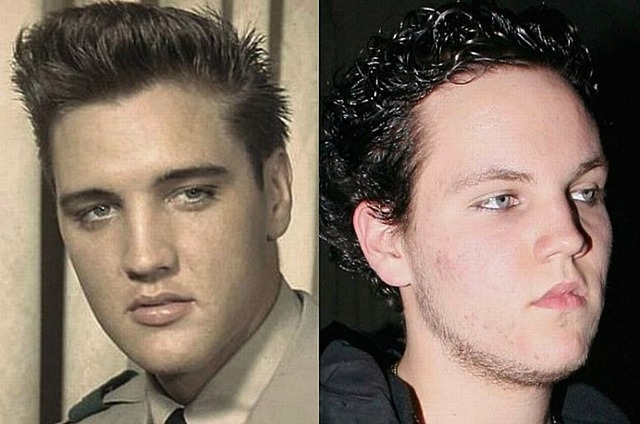
You know who could theoretically rock the role, at least in terms of genetic follow-through? Elvis’s 26-year-old grandson Benjamin Keough, who’s nearly a dead ringer. I’ve no idea if Keough can act or sing or anything, but he’s a chip off the old block.

My all-time favorite Elvis? Kurt Russell in John Carpenter‘s Elvis, a 1979 made-for-TV flick that was well above average.


(l.) G.I. Blues Elvis in ’60; Benjamin Keough.

Membership Assessments

In a 7.1 Hollywood Reporter piece about the hundreds of newly invited members of the Academy of Motion Pictures Art & Sciences, Scott Feinberg says the following about the two main Roma women, Marina de Tavira and Yalitza Aparicio:

“Most would agree that it makes sense to invite people who did excellent enough work to garner Oscar nominations or wins during the most recent awards season. This year, such courtesy was extended to Roma supporting actress nominee Marina de Tavira but not, a bit oddly, to lead actress nominee Yalitza Aparicio, who was eligible for an invite, despite this being her first film role, because of her nom.”

HE to Feinberg: “I’m sure that you and I suspect the same thing. The Academy regards Marina as a serious working actress (screen and stage roles), but they suspect that Yalitza’s performance in Roma was probably a one-off. She was chosen by Alfonso Cuaron because she looked right (those earnest eyes, that aura of innocence and simplicity) and could behave in the right way, which is to say plainly and minimally in the absence of honed acting skills.

“The odds of Yalitza starring or even costarring in another film are…well, who knows? I think it’s fair to say at this stage that she’s more of a ‘type’ than a performer. Her Wikipage reports that she’s “currently enrolled in EF international school in New York City to learn English.”

Svetlana’s Taormina Blastoff

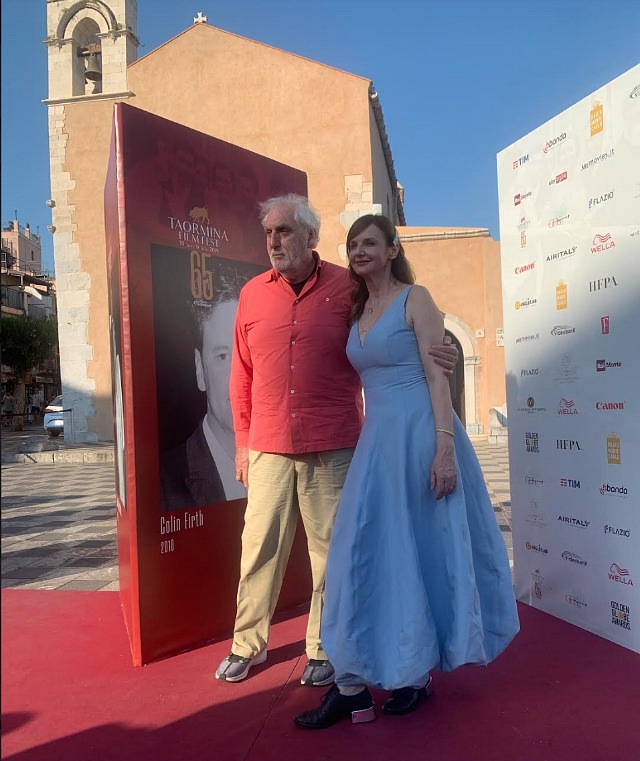
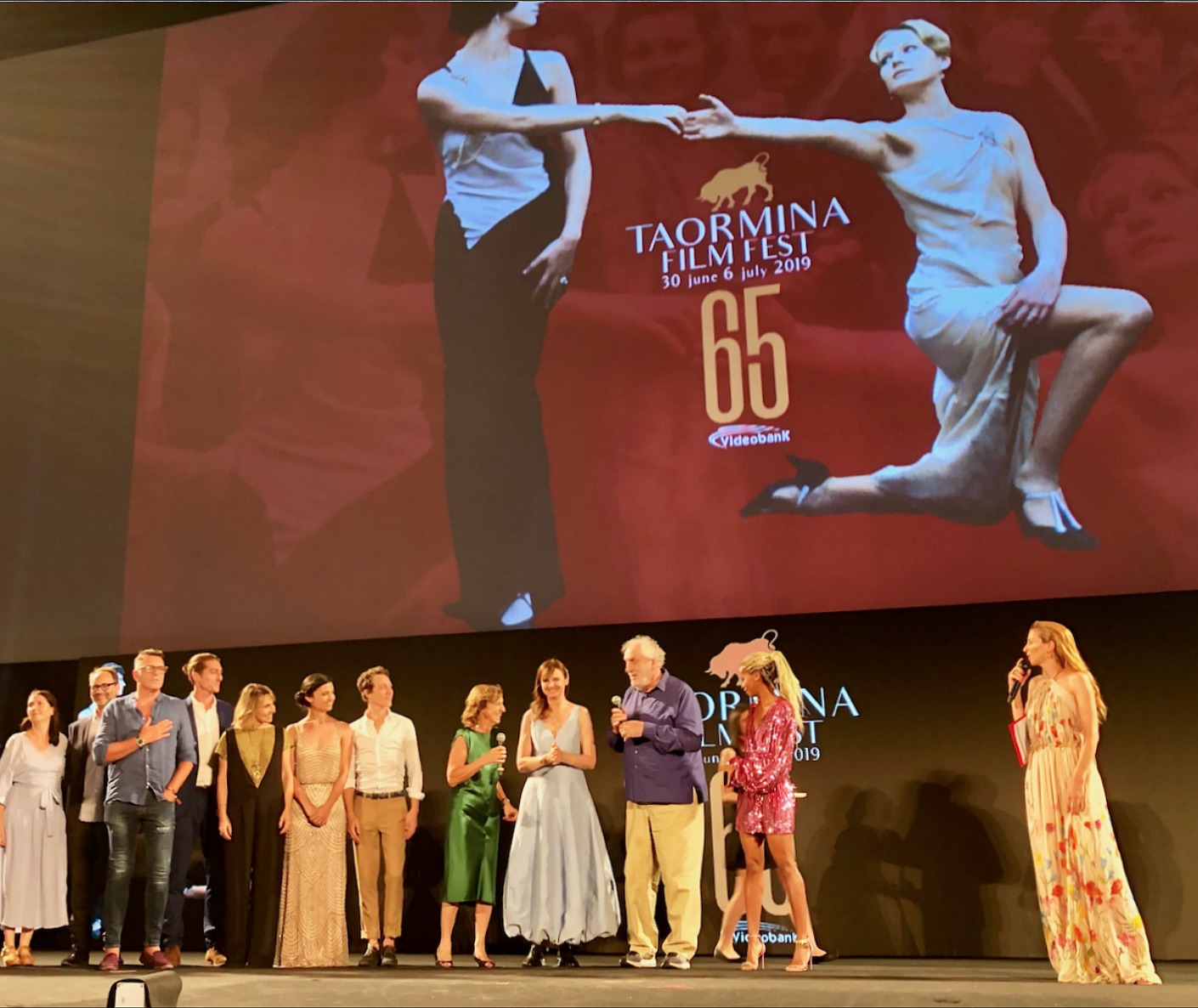
Congrats to HE’s own Svetlana Cvetko on the big, swanky Taormina Film Festival debut of Show Me What You’ve Got, a black-and-white menage a trois love story set in Los Angeles and Italy. Directed, shot and co-written by Svetlana (along with producer David Scott Smith).

The screening happened Tuesday night (7.2, 6 pm). Congrats also to Svetlana for having just been invited to become a member of the Academy. Well deserved.

Jett and I visited this ancient Sicilian town in 2010.

Show Me What You’ve Got director-cowriter Svetlana Cvetko with executive producer Phillip Noyce prior to Tuesday evening’s screening.
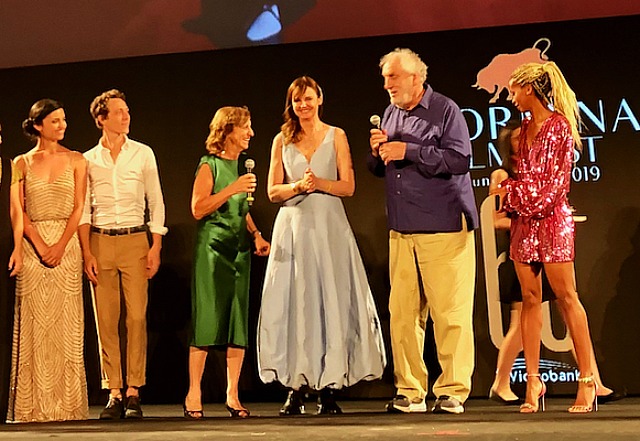
Show Me What You’ve Got director-cowriter Svetlana Cvetko (center) basks in post-screening applause with executive producer Phillip Noyce to her left.

Read more

Son of Horny Ape

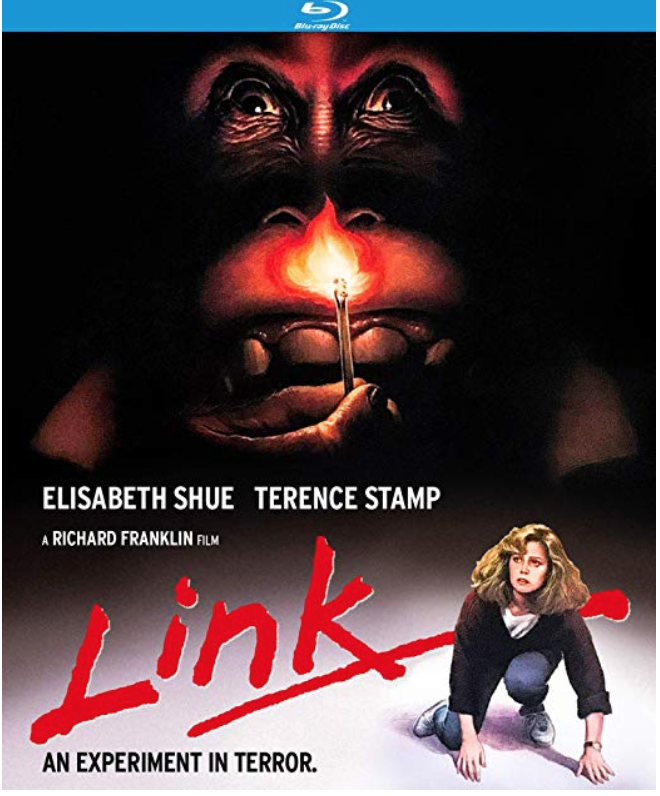
16 months ago I posted about Richard Franklin‘s Link (’86), which is hands down one of my all-time favorite monkey movies. I’m re-posting because I somehow missed the fact that the Kino Bluray came out a month and half ago. I’ve just ordered it. A “4K restoration” with audio commentary by film historian Lee Gambin and film critic Jarret Gahan, deleted workprint scenes, an audio interview with director Richard Franklin.

3.18.18: Nobody remembers Richard Franklin‘s Link (’86), but it was a witty, better-than-decent genre thriller with a nice sense of tongue-in-cheek humor, and shot with a great deal of discipline. Clever, dry, smarthouse. And nobody saw it.

Shot in Scotland in ’85, Link was basically about a watchful, intelligent and increasingly dangerous chimpanzee who develops a sexual obsession for a junior zoologist played by young Elizabeth Shue (who was 22 or 23 during filming).

A Thorn EMI production that was acquired by Cannon, Link costarred Terrence Stamp, was fairly well written by Everett De Roche, and was very carefully composed. Franklin (who died young in ’07) shot it with a kind of Alfred Hitchcockian style and language.

I wrote the Cannon press notes and in so doing interviewed Franklin. The then-39-year-old director worked very hard, he told me, to put Link together just so. Franklin made no secret of the fact that he was a lifelong Hitchcock devotee.

Boilerplate: “Jane, an American zoology student, takes a summer job at the lonely cliff-top home of a professor who is exploring the link between man and ape. Soon after her arrival he vanishes, leaving her to care for his three chimps: Voodoo, a savage female; the affectionate, child-like Imp; and Link, a circus ape trained as the perfect servant and companion.

“A disturbing role reversal takes place in the relationship between master and servant and Jane becomes a prisoner in a simian house of horror. In her attempts to escape she’s up against an adversary with several times her physical strength, and the instincts of a bloodthirsty killer.”

I helped out with Link screenings at Cannon headquarters on San Vicente Blvd., and I remember playing The Kinks “Ape Man” (a portion of which is heard in the film) as a kind of overture for invited guests.

Terrence Stamp, who starred in Link, told me during a Limey interview in ’99 that Franklin was very tough on film crews.

Read more

Zappy “Current War” Is Mandatory Viewing

A little more than two years after its debut at the 2017 Toronto Film Festival, Thomas Gomez-Rejon‘s The Current War (101 Studios, 10.4) is finally set to open commercially.

But don’t wait for streaming. It may sound hackneyed to say this, but Chung Chung-hoon‘s striking, ultra-widescreen compositions really need to be appreciated on a large screen. The bigger, the better.

The film was originally scheduled to be released on 12.22.17 by The Weinstein Company, and then the sexual abuse allegations against Harvey Weinstein shut the whole project down. After 18 months of hibernation and reflection, The Current War was acquired last April by 101 Studios for $3 million. Gomez-Rejon has added five additional scenes and trimmed ten minutes from the runtime. It will open later this month (7.26) in the UK but not stateside until October.

Original 9.10.17 HE review: “The Current War is an eccentric, visually unconventional period drama — that much is certain. 

The movie is basically an AC/DC thing — the battle between direct vs. alternating currents of electricity in the late 1880s and early 1890s, or a stab at creating compelling drama out of a battle of opposing modes and strategies for providing electricity to the public. 

This in itself, especially in an era of increasingly downscale if not submental approaches to mass entertainment, is highly eccentric. But the tone of inspirational strangeness doesn’t end there.

The DC team was led by genius inventor Thomas A. Edison (Benedict Cumberbatch) while the AC approach was steamrolled by engineer-businessman George Westinghouse (Michael Shannon) with a late-inning assist from genius Serbian inventor Nikola Tesla (Nicholas Hoult).

This is fine as far as histrionic line readings, personality conflicts and eccentric facial-hair appearances are concerned, but an especially striking visual style from South Korean dp Chung Hoon-Chung (It, The Handmaiden, Me and Earl and the Dying Girl) compounds the fascination.

In an attempt to reflect the unusual, headstrong mentalities of Edison and Westinghouse, Gomez-Rejon and Chung have gone with a kind of early ’60s Cinerama approach to visual composition — widescreen images, wide-angle lenses and a frequent decision to avoid conventional close-ups and medium shots in favor of what has to be called striking if not bizarre avant-garde framings in which the actors are presented as smallish figures against dynamically broad images and vast painterly landscapes.

The look of The Current War, in short, closely resembles the extreme wide-angle compositions in 1962’s How The West Was Won.

Read more

Let Me Guess

When you’re rehashing an Agatha Christie whodunit that could just as well be called “Who Killed The Haughty, Flinty Patriarch During His 85th Birthday Party?”, there aren’t that many ways to go. As the various members of the rich Thrombey family are all cynical, hard-edged, “who gives a shit?” types, it can probably be assumed…naaah, let’s not. But what are we to think when the Hercule Poirot-ish detective (Daniel Craig‘s “Benoit Blanc”) announces that no one can leave the family mansion as one of them is the murderer? My first thought, naturally, was “they all did it simultaneously” but director-writer Rian Johnson wouldn’t dare. Would he?

Christopher Plummer plays the elderly dead Thrombey; the living descendants and their spouses are played by Chris Evans, Jamie Lee Curtis, Toni Collette, Don Johnson, Michael Shannon, Katherine Langford, Jaeden Martell. Sidenote #1: Craig is looking a bit creased and weathered. Sidenote #2: All hail Lakeith Stanfield, but not so much his moustache.