Genetic Dupes

I’m trying to recall if Disney’s The Parent Trap (’61) was the first film in which an actor played identical twins who sometimes appeared in the same frame. I’d like to find an article that explains the mid 20th Century technology that allowed for this, and how it differed from the prevailing method[s] used today.

Three years after this harmless Hayley Mills family comedy a stupid 1964 Elvis Presley film, Kissin’ Cousins, used the same tech. And dear God, it was awful.

Twin flicks seemed to accelerate (emphasis on the “s” word) after David Cronenberg‘s Dead Ringers (’88). Since then we’ve seen a shitload. My 21st Century favorites, hands down, are Armie Hammer‘s Winklevoss twins in The Social Network.

If Obama Doesn’t Speak Up Now…

Bernie’s Democratic victory next summer will be on him, as will the second ruinous term of Donald J. Trump. I say this knowing that Bernie already has California in the bag. Bernie is Goldwater in ’64 or McGovern in ’72…take your pick. Either way the Beast is good for a second term. What a horrible, horrible situation.

Wise Avuncular Beardo

When I think of the late James Lipton, I think of a knowledgable film maven and a seasoned old-school academic who was very proficient at sophisticated flattery. Dapper and genteel and a Serious Movie Catholic, Lipton reliably secreted that unctuous sauce that brand-name actors live for when they go before the public without a role to play or makeup to wear. His Inside The Actors Studio interviews (’94 to ’18, when Lipton stepped down due to illness) were always subdued love fests, and “talent” loved him for that.

Q: “If heaven exists, what would you like to hear God say when you arrive at the pearly gates?”

A: “After a lifetime of uncertainty and scratching your head, you finally understand that I am everything and nothing and everything within that nothingness, and that we’re just transitioning from one form of matter to another, and great art — music and movies especially — is the only thing that really lasts, and you knew that when you were mortal and hopefully allowed as much great, lip-smacking art into your soul as possible. Now you’ve passed that stage, of course. In a twinkling of an eye you’ll be a baby again, but unless you’re an ESP type you won’t remember a damn thing.”

Read more

Klobuchar Follows Pete’s Lead

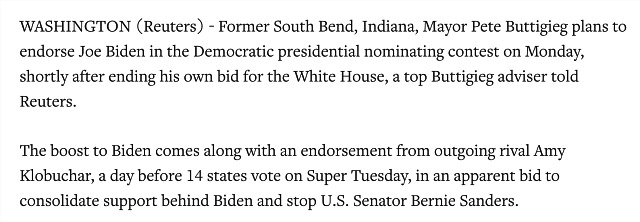
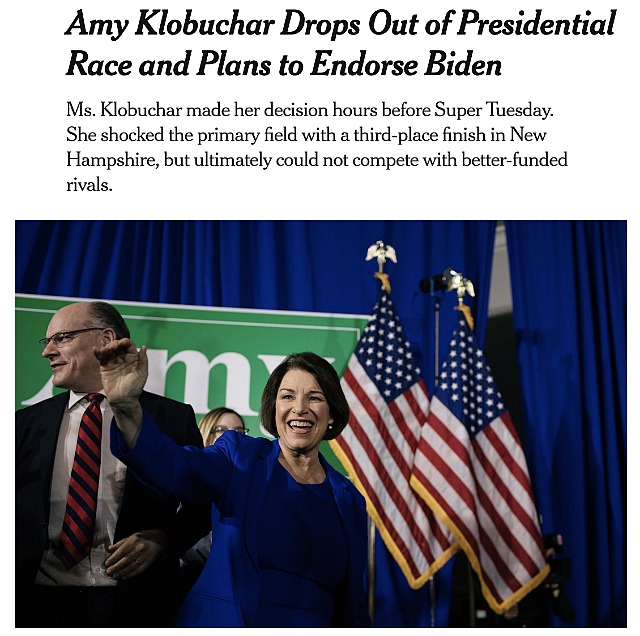
The withdrawal of Minnesota Senator Amy Klobuchar from the Democratic primary race is a good thing as far as it goes. But “taking one for the team in order to stop Bernie the Destroyer” was Pete Buttigieg‘s idea first — Amy is just following his lead. Except she’s been small potatoes all along, and her forthcoming official endorsement of Joe Biden in Dallas, while approvable and appreciated, won’t mean all that much.

If we really want to stop Bernie Elizabeth Warren and Michael Bloomberg have to bail also, and they probably won’t. Between Biden and Bloomberg who seems more mentally alert with the snapping of electric synapses? Or between Biden and Warren? We all know the answers, and yet it has to be Biden because we can’t fuck around any more. Bernie isn’t just George McGovern in ’72 but also Barry Goldwater in ’64. If he lassos the Democratic nomination we’re all GOING TO HELL with The Beast.

CG Dog + Pricey Ford = Big Loss

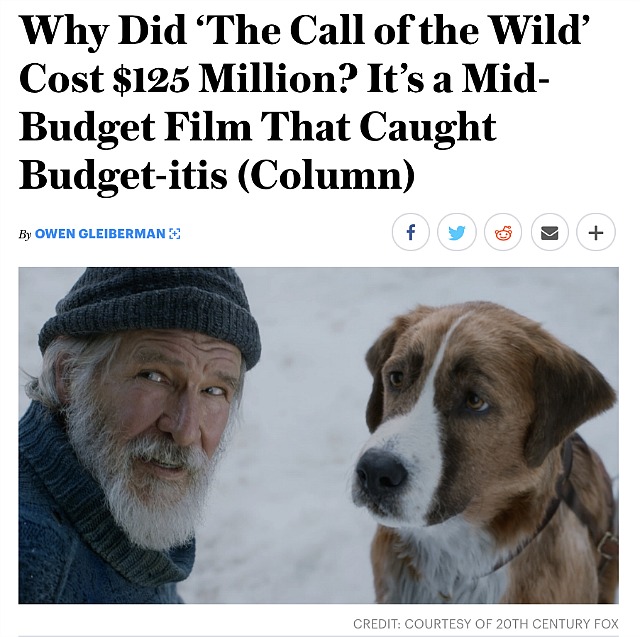
It’s been estimated that The Call of The Wild, a man-befriends-dog-in-the-Alaskan-wilderness movie which cost $125 million to produce, will lose roughly $50 million when all is said and done.

I don’t know how costly the CG work was but we can assume it accounted for a sizable chunk of that $125M. (Probably a similar percentage for the CG work on The Irishman.) Not to mention the $15M or $20M plus points that Harrison “paycheck” Ford scooped up.

Are you telling me that The Call of the Wild would’ve stiffed if the producers had cast, say, Kurt Russell or Tommy Lee Jones or even Clint Eastwood instead of Ford? The family audience would have only required some grizzled old gus with a certain name-brand value. How much would one of those guys cost? Probably under $10 million…right?

And the common consensus is that The Call of the Wild would have been a more emotionally engaging film if it had been shot organically a la Randall Kleiser‘s White Fang (’91), which cost $14 million to shoot (or $27 million in 2020 dollars). Or in the vein of Jean Jacques Annaud‘s The Bear (’88). Or even Disney’s Perri, a real-life squirrel movie produced by Disney in ’57.

Apology to @ManiLazic

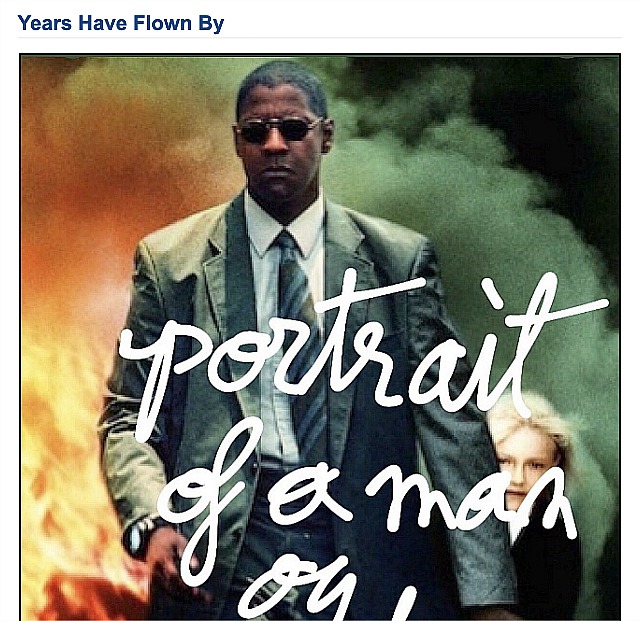
Hollywood Elsewhere regrets failing to credit @ManiLazic‘s excellent Man on Fire revisionist poster art. I fell for the blending of Céline Sciamma and Tony Scott, the motivational non-similarities between Adele Haenel and Denzel Washington‘s characters, the geographical rapport between northwestern France and Mexico City.

I saw it on Twitter three or four days ago but without any noticable credit. I forgot about it, and then saw it again. So I posted it. Because I really liked it.

Again, I humbly apologize to a fellow film writer (not to mention a Meisner-trained actress). I was thinking and moving too fast, as is my wont. Haste makes waste. Then again examples of unsigned and uncredited revisionist movie poster art appear on Twitter all the time and nobody says boo. They come and go, surface and subside…all part of a relentless daily cycle. Cheers & salutations.

“Mank” in Scope

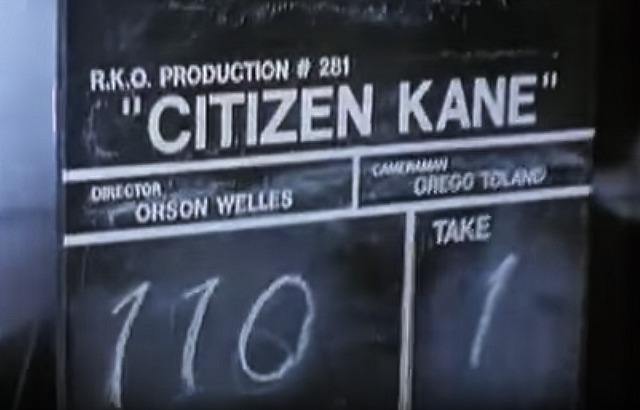
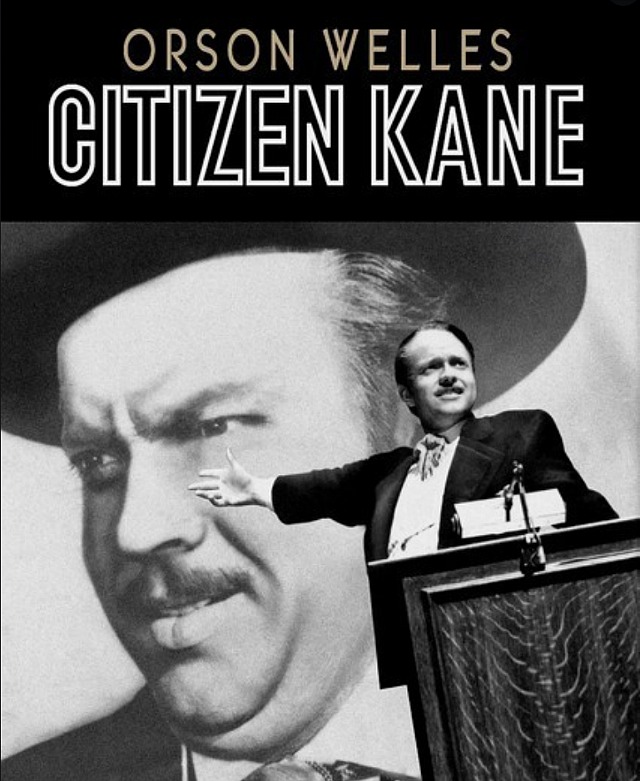
It’s not surprising that David Fincher‘s Mank (Netflix, award season) was shot in silvery monochrome, but it is a bit curious — certainly noteworthy — for a film set in old-time Hollywood (1940 to ’41) to use an aspect ratio of 2.39:1. In a period realm, widescreen a.r.’s summon associations with the ’50s and ’60s. Then again I personally adore black-and-white Scope — it’s among my absolute favorite formats (along with 1.37:1 Technicolor and 1.66:1 VistaVision).

It’s also unusual that Mank was the first theatrical feature to be shot by Erik Messerschmidt in a senior dp capacity. Fincher is using him because he served as dp on a few episodes of Mindhunter. Messerschmidt also did additional photography on The Empty Man and second-unit photography on Sicario: Day of the Soldado. He served as gaffer on Fincher’s Gone Girl (’14).

Read more

Pete Goes Down

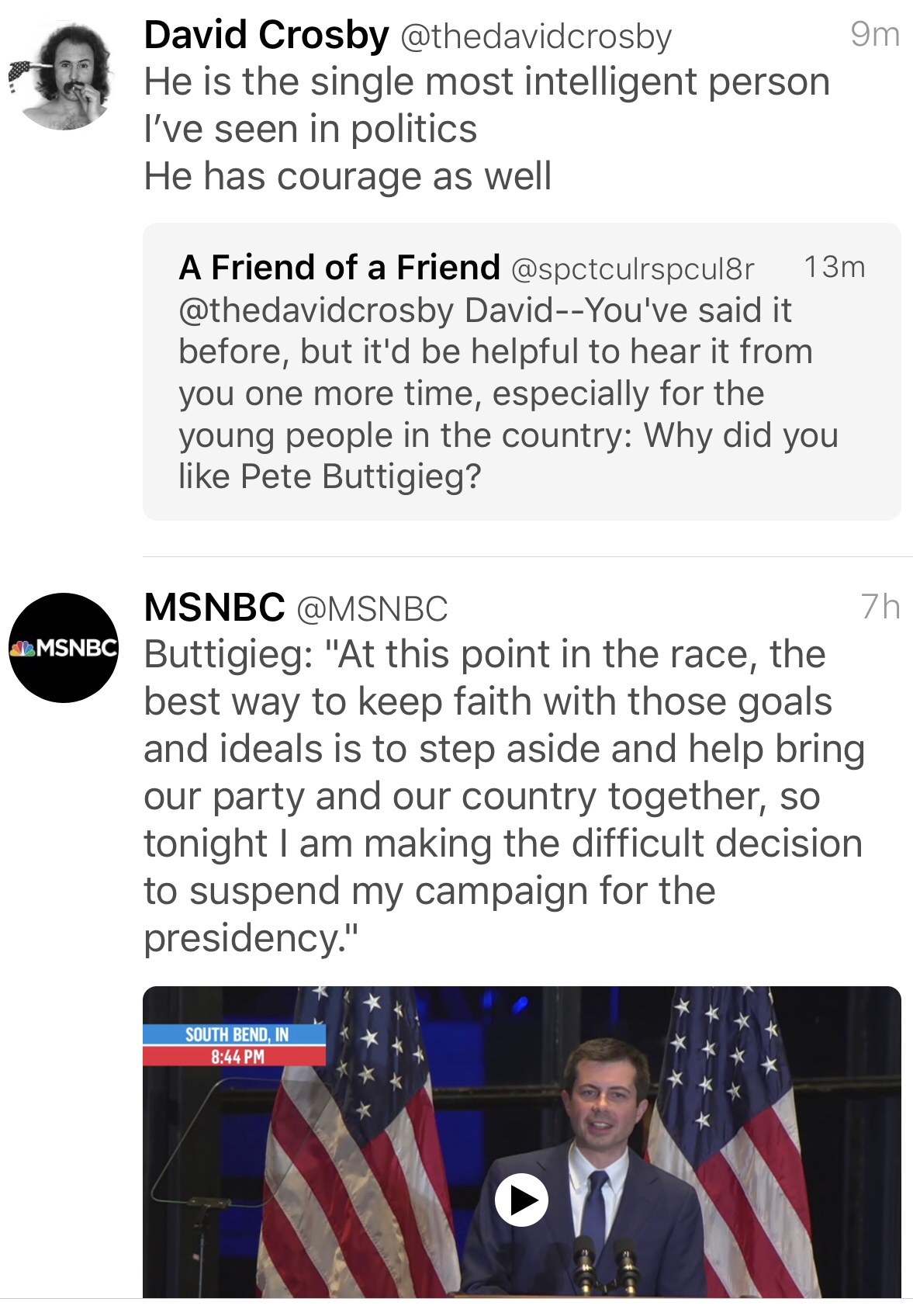
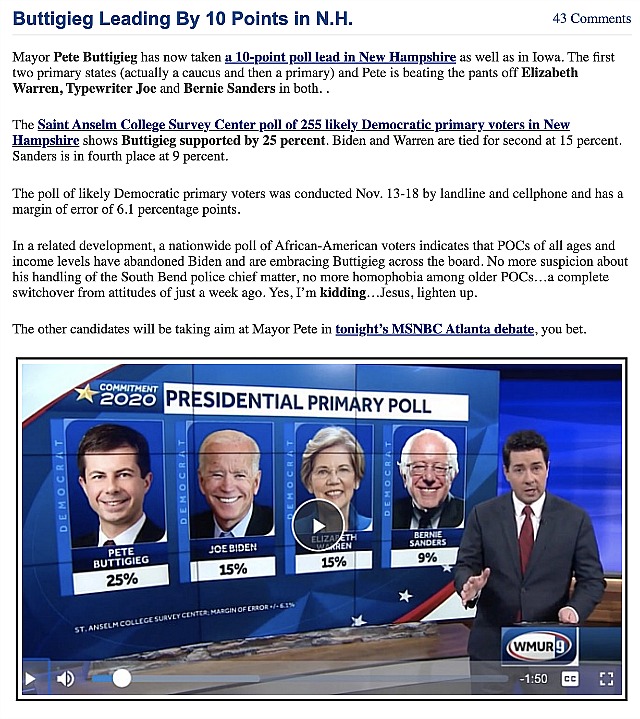
Only three or four months after ranking at the top of certain polls and looking like the young moderate liberal who might catch lightning and surge ahead and take the Democrat Presidential nomination, and only a couple of weeks after finishing neck-and-neck with Bernie Sanders in Iowa and just a little behind Sanders in New Hampshire…after coming really close and generating all kinds of excitement and intrigue and fierce debate, Pete Buttigieg is dropping out of the race.

My heart is broken in two. Tears are honestly welling up. I’ve been a loyal Pete guy since last spring or thereabouts. (I signed on when I realized that Beto was apologizing too much.) And now Democrats are officially fucked and stuck with the battle of the late 70something white-hairs with slightly bent-over postures.

Pete has fallen on his sword for the best of reasons. He knows that the race has come down to Bernie vs. Biden, and that the only chance to stop Bernie the Destroyer is to urge all the liberal moderates to vote for doddering Joe, come hell or high water and despite his senior conversational moments. It’s called biting into a reality sandwich, and it tastes fucking awful. Why is Amy Klobuchar still in the race? To what possible end?

For months African American voters (particularly the older homophobic contingent) have been turning their backs on Pete, and yesterday they really stuck the knife in when the former South Bend mayor ended up with a lousy 8.2% of the South Carolina primary vote. Thanks so much, POCs, for totally shutting down the only hope for generational turnover and Millennial vibrancy in the forthcoming presidential election. Goorah for homophobia!

AA voters did, however, get behind Biden big-time, and now he’s the only guy who has half a prayer of stopping Bernie. So at least there’s that.

Read more

“Sting” Saga, Part 2: Tony Bill’s Recollection

Here’s a recollection from The Sting producer Tony Bill. I asked him last night if he wanted to share along with Mike Medaovy. I received Tony’s response this afternoon around 2:45 pm:

“In the late 60’s my agent (as an actor) was a wonderful guy — Bill Robinson. He didn’t represent producers (nobody then did, actually) or directors. I was successfully acting in movies, but I wasn’t interested in being a movie star. I, and many of my young friends, hoped we could make our way as filmmakers. Around 1970 Robinson hired Mike Medavoy to work for him. It was his first job as an agent, and I introduced Mike to many of my aspiring friends. (Not that it matters, but they included Spielberg, Malick, Coppola, Donald Sutherland and others.)

“One of my best friends [at the time] was Terry Malick — a young AFI student. Another was John Calley, a producer who then became head of Warner Brothers. I had an idea for a movie about big-rig truckdrivers, loosely based on a bunch of country & western songs about life on the road. Calley backed my idea of hiring Terry to write it, and the script, Deadhead Miles (his first), ended up being made in 1971/72 by Paramount. It was disastrous, because I made the two biggest mistakes a producer can make: (1) I hired the wrong director, and (2) I didn’t fire him.

“While licking my wounds from that project, I read a script by another young, unknown writer who was just out of UCLA — David Ward. It was called Steelyard Blues. I thought it was a fresh, original but difficult film to get made, and I asked David what he wanted to do next. He gave me a 2 or 3-minute pitch about a young con man whose best friend is killed by a guy who he decides to con out of every cent he’s got, with the help of an experienced con man. He told me the ending would be ‘his surprise’.

“That was it: I was hooked. I told him to tell it again on tape, then set out to find enough money to option Steelyard Blues and commission The Sting.

“After several months, I met Julia and Michael Phillips and we pooled our meager resources. We made Mike our agent, and got Steelyard Blues made at Warner Brothers in 1972/73. Richard Zanuck and David Brown were our executives there. When the script for The Sting was finished, we set about to get it financed. It took over a year to finish; we never saw a word of it…or knew the ending…until Ward handed it in.

“We gave it first to Redford. It was fairly easy to do as I knew him from developing a script that we’d had many discussions about, and Julia knew him from working at First Artists in NYC. We wanted to try to get Ward approved to direct it, but Redford resisted that concept. I also sent it early on to my pal John Calley, but he didn’t want David, and didn’t like the script very much. He thought it was ‘a shaggy dog story.’ He made fun of himself for years about that. Frankly, no one ‘packaged’ our project. Our package was us, Redford, and the script: take it or leave it.

“So, in gratitude to Zanuck/Brown for having treated us well on Steelyard Blues, Julia, Michael and I then gave them The Sting to present to Universal, where they had moved their company. (That’s why it’s a ‘Zanuck/Brown presentation.’ They were not producers or executive producers — a misperception they hastened to allow and refused to correct in perpetuity.) They slipped it to George Roy Hill, who told Newman about it. He read it and asked to do it.

“By the way, Robert Shaw wasn’t the first person offered the part of Lonnegan: Richard Boone was. He turned it down.

Read more

Revised Proust Questionnaire

I posted a Proust Questionnaire thing a couple of years ago. I was just reading Tom Ford’s answers to same in the new Vanity Fair. It includes some questions that I didn’t address before. Here we go…

Your greatest fear? Confinement without wifi or phone chargers. Death by guillotine or being thrown into a crocodile pit. Being forced to wear ’70s and ’80s clothing.

The trait you most deplore in yourself? Impatience. Not having been more gentle in certain matters. Not having summoned the discipline and patience to learn to play piano when I was younger. Not having read more books.

Your idea of perfect happiness? There’s no “perfect” anything. Everything ebbs and flows. Impermanence is the only thing you can count on. That said, a kind of happiness would involve living in the Russell Square region of London with plenty of dough, but with frequent travel from one European city to another, occasionally Asia or the Middle East but mostly Europe, Eastern Europe and Russia. Train travel, motorcycles, rented cars. Back to London every two or three months, visits to New York, Savannah and the Caribbean area every six months. And writing the column every day, of course.

The trait you most deplore in others? The urge to cancel among Khmer Rouge wokesters. The callousness in people who lean their seats back too far in coach. Loudness, vulgarity, indifference to the feelings of others. People who throw their heads back and shriek with laughter in bars and cafes.

Your greatest extravagance? Shoes.

What do I most value in your friends? That they’re occasionally down with sharing a dinner. Or listening. Or helping out in a pinch.

Your favorite journey? My first trip to Europe in the summer of ’76.

Most overrated virtue? Achievement in sports.

What do you dislike most about your appearance? That I don’t have the svelte form that I had in my 20s, 30s and 40s.

Which living person do you most despise? The Beast.

Your favorite occupation? What I do now. If I couldn’t do the column I’d like to work as an international courier of some kind.

How would you like to die? Suddenly, without warning, preferably without trauma or great pain.

If you were forced to give up a certain vegetable for the rest of your life? Squash, beets, kale, yams, pumpkins, brussels sprouts.

What dead persons would you most like to meet and hang with?: Clara Bow, Stanley Kubrick, Robert Benchley, Cary Grant, Julius Caesar, Jesus of Nazareth, John Lennon, Honore de Balzac, Joan of Arc, Carole Lombard, Jim Morrison, Abraham Lincoln, Jimi Hendrix, Dorothy Parker, Howard Hawks.

Your greatest regret? Allowing my anger at my father to determine the course of my life for too many years. Not getting my life into gear sooner. Not being a better father with my younger son, Dylan. Stupidly and fearfully beating the shell of a turtle with a piece of wood when I was five or six years old (I thought it was a snapping turtle that might bite my finger off).

Read more

Medavoy to Cohen: “Modify Your Memory”

Many of us have read Rob Cohen’s story about how he discovered David Ward‘s script of The Sting while working for Mike Medavoy at International Famous Agency (IFA), which later merged with Creative Management Associates (CMA) in ’75 to become International Creative Management (ICM).

Cohen told the tale to journalist Germain Lussier in late November of 2008. I reposted the story in April 2012, or a couple of months before the release of a new Sting Bluray; I reposted it on 11.14.18.

I’ve known Medavoy since the early ’90s, and have always found him to be a decent hombre. I happened to run into him during the Neon/Parasite Oscar night party at Soho House on 2.9.20. I asked him about Cohen’s recollection and Medavoy said, “Yeah, I’ve heard that story.” He not only has a completely different recall but thinks it was “pretty silly” of Cohen “to have put himself at the center of it.”

I called Mike yesterday for the chapter-and-verse. Here’s how it goes, straight from the horse’s mouth:

Tony Bill had been my friend and client. Sometime in ’72 he said to me, ‘I want to option a con-man project from a very talented writer named David Ward. Ward was the author of The Sting, except when Tony got it hadn’t been written. It was just on tape. The option would be $5000, he told me, so how about you and I putting up $2500 each and you can leave the agency business and co-produce the film with me? I said ‘I don’t have enough money to leave the agency business but I’ll be your agent on it.’ On top of the fact that I had a lot of clients at the time and was in the midst of putting together Young Frankenstein and later on Jaws.

“Bill then found Michael and Julia Phillips to cofinance the option. Michael had been an investment banker in New York. Anyway the $5K went to David Ward. Then one day I was playing tennis in Malibu with Robert Redford, who had gotten the script. He decided he was interested in it. By this point I had listened to The Sting on tape, and I thought it was terrific. Then a script version came in, and I read it and liked it.

“Around the same time Cohen came to me for a job. I gave him the script and he liked it a lot. So based on our liking the same script I hired him as my assistant — that’s how he got the job.

“While in London Michael and Julia had given it to Dan Melnick while I was gone, and they were interested and got into a negotiation. At that time Ward wanted to direct the movie at MGM. Donald Sutherland and Peter Boyle, who were also my clients, had gotten the script first and wanted to play the leads. At the same time I gave it to Zanuck-Brown, who had just moved from Fox to Universal, and then they got it to George Roy Hill, whom they’d worked with on Butch Cassidy and the Sundance Kid.

“Then they gave it to Newman, who passed. Paul had an apartment in Manhattan, and George lived there also. So one night George and Redford sat in Newman’s apartment and tried to convince him, and at the end of the meeting Paul said he wasn’t gonna do it. But as he walked them to the elevator he said, ‘I’m just kidding, I’ll do it.’ And that was it. They came into the office and we made the deal. Right after that I was banned from the MGM lot.

Read more