Hanging Judge

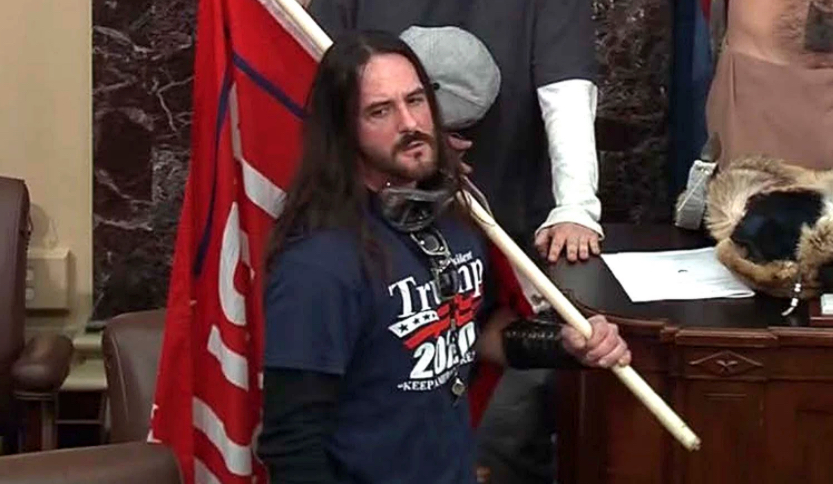
If it was my call, Capitol rioter Paul Allard Hodgkins would serve a minimum of two years behind bars, and I mean two years of breaking rocks with sledge hammers in the hot sun and getting sent to the hole if he starts any trouble. Or working on a Southern chain gang in the sweltering heat, next to Paul Newman and George Kennedy. And no parole.

Instead US District Judge Randolph Moss gave Hodgkins eight lousy months — a wrist-slap sentence.

Before sentencing, the Tampa-residing Hodgkins said he got carried away by the January 6th hysteria. “If I had any idea that the protest would escalate (the way) it did, I would never have ventured farther than the sidewalk of Pennsylvania Avenue,” Hodgkins told Moss.

Bullshit — that’s what his defense attorney told him to say! Prosecutors had asked for an 18-month sentence…also too light!

Moss: “The court has to consider both what I think are the extremely damaging events that occurred that day but also who Mr. Hodgkins is as an individual. And as I think is reflected by the sentencing I imposed, I tried to strike that balance.”

Still On Lowery Fence

At Sundance ’13 (8 1/2 years ago) I became a David Lowery devotee after catching Ain’t Them Bodies Saints (descendant of Robert Altman‘s Thieves Like Us, young love, guns, outlaws, rural flavor).

Three years later I got off the Lowery bus after totally hating Pete’s Dragon — a bone-headed, nonsensical, friendly dragon film, from Lowery and Disney and costarring Robert Redford.

During Sundance ’17 I hated The Yellow Birds, which Lowery co-wrote the screenplay for, but fell head over heels for Lowery’s minimalist Ghost Story (silent, watchful ghost under a plain bedsheet).

In ’18 came Lowery’s decent, modestly approvable Old Man & The Gun (Redford as gentleman bank robber).

Lowery is clearly a grade-A director, but he has two modes — intriguing, lower-budgeted art-house guy and big-budget fantasy popcorn guy.

And now we have Lowery’s The Green Knight (A24, 7.30), a medieval fantasy flick based on an Arthurian legend, which has been praised by the sensible and respected Globe and Mail critic Barry Hertz (“Dev Patel can cut off my head any time he likes”) and N.Y. Times columnist Kyle Buchanan (“A great movie where a roster of A24 all-stars all get to kiss Dev Patel on the cheek”). King Arthur’s obstinate nephew Sir Gawain (Patel) on a quest to confront a formidable CG tree creature.

Lowery’s next film is Disney’s Peter Pan & Wendy…another one!

I’m extremely suspicious of The Green Knight raves. Who wouldn’t be? I want to hear from a couple of sensible sourpuss critics.

Read more

Absolute Recognition

Because I’m the damn horse. The instant I read this I whispered “good God!” to myself. I was this exact same horse when I was 19, 28, 37 and at one or two other junctures. Amazing.

Telluride Singles, Doubles, Triples

Every July and especially August, Michael’s Telluride Film Blog gets more and more attention. Because for 13 or so years Michael Patterson has been doing a reasonably good job of speculating which films would constitute the annual Telluride Film Festival situation, a task that always involves a mix of rumor-chasing, spitballing, sniffing around and sensible deduction.

Telluride lineups aren’t that mysterious when you factor in each year’s Venice and Toronto lineups and apply a basic industry calculus, and when you consider the tendency of Telluride toppers Tom Luddy and Julie Huntsinger to invite and re-invite certain favorites, just like Cannes honcho Thierry Fremaux has his own special roster.

We’re all presuming that Paul Schrader‘s The Card Counter (Focus, 9.10) and Jane Campion‘s The Power of the Dog (Netflix) will be Telluride highlights. I’m hoping, naturally, that Asghar Farhadi‘s A Hero, which split the Grand Prix prize at the just-concluded Cannes Film Festival, will also be included.

Patterson is speculating that Guillermo del Toro‘s Nightmare Alley (Searchlight, 12.3) might be featured. Ditto Pedro Almodovar‘s Madres Paralelas (Parallel Mothers).

About a month ago Deadline‘s Pete Hammond, wrote that he’d heard that Netflix will have at least four films at Telluride “if things work out”, and that Warner Bros might have a film [in] Telluride as well, likely one of its awaited fall titles like David Chase’s Sopranos prequel The Many Saints of Newark, Clint Eastwood’s Cry Macho or even November title King Richard with Will Smith.

He added that a couple of Searchlight films, Wes Anderson’s The French Dispatch or Michael Showalter’s The Eyes of Tammy Faye, are possibilities.

I’m just starting to pay attention to The Power of the Dog. Set in 1920s Montana and based on Thomas Savage‘s same-titled novel, it’s about a strained relationship between two bachelor brothers, the closeted Phil Burbank (Benedict Cumberbatch) and his brother George (Jesse Plemons), both of whom are ranch-dwellers. Their relationship goes south when George marries a widow named Rose (Kirsten Dunst), and Phil adopts a hostile, bullying attitude. Or something like that. HE’s two cents: Given Campion’s exalted rep. I’m naturally looking forward to this. Plemons is a fascinating, well-respected actor, but he always plays creeps. I’m hoping to find my way around this concern.

The general Cannes response to Mia Hansen-Love‘s Bergman Island seemed to indicate dismay or disappointment, for the most part. The consensus about Todd HaynesThe Velvet Underground doc is that it focused too much on John Cale and not enough on Lou Reed.

Patterson has mentioned Ali or Muhammad Ali, a multi-part doc directed and produced by Ken Burns, David McMahon and Sarah Burns. It’s apparently slated for broadcast between 9.19 and 9.22.

Other Patterson possibles: Where Is Anne Frank?, Paris 13th District, Blonde, Cow, House of Gucci, The Last Duel, Mothering Sunday.

Normcore Tim, Pryor Signage

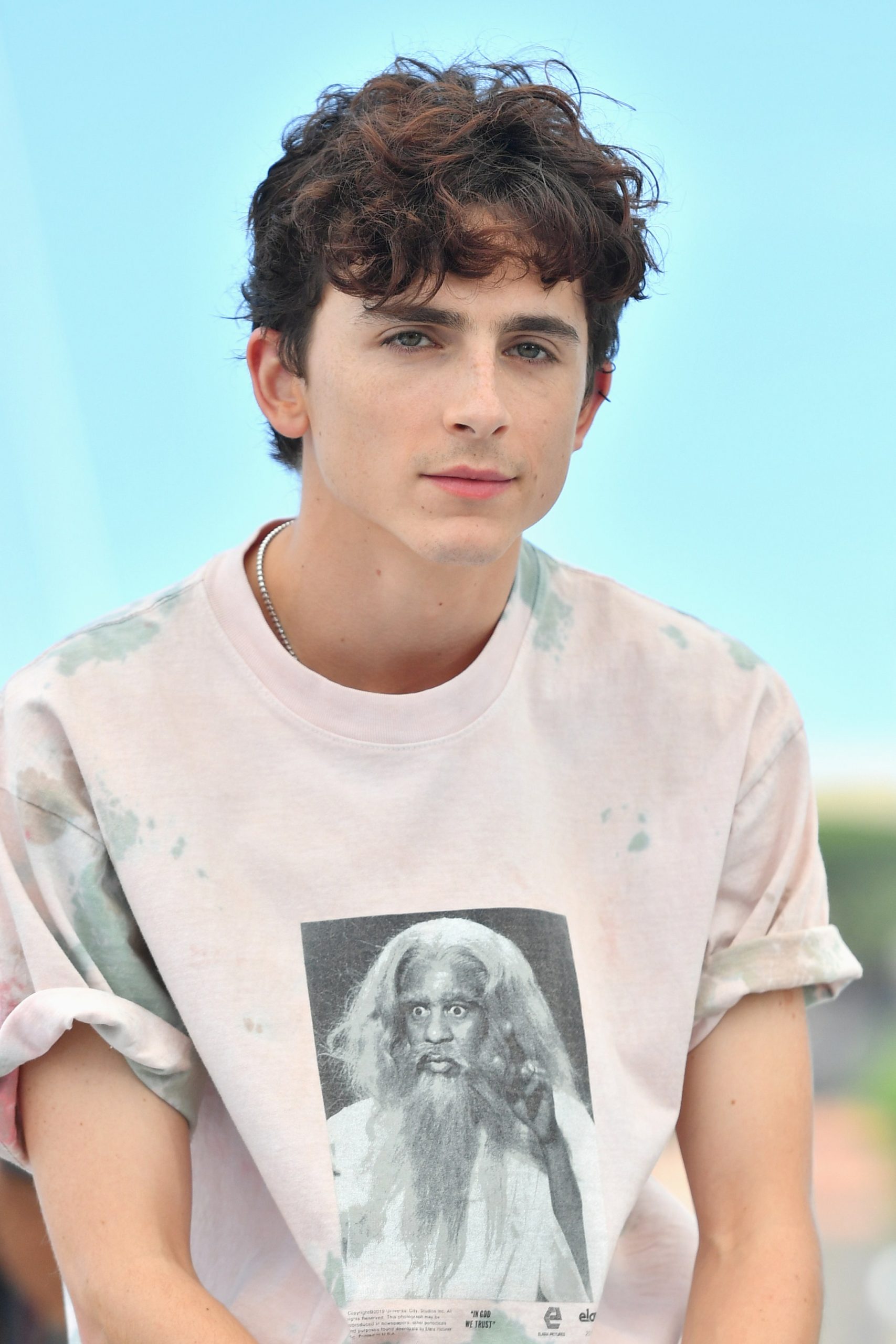
Three and a half months ago I reviewed a Kino Lorber Bluray of Marty Feldman’s In God We Tru$t (’80), an anti-religion, anti-corporate satire in which Richard Pryor played God. (Or more precisely “G.O.D.”).

An In God We Trust Richard Pryor-with-white-Godbeard T-shirt was subsequently created by Elara.world, a normcore merch line from an outfit run by the crazy Safdies (Josh and Benny) and Sebastian Bear-McClard (i,.e., Emily Ratajkowski’s significant husband).

A few days ago Timothee Chalamet, costar of Wes Anderson‘s The French Dispatch, wore the whitebeard-Pryor T-shirt during a Cannes Film Festival photo op. And here I am mentioning it. It’s all come full circle.

Posted on 3.21.21: “I just can’t fathom why a rich actor would choose to wear a schlubby normcore T-shirt. He could wear the coolest Calvin Klein or John Varvatos three-button T-shirt…some kind of cooler-than-shit creation with a little style, something he bought in Milan or London or at a tag sale in Marin County.

“What’s the point of a rich guy looking like some average dude from Worcester or Scotch Plains or Clearwater? To what end? To prove to himself that he’s average common too, just like him and the same as you?”

“Black Widow” Hasn’t Been Scolded Enough

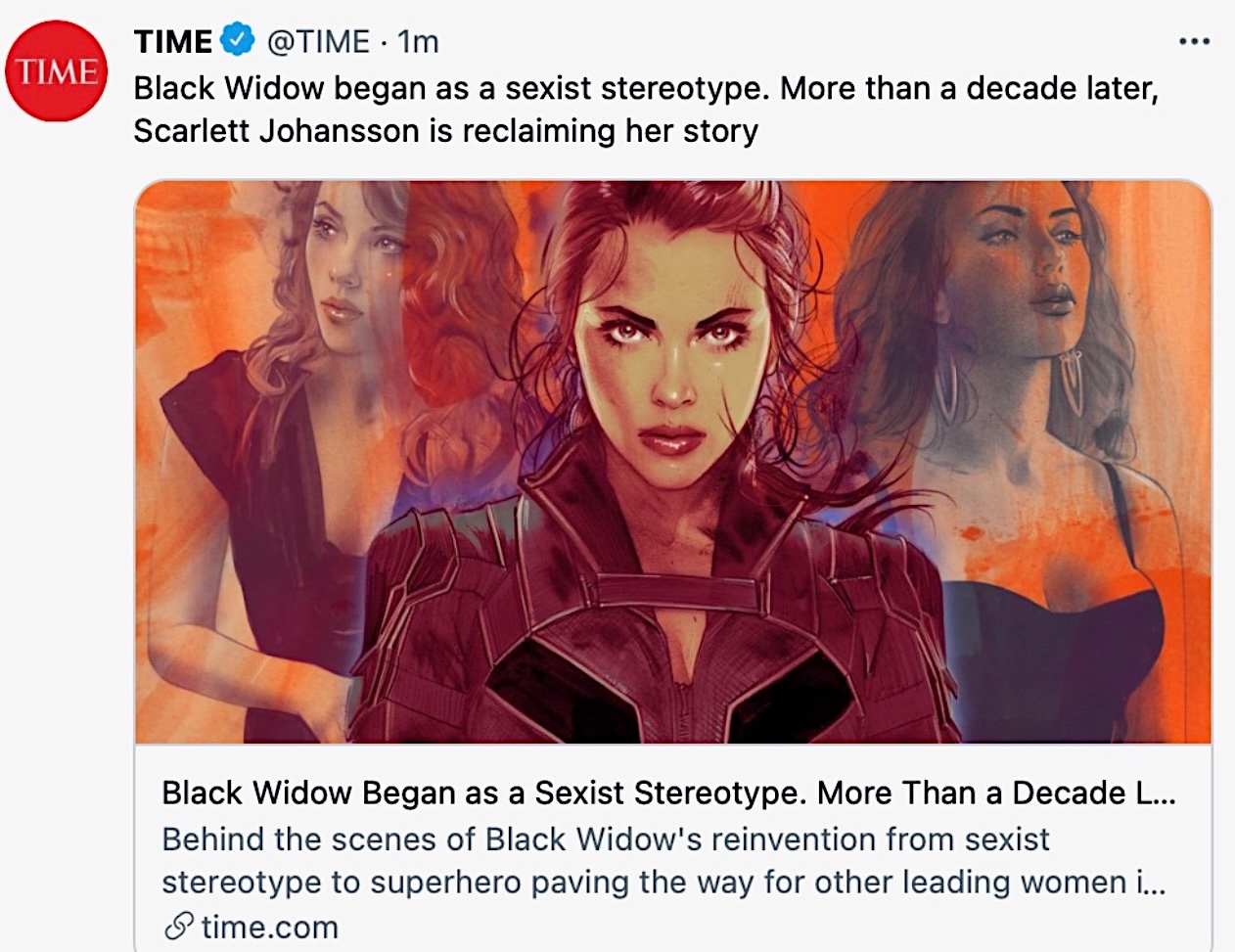
16 days ago a major Time magazine piece, written by Eliana Dockterman, celebrated the coming of Black Widow (Disney, 7.9), and particularly the rugged, progressive, toughed-up de-sexualizing of Scarlett Johansson‘s Natasha Romanoff. And that the movie did. What sector of your ticket-buying audience was revved by this strategy, apart from educated urban progressive women?

There was also the fact that for many of us, Black Widow sucked eggs. Marvel hardcores may have been been into it, but who else? Okay, the Rotten Tomatoes critics score is at 81% (way too kind) and the audience score is at a mystifying 92%. How can this be? Black Widow stinks — I know it does, I saw it at a theatre, I was miserable, etc.

And now, 10 days after opening and at the end of its second weekend, Black Widow has totally plunged at the box-office — down 67% from last weekend.

The first weekend alone told the tale. On Friday, 7.9, Black Widow brought in $39,510,446. On Saturday, 7.10 earnings were down 41% to $23,305,929. On Sunday, 7.11, the tally was $17,549,937 — down another 25%.

Deadline‘s Anthony D’Alessandro called this weekend’s fall-off “the second steepest ever for a Disney-distributed MCU title…if you want to know what the negative impact is by having a Marvel movie available in homes and in theaters at the same time, here it is.”

Then again the worldwide box-office so far is $264,012,671 — both domestic and international earning $132 million and change. So Black Widow isn’t a wipeout, or (to be fair) even close to one. But that domestic second-weekend plunge can’t be called encouraging.

Difference Between Fake-Out and Fake-In

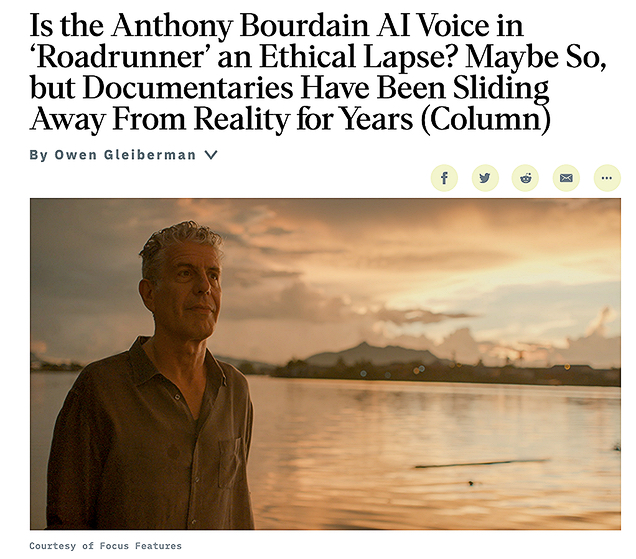
Variety‘s Owen Gleiberman has addressed the pearl-clutching outrage over Morgan Neville‘s decision to “digitally deepfake” Anthony Bourdain‘s voice in three aural passages in Roadrunner, the just-released doc about the late foodie and CNN travelogue adventurer.

As I pointed out in a 7.15 post titled “Bourdain Deepfake Isn’t A Problem,” Neville’s alleged offense involved the audible creation of sentences (i.e., three) not actually spoken by Bourdain but written by him. Neville created an A.I. replication of Bourdain’s voice, assembled from vowel and consonant splices and fragments of legit Bourdain recordings. And so we hear Bourdain “reading” the passages even though he didn’t actually do that.

Gleiberman believes that Neville should have copped to the fakery somewhere in the film (probably in the closing credits), but otherwise isn’t that rattled. His basic point is that “when it comes to swapping in fake reality, documentaries have been sliding down a slippery slope for years,” especially in the area of reenactments.

“A reenactment and a voice fake actually do different versions of the same thing,” he points out. “Both cement a reality in your mind — the image of something or the sound of something — that didn’t happen, at least not in the way it’s presented.”

Gleiberman also notes that the deepfake Bourdain voice “probably gets closer to reality than most reenactments do,” and that documentaries in which an actor will read a subject’s words, sometimes simulating their tone of voice, “isn’t much of a leap from what Roadrunner does.”

Shorter Gleiberman: “Not much of a hoo-hah here, fellas!”

Best passage: “The manipulation of Bourdain’s voice in Roadrunner seems to open a Pandora’s Box. What happens when unethical filmmakers employ such techniques? But let’s not pretend that we’ve been purists about it. Documentaries have been inching away from unalloyed reality for a long time. And it’s we in the audience who enable it. We’re the ones who like our reality sweetened, heightened, finessed until it looks just like a movie.”

Marriage vs. Gumption vs. Space Flight

What’s life without a little daring, a little risk?

I know that risk-removal is one sure way to reduce verve or excitement or in some cases reward in one’s life. It all boils down to concepts of what an acceptable level of risk might be.

In the case of Jeff Bezos’ Blue Origin spacecraft, which will launch Tuesday morning with Bezos and a few others aboard, there’s a 1-in-100 chance — 1% — of failure and death. Is that reckless or semi-reasonable for anyone with a seat?

382 space flights have happened since Alan Shepard‘s suborbital ascent about a Mercury space capsule on 5.5.61. Four of these have ended catastrophically. Which is where the Blue Origin odds come from.

What are the actual real-deal odds, given the specific technologies and technical challenges involved? Perhaps less than a 1% chance, perhaps a bit more. Similar odds presumably applied in the case of Richard Branson‘s recent Virgin Galactic flight.

Most of us have an idea of what a serious risk is. During a typical 1000-mile road trip, the statistical odds of an average motorist getting into an accident is something in the realm of 1-in-375. The odds of a typical air passenger being in a plane crash are microscopic — one in a million or several million, depending on your source. And those riding with Bezos on Tuesday can console themselves with that 99-out-of-100 chance that the flight will come off without a hitch.

It was reported last Wednesday that Ashton Kutcher had bought a $250K ticket aboard one of Branson’s Virgin Galactic flights, but that his wife, Mila Kunis, killed that notion.

Kutcher to Cheddar [5:20]: “When I got married and had kids, my wife basically encouraged that it was not a smart family decision to be heading into space when we have young children. So I ended up selling my ticket back to Virgin Galactic, and I was supposed to be on the next flight. But I will not be on the next flight.”

Kunis was right from a child-care perspective, of course — avoiding the Branson flight was a safer option than going on the flight. If I had young kids I would probably think twice about those 1-in-100 odds. Maybe.

On the other hand the Kutcher-Kunis anecdote points something out about the nature of married life. Being married tends to involve higher levels of safety and caution and, one could argue, timidity. Hence the statistics about married men living longer than unmarried men.

But I’ve thought about it over the last 15 or 20 minutes, and have decided that if I was in Kutcher’s shoes I wouldn’t have sold the Virgin Galactic ticket, and not just because I wouldn’t want to miss out on experiencing a sub-orbital space flight. (How many times is such an opportunity offered, even in this day and age?) I would have gone for it, finally, because of the lesson it would pass along to my kids, who always learn more from their parents’ example than anything else.

The lesson I would be passing along is that the most dangerous thing you can do in life is to always play it safe.

Could “Monster’s Ball” Be Made Today?

In a few months time Marc Forster‘s Monsters’ Ball will observe its 20th anniversary. It was a difficult film then and is still difficult in some respects (I watched it a couple of days ago), but Halle Berry nonetheless made history by winning a Best Actress Oscar for her performance, and after 19 and 1/2 years she’s still the only woman of color who’s won such an honor.

Monster’s Ball digs deeply into family anger and rural racism and it dives whole hog into sex and sexuality as a means of redemption. It’s a story about a corrections officer who seeks escape and transcendence and finally achieves that (or a semblance of that) at the very end.

It’s a fantasy, agreed, but a compassionate one.

I’m not sure if Monster’s Ball (which I first saw in early November ’01 at the AFI Fest) would be produced in today’s climate. I’ll take that back — it wouldn’t be produced today, for the simple fact that Film Twitter would howl and cut it to pieces if it were to suddenly appear.

17 years ago an anonymous “Black Man, Husband, Father, Son, Actor, Producer, Director, Poet, Warrior,” et. al. wrote that he was angry about Berry’s character (Leticia Musgrove), “a single mother who falls for the great white racist white man WHO PUT HER HUSBAND AND FATHER OF HER CHILD (played by Sean Combs) TO DEATH.”

Okay, except Billy Bob Thornton’s death-row prison guard character (i.e., Berry’s love interest) isn’t a “great racist white man” — he’s a middle-aged cog in that great racist white-man machine/mentality who slowly divests himself of that ugliness and emotionally comes into his own, partly because he can’t stomach the pain of having driven his son to suicide, but largely and more simply because he’s fallen in love with Berry and wants/needs to redeem himself in God’s eyes through his feelings for her.